
HR holiday calendar 2026 for US & India
Planning for 2026? This HR holiday calendar for India and the US helps you stay compliant, manage leave fairly, and avoid operational surprises.
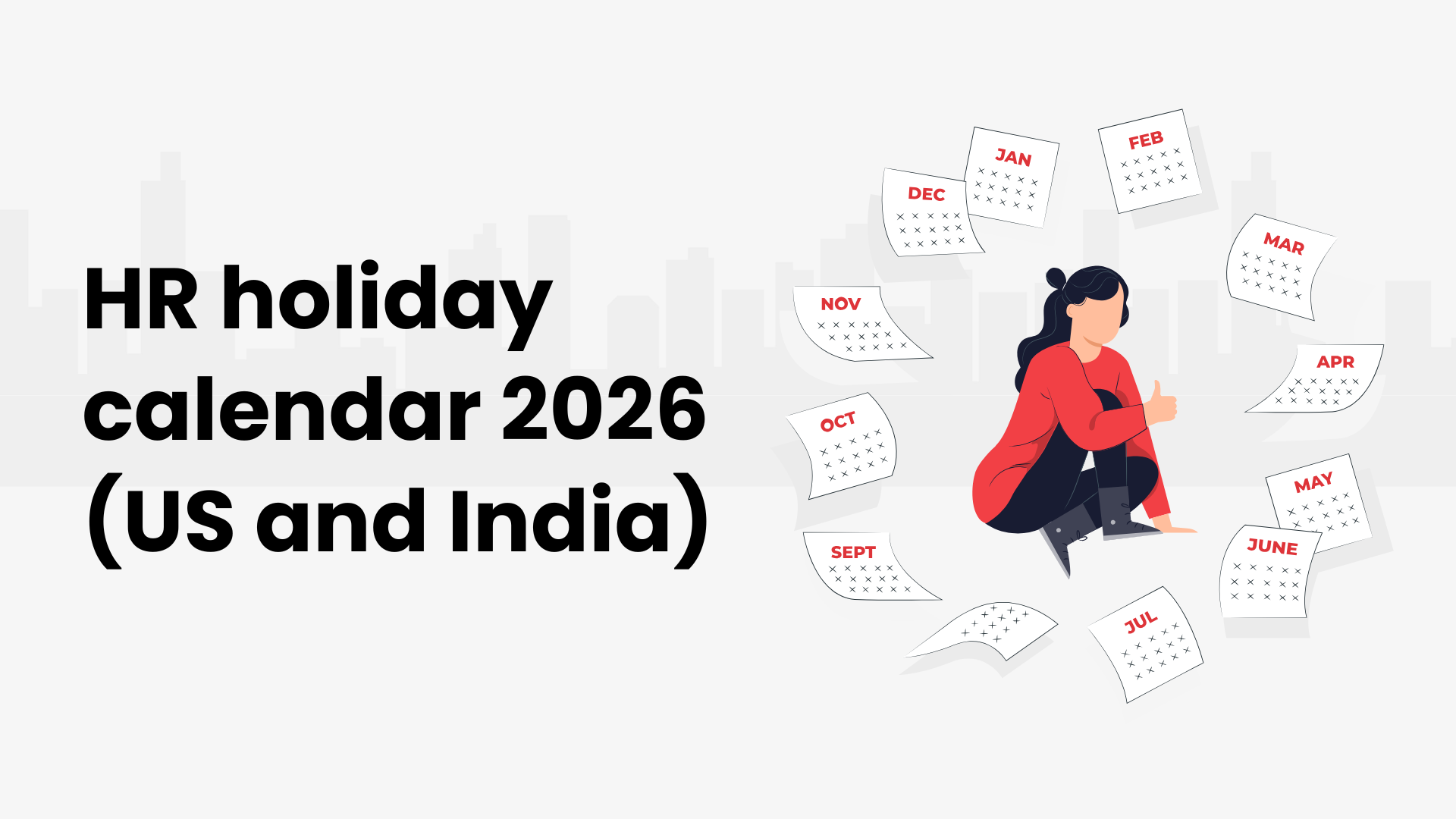
In 2026, the United States will have a total of 54 holidays, including 17 main federal (national) holidays and 37 state-specific holidays.
In India, the total number of holidays in 2026 comes to 54 as well, comprising 17 central government (national) holidays and 37 state-specific or optional/restricted holidays.
Know the full-length HR holiday calendar for the US and India in 2026, read below to plan your workforce, leaves, and operations effectively.
 ChatGPT
 Gemini
 Claude
 Grok
Grok Perplexity
What is an HR holiday calendar and why does it matter in 2026?
An HR holiday calendar is a structured record of federal holidays, state-recognized holidays, and company-observed days off. Unlike personal calendars, HR calendars directly influence core people operations, including:
- Paid time off (PTO) and floating holiday policies
- Attendance tracking and workforce availability
- Payroll processing and overtime calculations
- Hiring, onboarding, and performance cycles
- Employee engagement, burnout prevention, and retention
In 2026, the concentration of holidays around Mondays and Fridays creates more long weekends, increasing the need for advanced workforce and leave planning, particularly for customer-facing teams, healthcare, retail, manufacturing, and distributed workforces.

2026 Federal holidays calendar US (HR-approved)
The federal US holiday calendar is recognized across the United States. Most organizations observe all or a subset of these as paid holidays.
Date | Day | Federal Holiday |
|---|---|---|
January 1 | Thursday | New Year’s Day |
January 19 | Monday | Martin Luther King Jr. Day |
February 16 | Monday | Presidents’ Day |
May 25 | Monday | Memorial Day |
July 3 | Friday | Independence Day (Observed) |
June 19 | Friday | Juneteenth |
September 7 | Monday | Labor Day |
October 12 | Monday | Columbus Day |
November 11 | Wednesday | Veterans Day |
November 26 | Thursday | Thanksgiving Day |
December 25 | Friday | Christmas Day |
HR note: Monday and Friday holidays significantly increase PTO requests and travel-related absences.
Commonly observed (non-federal) holiday calendar in US workplaces
While not federally mandated, many US organizations also observe or partially recognize these holidays based on company culture, industry norms, or workforce expectations.
Date | Day | Non-federal holiday |
|---|---|---|
February 2 | Monday | Groundhog Day |
February 14 | Saturday | Valentine’s Day |
February 17 | Tuesday | Ramadan begins |
February 17 | Tuesday | Mardi Gras |
February 18 | Wednesday | Ash Wednesday |
March 03 | Wednesday | Chinese New Year |
March 17 | Tuesday | St. Patrick’s Day |
April 03 | Friday | Good Friday |
April 05 | Sunday | Easter Sunday |
May 5 | Tuesday | Cinco De Mayo |
May 10 | Sunday | Mother’s Day |
June 14 | Sunday | Flag Day |
June 21 | Sunday | Father’s Day |
October 31 | Saturday | Halloween |
November 2 | Monday | Day of the Dead |
November 08 | Sunday | Diwali |
November 27 | Friday | Black Friday |
November 30 | Monday | Cyber Monday |
December 04 | Friday | Hanukkah begins |
HR insight: These holidays often fall under company-observed or floating holidays, making early communication essential.
Long weekends and leave clusters in the US – 2026
From an HR and workforce planning perspective, long weekends are high-risk periods for understaffing.
High-impact long weekend periods in 2026:
- Memorial Day (May 25 – Monday): Start of peak summer PTO
- Independence Day (July 3 observed – Friday): Extended long weekend
- Labor Day (Sept 7 – Monday): End-of-summer leave surge
- Thanksgiving (Nov 26 – Thursday): PTO stacking on Friday
HR strategy tip: Implement team-based leave thresholds or require advance approvals during peak travel periods.
State-level holidays and regional variations (Critical for US HR Teams)
Unlike federal holidays, state holidays vary widely and are especially important for organizations with employees across multiple states.
Examples of state-specific holidays in 2026
State | Holiday | Notes |
|---|---|---|
Massachusetts | Patriots’ Day | Third Monday of April |
Texas | Texas Independence Day | Often observed by state agencies |
California | César Chávez Day | March 31 |
Alaska | Alaska Day | October 18 |
Hawaii | King Kamehameha Day | June 11 |
Why this matters: A holiday recognized in one state can impact shared workflows, payroll timelines, or customer support if not centrally planned.
Quarter-wise 2026 holiday calendar
Understanding holiday density across quarters helps HR teams balance workloads, hiring plans, and performance cycles.
Quarter | Holiday Load | HR Implication |
|---|---|---|
Q1 (Jan–Mar) | Moderate | Good for onboarding and training |
Q2 (Apr–Jun) | Light–Moderate | Strong productivity window |
Q3 (Jul–Sep) | Moderate | PTO spikes during summer |
Q4 (Oct–Dec) | Heavy | High leave congestion & year-end slowdowns |
India public & national holidays in 2026 (HR-approved)
These holidays are typically observed across most organizations and are considered mandatory or gazetted holidays.
Date | Day | Holiday |
|---|---|---|
January 1 | Thursday | New Year’s Day |
January 26 | Monday | Republic Day |
April 3 | Friday | Good Friday |
August 15 | Saturday | Independence Day |
October 2 | Friday | Gandhi Jayanti |
December 25 | Friday | Christmas |
HR note: Republic Day and Gandhi Jayanti often see extended leave requests, even if the holiday itself is a single day.
Major religious and cultural holidays in India – 2026
These holidays play a significant role in employee sentiment, absenteeism, and travel patterns, even when not mandatory.
Date | Day | Holiday |
|---|---|---|
January 14 | Wednesday | Makar Sankranti / Pongal |
February 17 | Tuesday | Maha Shivaratri |
March 29 | Sunday | Holi |
April 14 | Tuesday | Dr. Ambedkar Jayanti |
May 1 | Friday | Labour Day |
May 25 | Monday | Eid al-Fitr* |
June 21 | Sunday | Eid al-Adha (Bakrid)* |
July 17 | Friday | Muharram* |
August 28 | Friday | Onam |
August 29 | Saturday | Raksha Bandhan |
September 6 | Sunday | Janmashtami |
September 27 | Sunday | Eid-e-Milad* |
October 19 | Monday | Dussehra |
November 4 | Wednesday | Diwali |
November 5 | Thursday | Govardhan Puja |
November 6 | Friday | Bhai Dooj |
November 14 | Saturday | Guru Nanak Jayanti |
*Islamic holidays are subject to lunar sightings and may vary by region.
Long weekends and leave clusters in 2026
From an HR lens, long weekends are high-risk periods for understaffing.
High-impact long weekend opportunities:
- Good Friday (April 3): Natural 3-day break
- Labour Day (May 1 – Friday): Likely leave surge
- Gandhi Jayanti (Oct 2 – Friday): Extended travel window
- Diwali week (Nov 4–6): Multi-day leave stacking
HR strategy tip: Introduce leave caps per team during peak weeks or mandate staggered leave approvals.
State-wise holidays and regional variations (Critical for HR)
India does not follow a single uniform holiday structure. HR teams managing multi-state or remote employees must maintain location-based holiday calendars.
Examples of State-Specific Holidays in 2026
State | Date | Holiday |
|---|---|---|
Tamil Nadu | Jan 15 | Thiruvalluvar Day |
Punjab | Jan 13 | Lohri |
West Bengal | Apr 15 | Poila Boishakh |
Maharashtra | May 1 | Maharashtra Day |
Assam | Apr 14 | Bihu |
Karnataka | Nov 1 | Karnataka Rajyotsava |
Kerala | Nov 1 | Kerala Formation Day |
Goa | Dec 19 | Goa Liberation Day |
Why this matters: A holiday in one state can silently impact cross-functional dependencies if not planned centrally.
Quarter-wise holiday distribution in 2026
Understanding holiday density helps HR teams balance workloads.
Quarter | Holiday Load | HR Implication |
|---|---|---|
Q1 (Jan–Mar) | Moderate | Good time for hiring & onboarding |
Q2 (Apr–Jun) | Light | Ideal for performance reviews |
Q3 (Jul–Sep) | Moderate | Plan backups for festival travel |
Q4 (Oct–Dec) | Heavy | Expect leave congestion & slowdowns |
Please note these dates apply to 2026. Some holidays may vary by region, culture, or community, and certain states may observe additional holidays not listed here. For the most accurate and updated information, refer to local authorities or official calendars like USAGov.
How HR teams should use the holiday calendar 2026 strategically
For HR teams, a holiday calendar is not just a record of non-working days, it’s a planning framework that shapes how leave, capacity, payroll, and compliance are managed throughout the year.
When used strategically, the HR Holiday Calendar 2026 helps organizations reduce last-minute disruptions, maintain fairness in leave approvals, and support a healthier work-life balance.
Leave policy design and fair leave management
One of the most important uses of the 2026 HR holiday calendar in India is designing and refining leave policies.
Holidays influence when employees take time off, how leave clusters form, and whether certain teams end up carrying an unfair workload during peak periods.
By mapping all national, regional, and optional holidays early in the year, HR teams can clearly define mandatory holidays versus optional or floating holidays.
This is especially valuable for organizations with a diverse workforce, as floating holidays allow employees to observe festivals that matter to them without disrupting overall business continuity.
The holiday calendar also helps prevent unfair leave overlaps. When multiple employees request time off around long weekends or major festivals like Diwali, HR teams can proactively set leave limits per team or role.
This ensures business-critical functions continue to operate while maintaining transparency and consistency in leave approvals—an important factor for employee trust and engagement.
Workforce and shift planning around holidays
For operations-heavy, customer support, healthcare, manufacturing, and IT services teams, holidays directly affect workforce availability and service delivery.
The HR Holiday Calendar 2026 allows teams to identify low-capacity weeks well in advance, particularly during festival-heavy months or extended long weekends.
Once these periods are visible, HR and operations leaders can plan backup rosters, cross-train employees, or schedule rotational shifts to avoid burnout.
In some cases, service-level agreements (SLAs) or internal deadlines may need to be adjusted temporarily during high-holiday periods to reflect realistic staffing levels.
This proactive approach to workforce planning reduces last-minute firefighting, protects employee well-being, and ensures customers or internal stakeholders are not caught off guard by reduced availability during holidays.
Payroll, attendance, and statutory compliance planning
Holidays have a direct impact on payroll processing, attendance tracking, overtime calculations, and statutory compliance.
Missing or misclassifying a holiday can lead to payroll errors, incorrect overtime payouts, or delayed statutory filings, issues that quickly erode employee confidence.
Using the HR Holiday Calendar 2026 early allows payroll and HR teams to align salary processing dates with holidays, plan buffers for bank closures, and accurately calculate overtime for employees working on public holidays.
It also helps ensure compliance with state-specific labor laws, which may mandate paid holidays or compensatory offs in certain regions.
Advance planning in this area significantly reduces manual corrections, payroll disputes, and compliance risks throughout the year.
Role of HR software in holiday planning
Managing holidays manually becomes increasingly complex for organizations with hybrid, remote, or pan-India teams. This is where HRMS and leave management software play a critical role in holiday planning.
Modern HR software platforms allow HR teams to auto-sync state-wise and location-based holiday calendars, ensuring employees see only the holidays applicable to their work location.
These systems automatically reflect holidays in leave balances, attendance reports, and payroll calculations, reducing dependency on spreadsheets or manual tracking.
Many HRMS tools also send automated alerts before long weekends or major festivals, helping employees plan leave responsibly and managers prepare for capacity changes.
Over time, this automation minimizes errors, improves transparency, and allows HR teams to focus on strategic workforce planning instead of administrative follow-ups.
Best practices for HR leaders preparing for 2026
Preparing for 2026 becomes significantly easier when HR leaders treat the holiday calendar as a living planning document, not a one-time announcement.
Finalizing the HR Holiday Calendar 2026 before the end of the current year gives employees clarity and reduces uncertainty around leave planning.
Publishing the calendar company-wide early helps set expectations around festival leaves, long weekends, and peak leave periods. HR leaders should also communicate clear guidelines on overlapping leaves and critical business days to avoid confusion later.
Since government and state authorities may introduce changes, it’s important to monitor official notifications periodically and update the calendar when required.
Building flexibility into staffing plans, especially for business-critical teams, ensures the organization stays resilient even when last-minute changes occur.
Over to you
Staying updated keeps your hiring plans strong and is easier than you think.
- Watch how skill requirements change across industries.
- Follow trusted talent and HR communities for hiring insights.
- Review your assessment and interviewing methods regularly.
- Bookmark a platform you trust for streamlined evaluations.
When using tools like Testlify, staying updated becomes simpler since your team can assess real skills, standardize interviews, and adapt quickly to changing talent needs. Hiring gets smarter, faster, and far more reliable.
Don’t know where to start? Book a free demo
Frequently asked questions (FAQs)

Related resources
View all
HR & recruitment
Free job profile templates and how to customize
HR & recruitment
How to develop a job profile?
HR & recruitment
Best skills assessment question libraries: 3500+ skills coverage (Tech & non-tech)

HR & recruitment
Pros and cons of pre-hire assessments

HR & recruitment
11 different types of pre-hire testing for screening

HR & recruitment
6 real soft skills case studies every HR leader should study
Get started.
Hire on proof, not resumes.
Run your first skills-based assessment free — no credit card required.