
Behavioral competency: A desired attribute for startup hiring
Emphasizing behavioral competency in startup hiring builds a culture of collaboration and adaptability, creating a foundation for sustained growth beyond technical skills.

If you’ve ever been in a startup, you know this: one wrong hire can throw everything off. Nearly 90% of startup failures are tied to people problems (CB Insights, 2023).
In small teams, even one wrong hire can slow down decisions or create costly rework. That’s why technical skills alone don’t guarantee success.
That’s why more founders are asking: how do we know if someone will actually fit into our team’s way of working? The answer lies in behavioral competency.
 ChatGPT
 Gemini
 Claude
 Grok
Grok Perplexity
Key takeaways
- Most startup hiring failures come from behavior, not skills — 89% according to research.
- Behavioral competency means traits like adaptability, ownership, collaboration, and communication.
- Testing behavior requires structured interviews, small tasks, reference checks, and scorecards.
- Tools like Testlify simplify the process with AI interviews, project uploads, proctoring, and ATS integrations.
- Hiring for behavior first builds stronger teams that adapt and scale with the company.

What is behavioral competency?
Behavioral competency is the set of observable actions, attitudes, and skills that show how a person performs at work, such as adaptability, teamwork, communication, and integrity. It focuses on how people behave in real situations, not just on their technical abilities.
In simple terms, behavioral competency is just how someone behaves at work. It’s the patterns you can see: do they take ownership when things go wrong? Do they adapt when priorities flip overnight? Do they explain ideas clearly enough for others to run with?
Below are a few examples that matter most in startups:
- Adaptability – rolling with shifting deadlines and unclear paths.
- Ownership – stepping up when there’s no one else to hand the task to.
- Collaboration – making decisions with the team, not in a silo.
- Integrity – being someone others can rely on without second-guessing.
- Communication – keeping things clear so nothing falls through the cracks.
These aren’t soft skills in the fluffy sense. They’re the hard edge of whether a hire makes your startup faster or slower. If you miss them, you’ll feel it immediately.
Why does behavioral competency matter in startup hiring?
Startups don’t have the safety net of layers and layers of management. One person’s behavior can make or break how the whole team functions.
Research shows that 89% of hiring failures happen because of attitude and behavior, not technical skill.
For a five- or ten-person startup, that’s the difference between meeting milestones or missing them entirely.
Below are the three important reasons why behavioral competency should sit at the top of the hiring checklist:
- Every role carries weight: In a small team, one disengaged hire slows everyone else down. Someone who owns outcomes and communicates well keeps projects moving.
- Change is constant: A candidate’s ability to adapt and stay productive when plans shift is often more valuable than past titles on their résumé.
- Culture is fragile: The first few people you hire set the tone for everyone who comes after. When teamwork or honesty is missing, projects slow down. Worse, new hires copy the wrong habits.
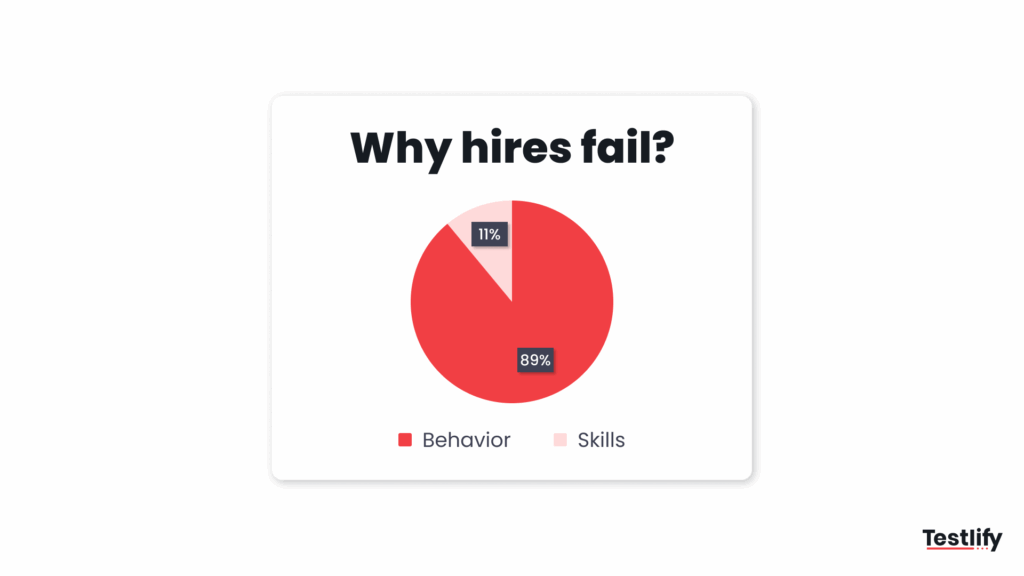
By making behavioral competency part of the hiring process, startups can avoid mis-hires.
Startups often don’t have time to design full interview scripts. With Testlify, you can pick the behaviors you want to measure, like adaptability or ownership, and send candidates AI video or audio questions.
It shows you the way candidates explain themselves, which can tell you a lot about communication and confidence.
Which behavioral traits should startups prioritize when hiring experienced talent?
Hiring someone who has years of experience in a large company is a safe bet. But in startups, the same person might struggle if they can’t adjust to the pace or the lack of structure.
A survey by LinkedIn found that 92% of hiring managers believe soft skills matter as much as or more than hard skills when making decisions. For startups, this number feels even higher.
Trait | Why it matters in startups |
|---|---|
Adaptability | Startups change plans often. The right hire can adjust quickly and keep work moving rather than slowing it down. |
Ownership | With small teams, everyone’s work is visible. Great hires take responsibility and see tasks through without waiting for direction. |
Collaboration | Roles overlap in early teams. Success depends on how well people share information and work with others across functions. |
Communication | Startups run fast. Clear, simple communication avoids confusion and keeps the whole team aligned. |
How do you assess behavioral competency?
Spotting behavioral competency is harder than checking a technical skill. You can test coding or sales numbers, but how can you know if someone will take ownership or stay calm when plans change?
There are practical ways to measure it:
1. Structured behavioral interviews
Research shows that structured interviews are twice as effective as unstructured ones in predicting performance (SHRM, 2023).
Instead of casual chats, ask every candidate the same set of questions about past situations.
Example: “Tell me about a time you had to adjust when a project suddenly changed direction. What did you do?” Their story reveals adaptability and problem-solving.
Testlify helps by letting you set up these questions once and send them to multiple candidates at the same time. You get all the responses back in one place.
2. Work samples and simulations
One of the best ways to test behavior is to give candidates a small task that mirrors real challenges.
For example, a product manager could be asked to prioritize features with limited resources. How they explain their choices tells you about ownership and collaboration.
Doing this live can eat up hours, especially if you’re reviewing multiple candidates. Testlify makes it easier by letting you add project-style tasks directly into an assessment. You can ask candidates to upload a document or submit a presentation.
3. Reference checks that go deeper
Most startups treat references as a formality. Instead, ask specific questions like: “How did they handle pressure when deadlines shifted?” or “What was their role in team conflicts?” Patterns in answers highlight consistent behaviors.
4. Scalable for volume
Even if you’re hiring five people today, you might need 50 tomorrow. Testlify scales easily: send the same structured interviews and tasks to dozens of candidates at once. Every answer lands in one dashboard so that you can filter, compare, and move fast.
5. Ready-made behavioral competency tests
Startups don’t always have the time to design their own assessments from scratch. That’s why Testlify includes a library of tests designed to measure behavioral traits directly.
For example:
- Situational Judgment Tests (SJT): Put candidates in real-life scenarios to see how they would act. Great for spotting adaptability and problem-solving.
- Communication Skills Test: Evaluates clarity, tone, and effectiveness of communication. Essential in small teams where every message counts.
- Teamwork & Collaboration Test: Checks how well a candidate can work across roles and share accountability.
- Leadership Test: Useful for lateral or senior hires to assess their initiative and leadership skills.
How have startups actually done this successfully?
Many startups already treat behavioral competency as a deal-breaker. Here are a few examples that show how it works in practice:
Thumbtack
When Thumbtack scaled, they needed senior hires fast. The CEO, Marco Zappacosta, realized that resumes didn’t show how people made tough calls. So they leaned heavily on behavioral interviews.
Instead of “What would you do here?”, they asked, “Tell me about a time you had to make a high-stakes decision without all the data.” They also referred to calling as a serious step, not a formality. If a pattern of weak judgment showed up, they passed.
Lesson: Past behavior is the clearest signal of future judgment.
YC startups
Y Combinator often advises founders to test for grit, autonomy, and comfort with chaos. Some portfolio companies do this by asking candidates to explain how they solved a problem with no playbook.
Others give take-home tasks to see if the candidate can push through uncertainty and deliver something useful.
Lesson: Lateral hires from big companies may struggle without structure. Test for grit and adaptability before you hire.
Conclusion: Why startups win by hiring for behavioral competency?
Startups rarely fail because people lack technical skills. They fail when hires can’t adapt or avoid responsibility. Hiring for behavioral competency reduces that risk.
Make behavioral competency part of every interview. If the time is tight, Testlify is there for you. Try it out!
Frequently asked questions (FAQs)
Related resources
View all
HR & recruitment
5 Benefits of EEOC compliant pre-employment testing

HR & recruitment
5 ways to simplify campus hiring with recruitment tech

HR & recruitment
Overcoming campus hiring recruitment challenges

HR & recruitment
Campus hiring guide to hire new grads at scale

HR & recruitment
Maximizing recruitment ROI using right recruitment software

HR & recruitment
How poor candidate experience affects a business
Get started.
Hire on proof, not resumes.
Run your first skills-based assessment free — no credit card required.