
Spans and Layers: How to Right-Size Your Org Structure
Discover the ultimate guide to spans and layers in organizations. Learn how to identify the right organizational structure for operational success.

Spans and layers decide how fast decisions move through your company and how much any one manager can actually carry. A span is the number of people who report to one manager. A layer is a level of management between the CEO and the front line. Get the mix wrong and you get overloaded bosses, slow approvals, and good people who leave because nobody has time to coach them.
This guide covers what spans and layers are, how to right-size them, and the part most org-design articles skip: how to hire and assess the people who have to run the structure you draw. Understanding the structure of an organization is what lets a recruiter match candidates to the way a team really works.
 ChatGPT
 Gemini
 Claude
 Grok
Grok Perplexity
TL;DR
- A span is how many people report to one manager. A layer is a level of hierarchy. Widen spans and you usually need fewer layers.
- The average manager’s team reached 12.1 people in 2025, up from 10.9 in 2024 (Gallup). The median is still five to six, so a few huge teams pull the average up.
- There is no magic number. The right span depends on how complex the work is and how much coaching the role needs.
- Flat structures move fast but stretch managers thin. Tall structures give control and clear career steps but slow decisions down.
- Structure only works if the people fit it. Wide spans need self-directed staff and high-capacity managers, so assess for that before you reorganize.

What are spans and layers?
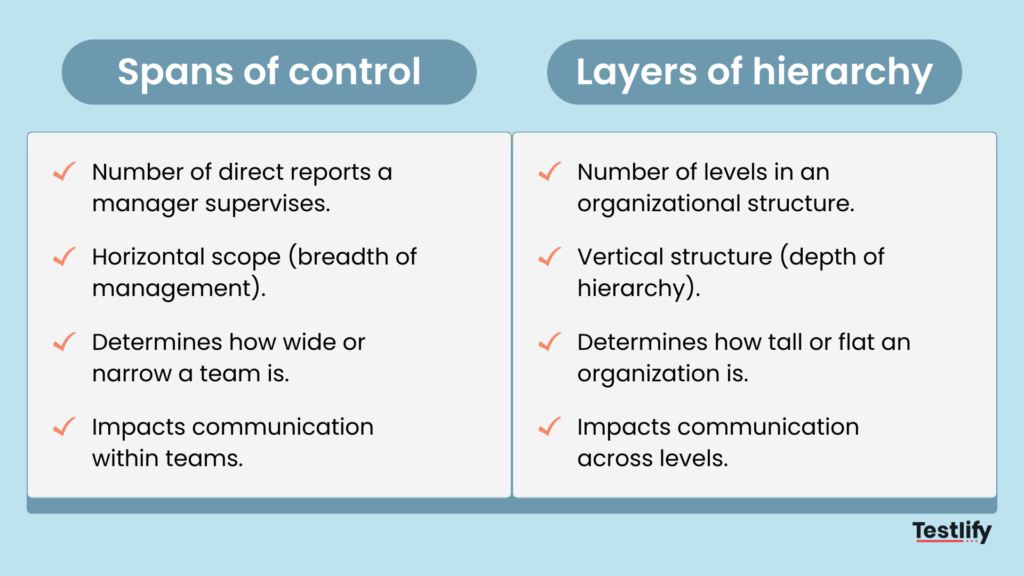
Spans and layers are the two numbers that describe the shape of an org chart. The span is horizontal (how wide a manager’s team is). The layers are vertical (how many rungs sit between the top job and the front line). Together they tell you how flat or how tall a company is.
What is span of control?
Span of control is the number of employees who report directly to one manager. It shapes how much attention each person gets, how fast information moves, and whether a manager has room to lead or is buried in status updates. Gallup’s 2025 data puts the average span at 12.1 people, up from 10.9 the year before, yet the median holds at five to six. Most managers run small teams; a minority of very large teams drag the average higher. For a fuller definition, see our span of control glossary entry.
What is a layer of management?
A layer is a single level of management in the hierarchy, like the step from a team lead to a department head. Count every reporting level from the CEO down to a frontline worker and you have the number of layers. Many companies aim for five to seven layers in total. Each extra layer adds a handoff, and every handoff is a place where a decision can stall or a message can get garbled.
How do spans and layers relate?
They pull in opposite directions. When one manager oversees many people (a wide span), the company needs fewer layers to reach everyone, so the structure flattens. When each manager has only a handful of reports (a narrow span), it takes more layers to cover the same headcount, so the structure gets taller. You cannot change one without moving the other.
Pro Tip: Do not average your way to a decision. Two companies can both report a span of eight while one has every manager at eight and the other has half its managers drowning at 20 and half coasting at two. Look at the spread, not just the mean, and fix the overloaded managers and the tiny micro-teams first.
What is the right span of control?
There is no single right number. McKinsey’s research on spans of control lands on the same point: the answer depends on the type of managerial work, not one rule for the whole company. A manager who mostly coaches through hard, novel problems can handle far fewer people than one who supervises steady, repeatable work. Use these ranges as a starting hypothesis, then check them against real manager workload.
Type of work | What the manager mostly does | Typical span |
|---|---|---|
Routine, standardized | Light supervision and exception-handling | 10 to 15+ |
Mixed or professional | Coaching plus reviewing output | 6 to 9 |
Complex or high-risk | Hands-on coaching and close oversight | 3 to 5 |
Flat or tall: which structure wins?
Neither wins outright; each trades speed for control. A flat structure (wide spans, few layers) moves fast and gives people room to act, which is why startups favor it. A tall structure (narrow spans, many layers) gives tight oversight and a clear ladder, which large, regulated firms need. The right call depends on your work, your risk, and how experienced your people are.
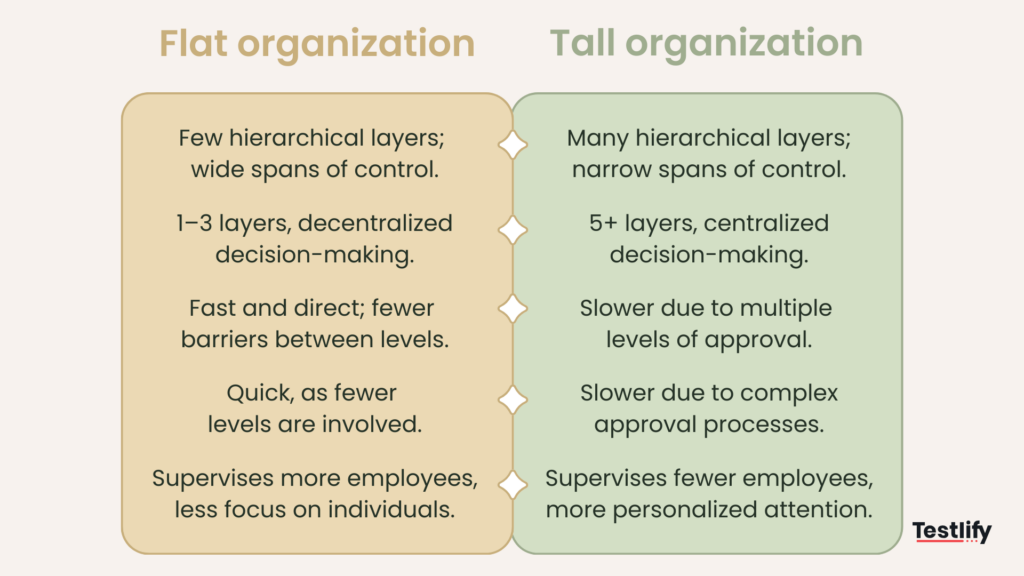
Flat structure | Tall structure | |
|---|---|---|
Span / layers | Wide span, few layers | Narrow span, many layers |
Decisions | Fast, made close to the work | Slower, more sign-offs |
Manager load | High, teams are large | Lower, teams are small |
Career path | Shorter, fewer rungs | Clearer, more rungs |
Best for | Startups, creative and agile teams | Large, complex, high-control firms |
How do spans and layers affect performance?
The structure you pick shows up in four places: decision speed, manager workload, engagement, and cost. Fewer layers mean a decision crosses fewer desks, so the company reacts faster, which matters most in fast-moving markets. More layers add checks but slow the same decision down. Wide spans cut management cost because you pay for fewer managers, but they risk burning those managers out.
Engagement is where the data gets interesting. Gallup found that team size barely mattered when employees got real feedback: about seven in ten stayed engaged regardless of how big their team was, but only one in four were engaged when feedback was missing. The lesson is blunt. A wide span is fine if the manager still coaches; it falls apart the moment coaching disappears. Closer employee engagement and morale tends to follow attention, not headcount.
Structure is also moving under everyone’s feet. Half of employers plan to restructure their business around AI by 2030, per the World Economic Forum’s Future of Jobs Report 2025, and Deloitte’s human capital research has tracked a steady drift away from rigid hierarchies toward flatter, team-based setups. Both trends widen spans and strip out middle layers, which raises the bar on the people who remain.
How do you design the right structure?
Start with the work, not the org chart. A pattern that keeps showing up is teams that copy a competitor’s structure and then wonder why it does not fit their roles. Work through these steps instead:
- Map the work first. Sort roles by how routine or complex they are. Routine work supports wider spans; complex work needs narrower ones.
- Clarify decision rights. Write down who decides what. Clear decision rights let you widen spans without losing control.
- Check manager capacity. A strong manager with good tools handles more people. Do not set a span the manager cannot actually cover.
- Benchmark, then adjust. Compare against peers in your industry, but treat their numbers as a reference, not a target.
- Plan for growth. A flat startup structure breaks as headcount climbs. Review spans and layers at least quarterly and adjust before they snap.
What should recruiters do about it?
Redraw the chart all you want; it only works if the people can run it. A wide span demands staff who can work without constant direction and managers who can coach at scale. A layered org needs people who are comfortable following process and growing through defined steps. So hiring and org design have to move together, and that is where evidence beats gut feel.
This is the job of the Testlify Competency-to-Evidence Matrix. The idea is simple: start with the role and the structure it sits in, list the competencies that structure demands (self-direction and judgment for a wide span, coordination and process discipline for a layered one), then connect each competency to measurable evidence through skills assessments, work simulations, and structured interviews. You hire for the structure on purpose instead of hoping the fit works out. Testlify supports the evidence; the hiring call stays with your team, and no single score should decide it alone.
Match this to organizational culture too. Flat teams tend to run informal and collaborative; tall ones run formal and structured. Screening for that fit up front saves a painful mismatch later.
How do you hire for the structure you are building?
Before you redraw the org chart, make sure the people can run it. Testlify’s skills, cognitive, and behavioral assessments measure self-direction, judgment, and managerial capacity with evidence instead of a hunch, so you can staff wide spans and lean layers with confidence. Book a demo or start free to see how it maps to the roles you are hiring.
Key takeaways
- Spans and layers are one decision, not two. Widening the average span flattens the company and removes layers, so changing one always moves the other. Design them together or you will fight yourself later.
- The average is rising, but the median is not. Spans averaged 12.1 in 2025 versus 10.9 in 2024, yet the median stayed at five to six. Plan around your own distribution, because the mean hides overloaded managers and tiny micro-teams.
- There is no universal right span. Routine work supports 10 to 15 reports; complex work needs three to five. Set the number from the work and the manager’s capacity, not from a competitor’s chart.
- Flat buys speed, tall buys control. Flat structures decide fast and cost less in management but stretch people thin; tall structures supervise closely and offer clearer careers but slow decisions. Pick the trade-off your market rewards.
- Feedback matters more than team size. Engagement held near seven in ten at any team size when feedback was strong, and fell to one in four without it. A wide span is safe only if the manager still coaches.
- Structure follows people. A new chart fails if the staff cannot operate it. Assess for self-direction, judgment, and process fit before you reorganize, so the structure and the hires reinforce each other.
Frequently asked questions (FAQs)

Content Writer
Yashika Khandelwal is a Content Writer with 3+ years of experience creating research-backed content on hiring, talent assessment, and HR technology. She is a registered Organizational Psychologist and subject matter expert who combines behavioral science with practical recruitment insights to produce accurate, evidence-based content.
LinkedInRelated resources
View all
HR & recruitment
Workforce Reduction: Steps, Alternatives, and Best Practices

HR & recruitment
7 ways to start your talent search and sourcing strategy

HR & recruitment
HR Benchmarking: Types, benefits and challenges

HR & recruitment
Agile recruitment: Step-by-step process and benefits

HR & recruitment
Job Crafting: Types, Examples, and How to Do It (2026)

HR & recruitment
Best practices to ensure authenticity in candidates’ skills assessment tests
Get started.
Hire on proof, not resumes.
Run your first skills-based assessment free — no credit card required.