
Phased return to work: a complete guide for HR teams
Everything HR needs to manage a phased return to work — pay rules, 8-week schedule template, FMLA/ADA compliance, and what to do when it fails.

TL;DR
- 40% of employees who are absent for more than four weeks never return to work. A structured phased return to work program is the single highest-leverage intervention for recovering that talent. (UK Fit Note Evaluation, DWP)
- A phased return is not a favour — it is a risk management tool. Done correctly, it protects the business from extended absence costs, discrimination claims, and talent loss simultaneously.
- Pay during a phased return depends on the arrangement: full pay for reduced hours is common but not required; statutory sick pay (SSP), occupational sick pay, or annual leave top-ups are the main alternatives. Get this in writing before day one.
- The 8-week model is the standard: weeks 1-2 at 50% hours, weeks 3-4 at 75%, weeks 5-8 at full hours with reduced responsibility load. Enterprise teams should document this as a formal return-to-work agreement, not an informal manager conversation.
- In the US, phased returns frequently intersect with FMLA intermittent leave and ADA reasonable accommodation obligations. Enterprise HR must document both the medical need and the accommodation decision to avoid EEOC exposure.
- The three most common failure points: manager resistance, unclear end-date expectations, and no escalation path if the employee’s condition worsens. Each requires a specific protocol, not just goodwill.
- Testlify’s skills-based assessment framework can verify role-readiness before an employee returns to full duties — reducing the risk of a relapse triggered by premature full workload reintroduction.
An employee returns from six weeks of medical leave. By week two they are struggling — the workload is full, the expectations are unspoken, and no one has checked in. By week four they are absent again. This is not a medical outcome. It is an HR process failure. A phased return to work prevents exactly this — but only when it is designed as a formal system, not a loosely managed favour.
This guide covers everything enterprise HR teams need: what a phased return is, who qualifies, how pay works, the 8-week schedule model, FMLA and ADA compliance requirements, and what to do when a return does not go as planned.
 ChatGPT
 Gemini
 Claude
 Grok
Grok Perplexity
What is a phased return to work?
A phased return to work is a structured reintegration programme where an employee returning from extended absence gradually increases their working hours and responsibilities over a defined period — typically four to eight weeks. Rather than returning to full duties on day one, the employee and employer agree to a written plan with milestones, check-in points, and a clear end-date for the phased period.
The phased approach serves three functions simultaneously: it protects the employee from relapse by preventing abrupt workload reintroduction, it protects the business from extended absence costs and potential discrimination liability, and it creates a documented record of the employer’s efforts to support the employee’s return — relevant in any subsequent employment tribunal or EEOC proceeding.
Phased returns are most commonly triggered by four categories of absence: medical or surgical recovery, mental health episodes (burnout, anxiety, depression), maternity or parental leave, and bereavement or family crisis. The mechanism is the same across all four — the specific support structures differ by type, which is covered in the next section.

Who qualifies for a phased return to work?
Any employee returning from an absence that has materially affected their capacity to perform their full role is a candidate for a phased return. In practice, enterprise HR should treat phased returns as the default for absences lasting four weeks or more — the retention risk above that threshold is significant enough that an informal “just come back when you’re ready” approach is not defensible.
The four primary groups:
Medical or surgical recovery
Post-operative employees, employees recovering from serious illness, or those managing chronic conditions (cancer treatment cycles, MS, cardiac events). Phased return timelines here should be driven by occupational health assessment, not manager intuition.
Mental health recovery
Burnout, clinical anxiety, depression, or crisis episodes. These employees often need a modified responsibilities plan — reduced decision load, temporary removal from high-pressure projects — in addition to reduced hours. Hours alone is not sufficient.
Maternity, paternity, or shared parental leave
Particularly relevant for extended leave (six months or more) where operational changes, team changes, and technology updates have occurred. Treat this like a structured onboarding — the employee knows the company but not the current state of it.
Bereavement or personal crisis
Grief does not follow a linear recovery arc. Phased returns for bereavement often need built-in flexibility clauses — a fixed 8-week timeline can feel artificial when the underlying situation is unresolved.
Once it is clear a phased return applies, the immediate question most HR teams get stuck on is duration — and specifically, what the employee gets paid during it.
How long does a phased return to work last?
The standard duration is four to eight weeks, extendable to twelve weeks for complex medical cases. Shorter timelines (two weeks) are appropriate for brief absences where the primary need is confidence reintegration rather than physical recovery. Beyond twelve weeks, the arrangement typically transitions into a formal reasonable adjustment or part-time contract — it is no longer a temporary phased return.
The 8-week model is the most widely used in enterprise HR. The schedule below reflects standard practice and should be adapted based on occupational health guidance:
Week | Hours (of full week) | Responsibility load | Check-in |
|---|---|---|---|
1-2 | 50% (e.g. 18-20 hrs) | Core tasks only, no management/escalation duties | Daily brief check-in with line manager |
3-4 | 75% (e.g. 28-30 hrs) | Standard tasks, limited project ownership | Weekly 30-min structured review |
5-6 | 90% (e.g. 33-35 hrs) | Full task load, reduced deadline pressure | Weekly review, flag any concerns early |
7-8 | 100% | Full duties, formal end-of-phased-return review | End-of-programme sign-off meeting |
Two points enterprise HR teams often skip: first, the end-of-programme review is not optional — it is the formal closure of the phased return agreement and the point at which any ongoing accommodations are documented. Second, if the employee is not at 100% capacity by week 8, the decision is whether to extend the phased period or convert to a permanent reasonable adjustment. Do not let it drift informally past the agreed end-date.
Duration and schedule are easier to plan than pay — which is where most line managers and many HR teams are genuinely unsure of the rules.
Does a phased return to work affect pay?
Yes — and the specific outcome depends entirely on which arrangement is in place. This is the section most employees want answered before they agree to a phased return, and most HR guides leave it vague. Here is the actual breakdown:
Arrangement | Pay outcome | When to use |
|---|---|---|
Full pay for reduced hours | Employee receives full salary despite working fewer hours. Employer absorbs the cost differential. | Short duration (2-4 weeks), goodwill/retention priority, high-value employees |
Pro-rata pay (hours worked only) | Employee paid only for hours actually worked. No top-up. | Longer durations, standard company policy, where full-pay precedent would be problematic |
Statutory sick pay (SSP) top-up | Employee on SSP for non-worked hours, full pay for worked hours. SSP rate is £116.75/week in the UK (2026). | UK employees still within their SSP eligibility window |
Annual leave supplement | Employee uses accrued annual leave to top up pay for non-worked hours | Where employee prefers not to go onto SSP; useful for shorter gaps |
Occupational sick pay (OSP) | Company-specific enhanced sick pay scheme, typically covers a defined period beyond SSP | Where company has an OSP policy; check eligibility rules |
In the US, the pay picture is different: FMLA leave is unpaid (though employers may require or allow the employee to use accrued PTO concurrently). A phased return that runs concurrently with remaining FMLA entitlement may qualify as intermittent FMLA — meaning the reduced hours days count against the employee’s 12-week FMLA bank. Document this clearly in the return-to-work agreement.
Whatever arrangement is agreed, the pay terms must be in writing before the phased return begins. Verbal agreements create ambiguity and risk. The written agreement should specify: pay rate during each phase, what happens if the employee cannot progress on schedule, and who authorises any extension.
With pay terms settled, the next question is what else the written plan needs to cover — five components that determine whether the programme actually holds up in practice.
Key elements of a phased return to work plan
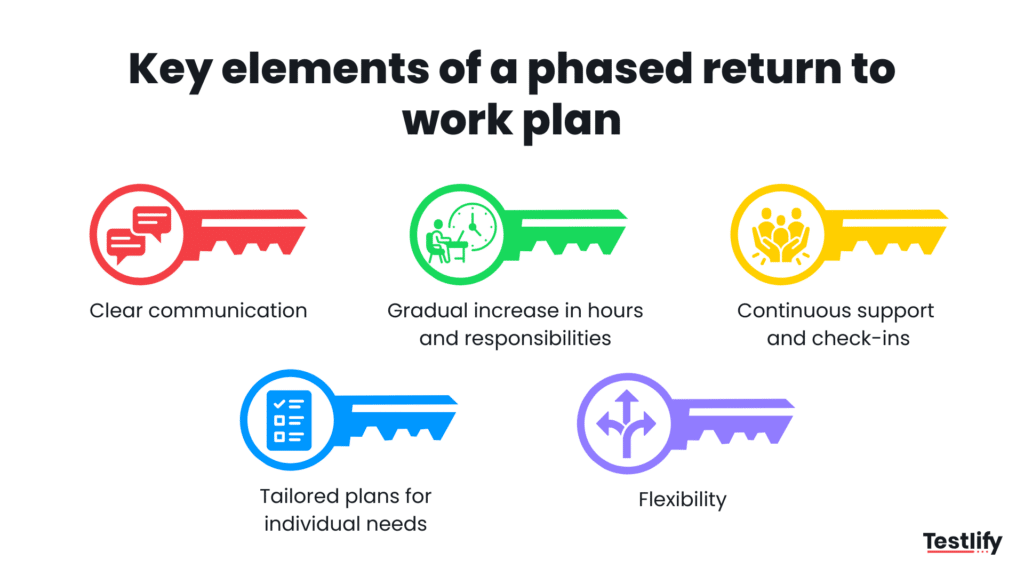
A phased return plan that exists only as a calendar entry will fail. The plan needs five components to function as an actual system:
Written return-to-work agreement
A signed document covering: start date, phase schedule (hours per week per phase), pay arrangement, responsibility load per phase, check-in cadence, escalation procedure, and planned end date. Both employee and manager sign. HR retains a copy. This is not bureaucracy — it is the legal record of what was agreed and protects both parties.
Occupational health input
For medical or mental health absences, an occupational health professional (OHP) assessment should inform the plan. The OHP assessment tells you what adjustments are medically indicated — reduced hours, modified duties, environmental changes (lighting, noise, screen time limits). HR and line managers should not make these calls without clinical input.
Clear scope limitation per phase
The hours reduction is the visible part. The responsibility reduction is equally important and more often skipped. An employee back at 50% hours but still expected to respond to escalations, attend all leadership meetings, and own critical project decisions is not on a phased return — they are on a reduced hours contract with full accountability. Define what is in scope for each phase explicitly.
Manager briefing
The line manager is the daily contact point for the returning employee. If the manager has not been briefed on what a phased return requires — specifically, what they should not ask the employee to do in phase one — the plan will be undermined within the first week. Manager briefing is not optional.
Escalation path
What happens if the employee’s condition worsens during the phased return? Who decides whether to pause, extend, or convert to sick leave? This decision path needs to be agreed before it is needed, not improvised in the moment.
Having these elements in place makes implementation straightforward — which is where most managers want the most practical guidance.
How to implement a phased return to work
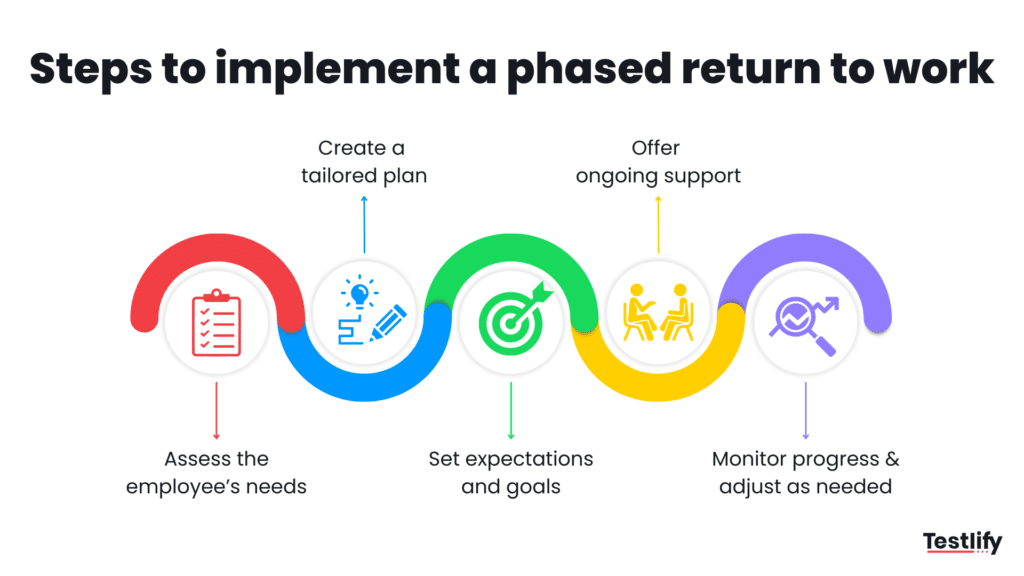
Step 1: Conduct a return-readiness assessment
Before scheduling the return date, assess whether the employee is ready. For medical absences, this means an occupational health clearance or GP fit note recommending a phased return. For mental health absences, an OHP or HR conversation covering capacity, triggers, and support needs. Do not default to “they said they’re ready” — readiness should be verified, not self-reported alone.
Step 2: Draft the phased return agreement
Using the 8-week model as a baseline, create the written agreement. Involve the employee in setting the schedule — a plan they helped design has significantly higher adherence than one handed to them. Cover pay, hours, responsibility scope, check-in frequency, and what constitutes a successful end to the programme.
Step 3: Brief the line manager
A 30-minute briefing before day one. Cover: what the employee needs from the manager during each phase, what topics are off-limits in early check-ins (performance ratings, upcoming changes, team conflicts), what the escalation path is, and how to handle team questions about the returning employee’s availability.
Step 4: Prepare the team
The returning employee’s team will notice the reduced hours and modified role. A short communication from the manager — “Alex is back on a phased schedule for the next eight weeks, available [hours], focused on [defined scope]” — prevents speculation and removes pressure from the returning employee to explain their situation.
Step 5: Run structured check-ins
Daily for the first two weeks (brief, 10 minutes, not a performance review). Weekly from week three onwards. The check-in has one question: “Is this pace right for you?” Not “are you keeping up with workload” — which will elicit the answer the employee thinks you want. The check-in is clinical, not managerial.
Step 6: Formal end-of-programme review
At week 8 (or agreed end date), a structured review: is the employee at full capacity? Are any ongoing accommodations needed? If the answer to the first is no, the decision tree is: extend phased period (maximum 12 weeks total), convert to reasonable adjustment / part-time, or return to sick leave. Document the outcome and the decision rationale.
Implementation quality determines whether the phased return achieves its goal — but even well-run programmes sometimes fail, and HR needs a clear protocol for that scenario.
Pro Tip: Before the phased return starts, ask the line manager one question: Is the team in a crunch period right now? A returning employee joining at 50% hours during a high-pressure sprint will face invisible workload pressure no written plan can prevent. If the answer is yes, delay the start date by two weeks — the schedule flexibility costs almost nothing; the relapse risk it prevents is significant.
What if a phased return to work fails?
A phased return fails when the employee cannot sustain the agreed schedule and requires a further period of absence before completing the programme. This is not uncommon — AIHR data suggests approximately 15-20% of phased returns result in a second absence episode. The failure should trigger a structured response, not an ad-hoc manager conversation.
Immediate step: pause the programme
If the employee signals they cannot continue, pause the phased return and revert to sick leave or medical leave status. Do not pressure continuation. Document the date, the reason given (at the level of detail the employee is comfortable sharing), and who made the decision.
Second occupational health assessment
A fresh OHP assessment to determine whether the original plan was mismatched to the employee’s actual condition, or whether the condition has changed. This assessment informs the next plan.
Revised plan or permanent accommodation
Options after a failed phased return: redesign the phased plan with different parameters (slower progression, further responsibility reduction), agree a permanent part-time arrangement, agree a role adjustment (different duties, different team), or — where none of the above is feasible — begin a formal capability or ill-health process. The last option should come only after documented good-faith efforts at accommodation.
Legal documentation
Every decision point in a failed phased return should be documented. In the US, if the employee is covered by ADA, the failure of the phased return does not end the employer’s reasonable accommodation obligation — a different accommodation may still be required. In the UK, if the employee has a disability under the Equality Act 2010, the employer must show they took all reasonable steps before any adverse employment action.
For enterprise HR teams, the failure protocol is not just about the individual case — it is about the paper trail. A well-documented failed phased return dramatically reduces tribunal and EEOC risk compared to one that dissolved informally with no written record.
That documentation mindset extends beyond individual failures — enterprise teams managing phased returns at scale need compliance infrastructure that covers FMLA, ADA, and HRIS tracking simultaneously.
Enterprise HR considerations: compliance and documentation
Phased returns in large organisations introduce compliance dimensions that smaller employers rarely encounter. Enterprise HR teams managing phased returns at scale should have protocols for all of the following:
FMLA intersection (US)
If the employee has remaining FMLA entitlement, a phased return on reduced hours may qualify as intermittent FMLA leave. The reduced days count against the employee’s 12-week bank. HR must track FMLA usage in the HRIS during the phased return period. Failure to do so creates ambiguity about how much FMLA entitlement remains — which becomes a problem if the employee needs further protected leave.
ADA reasonable accommodation documentation
A phased return for a disability-related absence is a form of reasonable accommodation. The interactive process — the documented conversation between HR and the employee about what accommodations are needed and feasible — must be on file. The phased return plan itself is evidence of the accommodation. Any deviation from it (e.g., manager increasing the employee’s responsibilities ahead of schedule) creates liability.
UK Equality Act 2010
Employees with conditions that qualify as disabilities under the Act (which includes many mental health conditions and chronic illnesses) are entitled to reasonable adjustments. A phased return is a standard reasonable adjustment. Refusing one without documented justification is an Equality Act risk.
HRIS tracking
Enterprise HR should record phased return status in the HRIS (Workday, SAP SuccessFactors, or equivalent): start date, end date, phase parameters, pay arrangement, and outcome. This creates the audit trail needed for manager escalations, legal proceedings, and pattern analysis (are certain teams or managers generating more failed phased returns?).
Manager training
The most common failure point in enterprise phased return programmes is line manager behaviour — specifically, managers who informally increase expectations ahead of schedule, who make the returning employee feel they are a burden, or who fail to brief the team correctly. Annual manager training on phased return protocols is a compliance investment, not a soft skill.
Skills-based readiness assessment
For roles with specific technical or operational requirements, skills-based assessment before full-duty reinstatement reduces the risk of a relapse triggered by premature return to complex tasks. A short role-readiness assessment — mapped to the core competencies of the role — gives HR and the returning employee objective confirmation that full duties are appropriate. This is particularly relevant for quality-of-hire outcomes in enterprise roles where a failed full-duty return has downstream team impact.
Key Takeaway: The difference between a phased return that works and one that fails is almost never the schedule — it is manager behaviour in weeks 1 and 2. A line manager who informally escalates expectations ahead of the agreed phase is the single highest-risk factor in any programme. Brief the manager before day one, every time, without exception.
Frequently asked questions

Content Writer
Yashika Khandelwal is a Content Writer with 3+ years of experience creating research-backed content on hiring, talent assessment, and HR technology. She is a registered Organizational Psychologist and subject matter expert who combines behavioral science with practical recruitment insights to produce accurate, evidence-based content.
LinkedInRelated resources
View all
HR & recruitment
What Is Adaptive Leadership? Definition, Principles, and HR Applications (2026)

HR & recruitment
Inclusive succession planning: promoting diversity in leadership roles

HR & recruitment
Skills Profile: What It Is and How to Build One (2026)

HR & recruitment
Talent mobility: Benefits, strategies, and best practices

HR & recruitment
Deductive vs inductive reasoning: What are they and when to use?

HR & recruitment
Building a Winning Team in the Financial Sector — Essential Recruiting Tips
Get started.
Hire on proof, not resumes.
Run your first skills-based assessment free — no credit card required.