
How to operationalize DEI in the enterprise recruitment funnel
Learn how to operationalize DEI in every stage of your enterprise recruitment funnel with practical strategies for inclusive hiring and retention.

Enterprises around the globe are embracing Diversity, Equity, and Inclusion (DEI) as a core part of their mission, values, and strategy. But making DEI more than a checkbox takes especially in hiring.
So, how do you truly operationalize DEI in your recruitment funnel? How do you move from good intentions to real, measurable action?
This blog is here to help you understand what it takes to embed DEI at every stage of the recruitment process practically, sustainably, and with impact.
 ChatGPT
 Gemini
 Claude
 Grok
Grok Perplexity
What is DEI (Diversity, Equity, and Inclusion)?
Recruitment and organizational culture, DEI stands for Diversity, Equity, and Inclusion. These three interconnected principles form the foundation of a workplace that values and leverages the unique backgrounds, perspectives, and contributions of all employees.
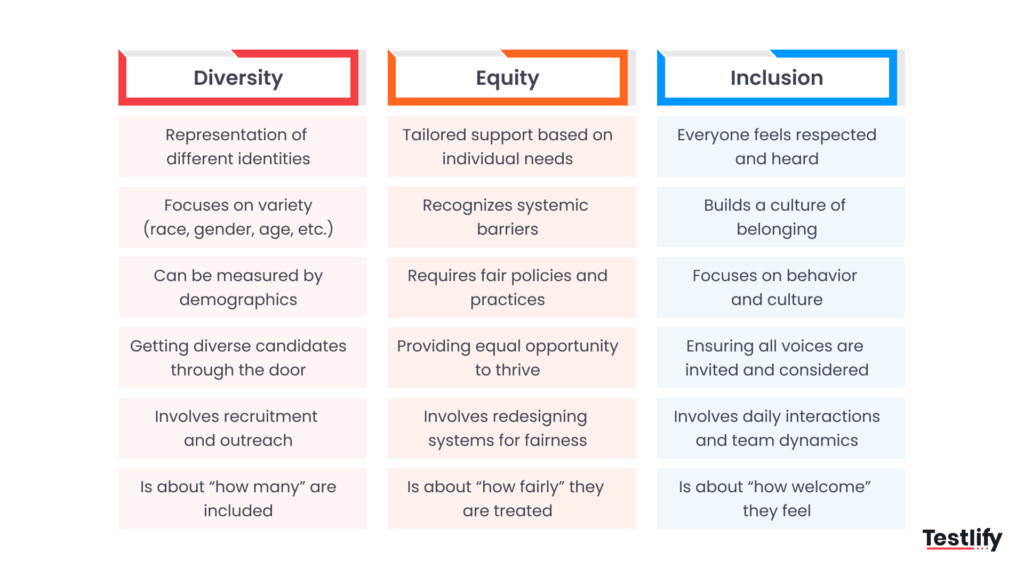
Diversity
Diversity refers to the presence of differences within a given setting, encompassing various dimensions such as:
- Race and ethnicity
- Gender and gender identity
- Sexual orientation
- Age
- Disability
- Cultural background
- Socioeconomic status
- Religious beliefs
In the workplace, diversity means having a workforce that reflects a broad spectrum of these characteristics, ensuring that all individuals have representation and a voice.
Equity
Equity involves ensuring fair treatment, access, opportunity, and advancement for all individuals, while striving to identify and eliminate barriers that have historically led to unequal treatment.
Unlike equality, which treats everyone the same, equity recognizes that different people have different needs and circumstances and adjusts resources and opportunities accordingly to achieve fair outcomes.
In recruitment, equity means implementing practices that provide all candidates with a fair chance, considering their unique backgrounds and challenges.
Inclusion
Inclusion is the practice of creating environments in which any individual or group can be and feel welcomed, respected, supported, and valued. In the workplace, inclusion ensures that all employees feel they belong and are empowered to contribute fully to the organization’s success.
An inclusive workplace actively seeks to involve every employee, fostering a culture where diverse perspectives are heard and valued.

Why does DEI matter in recruitment?
Before we dive into the “how,” let’s take a moment to understand the “why.”
Studies consistently show that diverse teams outperform homogeneous ones. Diversity brings in new perspectives, fosters innovation, and improves decision-making. Companies with inclusive cultures are also better at attracting and retaining top talent.
Beyond business benefits, promoting DEI is simply the right thing to do. Every candidate deserves an equal opportunity to succeed, regardless of their background.
Modern candidates, especially Millennials and Gen Z, care deeply about a company’s values. They’re evaluating your commitment to DEI, and if they don’t see it in your hiring practices, they may look elsewhere.
What does it mean to operationalize DEI?
Operationalizing DEI means weaving it into the fabric of your recruitment process. It’s not about one-off trainings or statements about consistent, intentional actions at every stage of the funnel.
Let’s walk through what that looks like.
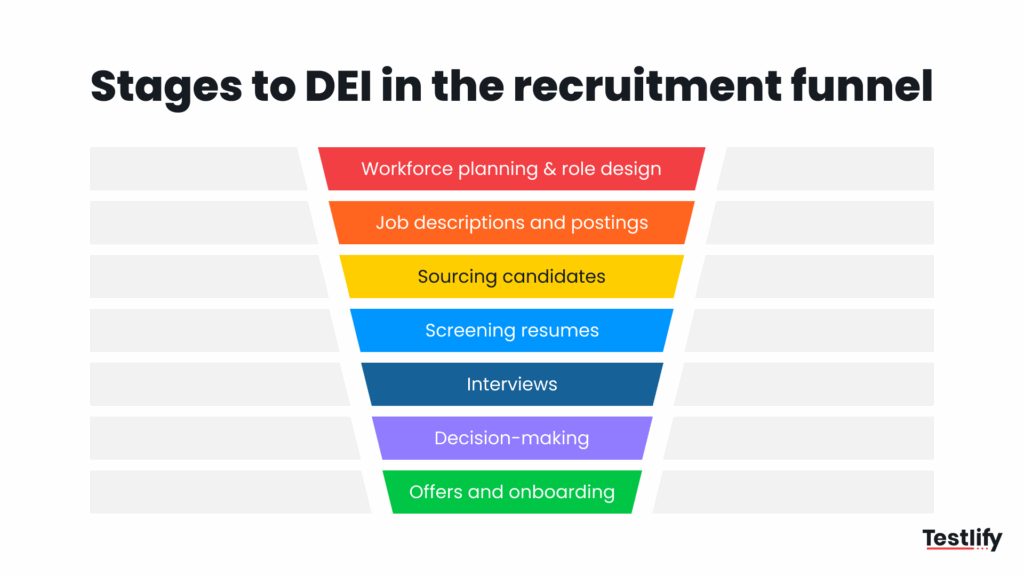
1. Workforce planning & role design
Before the job is even posted, inclusion begins with how roles are designed. Are your job levels, titles, and pay bands equitable? Are opportunities distributed fairly across departments?
Audit past hiring and promotion data to identify disparities. Are women or underrepresented groups clustered in certain roles or levels? If so, there’s work to be done upstream.
2. Job descriptions and postings
Job descriptions should be free of biased or exclusionary language. Words like “rockstar,” “aggressive,” or “dominant” can subtly signal a culture that isn’t inclusive. Tools like Textio or Gender Decoder can help make language more neutral.
Be mindful of requirements. Long lists of qualifications can deter candidates, especially women and marginalized groups, from applying if they don’t meet every single one. Focus on skills and must-haves.
Include a DEI statement that is authentic, concise, and positioned early in the job post. Candidates shouldn’t have to dig through your website to know if you value inclusion.
3. Sourcing candidates
If your current candidate pool lacks diversity, look at where you’re sourcing. Are you relying too heavily on referrals or a few schools?
Expand your reach:
- Partner with HBCUs and community colleges
- Post on diversity-focused job boards
- Build relationships with professional organizations
Boolean searches can inadvertently exclude diverse candidates if written too narrowly. Train sourcers on inclusive search practices.
Some companies use software to anonymize resumes at the sourcing stage. While it’s not a silver bullet, it can help reduce unconscious bias.
4. Screening resumes
Create a rubric for evaluating resumes so that every candidate is judged on the same criteria. This helps reduce bias and ensures consistency.
Does a candidate have to come from a top-tier school or a Fortune 500 company? Skills and experience often matter more than pedigree. Be open to non-traditional backgrounds.
Invest in training that helps recruiters recognize and interrupt bias in resume screening. Make it ongoing, not just a one-time workshop.
5. Interviews
Unstructured interviews are breeding grounds for bias. Standardize your interviews by:
- Asking the same core questions to all candidates
- Using scoring rubrics
- Defining in advance what “good” answers look like
Representation matters. Having a diverse interview panel can reduce bias and make candidates feel more welcome. It also gives a more rounded view of each applicant.
Not everyone knows how to interview inclusively. Provide training on:
- Microaggressions
- Cultural competency
- Active listening
- Reducing similarity and affinity bias
6. Decision-making
Avoid giving too much weight to any single interviewer’s opinion. Use debrief sessions where interviewers discuss candidates together and compare ratings. This helps check bias and allows for broader perspectives.
Analyze pass-through rates by demographic groups. Are certain groups being disproportionately rejected at certain stages? If so, investigate why and adjust.
7. Offers and onboarding
Offer salaries based on market data and internal equity not previous compensation. Women and BIPOC candidates are often underpaid relative to their peers, and using salary history only perpetuates these gaps.
Your DEI commitment shouldn’t stop once a candidate says yes. Onboarding should be welcoming to all. Make sure materials reflect diverse voices and perspectives, and offer mentorship for new hires from underrepresented backgrounds.
Supporting structures for long-term success
Embedding DEI in recruitment isn’t a solo act. It requires a supportive infrastructure.
Leadership must be visibly committed. That includes setting goals, providing resources, and holding teams accountable.
If possible, hire DEI professionals who can partner with HR and recruitment teams to build inclusive systems and provide guidance.
Treat DEI like any other business goal. Set measurable targets, track progress, and report outcomes. For example:
- % of diverse candidates in pipeline
- % of interview panels with representation
- Offer acceptance rates by demographic group
Tools and tech that can help
Technology can be a powerful ally in building a more inclusive recruitment process if used thoughtfully. From writing job descriptions to screening candidates fairly, the right tools can help eliminate bias, improve efficiency, and support data-driven DEI decisions.
Writing inclusive job descriptions
Crafting the right job description is often your first chance to attract diverse talentand it matters more than many realize. The language you use can either welcome or alienate candidates from underrepresented backgrounds.
Tips for writing inclusive descriptions
Even with great tools, here are a few best practices:
- Avoid jargon like “rockstar.” These terms can feel exclusive.
- Keep requirements realistic; list only the skills truly needed.
- Use gender-neutral language and emphasize your company’s DEI commitment.
With the right tech, like Testlify, and the right approach, your job descriptions can become a magnet for diverse, qualified candidates while setting the tone for a more inclusive hiring process.
Use tools to remove bias
Tools like Testlify make it easier than ever to create inclusive job descriptions. Its AI-powered job description generator helps you write clear, bias-free, and role-specific postings that resonate with a wide talent pool. This means you spend less time editing and more time attracting the right candidates.
Focus on skills, not backgrounds
Testlify also helps shift the focus from traditional credentials (which can carry systemic bias) to actual skills and competencies. With its bias-free skills assessments, you can evaluate candidates based on what they can do not where they went to school or who they know. This levels the playing field and supports equity from the start.
Common mistakes to avoid in DEI
Implementing DEI initiatives is a commendable step toward fostering a more inclusive workplace. However, organizations often encounter pitfalls that can undermine these efforts. Recognizing and addressing these common mistakes is crucial for creating a truly equitable environment. Let’s explore some of the most prevalent missteps and how to avoid them.
Thinking dei is just a “recruiting problem”
Many organizations mistakenly limit DEI to hiring efforts. In reality, DEI is a company-wide challenge that also involves retention, employee experience, leadership development, and culture. Without addressing these areas holistically, diverse hiring efforts will struggle to succeed or scale meaningfully over time.
Tokenism
Tokenism is when someone is included just to look diverse, not to truly be included or valued. Hiring diverse candidates just to “check a box” can backfire. Tokenism is easily recognized by candidates and employees alike. It undermines trust and signals inauthenticity. Genuine inclusion means supporting diverse employees with equitable resources, meaningful opportunities, and a culture where they can truly thrive, not just be seen.
Fatigue and frustration
DEI work can feel slow and sometimes exhausting, especially when results aren’t immediate. But meaningful change takes time, consistency, and patience. It’s normal to feel discouraged but don’t quit. Staying committed to progress, even in the face of challenges, is what leads to real transformation over the long term.
Final thoughts: Progress over perfection
Operationalizing DEI in recruitment isn’t about being perfect. It’s about making intentional choices, listening to feedback, and always striving to do better.
Start where you are. Take one step at a time. Build momentum.
Because when you create a recruitment funnel that values every candidate, you don’t just build a more diverse workforce, you build a stronger, more resilient, more human organization.
For further reading, explore Enterprise Architect.
Frequently asked questions (FAQs)

Content Writer
Yashika Khandelwal is a Content Writer with 3+ years of experience creating research-backed content on hiring, talent assessment, and HR technology. She is a registered Organizational Psychologist and subject matter expert who combines behavioral science with practical recruitment insights to produce accurate, evidence-based content.
LinkedInRelated resources
View all
HR & recruitment
Building a global interview infrastructure

HR & recruitment
Breaking hiring silos: Aligning TA with L&D and DEI

HR & recruitment
How to build a recruitment center of excellence (CoE)?

HR & recruitment
Seasonal and project-based hiring: Playbook for volume flexibility

HR & recruitment
Why Employer Value Proposition (EVP) is your talent magnet in 2026?

HR & recruitment
eSIM for HR and Global Talent Mobility: 6 Ways eSIM Transforms HR Management
Get started.
Hire on proof, not resumes.
Run your first skills-based assessment free — no credit card required.