
What is a job leveling matrix? 3 powerful reasons to use it
Learn how job leveling and a matrix clarify roles, ensure fair pay, and provide clear career paths for employee growth in your organization.

Do you sometimes feel like your team members aren’t clear on their roles, or you’re unsure if everyone’s pay is fair? That’s where job leveling comes in.
Job leveling helps you define clear roles, align responsibilities, and ensure that everyone is being compensated fairly for their work.
Plus, for employees, it clearly outlines what they need to do to advance their careers and shows exactly how their efforts tie into transparent salary ranges.
In this article, we’ll answer all the big questions: What is job leveling? Why does it matter? And how can a job leveling matrix make the whole process easier?
Let’s jump in and explore how you can bring more order and fairness to your organization with job leveling.
 ChatGPT
 Gemini
 Claude
 Grok
Grok Perplexity
What is job leveling?
Job leveling, also known as job classification or job grading is a structured system used to define the different job roles and categorize them based on responsibilities, skills, and experience. This system helps create a clear understanding of what’s expected from employees at each level.
Whether you’re mapping out roles for a new hire or revisiting responsibilities for a long-term employee, it helps you group similar roles. It also ensures that comparable qualifications and salary ranges are applied across the board.

How to do job leveling?
Building a job leveling system might seem overwhelming at first, but with the right steps and team in place, it becomes a straightforward process that can benefit both employees and the organization. Here’s how you can implement the process efficiently.
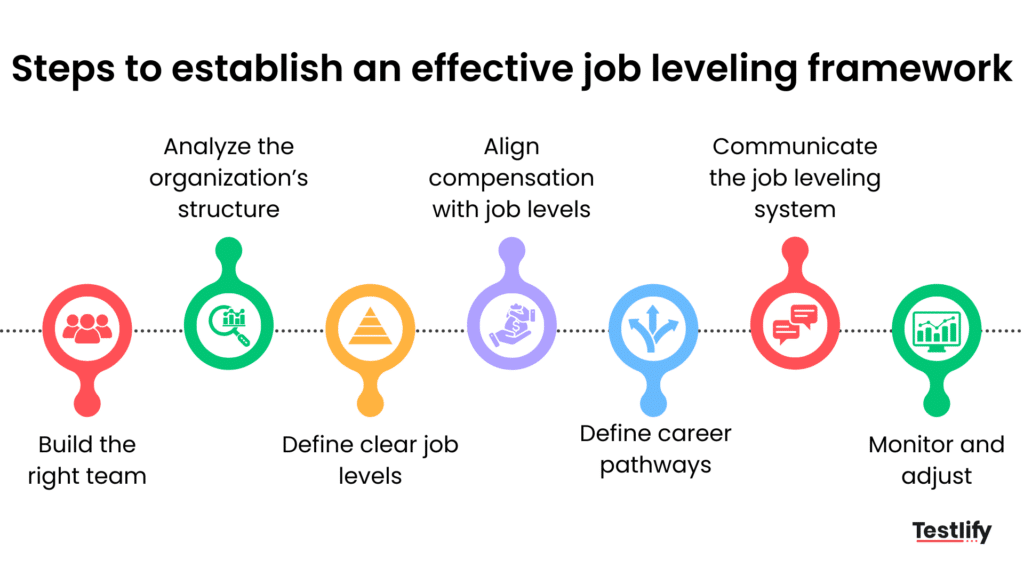
1. Build the right team
The first step is bringing together the right stakeholders. A mix of HR professionals, company leadership, and department managers will give you a broad perspective on job roles and help ensure that each position is accurately described.
Input from different levels ensures that the framework aligns with the organization’s structure and culture.
2. Analyze the organization’s structure
Before diving into specific roles, take a step back and look at your organization as a whole. Ask questions like:
- How many job levels currently exist?
- Are there gaps between certain positions?
- How many levels do you want after job leveling?
This analysis helps you understand how many job levels you need to create to ensure smooth transitions between roles.
3. Define clear job levels
Once you have a sense of your organizational structure, it’s time to define job levels. These levels represent different tiers of responsibility, leadership, and skills.
Whether it’s entry-level employees or senior management, each level should be clearly defined to reflect the complexity and scope of the role.
Tip: Keep the definitions simple but specific. Make sure the responsibilities and expectations are unambiguous for each level.
To give you a clear picture of how job leveling works, here’s an example of a framework. The table below shows how different job levels align with roles, responsibilities, required skills, and corresponding salary ranges.
You can use this template as a starting point for creating your own structure, modified according to your organization’s needs.
Job Level | Role | Responsibilities | Skills/Experience | Salary Range |
|---|---|---|---|---|
Level 1 (Entry-Level) | Junior Developer | Assists in coding, learning new technologies | Basic coding skills, < 2 years experience | $40,000 – $50,000 |
Level 2 (Mid-Level) | Software Developer | Leads small projects, mentors junior employees | Strong coding skills, 3-5 years experience | $60,000 – $75,000 |
Level 3 (Senior) | Senior Developer | Manages projects, leads technical decisions | Advanced technical skills, 5-8 years experience | $85,000 – $100,000 |
Level 4 (Lead) | Lead Developer | Oversees entire development team, strategy | Leadership skills, 8+ years experience | $110,000 – $130,000 |
Level 5 (Executive) | Chief Technology Officer (CTO) | Sets company-wide tech vision, strategic decisions | Executive-level experience, 10+ years | $150,000+ |
4. Align compensation with job levels
Fairness is key. At each job level, employees should be compensated based on their responsibilities and the skills required. Aligning compensation structures with the job levels ensures transparency and fairness across the company.
Use external market data and internal pay scales to develop appropriate salary ranges for each level.
Organizations with structured compensation systems, according to PayScale, report a 10% reduction in pay inequality. This alignment prevents pay discrepancies and also boosts employee satisfaction.
Pro Tip: Ensure your compensation plan is consistent with industry standards, so your company remains competitive in attracting and retaining talent.
5. Define career pathways
A successful job leveling system should provide employees with clear career paths. This means mapping out how they can progress from one level to the next, the skills they need to develop, and what responsibilities they must take on to grow.
Providing this transparency helps keep employees motivated and engaged, as they can see a clear path to advancement.
6. Communicate the job leveling system
Once you’ve established the job leveling framework, make sure it’s shared with all employees. Explain how job levels work, how they impact salary ranges, and what career growth opportunities are available.
This helps employees understand their current level, the expectations for progression, and how they can move up within the company.
Tip: Don’t just share the framework at the end—keep employees updated throughout the process to avoid confusion and build trust.
7. Monitor and adjust
Job leveling isn’t a one-time task. Regularly monitor the system to ensure it remains relevant to your organizational needs and industry standards.
As roles evolve, so should your job leveling framework. Gather feedback from managers and employees, and be open to making adjustments as needed.
What Is a job leveling matrix?
A job leveling matrix is a method that simplifies the way organizations define and organize their job roles. It maps out job levels across different departments, showing how responsibilities, skills, and compensation increase as employees move up through the hierarchy.
Think of it as a guide that helps both employees and managers see exactly where each role fits in and what is needed for career progression.
A job leveling matrix is structured like a table or grid, with columns representing different job levels (such as entry-level, mid-level, and senior positions) and rows representing different departments or functions (such as marketing, HR, or engineering).
Each cell within the matrix outlines the key responsibilities, skills, and corresponding salary range for that role, making it easy to compare positions across the organization.
Level | Role | Responsibilities | Skills Required | Salary Range |
|---|---|---|---|---|
Level 1 | Junior Marketing Associate | Assists with campaigns, learns tools and analytics | Basic marketing knowledge, 0-2 years experience | $40,000 – $50,000 |
Level 2 | Marketing Specialist | Manages small campaigns, works with team leads | Intermediate knowledge, 3-5 years experience | $55,000 – $70,000 |
Level 3 | Senior Marketing Manager | Leads multiple campaigns, mentors junior staff | Advanced marketing expertise, 6+ years experience | $75,000 – $90,000 |
Why a job leveling matrix is essential: 3 Powerful reasons
Job leveling matrix is essential for building a transparent and fair workplace where employees feel motivated and understand their roles. Below are three powerful reasons why every organization should adopt a job leveling matrix.
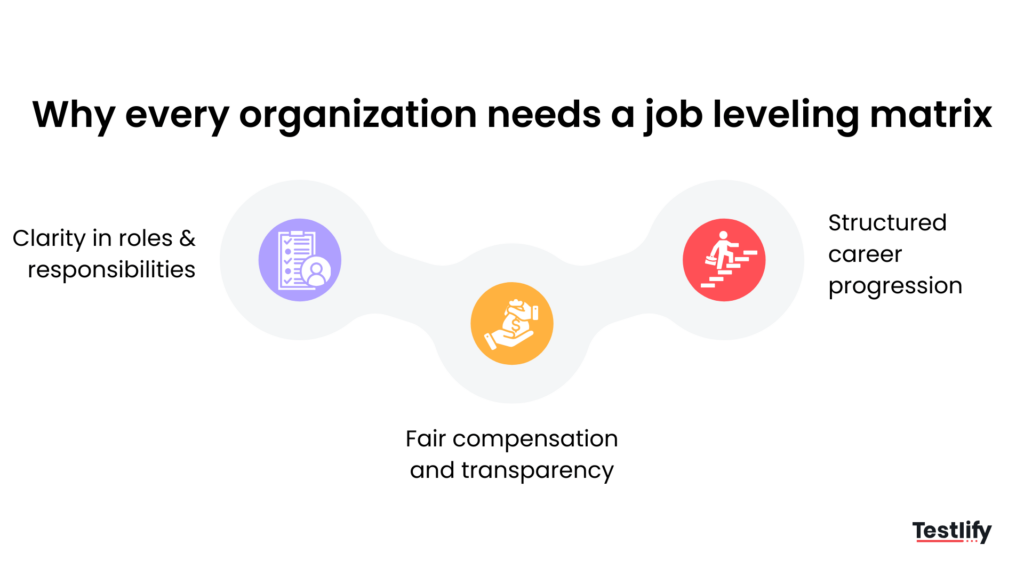
1. Clarity in roles and responsibilities
One of the biggest challenges organizations face is role confusion. Employees often aren’t sure where their responsibilities begin and end, or what’s expected of them as they advance.
How a matrix helps – A job leveling matrix provides crystal clear descriptions of what’s expected at each level within the organization.
Whether an employee is at an entry-level position or senior management, the matrix outlines their responsibilities, the skills they need, and what they should focus on to move up.
This clarity prevents misunderstandings and also empowers employees by giving them a clear roadmap for success.
2. Fair compensation and transparency
Fair pay is a cornerstone of employee satisfaction. A job leveling matrix ensures that compensation is directly tied to the skills and responsibilities of each level.
How a matrix helps – With a job leveling matrix, employees can see the salary range for their current level as well as the range for the next level up. This transparency helps them understand how their performance and skill development directly impact their pay.
Knowing that their compensation is fair and aligned with their contributions motivates employees to improve their skills and advance to higher pay grades.
3. Structured career progression
Without a clear path for career growth, employees can feel stuck, leading to disengagement and high turnover. A job leveling matrix plays a critical role in providing employees with a well-defined, structured career progression plan.
A well-structured job leveling system shows employees exactly what steps they need to take to move from one level to the next. This structured approach helps organizations retain top talent by keeping employees engaged and motivated.
How a matrix helps – With a job leveling matrix, employees can visualize their entire career path, from entry-level roles to senior positions.
The matrix outlines the specific skills and experience needed to progress, making the path forward more transparent and achievable. Employees know exactly what they need to work on.
Final thoughts
Job leveling matrix helps eliminate role confusion, aligns pay with responsibilities, and provides clear paths for advancement.
Through job leveling, companies can improve employee engagement and retention. When employees understand their role and how to progress, they are more likely to stay motivated and contribute to the organization’s success.
Integrating a job leveling matrix into your talent management strategy can help you create a more transparent workplace.
Job leveling: Frequently asked questions

B2B SaaS Content Writer
Rishav Kumar is a B2B SaaS content writer with 4 years of experience. He loves crafting engaging content. Always exploring fresh ideas, he's passionate about helping businesses grow through impactful writing.
LinkedInRelated resources
View all
HR & recruitment
Hire the best nursing talent with these 3 recruitment strategies

HR & recruitment
Finding the right fit when recruiting for high-demand healthcare roles

HR & recruitment
Strategies for nursing talent evaluation for stronger healthcare teams

HR & recruitment
Talent Density: How to Build a Team Like Netflix

HR & recruitment
Skill Will Matrix: A Manager’s Guide to 4 Quadrants

HR & recruitment
Pay transparency uncovered: What employers won’t say
Get started.
Hire on proof, not resumes.
Run your first skills-based assessment free — no credit card required.