
What is high-performance culture and how to build one?
Learn how to create and sustain a high-performance culture that boosts engagement, productivity, and innovation in your organization.

You must have probably heard the term “high-performance culture” being thrown around a lot. But what does it really mean? And, more importantly, how do you create one that drives real results for your organization?
Building a high-performance culture is no longer a luxury. A company culture where employees are motivated and engaged, yet consistently delivering at their best, can differentiate your organization from the competition. However, this is not just about good intentions; it takes strategic planning, the right mindset, and commitment across the entire organization.
In this blog, we’ll walk you through what a high-performance culture looks like, why it’s crucial for business success, and most importantly-how you can develop one in your own organization.
 ChatGPT
 Gemini
 Claude
 Grok
Grok Perplexity
What is a high-performance culture?
A high-performance culture is the kind of organization where employees deliver beyond their normal means to ensure both personal success and organizational accomplishment.
It’s not about producing a lot in less time or being a workaholic; it’s about being smart, having purpose, working in teams, and keeping one’s self on a high accountability standard.
Employees in a high-performance culture are encouraged to do their best for good work; they know their contributions are known, valued, and in concert with those of all other employees.
Why is a high-performance culture so important?
You may wonder, “What difference does a high-performance culture really make?” Let’s break it down.
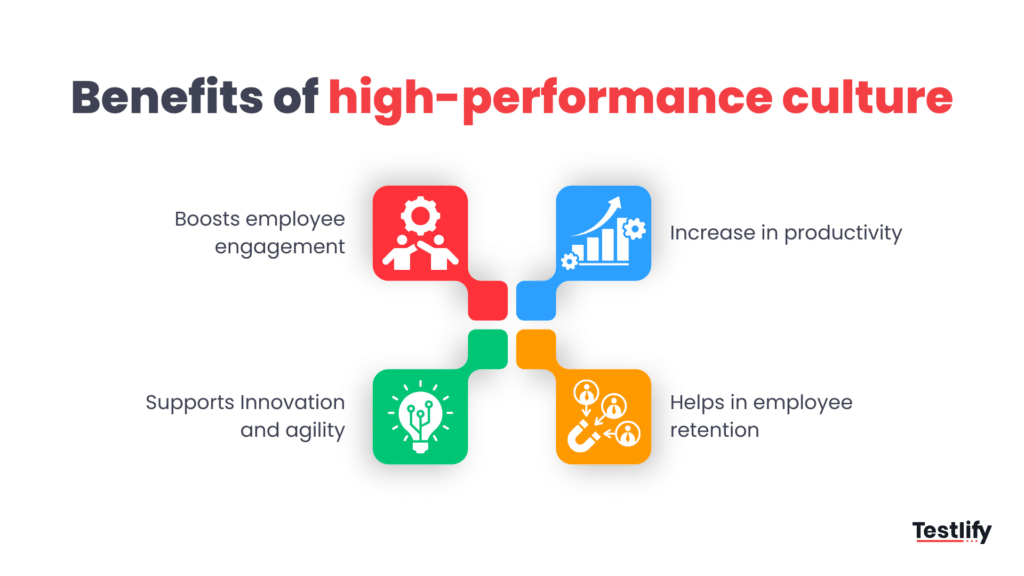
1. Higher employee engagement
According to Gallup report, 15% of global employees are engaged at work. Thus, a high-performance culture has the ability to flip the numbers around: create an environment that makes the people feel invested in, valued, and excited about adding value to their organization.
2. Increased productivity
Productivity shoots high in a performance culture because one knows what one is supposed to do and get results. McKinsey research shows that companies with higher engagement levels in employees are more profitable by 21% as well as exhibit 17% better productivity than comparable companies with relatively low engagement.
3. Innovation and agility
Innovative high-performance cultures thrive on innovation. As the employee gets empowered to experiment, fail, and learn, new ideas and solutions emerge at a faster rate. In fact, companies embracing innovation see revenue growth 30% higher than companies that do not, according to a PwC study.
4. Employee retention
One of the key issues in today’s job market is talent retention. According to Gallup, 52% of employees are currently looking for new job opportunities. This sets up strong resistance against this in a high-performance culture.
When employees feel connected to the company’s mission and appreciate what they have accomplished, they’re less likely to leave. Deloitte actually states an organization with strong cultures has 14 times more employee retention than those that have weak culture.
Clearly, a high-performance culture is crucial for achieving business success. But how do you create and maintain one?

How to build a high-performance culture
As an HR leader, you’re in the perfect position to nurture and build a high-performance culture within your organization. Here’s a step-by-step guide to help you get started.
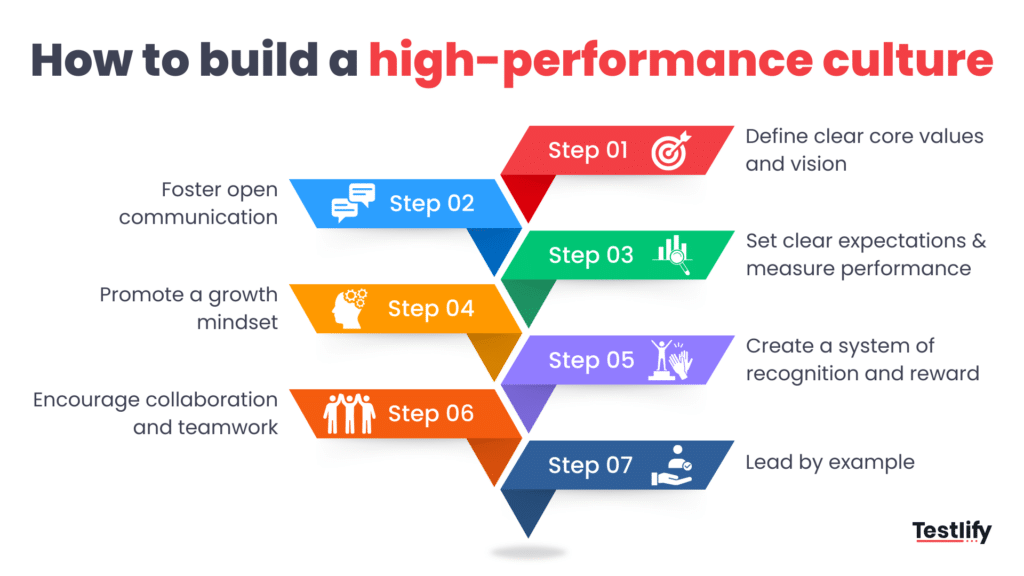
1. Define clear core values and vision
The first step to building a high-performance culture is to ensure that the entire organization understands its core values and vision. These elements serve as the foundation for every decision, behavior, and interaction within the company.
Employees who understand the company’s values and vision are far more likely to align their work with the organization’s goals. According to a study by Harvard Business Review, companies with clearly defined values and a strong vision experience 40% higher levels of employee engagement.
What you can do:
- Clarify the company’s mission and vision. These should be more than just statements on a website—they should reflect the essence of what your organization stands for and the long-term goals it’s striving to achieve.
- Identify key values. Core values like accountability, integrity, innovation, and collaboration should be clearly communicated and exemplified by leadership at all levels.
- Align everything to these values. From hiring practices to performance reviews, ensure that the company’s values are embedded in all aspects of your organization.
2. Foster open communication
Communication is critical in building a high-performance culture. Without open, transparent, and ongoing communication, employees may feel disconnected, uninformed, and disengaged.
A survey by McKinsey found that companies with transparent communication are 25% more likely to retain top talent and have 20% higher employee satisfaction. Clear communication in organization fosters trust, enables collaboration, and creates a sense of shared purpose.
What you can do:
- Leadership should communicate key company news and progress towards goals regularly—whether through newsletters, town halls, or informal check-ins.
- Make sure employees feel heard by creating channels for feedback, whether through surveys, one-on-one meetings, or team discussions.
- Leverage communication tools like Slack or Microsoft Teams to create a space where employees can share ideas, ask questions, and stay updated.
3. Set clear expectations and measure performance
Setting clear expectations and holding employees accountable for their performance is key to building a high-performance culture. When employees know what success looks like and are given the resources to succeed, they are far more likely to thrive.
According to a study by Gallup, employees who receive regular feedback are 3.5 times more likely to be engaged than those who don’t. Setting clear, achievable goals ensures everyone knows what they are working toward.
What you can do:
- Establish clear KPIs. Ensure that each role has clearly defined performance indicators (KPIs) that are aligned with broader company objectives.
- Use regular check-ins. Implement regular performance reviews to ensure employees are staying on track and feel supported. This could be quarterly or even monthly, depending on the role.
- Be transparent about expectations. Share how performance will be measured and how employees can achieve their goals.
4. Promote a growth mindset
A growth mindset is essential for a high-performance culture. It’s the belief that abilities and intelligence can be developed through hard work, learning, and dedication. Fostering this mindset creates a culture where employees are motivated to continuously improve.
Research by Carol Dweck, a psychologist at Stanford University, shows that employees with a growth mindset are more likely to embrace challenges, learn from feedback, and persist through setbacks, all of which contribute to high performance.
What you can do:
- Offer training programs, leadership development opportunities, and access to online courses to help employees expand their skill sets.
- Promote learning from failure. In a high-performance culture, mistakes should be viewed as opportunities to learn, not as setbacks.
- Recognize and reward employees for efforts to improve, even if the final result isn’t perfect.
5. Create a system of recognition and reward
Recognition is one of the most powerful tools in fostering a high-performance culture. Employees who feel appreciated are more likely to remain engaged and motivated.
According to Gallup, employees who are recognized on a regular basis are 5 times more likely to stay with their current employer. Recognition can come in many forms, from public praise to bonuses or promotions.
What you can do:
- Celebrate both big and small wins. Recognition doesn’t always have to be for major achievements—it can also be for everyday efforts that align with company values.
- Offer performance-based rewards. This could include bonuses, raises, extra time off, or professional development opportunities.
- Take the time to recognize employees in a way that resonates with them, whether through a handwritten note or a shout-out at a team meeting.
6. Encourage collaboration and teamwork
No organization is truly high-performing without strong teamwork. Collaboration fosters creativity, problem-solving, and innovation, which are all essential components of high performance.
A report by Salesforce found that 86% of employees and executives cite lack of collaboration as a major contributor to workplace failures. In high-performance cultures, collaboration is not just encouraged—it’s expected.
What you can do:
- Encourage employees to collaborate across departments and teams to solve problems and share ideas.
- Promote team-based goals. Create goals that require input and effort from multiple team members, rather than focusing solely on individual performance.
- Use collaborative tools to help teams work together seamlessly, even if they are in different locations.
7. Lead by example
Finally, leadership plays a critical role in shaping the culture of the organization. Leaders must model the behaviors and attitudes they want to see in their teams. If leaders aren’t fully committed to the culture, it’s unlikely that employees will be.
Leadership behaviors have the strongest correlation with employee engagement, more so than any other factor. Leaders set the tone for how employees behave and what they prioritize.
What you can do:
- Demonstrate commitment to the organization’s values, goals, and work ethic.
- Be transparent and approachable. Leaders should be open to feedback and willing to have honest conversations with their teams.
- Support your employees. Offer guidance, mentorship, and resources to help employees achieve their goals.
Conclusion
Building and sustaining a high-performance culture is not a quick fix—it’s an ongoing journey. With the right strategies in place, HR professionals can play a pivotal role in creating an environment where employees feel engaged, motivated, and empowered to do their best work.
By establishing clear values and goals, encouraging open communication, continuous learning, and the rewarding of high performance, you should be able to build a culture that helps to drive results not only for the employees but also for the entire organization.
High-performance culture is not about doing things faster or working harder. It is more about creating an environment where people thrive. And when people thrive, the whole organization thrives with them.
So, are you ready to start building a high-performance culture in your organization? The results will speak for themselves.
Frequently asked questions (FAQs)

Content Writer
Yashika Khandelwal is a Content Writer with 3+ years of experience creating research-backed content on hiring, talent assessment, and HR technology. She is a registered Organizational Psychologist and subject matter expert who combines behavioral science with practical recruitment insights to produce accurate, evidence-based content.
LinkedInRelated resources
View all
HR & recruitment
7 Proven strategies to combat workplace negativity today

HR & recruitment
What is a recruitment fair? (Tips for attending one)

HR & recruitment
Are T-shaped skills the future of hiring? Here’s why

HR & recruitment
Beyond clinical skills: using AI to assess soft skills in healthcare hiring

HR & recruitment
How to conduct a skills audit?

HR & recruitment
What is regretted attrition and how to reduce it?
Get started.
Hire on proof, not resumes.
Run your first skills-based assessment free — no credit card required.