
How can employers assess candidates’ clerical skills?
Assess clerical skills effectively with structured tests. Learn how to identify top talent and streamline hiring with Testlify’s AI-powered assessments.

How do you know if a clerical candidate is genuinely skilled or just good at writing resumes?
Clerical professionals are the backbone of any organization. They handle essential tasks like data entry, scheduling, document processing, and general administrative support. Without them, day-to-day operations might even slow down.
To find the right candidate for a clerical role, you must ensure they have the right skills, attention to detail, and ability to manage tasks efficiently.
Resumes and interviews alone won’t always reveal these abilities. That’s why recruiters use skill-based assessments to evaluate clerical candidates.
If your intentions include knowing the most essential clerical skills and the best ways to assess them, keep reading further!
 ChatGPT
 Gemini
 Claude
 Grok
Grok Perplexity
Why are clerical skills important?
Regardless of size or industry, every organization depends on clerical professionals to keep daily operations running smoothly. These employees handle essential tasks like data entry, document management, scheduling, and communication.
One of the biggest reasons clerical skills are so important is accuracy. A small mistake in data entry, scheduling, or record-keeping can lead to costly errors.
Clerical professionals also play a key role in time management and organization. They handle multiple responsibilities, and their ability to handle these tasks efficiently helps managers and executives to focus on more strategic work.
From corporate offices to healthcare, finance, and education, clerical staff are required in almost every industry. That’s why hiring candidates with strong clerical skills is crucial.

6 Key clerical skills employers should look for
Not everyone is cut out for clerical work. It requires a unique mix of technical ability and precision. Candidates might have years of experience, but if they lack the right skills, they can slow down workflows instead of improving them.
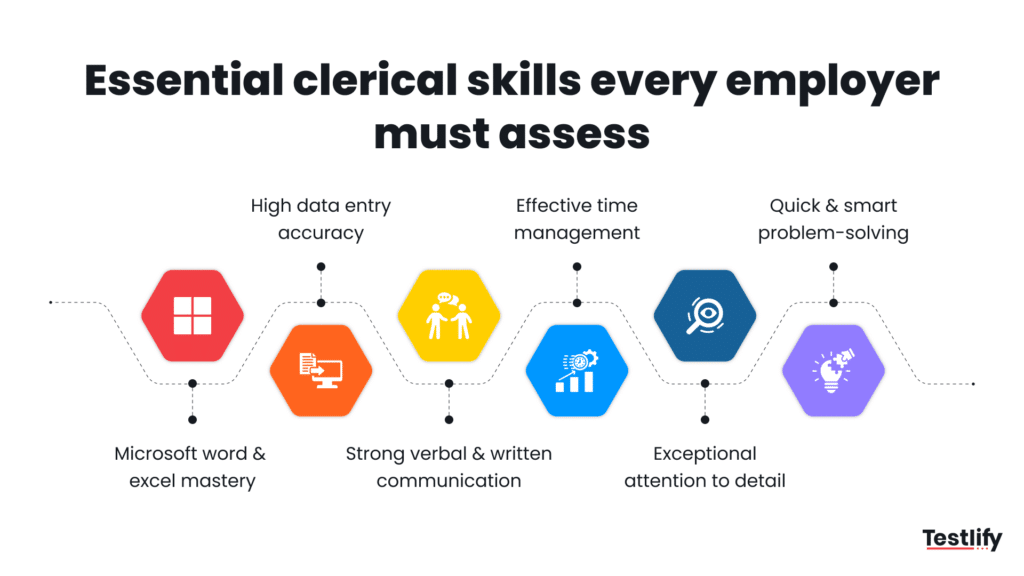
Below are the top clerical skills every employer should look for:
Microsoft Word & Excel proficiency
Most clerical tasks involve handling documents and spreadsheets. A good candidate should be comfortable creating and editing documents in Microsoft Word and working with data, formulas, and reports in Excel. They might not be the right fit if they struggle with basic formatting or spreadsheet functions.
Data entry accuracy
Clerical staff often deal with large volumes of data. It can be anything from entering records and updating databases to managing invoices. If any minor typo in financial or client records happens, it may result in costly errors.
Verbal and written communication
A clerical role isn’t just about paperwork. Candidates will interact with managers, clients, and teams through emails, reports, phone calls, and meetings. They must know how to express information clearly and professionally.
Time management
Clerical roles include various tasks such as answering calls, scheduling meetings, processing paperwork, and more.
Without strong organizational skills, things can easily slip through the cracks. The best candidates prioritize well and manage their workload efficiently without constant supervision.
Attention to detail
A misplaced decimal or an overlooked typo can create major issues. Clerical staff must be detail-oriented. They must know that documents, schedules, and records are accurate and error-free before they reach the managers or clients.
Problem-solving skills
No two days are the same in an office. Systems crash, files go missing, and last-minute scheduling conflicts happen. A strong clerical employee should not panic; they should know how to find solutions and keep things running smoothly.
Hiring someone with these skills ensures fewer errors, smoother workflows, and a more productive work environment. That’s why skill-based assessments are crucial to identifying top clerical talent before hiring.
How to identify candidates with strong clerical skills?
Many candidates claim to have clerical skills, but how do you separate the truly skilled from those who look good on paper? The key is assessing real abilities, not just experience. Here’s how you can do it:
Look beyond the resume
Anyone can list “strong organizational skills” or “proficient in Microsoft Excel,” but that doesn’t mean they can actually do the job.
Instead of just scanning resumes for keywords, look for real examples of their work. Did they manage office records efficiently? Did they handle high-volume data entry with accuracy? If the resume doesn’t give specifics, it’s a red flag.
Ask the right interview questions
Generic interview questions won’t reveal much. Instead, test their thinking process with real scenarios:
- “A manager needs you to book a meeting, but the schedule is packed. How do you handle it?”
- “You spot a mistake in an important report minutes before submission. What do you do?”
- “How do you prioritize when you have five urgent tasks at once?”
Good candidates will walk you through their approach clearly. If they struggle to explain, they might struggle on the job, too.
Use real-world skill tests
What is the best way to assess clerical skills? Put them to the test. Instead of relying on self-reported skills, have them complete practical exercises that match the job’s daily tasks. Below are some of the best ways to test clerical skills:
- Microsoft Word & Excel Test – Can they format a document? Use formulas in Excel? Create a report?
- Data Entry & Typing Test – Can they enter information quickly and accurately?
- Attention to Detail Test – Give them a document with errors. See if they spot them.
- Problem-Solving Test – How do they handle scheduling conflicts, missing documents, or last-minute changes?
These assessments don’t just show what they know—they show how they work under pressure.
The best way to assess clerical skills with Testlify
A resume might tell you that a candidate is “proficient in Microsoft Word and Excel,” but can they actually format a document correctly or organize spreadsheet data without errors? A great resume doesn’t always mean great skills.
The only way to be sure is through real-world skill assessments. Instead of relying on self-reported abilities, structured tests prove whether a candidate can handle tasks of a clerical role.
Testlify makes this process seamless by offering AI-powered clerical assessments. Testlify provides data-driven insights that help recruiters make smart and confident hiring choices.
Best tests to assess clerical candidates
1. Clerical aptitude test – This test measures a candidate’s logical reasoning and ability to handle administrative tasks efficiently. It helps employers evaluate whether a candidate can manage office workflows effectively.
2. Office clerk test – Designed for general clerical roles, this test evaluates a candidate’s administrative knowledge and ability to multitask under pressure. It ensures candidates can keep up with day-to-day office demands.
3. Administrative clerk test – A great administrative clerk must be able to prioritize tasks, manage schedules, and communicate effectively. This test evaluates their time management and coordination skills.
4. Data entry test – A data entry clerk assessment is a standardized test designed to evaluate a candidate’s ability to accurately and efficiently enter data into a system.
5. Typing Test – This test evaluates advanced grammar, punctuation, and capitalization skills.
6. Problem-solving test – Unexpected challenges arise in every clerical role. Whether it’s a scheduling conflict, a missing file, or an urgent request, this test evaluates how well a candidate thinks on their feet and finds solutions.
7. Microsoft Word test – From drafting reports to formatting official documents, clerical professionals must be proficient in Microsoft Word. This test assesses their ability to efficiently create, edit, and format documents.
8. Microsoft Excel test – Excel is a key tool for clerical work for data organization, calculations, and reporting. This test evaluates candidates’ ability to use formulas, sort data, and create structured spreadsheets.
9. Attention to detail (Visual) test – This assessment measures a candidate’s capacity for paying attention to visual information and details.
10 – Attention to detail (Textual) test – This test evaluates the ability to process information while maintaining textual detail.
Conclusion
Without strong clerical staff, businesses can face delays, errors, and disorganization that affect productivity.
The challenge, however, is identifying who can actually do the job. A polished resume might look good, but it doesn’t prove whether a candidate is actually holding the proper skills. That’s why skill-based assessments are essential.
Testlify makes this process effortless. Instead of relying on gut instinct, recruiters get data-backed insights that reveal a candidate’s strengths before they’re hired. That means faster hiring!
If you’re serious about hiring skilled, reliable, and detail-oriented clerical staff, it’s time to move beyond outdated hiring methods. Try Testlify today and make hiring decisions confidently.
Frequently asked questions (FAQs)

B2B SaaS Content Writer
Rishav Kumar is a B2B SaaS content writer with 4 years of experience. He loves crafting engaging content. Always exploring fresh ideas, he's passionate about helping businesses grow through impactful writing.
LinkedInRelated resources
View all
HR & recruitment
Types of interviews: A complete HR guide

HR & recruitment
Job characteristics model 101: A complete guide

HR & recruitment
9 HR models every HR professional must know in 2026

HR & recruitment
What Is a Projective Assessment? Types, Uses, and Reliability in Hiring (2026)

HR & recruitment
What are personality hires and signs you might be making one

HR & recruitment
Accurate Staffing: How to Improve Hiring Accuracy and Avoid Costly Bad Hires
Get started.
Hire on proof, not resumes.
Run your first skills-based assessment free — no credit card required.