
Enterprise guide: Centralized vs decentralized recruitment
Discover which hiring model fits your enterprise best. Compare cost, speed, strategy, and scalability.

Centralized recruitment puts one team in charge of hiring for the entire company. Decentralized recruitment hands that job to each department, branch or region. Almost every company that runs more than one location ends up somewhere between the two, so the useful question is not which model wins. It is which hiring decisions belong in the middle, and which belong at the edge.
That question has a right answer, and it is not the same answer for policy as it is for people. Get the split wrong and you either slow down every local hire waiting for head office, or you wake up with nine versions of the same interview process and no idea which one works.
TL;DR
- Centralized recruitment means one team owns the process, the tools and the standards. Decentralized means each business unit runs its own hiring.
- Centralized is the more common setup: 52% of employers in North America ran a centralized talent acquisition model in 2023, against 19% decentralized.
- Decentralized hiring is growing fast, up 73% in a year, because local labour markets have stopped moving in step with each other.
- Cost favours the centre. Speed and local fit favour the edge. Neither advantage survives if the other side is run badly.
- The split that works: centralize the standard (what good looks like, how candidates are evidenced, what the law requires), devolve the decision (who to hire, how fast, in which market).
 ChatGPT
 Gemini
 Claude
 Grok
Grok Perplexity
What is centralized recruitment?
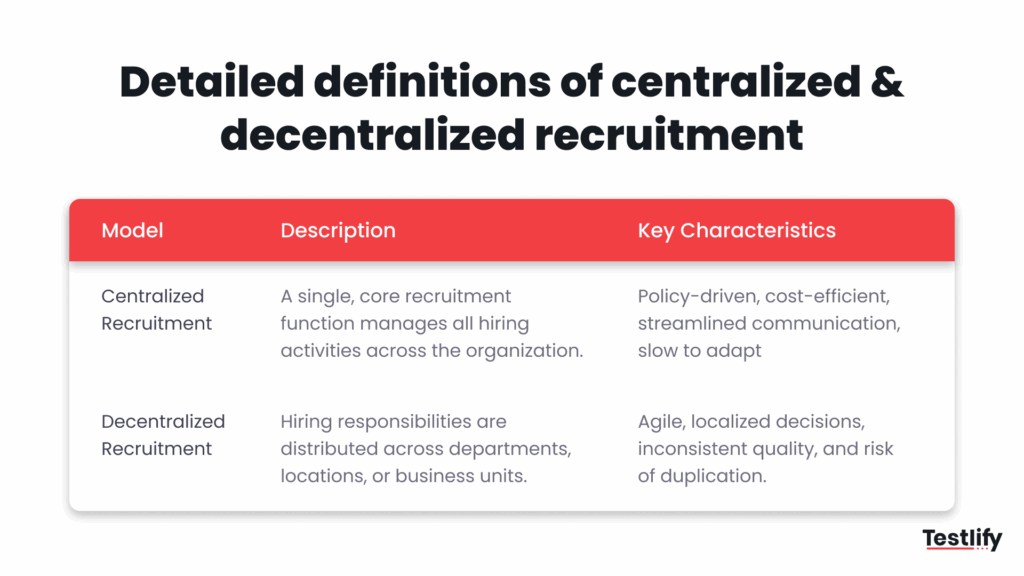
Centralized recruitment is a hiring structure where one team, usually corporate HR or a central talent acquisition function, owns recruitment for the whole organization. That team controls the job templates, the screening steps, the tools, the vendor contracts and the final process standards, and every business unit hires through it.
It is the most common shape by some distance. In the 2023 CandE benchmark research, 52% of participating North American employers ran a centralized model, 19% ran a decentralized one, 3% outsourced, and a further 25% ran a blend of central plus outsourced or devolved plus outsourced. Across Europe, the Middle East and Africa the picture is flatter: centralized and decentralized were tied at 33% each.
What the centre buys you is comparability. When every candidate for a customer support role goes through the same assessment and the same scoring, a hiring manager in Manchester and one in Manila are looking at the same evidence. That is also what makes the process defensible when someone asks why one candidate advanced and another did not.

What is decentralized recruitment?
Decentralized recruitment moves hiring authority out to individual departments, local managers or regional teams. Each unit sources, screens, interviews and decides on its own, usually against its own headcount budget, without routing approvals through a central function.
The case for it is not that head office is incompetent. It is that hiring conditions genuinely differ by place, and the people closest to a market read it faster than a dashboard does.
Decentralized recruiting: who actually owns what
In practice, devolved hiring rarely means the centre disappears. It means the local team owns the shortlist, the interview loop and the offer, while someone at the centre still owns the employment contract templates and the payroll consequences. The failure mode is leaving that boundary undefined, so both sides assume the other is handling background checks.
Accountability is the real prize. When the manager who will live with the hire also picks the hire, quality stops being someone else's KPI.
Decentralized staffing models across multiple sites
Multi-site employers, retail chains, construction firms, agency networks and clinic groups, tend to devolve furthest, because a site that cannot fill a shift this week has a different problem from a head office filling a role this quarter. The tradeoff shows up in the data layer: nine sites hiring independently produce nine spreadsheets, and nobody can answer which of them is actually good at hiring.
Centralized vs decentralized recruitment: key differences
Here is how the two models compare across the dimensions that decide the argument in most companies.
Dimension | Centralized recruitment | Decentralized recruitment |
|---|---|---|
Speed of hiring | Slower for urgent or niche roles. Every request joins one queue. | Faster. Local managers act on what their team needs this week. |
Process control | High. One workflow, one set of steps, applied everywhere. | Varies by unit. Flexible, harder to see and harder to audit. |
Cost per hire | Lower. Shared tools, bulk vendor rates, fewer duplicated seats. | Higher. Duplicate tool licences and separate agency contracts. |
Employer branding | Consistent messaging at every touchpoint. | Drifts by location, which weakens brand recall at scale. |
Candidate experience | Predictable, but can read as impersonal in smaller markets. | Personal and locally relevant, though quality swings widely. |
Hiring autonomy | Limited. Business units request rather than decide. | Full. The unit owns its own hiring strategy. |
Compliance and oversight | Easier. One policy to update when the law changes. | Risky. Local practice drifts away from written policy. |
Local market fit | Rigid. One template rarely fits every labour market. | Strong. Pay, sourcing and timing adapt to the local market. |
Data and analytics | One pipeline, so benchmarking across units is possible. | Fragmented. Enterprise-wide reporting is guesswork. |
Scalability | Good for repeating a proven model in similar markets. | Good for entering new or unpredictable geographies. |
Read the table as a set of trades rather than a scoreboard. Centralization buys consistency and pays for it in speed. Devolution buys speed and pays for it in visibility.
Which model costs less to run?
Centralized recruitment is usually cheaper per hire, because cost in recruiting is mostly fixed cost that has been duplicated. One assessment platform beats five. One negotiated agency rate beats nine local ones. One team that has run the process 400 times beats forty managers who have each run it ten.
The cost that centralization does not remove is the cost of an empty seat. A role that stays open an extra three weeks because it is queued behind head office priorities costs real revenue in a sales territory or a clinic, and that cost never appears in the recruiting budget. It appears in the operating one, which is exactly why the two sides of this argument never see the same numbers.
Cost category | Centralized | Decentralized |
|---|---|---|
Technology | Shared assessment and tracking tools, one licence pool. | Each unit buys its own, so spend duplicates quietly. |
Recruiter headcount | Fewer people, higher specialisation per requisition. | More partial recruiters spread thin across units. |
Agency and vendor spend | Bulk contracts negotiated once at group rates. | Many small contracts at retail rates. |
Job advertising | Pooled budget, better placement and better tracking. | Scattered spend, weak attribution. |
Training the hiring team | One curriculum, delivered once. | Repeated per unit, and inconsistently. |
Compliance exposure | Lower. Policy changes land everywhere at once. | Higher. Local practice can drift into real legal risk. |
Cost of a vacancy | Higher. Longer queues mean longer open roles. | Lower. Local hires close faster. |
Pro tip: before you restructure anything, price one vacancy in your highest-revenue location for one extra week. If that number is larger than the tooling you would save by centralizing, you have just found your answer, and it is not the answer the procurement spreadsheet gives.
When does centralized hiring work best?
Centralized hiring works best when roles repeat, standards matter more than speed, and the cost of an inconsistent decision is high. Think regulated industries, high-volume roles with one job profile, graduate intakes, and any organization where one bad hiring practice in one office becomes a company-wide legal problem.
It suits you if most of these are true:
- You hire the same handful of role types repeatedly, across locations.
- You are in a regulated sector where hiring decisions must be evidenced and defended.
- Your employer brand is a real asset and inconsistency damages it.
- Central HR already owns policy, so hiring is the outlier.
- You need to compare quality of hire across units and currently cannot.
Centralized talent acquisition at scale
Once a centralized talent acquisition function passes a few hundred hires a year, its advantage stops being cost and becomes learning. The same team sees which assessment predicts performance in a role, which interview question adds nothing, and which source produces people who stay. A devolved structure collects the same experience and then loses it, because it never lands in one place. This is the strongest argument for the centre that rarely gets made, and it compounds every year.
When does decentralized hiring win?
Decentralized hiring wins when local conditions vary more than the role does. Labour markets have stopped behaving as one national market: as of 31 October 2025, Indeed Hiring Lab measured an average job postings index of 98.6 across the largest US metro areas, against 112.0 in mid-size metros and 115.5 in small ones.
Pay diverges the same way. US county employment and wage data put the national average weekly wage at $1,654 in the first quarter of 2026, up 3.9% on the year, but employment grew in only 151 of the 376 largest counties. Half the country was hiring and half was not. A single national pay band and one sourcing playbook cannot be right in both halves at once.
So devolve when:
- Roles and required skills differ meaningfully by site.
- Speed decides whether you get the candidate at all.
- Local language, culture or regulation shapes the interview.
- Business units carry their own growth targets and headcount.
- Your locations sit in labour markets that move independently.
The caveat nobody writes down: devolution works when local managers are good at hiring. If they are not, you have not distributed authority, you have distributed the guesswork. Fix the evidence first, then move the decision.
Should you centralize job descriptions?
Yes, but only the skeleton. Centralize job descriptions at the level of the role: title, level, the competencies the role requires, how those competencies get assessed, and the legally required content. Let local teams own the parts that are genuinely local, which is pay range, location detail, shift pattern and the language the advert is written in.
This is not a style preference. Under the EU pay transparency directive, Article 5(2) states that "an employer shall not ask applicants about their pay history during their current or previous employment relationships", and applicants must be told the initial pay or its range before the interview. A rule like that lands in the job description and the screening script, in one country and not another. Centralizing the template is how you make sure the right version reaches the right market, and devolving the pay line is how you keep it accurate.
Standardized job descriptions also do quiet work downstream. If two sites describe the same role differently, their hiring data cannot be compared, and every "which location hires best" question turns into an argument about definitions.
How does a hybrid model actually work?
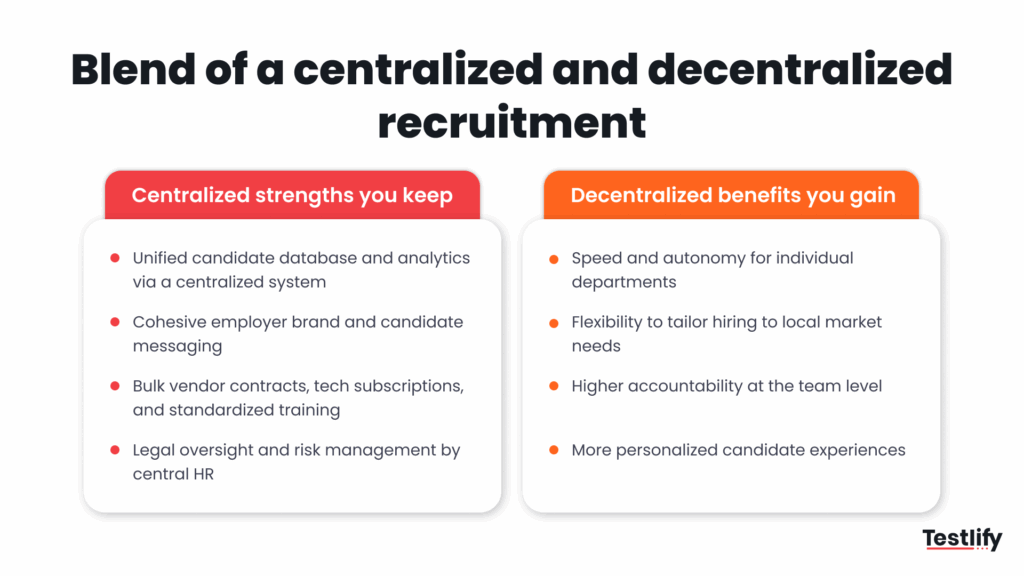
A hybrid model centralizes the standard and devolves the decision. The centre defines what a good hire looks like, how candidates are measured and what must legally happen. Local teams decide who to hire, when, and how quickly, using that shared evidence.
The reason hybrid keeps winning arguments is that hiring demand has not gone away and has not gotten easier to forecast. The US Bureau of Labor Statistics counted 7.3 million job openings and 5.1 million hires in July 2026. At that volume, a pure centre becomes a queue and a pure edge becomes chaos.
The Testlify Hiring Workflow Method is the version of this we use with customers: define role competencies once, assess against them consistently, verify the integrity of the result, collect structured reviewer feedback, sync the outcome into whatever system of record the business already runs, and keep the hiring decision with an accountable human. The standard travels. The judgement stays local.
In practice the split looks like this:
- Centre owns: role competency maps, assessment design, scoring thresholds, compliance rules, vendor contracts, reporting definitions.
- Local owns: sourcing channels, interview scheduling, pay within band, the hire or no-hire call, start date.
- Shared: the candidate record, the evidence behind each decision, and the quality-of-hire data that comes back afterwards.
A useful rule of thumb: if a decision affects whether two candidates are treated the same, it belongs at the centre. If it affects how quickly one candidate gets an answer, it belongs locally. Most disputes resolve cleanly against that test, and the ones that do not are usually about budget rather than hiring.
How Testlify supports both models
A hybrid model only holds together if every location is producing evidence that means the same thing. That is the specific job Testlify does, and it is worth being precise about how.
One standard, applied everywhere. A role-based skills assessment built once can be sent by any site, with the same questions, the same weighting and the same scoring rules. Question banks can be fixed, so every candidate sees the same set, or variable, so the platform draws unused questions from a larger pool. Real-time translation lets a candidate answer in their preferred language without the centre losing comparability.
Local speed without a scheduling bottleneck. One-way and two-way conversational AI video and voice interviews run on the candidate's clock, with configurable attempts, preparation time, recording limits and automatic multilingual transcripts. AI scores open answers and flags strengths and gaps, and a human reviewer can override any of it. Testlify ships that disclaimer in the product: AI scores and insights are for guidance only, and the final decision stays with your team.
One reporting layer instead of nine spreadsheets. Recruiters get percentile ranks and candidate comparisons, plus item-level statistics on the questions themselves, including difficulty and discrimination indices and a quality-risk flag for questions that are not working. That is how a central team finally answers which location hires well, rather than which location argues best.
It fits the stack you already run. If your business already uses an applicant tracking system, Testlify plugs in as the screening and interviewing layer and leaves that system as the record, across 100+ ATS integrations. Teams with no tracking system at all get a simple built-in pipeline: post the job, take applications, move candidates from applied to reviewed to shortlisted. It is deliberately basic, and it is meant for the company that does not want to buy two tools.
Where centralization tends to break is hiring velocity, and where devolution breaks is consistency. Fixing the second is what makes the first affordable.
Ready to see whether a shared evidence layer would hold your locations together? Book a demo and walk through a live assessment with your own role, or start a free trial and build one yourself. No credit card needed.
Key takeaways
- The model is a split, not a choice. Very few companies run a pure version of either. Deciding which specific decisions sit centrally is more useful than picking a label, because the label does not tell a regional manager what they are allowed to do on Monday.
- Centralized is still the default, but it is losing ground. 52% of North American employers ran a centralized model in 2023 against 19% decentralized, yet the decentralized share grew 73% in a year. If your structure has not been revisited since before that shift, it is worth reopening.
- Cost arguments are usually incomplete. Centralization saves tooling, vendor and training spend, which is visible. Devolution saves vacancy cost, which is invisible to the recruiting budget and lands in operations. Compare both or the decision is decided by whoever owns the spreadsheet.
- Local markets have genuinely diverged. Job postings ran higher in small US metros than in the largest ones in late 2025, and wage growth in early 2026 was concentrated in under half of the biggest counties. One national playbook cannot fit markets moving in opposite directions.
- Compliance forces the policy layer central. Rules like the EU ban on asking candidates about pay history apply per country and change the job advert and the screening script. That belongs in a template someone owns, not in each manager's habits.
- Devolve the decision only after you have fixed the evidence. Handing hiring authority to a manager with no structured assessment does not decentralize judgement, it decentralizes guessing. Standard evidence first, local authority second.
- The test that settles most arguments: if a decision affects whether two candidates are treated the same, centralize it. If it only affects how fast one candidate hears back, push it local.
FAQs

B2B SaaS Content Writer
Rishav Kumar is a B2B SaaS content writer with 4 years of experience. He loves crafting engaging content. Always exploring fresh ideas, he's passionate about helping businesses grow through impactful writing.
LinkedInRelated resources
View all
HR & recruitment
How to stand out in a competitive talent market

HR & recruitment
How image-to-video AI is transforming HR communication

HR & recruitment
Speed vs accuracy in enterprise hiring funnel

HR & recruitment
How to build a recruitment tech stack that works at enterprise scale

HR & recruitment
How to hire startup web app development company

HR & recruitment
How small businesses can use scheduling software to attract top talent
Get started.
Hire on proof, not resumes.
Run your first skills-based assessment free — no credit card required.