
Global hiring insights: Key strategies for success
Master global hiring with insights on compliance, tools, and strategy to build a diverse, high-performing international workforce.

Recruiting the best talent around the world is not only a trend, but it’s quickly becoming a requirement for organizations seeking to grow, innovate, and remain competitive.
As an HR professional, you already have your hands full with workforce planning, compliance, talent engagement, and employer branding. Introducing global hiring into the mix might feel like too much, but with the right information, it doesn’t have to be.
This blog takes you through everything you must know about global hiring, from learning the why to the how, and what to look out for along the way.
 ChatGPT
 Gemini
 Claude
 Grok
Grok Perplexity
Why does global hiring matter?
Gone are the days when you used to depend entirely on your local talent pool. With remote work being common and digital infrastructure growing around the world, you can now access the best available talent from virtually anywhere around the globe.
Hiring globally can give your organization a distinct edge:
- Diverse perspectives = more innovation
- Follow-the-sun productivity = 24/7 operations
- Cost optimization = hiring in countries with lower living costs without compromising talent quality
In most parts of the world, particularly in specialized and technology fields, local talent pools are evaporating. Broadening your hiring pool worldwide can assist in plugging troublesome skill gaps quicker and more effectively.

Understanding the global hiring landscape
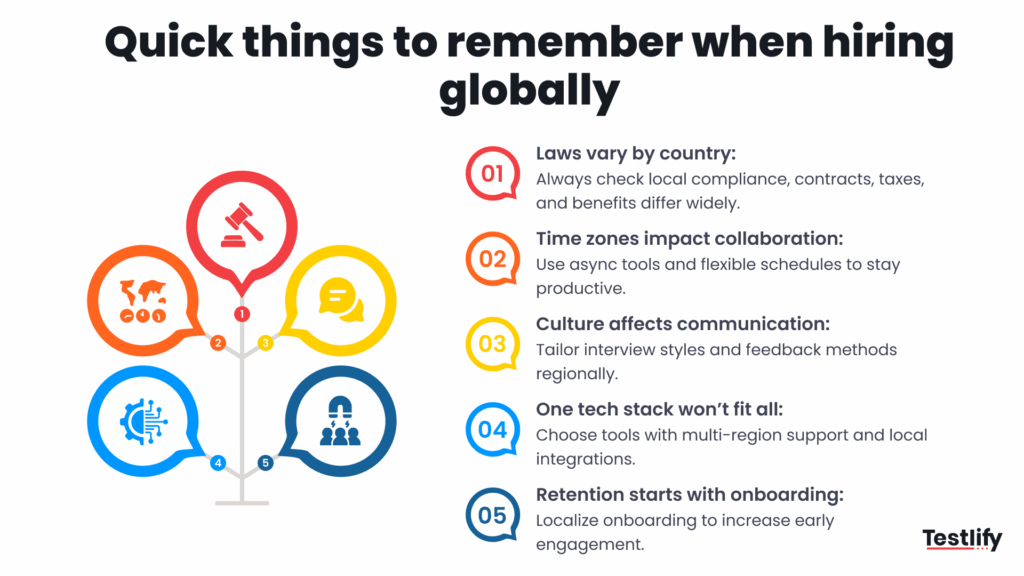
Each country has unique employment laws, cultural norms, and talent expectations that can shape your global hiring approach.
It’s not one-size-fits-all
Each country comes with its own labor laws, cultural expectations, payroll systems, and tax requirements. What works in Germany may not fly in Brazil, and what’s standard in the U.S. may be illegal in Japan.
Employer of record (EOR) vs. Entity setup
You typically have two ways to hire globally:
- Setting up a legal entity in the target country gives you full control but requires more time, money, and legal legwork.
- Use an Employer of Record (EOR), a third-party service that hires on your behalf and handles compliance, payroll, and benefits.
Local hiring trends and regulations
Some key insights to keep in mind:
- Europe: Strong labor protections; expect structured contracts and generous benefits.
- Asia-Pacific: High competition in tech hubs like Singapore and India; also, cultural nuances are critical in negotiation.
- Latin America: Favorable cost structures but often more complex labor laws.
- North America: High wage expectations, but also a massive, skilled workforce.
Building a global hiring strategy
A successful global hiring initiative starts with a clear, business-aligned strategy. From selecting target countries to budgeting for international operations, strategic planning helps ensure your hiring efforts are effective and sustainable.
Start with your business goals
Are you expanding into new markets? Looking to reduce operational costs? Trying to build around-the-clock support? Your global hiring approach should be directly tied to your broader company goals.
Identify target countries
Some factors to consider when choosing where to hire:
- Talent availability
- Cost of labor
- Time zones
- Legal complexity
- Language barriers
Budget for global hiring
Global hiring isn’t just about salaries. You’ll also need to factor in:
- Compliance costs
- Local benefits (which can be mandatory)
- Tools for communication and collaboration
- Currency exchange rates
Navigating compliance and legal frameworks
Compliance is non-negotiable in global hiring. Labor laws, tax obligations, and employment contracts vary worldwide, and understanding these legal frameworks is key to avoiding costly penalties and maintaining operational integrity.
Work visas and permits
If you’re relocating employees or hiring in-country nationals, visa requirements vary dramatically by country. Always check local immigration laws before making any decisions.
Options for work visas
Work visas vary by country, but most fall into a few main categories:
- Talent or Extraordinary Ability Visas: For individuals recognized for unique expertise, including the U.S. O-1 visa, U.K. Global Talent Visa, or Canada Start-Up Visa.
- Employer-Sponsored Visas: For skilled professionals supported by a local employer, such as the U.S. H-1B visa, U.K. Skilled Worker Visa, or Australia TSS (Subclass 482).
- Intra-Company Transfer Visas: For employees moving within global organizations, like the U.S. L-1 visa, Canada ICT, or EU ICT Permit.
- Digital Nomad Visas: For remote employees working for foreign companies while living abroad, such as those offered by Portugal, Estonia, and Costa Rica.
Each visa type has different eligibility criteria, timelines, and renewal rules, so always make sure to check the requirements or consult an Employer of Record before hiring internationally.
Employment contracts
These are not optional. Every country has its own rules about:
- Termination clauses
- Probation periods
- Non-compete agreements
- Working hours
Always work with local legal counsel or a trusted global hiring partner.
Payroll, taxation, and social contributions
This is often where things get tricky. Here’s why:
- You might be liable for taxes in the employee’s country.
- There are mandatory social contributions (e.g., pensions, health insurance).
- Currency fluctuation can impact net pay.
Many companies use global payroll platforms or partner with EOR providers to simplify this.
Tools and technology for global hiring
The correct technology stack can be the difference between success and failure in global hiring. From applicant tracking systems to payroll platforms, scalable investments in tools simplify hiring, enhance candidate experience, and facilitate compliance.
Skills assessments
Skills testing tools help you assess candidates objectively, particularly when hiring internationally, where resumes and education levels differ. You can test technical, cognitive, or job-specific skills in real time or asynchronously with talent assessment tools like Testlify. Such tools help you hire for ability, not credentials, and cut down on unconscious bias.
Applicant Tracking Systems (ATS)
An effective ATS is the backbone of global hiring. It helps streamline candidate management across time zones and geographies. Look for:
- Multi-language support
- Integration with local job boards
- GDPR compliance
Video interviewing platforms
During borderless hiring, video interviewing software is key to timely, accessible candidate evaluations. Testlify supports video interviews, eliminating scheduling conflicts and allowing structured evaluation. These products improve candidate experience while providing recruitment teams with increased flexibility and scope.
Collaboration and productivity tools
You’ll need a stack of tools to support remote global teams:
- Slack, Teams (communication)
- Notion, Confluence (documentation)
- Jira, Trello, Asana (project management)
Global payroll and compliance solutions
It can be intricate to manage payroll and compliance in different countries, but technology providers make this easy. They do everything from onboarding to taxes, benefits, and pay slips in local formats, all through a single platform. These technologies maintain precision, eliminate risk, and make global HR operations considerably more efficient.
Cultural sensitivity in global hiring
Cross-cultural recruitment is about interacting with different cultures, languages, and communication styles. Being culturally sensitive not only enhances candidate interactions but also forms the basis for diverse, high-performing teams.
Language and communication styles
Even when the working language is English, tone and clarity are important. What is polite or assertive in one culture won’t always translate in another.
Interview expectations
In some countries, there is an expectation for a formal process, while in others, a more informal style is preferred. Ensure your recruiters are culturally aware.
Holidays and work norms
Be aware of local holidays, time off expectations, and attitudes toward work-life balance. For example:
- France: Expect long summer breaks.
- China: Be ready for week-long shutdowns during the Chinese New Year.
- Middle East: Friday and Saturday may be the weekend, not Saturday-Sunday.
Building a strong global employer brand
Your employer brand speaks volumes to candidates, especially in unfamiliar markets. Showcasing your values, culture, and commitment to diversity helps attract top talent and build trust across borders.
Candidates across the world research companies thoroughly. A strong employer brand helps you attract top talent in competitive markets.
Tips to build your global brand
- Localize your careers page to offer multiple language versions.
- Highlight diversity, showcase your commitment to inclusion.
- Use employee testimonials from various regions.
- Engage on regional platforms.
Onboarding and retention in a global context
A strong onboarding experience sets the tone for long-term success. Tailoring onboarding processes to different regions and focusing on continuous engagement are key to retaining international talent.
Tailored onboarding
The first 90 days are critical. A globally distributed team needs:
- Virtual onboarding sessions
- Country-specific compliance documentation
- A buddy system or mentorship program
Building culture across borders
Create rituals and routines that unite the team:
- Virtual town halls
- Cross-border team projects
- Global recognition programs
Monitor retention and engagement
Use pulse surveys, feedback tools, and regular 1-on-1s to check how international hires are doing. Early attrition often comes from a lack of connection or misalignment with company values.
Common mistakes to avoid when hiring globally
Even experienced HR teams can get it wrong while recruiting internationally. Knowing common mistakes, such as overlooking compliance, underestimating cultural differences, or ignoring remote teams, is what allows you to create smarter, more powerful recruitment systems.
Overlooking compliance
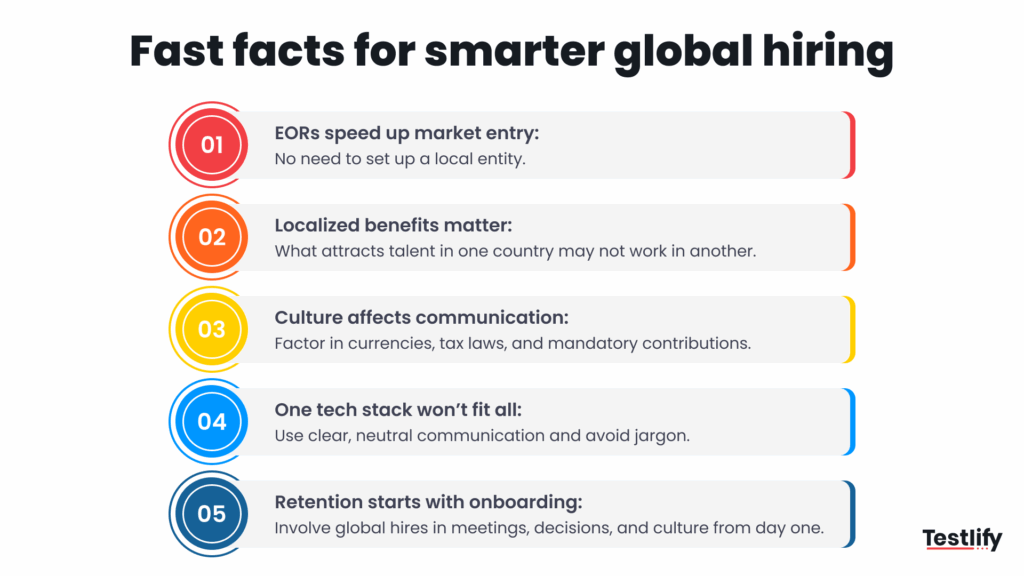
One of the most common errors is misclassifying workers or forgetting about local labor regulations. Payment of overseas contractors without registering in the country may lead to heavy monetary fines, legal suits, or even being excluded from conducting business there. Always hire professional native-language experts or employ a compliant talent solution such as an Employer of Record (EOR) to be on the safe side.
Ignoring time zones
Scheduling project deadlines or meetings strictly based on your own time zone might look efficient, but it usually causes friction and resentment among remote teams. It can destroy work-life balance and make the team members feel left out. Make use of shared calendars, staggered schedules, or asynchronous workflows to allow for equitable collaboration across time zones.
Poor communication
Global teams are completely dependent on transparent, timely, and clear communication. Without documentation methods, centralized resources, and asynchronous communication tools, pertinent information is lost.
This creates disengagement, missed deadlines, and confusion. Set strong communication methods and utilize platforms that include documentation and knowledge sharing to ensure everyone is on the same page.
Treating global teams as afterthoughts
Remote global employees tend to feel isolated when they are not engaged in decision-making or team-building initiatives. This isolation can result in low participation and high turnover.
Engage global teams as a part of your workforce by engaging them in culture-building activities, providing growth opportunities, and acknowledging their contributions on a regular basis.
Future of global hiring
Worldwide hiring is changing fast, fueled by AI, remote working, and changing workforce expectations. Keeping ahead of trends enables HR leaders to future-proof their own hiring processes and secure world-class talent.
AI and global recruiting
Artificial intelligence is transforming the way businesses hire internationally by automating candidate matching, screening, and sourcing. AI can cut time-to-hire significantly and enhance the quality of talent.
But it’s important to apply these technologies responsiblymaking sure they are unbiased, transparent in decision-making processes, and fully compliant with global data protection and labor laws.
Recommended reading: Why remote companies are leaning on AI interviews for global hiring
Rise of global benefits platforms
With the workforce more distributed than ever, businesses are turning towards integrated global benefits solutions. These systems allow for the standardization of offerings such as health coverage, retirement, wellness initiatives, and learning allowances across borders.
This allows businesses to provide equal benefits no matter where employees are located, improving retention and making them more appealing to top talent from around the world.
Flexible work equals flexible locations
The future of international recruitment is based on flexibility. Employees are increasingly demanding the mobility to work from anywhere, whether from their home country, while abroad, or during relocations.
Underpinning this flexibility with appropriate infrastructure and policy supports companies in securing high-performing professionals who value work-life balance, independence, and autonomy at work.
Final thoughts
Global recruitment can seem daunting, but it’s also a chance to transform your workforce and tap into the world’s best talent wherever they are.
By connecting recruitment activity with business strategy, maintaining compliance, leveraging technology, and crafting a vibrant cross-border culture, HR leaders can spearhead the development of truly global organizations.
So whether you’re just exploring the idea of global hiring or already knee-deep in international expansion, remember: the world isn’t just your oyster’s your talent pipeline.
Frequently asked questions (FAQs)

Content Writer
Yashika Khandelwal is a Content Writer with 3+ years of experience creating research-backed content on hiring, talent assessment, and HR technology. She is a registered Organizational Psychologist and subject matter expert who combines behavioral science with practical recruitment insights to produce accurate, evidence-based content.
LinkedInRelated resources
View all
HR & recruitment
How to operationalize DEI in the enterprise recruitment funnel

HR & recruitment
Building a global interview infrastructure

HR & recruitment
Breaking hiring silos: Aligning TA with L&D and DEI

HR & recruitment
How to build a recruitment center of excellence (CoE)?

HR & recruitment
Seasonal and project-based hiring: Playbook for volume flexibility

HR & recruitment
Why Employer Value Proposition (EVP) is your talent magnet in 2026?
Get started.
Hire on proof, not resumes.
Run your first skills-based assessment free — no credit card required.