Demo
Demo
 +1 (844) 755 8378
 Contact


Hiring in 2026 is very different from what it was even a few years ago. Roles are evolving faster, skills have shorter shelf lives, and resumes alone no longer tell the full story. That’s where aptitude tests come in.
For HR professionals and recruiters, aptitude tests have become one of the most reliable ways to predict job success, reduce bias, and make confident hiring decisions. But with new tools, AI-driven assessments, and changing candidate expectations, it’s important to understand how aptitude testing is evolving.
This guide is written for HR teams who want clarity, not jargon. We’ll walk through what aptitude tests are, why they matter in 2026, how to use them effectively, and what to avoid. Think of this as your practical, no-nonsense handbook.
Summarise this post with:
 Chatgpt
 Perplexity
 Gemini
 Grok
Grok Claude
What are aptitude tests?
Aptitude tests are structured assessments designed to measure a candidate’s ability to perform specific types of tasks. Unlike knowledge tests, which assess what someone already knows, aptitude tests focus on potential.
In simple terms:
- Knowledge tests ask: What do you know right now?
- Aptitude tests ask: How quickly and effectively can you learn or solve problems?
That’s why aptitude tests are especially useful when:
- Hiring fresh graduates
- Recruiting for roles with steep learning curves
- Evaluating candidates from diverse backgrounds

Why aptitude tests matter more than ever in 2026?
With resumes becoming less reliable and skills changing rapidly, aptitude tests help recruiters focus on potential rather than past experience. In 2026, role of aptitude tests in making fair, data-backed hiring decisions.
The resume is no longer enough
In 2026, resumes are:
- Heavily optimized for keywords
- Often AI-generated or enhanced
- Less reliable as predictors of performance
Aptitude tests cut through the noise by showing how candidates think, not just how they present themselves.
Skills are changing faster than job titles
Many roles today didn’t exist five years ago. Aptitude tests help recruiters assess adaptability, reasoning, and learning ability, which are far more future-proof than static skills.
Remote and hybrid hiring is the norm
With distributed teams, recruiters need objective tools to fairly evaluate candidates across locations. Aptitude tests provide consistent, standardized measurement, regardless of geography.
DEI and fair hiring are business priorities
When designed and used correctly, aptitude tests can:
- Reduce unconscious bias
- Focus decisions on ability, not background
- Support equitable hiring practices
Aptitude tests vs skills tests: What’s the difference?
This is a common question in HR teams, so let’s simplify it.
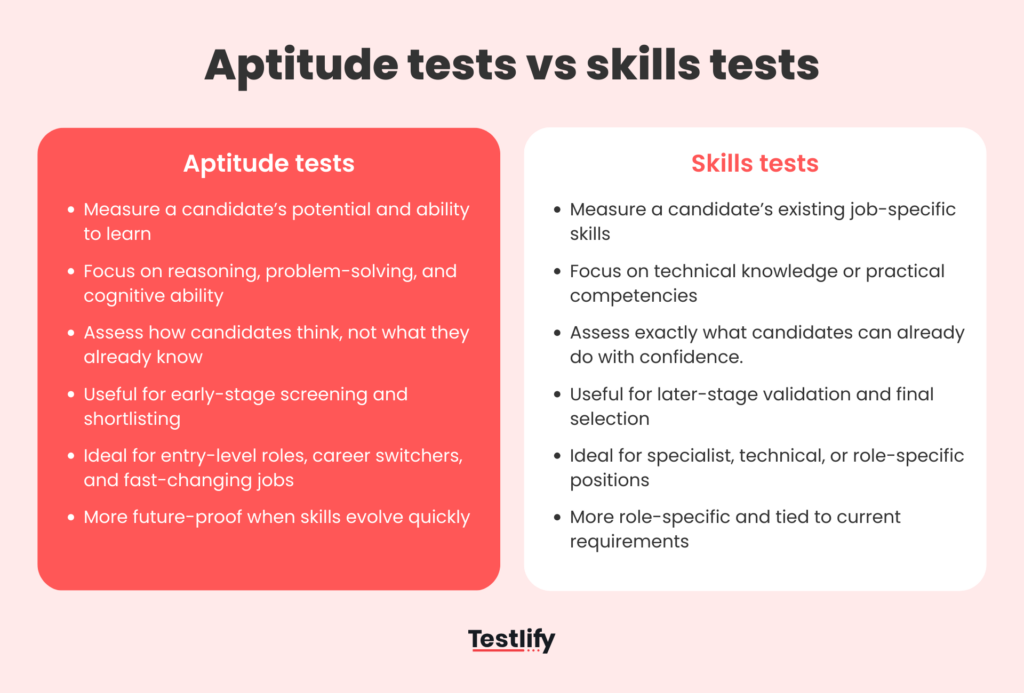
Aptitude tests
- Measure potential and cognitive ability
- Focus on problem-solving, reasoning, and learning speed
- Useful early in the hiring funnel
Skills tests
- Measure job-specific knowledge or technical skills
- Focus on what candidates can already do
- Useful in later hiring stages
Use aptitude tests and technical aptitude tests for screening and shortlisting, and skills tests for final validation.
Common types of aptitude tests recruiters use
Not all aptitude tests measure the same thing. Understanding the different types of aptitude tests helps HR teams choose assessments that truly match the demands of the role.
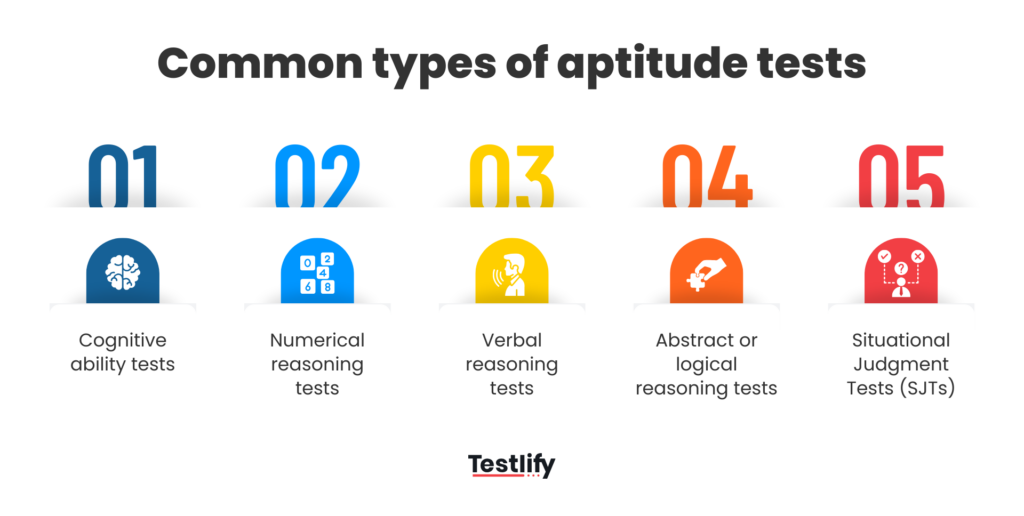
1. Cognitive ability tests
Cognitive ability tests assess general mental ability, including:
- Logical reasoning
- Pattern recognition
- Critical thinking
These tests are among the strongest predictors of job performance across roles.
2. Numerical reasoning tests
Numerical reasoning tests are used to assess:
- Data interpretation
- Basic math skills
- Comfort with numbers
Commonly used for:
- Finance
- Analytics
- Operations
- Sales roles
3. Verbal reasoning tests
Verbal reasoning tests measure:
- Reading comprehension
- Ability to draw conclusions from written information
- Communication-related reasoning
Useful for roles that involve:
- Client interaction
- Documentation
- Decision-making
4. Abstract or logical reasoning tests
Logical reasoning tests focus on:
- Identifying patterns
- Solving unfamiliar problems
- Thinking beyond learned rules
They’re excellent for assessing raw problem-solving ability, especially in tech and leadership roles.
5. Situational Judgment Tests (SJTs)
Situational Judgment Tests (SJTs) present real-world workplace scenarios and ask candidates how they would respond.
They help evaluate:
- Decision-making
- Emotional intelligence
- Alignment with company values
In 2026, SJTs are increasingly popular for leadership and people-facing roles.
How aptitude tests fit into the modern hiring funnel?
Aptitude tests work best when they’re used at the right stage of hiring. From early screening to final decisions, they bring structure and objectivity to the process.
Stage 1: Application screening
Instead of manually reviewing hundreds of resumes, recruiters now:
- Invite candidates to take a short aptitude assessment
- Automatically shortlist based on benchmark scores
This saves time and improves consistency.
Stage 2: Structured interviews
Aptitude test results give interviewers:
- Talking points
- Insight into strengths and gaps
- Data to ask more targeted questions
Stage 3: Final decision-making
When used alongside:
- Interviews
- Skills tests
- Culture-fit assessments
Aptitude tests provide an objective anchor for hiring decisions.
The role of AI in aptitude testing in 2026
AI has transformed aptitude testing by making assessments smarter, faster, and more personalized. In 2026, it helps recruiters gain deeper insights while improving the candidate experience.
Smarter test design
AI helps:
- Adapt question difficulty in real time
- Reduce test length without losing accuracy
- Personalize assessments by role
Better candidate experience
Modern platforms use AI to:
- Provide instant feedback
- Reduce test fatigue
- Offer mobile-friendly testing
Advanced analytics for HR teams
AI-powered dashboards can show:
- Predictive performance scores
- Hiring funnel drop-offs
- Correlations between test results and job success
How to choose the right aptitude test for your organization?
Selecting the right test isn’t about following trends, it’s about aligning assessments with job requirements and business goals. The right choice leads to better hires and stronger teams.
Start with the role, not the tool
Ask yourself:
- What abilities actually matter for success in this role?
- Is it problem-solving, learning speed, communication, or decision-making?
Avoid generic testing for all roles.
Validate for job relevance
In 2026, compliance and fairness matter. Ensure your tests:
- Are validated for job relevance
- Do not disadvantage specific groups
- Are aligned with employment laws in your region
Keep it short and respectful
Candidates expect efficiency. Long, exhausting tests can hurt your employer brand.
A good rule of thumb:
- 20–40 minutes total assessment time
- Clear instructions and expectations
Candidate experience: Why HR should care?
For many candidates, aptitude tests are their first real interaction with your company. A smooth and transparent experience can strengthen your employer brand and reduce drop-offs.
A poor experience can lead to:
- High drop-off rates
- Negative employer branding
- Loss of top talent
A good experience, on the other hand:
- Builds trust
- Signals professionalism
- Improves offer acceptance rates
Tips to improve candidate experience
- Explain why you’re using the test
- Share how results will be used
- Offer feedback where possible
Common mistakes recruiters make with aptitude tests
Even the best tests can fail if they’re used incorrectly. Knowing the common pitfalls helps HR teams avoid poor hiring decisions and negative candidate experiences.
Using them as the only decision tool
Aptitude tests are strong predictors of potential, but they should never stand alone. Relying only on test scores can cause recruiters to miss important context like motivation, communication skills, or cultural fit. The best hiring decisions come from combining aptitude results with structured interviews, skills assessments, and human judgment.
Ignoring test validity
Not all aptitude tests are scientifically validated or job-relevant. Using outdated or poorly designed tests can lead to inaccurate results and unfair decisions. HR teams should ensure their assessments are proven to predict job performance and are regularly reviewed to stay aligned with changing role requirements and workforce needs.
Poor communication with candidates
When candidates don’t understand why they’re being tested or how results will be used, it creates stress and distrust. Clear communication helps set expectations, reduces drop-offs, and improves employer branding. Explaining the purpose of the test and offering feedback where possible makes the process feel fair and transparent.
Legal and ethical considerations in 2026
HR teams must ensure aptitude testing aligns with:
- Local employment laws
- Data privacy regulations
- Accessibility standards
Data privacy
Candidates need clarity on how their personal and assessment data is handled. HR teams should clearly communicate what information is collected, how long it will be stored, and who has access to it. Strong data privacy practices are essential for compliance, transparency, and maintaining candidate confidence in the hiring process.
Accessibility
Aptitude tests should be designed so all candidates can participate fairly. This means mobile-friendly platforms, support for candidates with disabilities, and language options where possible. Prioritizing accessibility helps organizations widen their talent pool and demonstrates a genuine commitment to inclusive and equitable hiring.
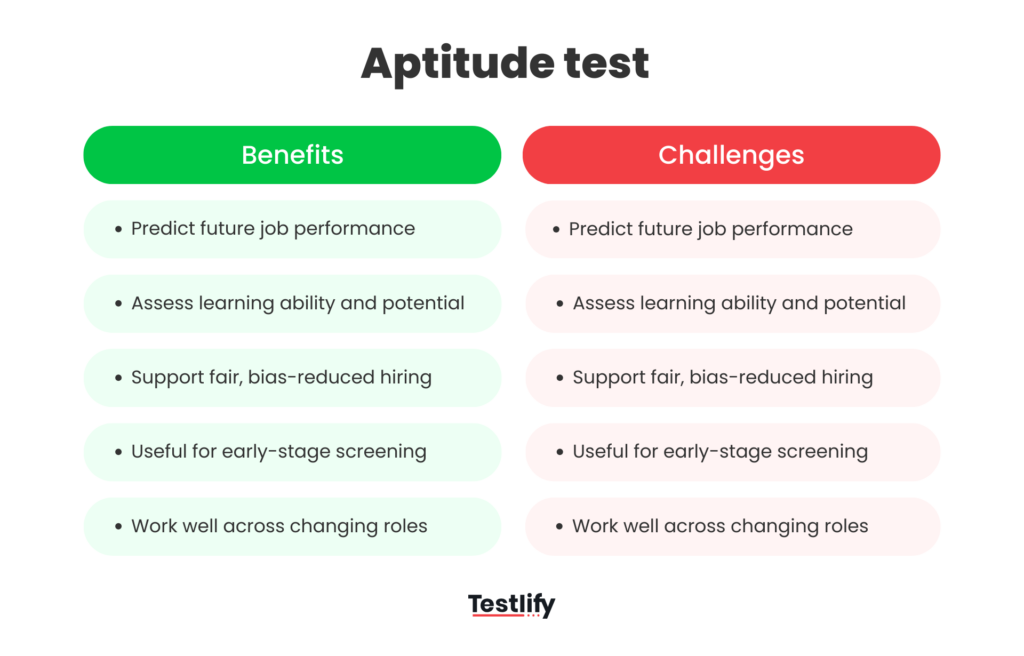
There are a lot of advantages and disadvantages to aptitude tests. You can use it to your best with Testlify’s aptitude test.
How to interpret aptitude test results?
Aptitude test results provide valuable insights, but they must be interpreted thoughtfully. HR teams should focus on ranges rather than rigid cut-offs, comparing scores with role benchmarks and considering the candidate’s overall profile. This approach ensures a more nuanced and fair evaluation of potential.
Think in ranges, not absolutes
Rigid cut-off scores can overlook candidates who may excel in other areas. Instead, focus on score ranges, compare results against role-specific benchmarks, and consider the candidate’s overall profile. This approach helps recruiters make balanced decisions and identify high-potential candidates who might otherwise be missed.
Combine quantitative and qualitative insights
Test scores are a guide, not a verdict. Use results to ask more targeted interview questions, identify learning or development needs, and shape onboarding plans. Combining quantitative data with qualitative observations provides a fuller picture of each candidate’s potential and ensures more informed hiring decisions.
Future trends in aptitude testing beyond 2026
Aptitude testing continues to evolve with new technologies and expectations. Understanding what’s coming next helps HR teams stay ahead and future-proof their hiring strategies.
Gamified assessments
Game-based assessments are becoming more popular because they reduce test anxiety, measure real-time decision-making, and increase candidate engagement. By turning assessments into interactive experiences, organizations can better evaluate potential while creating a more positive and enjoyable candidate journey.
Continuous assessment models
Some organizations are moving beyond one-time tests to continuous assessment models. This includes micro-assessments over time, on-the-job simulations, and tracking learning agility. Continuous assessments provide a more accurate picture of a candidate’s abilities and potential for growth within the organization.
Greater transparency
Candidates now expect more transparency in hiring assessments. They want clear feedback, explanations of their scores, and assurances that AI is used ethically. Prioritizing transparency builds trust, improves the candidate experience, and strengthens your employer brand in a competitive talent market.
Final thoughts
In 2026, aptitude tests are no longer optional or experimental. They are a strategic asset for HR teams that want to hire smarter, faster, and fairer.
When used thoughtfully, aptitude tests:
- Improve the quality of hire
- Enhance candidate experience
- Support diversity and inclusion
- Save time and resources
The key is not just using aptitude tests, but using them well.
As an HR professional, your goal isn’t to find the “perfect” score. It’s to uncover potential, support informed decisions, and build teams that can grow with your organization.
And aptitude tests, when done right, help you do exactly that.