
How to build a recruitment tech stack that works at enterprise scale
Learn how to build a scalable recruitment tech stack for enterprise hiring tools, strategy, and tips to streamline and optimize your hiring process.

How to build a recruitment tech stack that works at enterprise scale
Talent acquisition isn’t just about posting jobs and screening resumes; it’s about building smart, scalable systems that attract, engage, and hire top talent faster and more efficiently.
For enterprise HR teams, that means developing a recruitment tech stack that works at scale.
But what exactly is a recruitment tech stack? And how do you go about building one that fits your organization’s complex hiring needs?
Let’s dive in.
 ChatGPT
 Gemini
 Claude
 Grok
Grok Perplexity
What is a recruitment tech stack?
A recruitment tech stack is a toolkit, a set of software solutions and digital platforms that help streamline and automate the entire hiring process.
From sourcing candidates and managing applications to onboarding new hires and analyzing performance, your tech stack should support every stage of the recruitment funnel.
At an enterprise level, this tech ecosystem becomes even more crucial. You’re likely hiring for hundreds of roles across various departments and regions. Without the right tools in place, things can quickly become chaotic, inefficient, and costly.
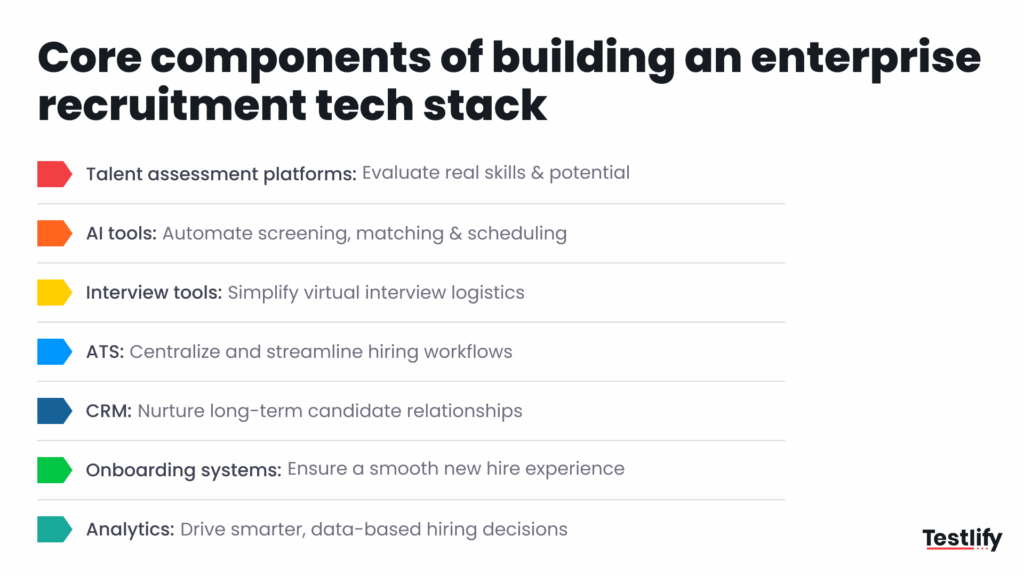
Each of these tools should work together seamlessly to support your HR team’s goals.

Why do you need a recruitment tech stack?
Now, you might be wondering why invest in all these tools? Can’t we just rely on our ATS and be done with it?
Speed, efficiency, and candidate experience are all critical to staying ahead. A well-designed recruitment tech stack enables you to:
1. Hire faster using automation tools
A recruitment tech stack powered by automation and AI can significantly cut down your time-to-hire. Smart tools help screen resumes, auto-schedule interviews, and send timely updates, freeing up your recruiters to focus on top candidates.
When hiring speed is crucial, especially at scale, these tools ensure you’re not losing out on great talent due to delays in your process.
2. Improve candidate experience
Today’s candidates expect a seamless, digital-first experience. Recruitment technology helps you deliver faster responses, smoother application journeys, and consistent communication.
Whether it’s automated updates or mobile-friendly applications, these features reduce friction and drop-offs. A positive experience keeps candidates engaged and even if they don’t get the job, they’re more likely to view your brand favorably and reapply in the future.
3. Enhance data-driven decisions
A strong tech stack doesn’t just automate tasks it empowers your team with real-time insights. From source-of-hire to diversity tracking and funnel conversion rates, recruiting data helps you identify what’s working and where to improve.
This allows your HR team to make smarter, faster decisions and build hiring strategies based on facts, not guesswork, improving outcomes at every stage of the funnel.
4. Support collaboration across teams
Recruiting is a team sport. With the right tools, HR, hiring managers, and executives can all stay in sync. Shared dashboards, automated reminders, and clear workflows ensure everyone knows their role and timelines.
This reduces miscommunication, speeds up decisions, and makes the entire hiring process smoother especially in large organizations with multiple stakeholders involved in every hire.
Challenges of building and running a recruitment tech stack
Of course, building a recruitment tech stack isn’t as simple as signing up for a few tools. Enterprises face unique challenges, including:
1. Tool overload
With a flood of recruitment tools available, it’s easy to invest in multiple platforms that do similar things or worse, don’t work well together. This results in confusion, wasted budgets, and underutilized software.
A cluttered tech stack can overwhelm recruiters rather than help them. Prioritizing essential tools with clear functions helps avoid unnecessary complexity and ensures the stack adds real value.
2. Integration complexity
Enterprise environments often rely on multiple systems, HRIS, payroll, compliance tools, and more. Integrating recruitment technology with these existing platforms can be technically challenging and time-consuming.
Poor integration leads to disjointed workflows, manual data entry, and operational inefficiencies. It’s vital to choose solutions designed with open APIs and proven compatibility with your current ecosystem to create a seamless hiring experience.
3. User adoption
Even the most advanced tool is ineffective if your team doesn’t embrace it. Lack of proper onboarding, confusing interfaces, or resistance to change can all hinder adoption.
To make your tech stack successful, you need strong change management strategies, training sessions, and ongoing support. Adoption isn’t just about buying software, it’s about ensuring your people can and will use it effectively.
4. Data silos
When recruitment tools don’t integrate, data ends up trapped in separate systems. This limits your ability to analyze performance across the entire hiring lifecycle. Silos also slow down communication and decision-making.
Breaking these barriers requires selecting tools that share data fluidly and building centralized dashboards that bring insights together from all stages of the recruiting process.
5. Compliance and security
Recruitment involves handling sensitive personal data, which comes with significant legal and ethical responsibilities. A fragmented tech stack can increase the risk of data breaches and non-compliance with regulations like GDPR or EEOC.
Ensuring your tools meet security standards, provide audit trails, and include user access controls is essential for protecting candidate information and maintaining organizational integrity.
How to build your recruitment technology ecosystem?
Ready to build your own recruitment tech stack? Here’s how to get started.
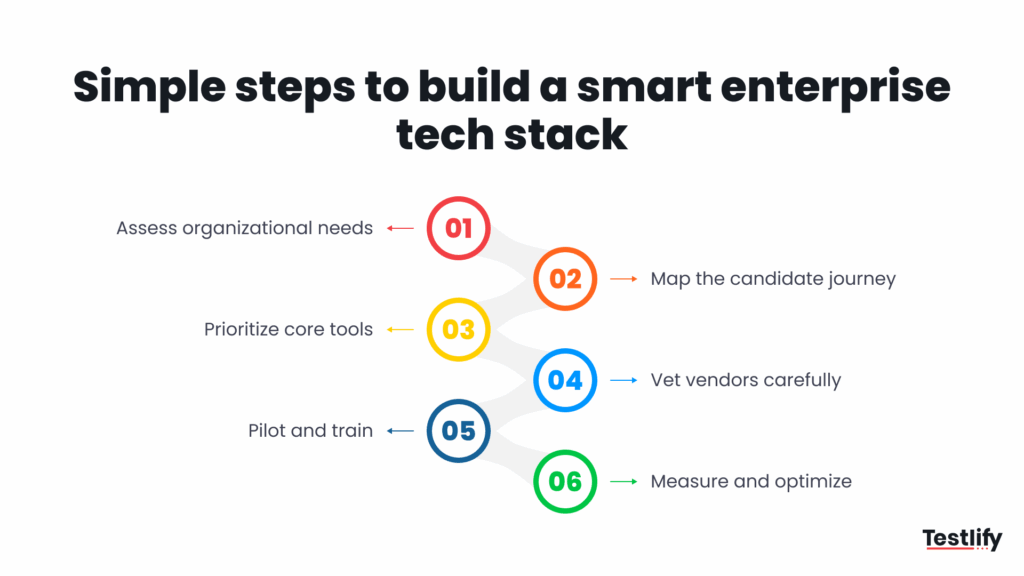
Step 1: Assess your needs
Start by analyzing your current recruitment process. What are your bottlenecks? Where are you losing candidates? What feedback are you hearing from hiring managers?
Build a wish list based on:
- Hiring volume
- Candidate experience goals
- Key metrics (time-to-hire, cost-per-hire, etc.)
- Scalability
- Diversity and inclusion goals
Step 2: Map the candidate journey
Put yourself in the candidate’s shoes. From discovering your job post to accepting an offer, every touchpoint matters. Mapping out this journey helps you identify where candidates face friction and where tech can help, such as automated emails or user-friendly application platforms. This exercise ensures your tech stack improves both process efficiency and candidate experience from start to finish.
Step 3: Identify core tools vs. Nice-to-haves
Separate your must-have tools from extras. An ATS and onboarding platform are usually essential, while tools like AI sourcing or gamified assessments might be optional. Consider the business impact and integration ease of each tool. Prioritizing helps avoid bloated stacks and ensures your budget is focused on tools that solve real problems and scale with your needs.
Step 4: Vet and select vendors carefully
Don’t rush vendor selection. Demo several options and ask about system compatibility, customer support, data security, and scalability. Consider how easily each tool integrates with your existing systems.
Involve IT, security, and legal teams early to avoid costly issues later. Choose vendors who align with your goals and can grow alongside your organization.
Demo multiple platforms. Ask about:
- Integration with existing systems
- Customer support and SLAs
- Customization capabilities
- Data security and compliance features
Scalability and user limits. Step 5: Pilot and train
Roll out new tools gradually. Start with a pilot in one department to test functionality and gather user feedback. Use this stage to fine-tune configurations and workflows. Provide structured training so users feel confident using the new system. Proper onboarding and early wins help build momentum for wider adoption across the organization.
Step 6: Measure and optimize
After implementation, track key performance indicators like time-to-hire, cost-per-hire, and candidate satisfaction. Compare results before and after adoption. Use the data to identify gaps, make improvements, and ensure your tech stack continues to meet business goals. Regular reviews keep your ecosystem agile and aligned with your evolving recruitment needs.
Which tools should recruiters include in the tech stack?
Let’s break down the essential categories and leading tools often found in enterprise recruitment stacks.
1. AI and automation tools
AI-powered tools bring intelligence and efficiency to your hiring process. From automatically screening resumes to scheduling interviews or even running virtual assessments, these tools save time and reduce manual tasks. They also improve decision-making by matching candidates to roles based on data, not just keywords.
Popular options:
- Testlify
2. Skills assessment platforms
Skills assessments analyzesgo beyond the resume to evaluate real skills, cognitive ability, and personality traits. Whether you’re hiring software engineers, sales reps, or customer service agents, these platforms help predict job performance and culture fit. They can also standardize evaluation and reduce unconscious bias in hiring.
Popular options:
- Testlify
3. Applicant Tracking System (ATS)
An ATS is the backbone of any recruitment tech stack. It centralizes all job postings, applications, and communication, giving your team a single platform to manage the hiring process. From requisition approvals to interview scheduling, a solid ATS keeps things organized, compliant, and trackable, especially vital at enterprise scale.
Popular options:
- Greenhouse
- Lever
- iCIMS
- Workday Recruiting (for larger enterprises)
4. Candidate Relationship Management (CRM)
CRMs help you build and maintain relationships with potential candidates, even before they apply. Perfect for proactive sourcing, talent pooling, and nurturing passive candidates, CRMs allow you to engage top talent over time so when the right role opens up, you’ve already laid the groundwork.
Popular options:
- Beamery
- Avature
- SmashFly
5. Sourcing tools and job boards
Finding great candidates means going beyond your careers page. Sourcing tools and job boards expand your reach, giving you access to active and passive talent pools across platforms and industries. These tools help recruiters search smarter, target the right candidates, and advertise roles where they’re most likely to be seen.
Popular options:
- LinkedIn Recruiter
- Entelo
- SeekOut
- Indeed
- Hired
6. Interviewing tools
Interviewing tools simplify scheduling, coordination, and virtual meetings. Whether you’re managing global time zones or multiple interviewers, these tools create seamless workflows and eliminate back-and-forth. Many also include structured interview guides and feedback forms to keep the process consistent and collaborative.
Popular options:
- Zoom or Microsoft Teams
- GoodTime
- Modern Hire
7. Onboarding platforms
A great candidate experience shouldn’t stop at the job offer. Onboarding platforms help new hires feel welcomed and prepared by streamlining paperwork, training, and introductions. These tools ensure consistency across departments and locations, reduce manual tasks for HR, and set new employees up for long-term success.
Popular options:
- BambooHR
- SAP SuccessFactors
- Sapling
8. Analytics and reporting
What gets measured gets improved. Analytics tools track everything from time-to-hire and cost-per-hire to DEI metrics and recruiter productivity. These platforms help you spot bottlenecks, understand candidate behavior, and make better, data-informed decisions turning recruiting from a reactive function into a strategic powerhouse.
Popular options:
- Visier
- Tableau (integrated with your ATS)
- HR dashboards built into enterprise HRIS systems
3 things to consider before choosing a tech stack
Before signing any contracts or scheduling demos, ask yourself these three questions.
1. Will this scale with us?
Your recruitment needs today may look very different a year from now. Choose tools that can handle increasing volumes of applicants, multiple job postings, and collaboration across departments and geographies.
A scalable solution ensures you won’t need to replace it as you grow. Look for platforms with flexible pricing, cloud infrastructure, and proven success in large enterprise environments.
2. Does it integrate well?
A powerful recruitment tool is only as good as its ability to work with your existing systems. Poor integration leads to manual work, duplicate data, and misaligned processes.
Ensure the tool connects smoothly with your ATS, HRIS, payroll, and compliance platforms. Prioritize solutions that offer open APIs, native integrations, and a track record of successful enterprise deployments.
3. Will our teams actually use it?
No matter how impressive a tool is, it’s useless if your team avoids it. Prioritize user-friendly platforms with intuitive interfaces and minimal learning curves. Involve recruiters early in the evaluation process to get their input.
Tools with strong user adoption rates, built-in training resources, and responsive customer support help ensure your investment pays off in real-world usage.
Final thoughts
Building a recruitment tech stack that works at enterprise scale isn’t a one-and-done project. It’s a continuous process of evaluation, adoption, and optimization.
But when done right, your tech stack becomes more than just a set of tools, it becomes a competitive advantage. You’ll attract better talent, make smarter decisions, and create a world-class hiring experience.
So, start small. Focus on what truly matters. And always keep the candidate and your recruiting team at the heart of your strategy.
Frequently asked questions (FAQs)

Content Writer
Yashika Khandelwal is a Content Writer with 3+ years of experience creating research-backed content on hiring, talent assessment, and HR technology. She is a registered Organizational Psychologist and subject matter expert who combines behavioral science with practical recruitment insights to produce accurate, evidence-based content.
LinkedInRelated resources
View all
HR & recruitment
How to hire startup web app development company

HR & recruitment
How small businesses can use scheduling software to attract top talent

HR & recruitment
Key hiring metrics every large organization should monitor

HR & recruitment
Global hiring insights: Key strategies for success

HR & recruitment
How to operationalize DEI in the enterprise recruitment funnel

HR & recruitment
Building a global interview infrastructure
Get started.
Hire on proof, not resumes.
Run your first skills-based assessment free — no credit card required.