
Benefits of AI in recruitment & its challenges
Benefits of ai in recruitment explained with real use cases, key risks, and where human judgment still matters in hiring.

If your inbox is full of resumes and your hiring managers want a shortlisted candidate by the next day, Artificial Intelligence can feel like the only way out. And in many cases, it helps. The benefits of AI in recruitment include faster screening, better matching, and more consistent evaluation across candidates, especially when you are up to volume hiring.
Still, speed can come with its own sets of problems. AI can miss context, reward keyword-heavy resumes, and make rejections harder to explain. In this blog, we’ll cover the wins first, then the challenges and finally a practical view of where AI fits best and where it needs tighter controls.
 ChatGPT
 Gemini
 Claude
 Grok
Grok Perplexity
TL;DR – Key takeaways
- Blue-collar jobs are in high demand, and skilled workers are harder to find.AI instantly speeds up the hiring process by analyzing resumes at scale, saving recruiters hours of manual review.
- Instead of just trusting a resume, AI assessments let you test and verify a candidate’s actual skills.
- AI tools engage candidates 24/7, handling early screening questions so applicants never feel ignored.
- AI learns from historical data, which means it can easily copy past hiring biases if not monitored closely.
- AI should only be used as a strong filter; human judgment is always required to make the final hiring decision.

Benefits of AI in recruitment
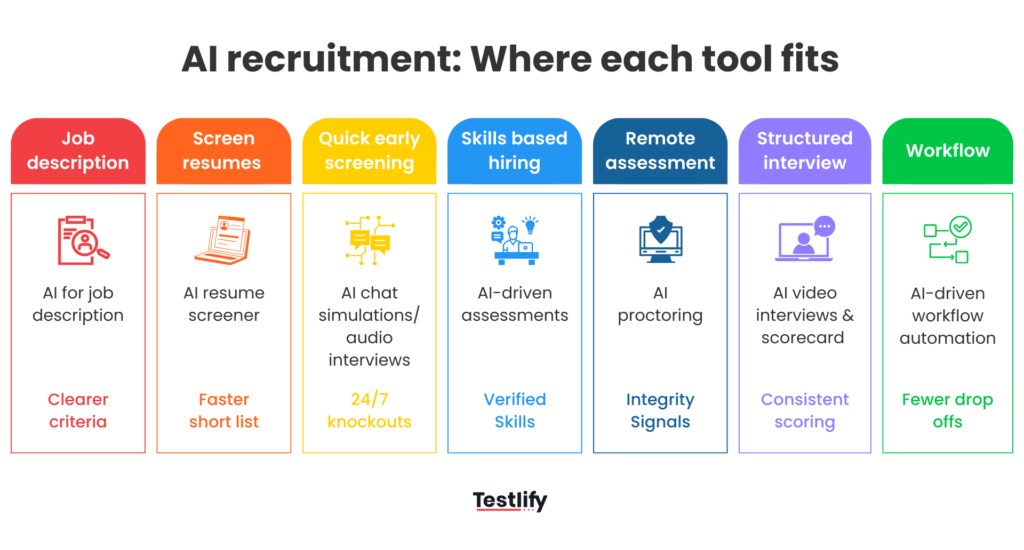
AI is a fundamental requirement for scaling hiring operations efficiently. AI tools can quickly screen resumes, run skills-based assessments, and support structured interviews so teams don’t rely on gut feeling alone. Let’s explore its benefits broadly.
Screen resumes faster
Manually reviewing hundreds of resumes for a single open role can take a lot of recruiter bandwidth. This bottleneck not only delays time-to-hire but also increases the risk of losing top-tier candidates to faster-moving competitors.
AI resume screener instantly accelerates this phase by parsing and analyzing applications at scale. Modern AI understands semantic context, they don’t rely only on keyword matching. It evaluates a candidate’s actual experience, past projects, and career trajectory against the core requirements of the job description in seconds.
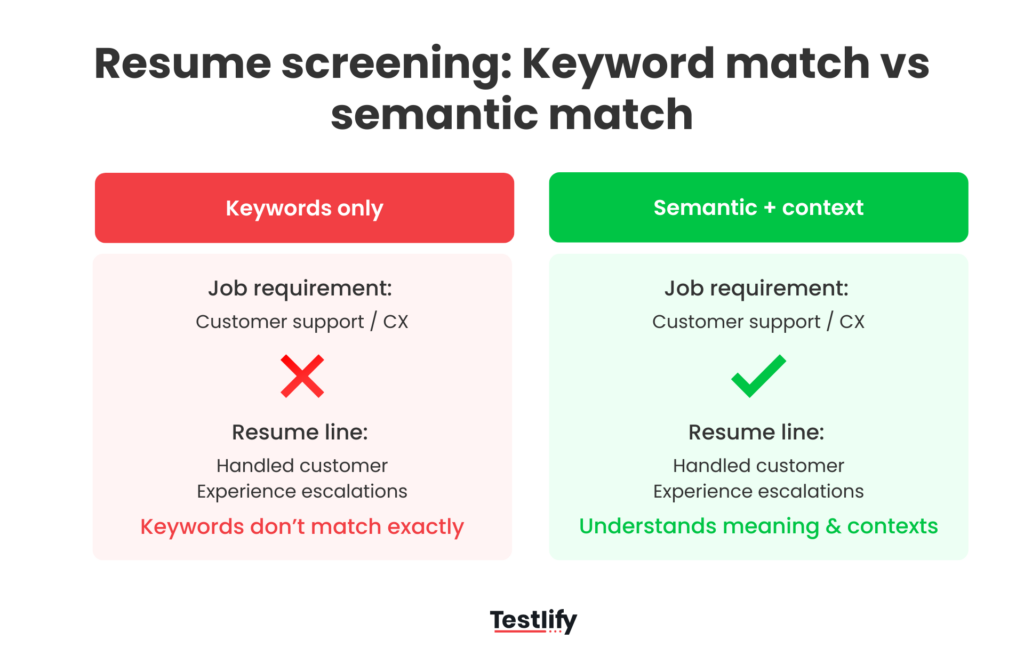
This rapid, intelligent shortlisting drastically reduces initial screening time which in turn reduces cost-per-hire.
AI can reflect potential bias if it’s trained on historical data from past hiring patterns or if your job descriptions are unclear. The fix is straightforward: define role requirements clearly, review the AI shortlist manually, and use AI as a filter, not the final decision-maker.
Learn More About: AI Resume Screener
Quick early screening
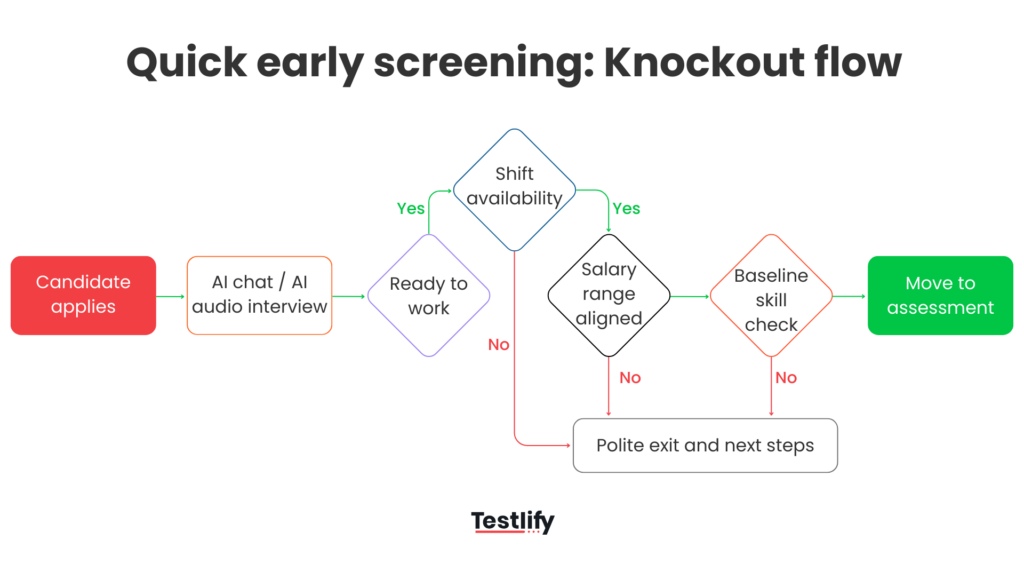
Once a resume is parsed, the immediate next hurdle is verifying a candidate’s basic qualifications. Using AI chat simulations and AI audio interviews can help talent teams to engage candidates 24/7 for global recruitment.
These tools dynamically ask essential knock-out questions such as right-to-work status, shift availability, salary expectations, or baseline technical knowledge. This immediate, two-way interaction guarantees a responsive experience for the applicant while ensuring that only candidates who meet the non-negotiable criteria advance in the talent pipeline.
Benefits in the hiring process:
- Cuts screening time fast: You filter out clear mismatches early, so only relevant profiles move forward.
- Reduces back-and-forth scheduling: Candidates can complete the first step anytime, which speeds up the recruitment process.
- Improves candidate experience: People get quicker updates instead of waiting days for a call.
- Keeps screening consistent: Everyone gets the same questions, making comparisons easier for human resources teams.
Explore More: Conversational AI audio interviews for call center hiring
Skills-based hiring
Two applicants might share the exact same job title and years of experience, but possess vastly different capabilities. Here, skills-based hiring eliminates this guesswork. If you deploy AI-driven assessments, you can evaluate verifiable competencies of a candidate.
How AI helps here
- Role-based tests (coding, Excel, aptitude, domain knowledge, situational judgment)
- Structured scoring and benchmarks
- Instant evaluation reports so recruiters don’t have to manually review everything
Skills-based hiring raises the quality of hire because selection is rooted in demonstrated capability, not just past pedigree. It also makes shortlisting fairer, since candidates from non-traditional backgrounds can prove their worth through actual performance, which helps reduce unconscious bias in the early stages.
On top of that, it optimizes interview time, because only applicants who clear an objective skill bar reach hiring managers, making human-to-human interviews more strategic and focused.
Finally, it supports data-backed decisions, with clear competency breakdowns that help Human Resource Teams explain and justify pipeline progression to stakeholders.
Trust in remote assessments
Remote hiring can scale your reach, but it also introduces a critical vulnerability (integrity of the assessment). If you can’t trust the test results, the entire evaluation process breaks down. AI-powered proctoring secures the assessment workflow.
AI proctoring helps avoid one on one invigilation. AI proctoring operates discreetly in the background, focusing on three core verifications:
- Identity checks: Instantly confirms the person taking the assessment is the actual applicant.
- Environment scan: Scans the candidate’s workspace to avoid the risk of unauthorized outside assistance.
- Behavioral tracking: Monitors for digital anomalies like tab switching, copy-paste patterns, multiple faces in the frame, or unexpected device changes.
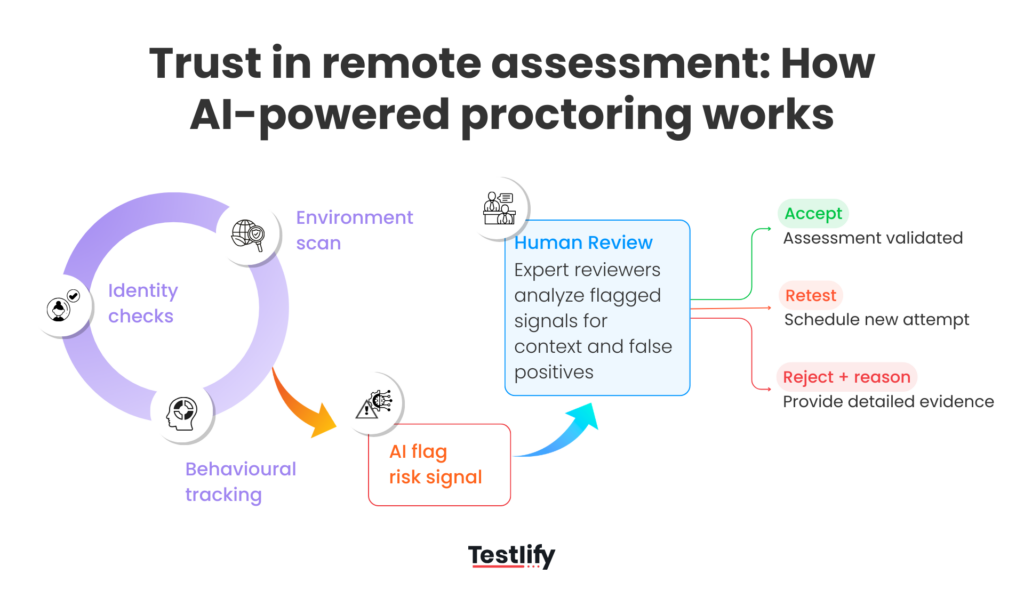
Trust in remote assessments matters because if you can’t trust the score, the whole hiring process becomes guesswork.
With AI proctoring in the recruitment process, hiring teams get more reliable test results because performance is far more likely to reflect real skill, not outside help. It also reduces cheating risk at scale, which is a big deal in high-volume talent acquisition where human resources teams simply can’t manually watch every test session.
Structured interview
Structured interviews make hiring decisions more consistent because every candidate is evaluated on the same questions and the same scoring criteria, instead of whatever comes up at the moment.
This is where AI video interviews fit naturally into the recruitment process, especially when you’re hiring at scale. They help standardize the interview flow, capture responses cleanly, and support a clear evaluation rubric
AI for job descriptions
Using AI for job descriptions helps you attract the right candidates because it improves the input that drives the whole recruitment process.
Instead of vague or inflated requirements, AI tools can help tighten the language, highlight the actual skills needed, and remove unnecessary fluff that scares away qualified candidates.
For human resources and talent acquisition teams, the benefit is simple:
- Better job descriptions
- Create a cleaner pipeline
- Fewer irrelevant applications
- Smoother candidate experience
Try Out: Job Descriptions Generator
AI-driven workflow automation
AI-driven workflow automation keeps the hiring process moving without constant manual follow-ups. It can send status updates, schedule interviews, share reminders, and push candidates to the next step on time.
For human resources teams, this means less admin work and fewer missed steps. For candidates, it improves the candidate experience because they get quicker responses and clearer next steps, while recruiters still use human judgment for final decisions.
Challenges of AI in recruitment
While AI brings massive efficiency to talent acquisition, it is not a flawless silver bullet. Implementing these tools introduces new risks that HR teams must actively manage.
- Algorithmic bias: AI learns from historical data. If your past hiring practices favored certain demographics or backgrounds, the AI will silently automate and scale those exact same biases, actively working against your diversity and inclusion goals.
- The Black Box effect: Many AI tools lack transparency. When an algorithm rejects a candidate, it rarely explains why. This makes it incredibly difficult for recruiters to justify pipeline decisions or audit the system for fairness.
- Loss of the human touch: Recruitment is fundamentally about people. Over-automating the pipeline with generic chatbots and instant rejections can make the candidate experience feel cold and transactional, causing top talent to drop out of the process.
- Data privacy risks: AI requires massive datasets to function effectively. Ingesting, analyzing, and storing sensitive applicant information creates significant compliance hurdles and security vulnerabilities.
- Over-reliance on automation: It is easy for busy recruiters to blindly trust the machine. When teams rely entirely on AI to make the final call, they lose the nuanced human judgment required to assess cultural alignment, ambition, and long-term potential.
Where AI helps most vs where to be careful
To use AI in recruitment well, treat it like a powerful filter, not a final judge. AI tools are strongest in high-volume, repetitive work, like when you need to screen resumes quickly, run assessments at scale, and keep the recruitment process moving with scheduling, reminders, and updates. This improves speed and the candidate experience, while helping human resources teams focus on decision-making instead of admin.
The caution is simple: AI systems can scale potential bias if they learn from historical data or if your job descriptions are unclear. Some tools also act like a “black box,” making decisions hard to explain or audit.
And if you over-automate, the process can feel cold and transactional. The best balance is human oversight: let AI rank, flag, and summarize, but keep human judgment for final calls.
Quick table: Where AI works best and where it needs humans
Use case | AI helps most when | Be careful when |
|---|---|---|
High-volume filtering (screen resumes, basic screening) | You need to sort lots of applications fast and find qualified candidates | It starts acting like the final judge and misses context |
Skills checks (assessments, structured scoring) | You want objective signals, not just past pedigree | The test doesn’t match the role, so good candidates get filtered out |
Remote testing trust (proctoring signals) | You need reliable online assessment results at scale | Flags are treated as verdicts instead of review signals |
Process speed (scheduling, reminders, updates) | You want a smoother hiring process and better candidate experience | Automation feels cold, generic, or too aggressive |
Final decisions | AI summarizes and supports human judgment | AI systems decide without human oversight, transparency, or accountability |
Conclusion
The pros and cons of AI in recruitment come down to balance.
The pros: it helps screen resumes faster, supports skills-based hiring, keeps interviews structured, and automates the busywork that slows the hiring process.
The cons: AI systems can scale potential bias from historical data, make decisions hard to explain, and hurt candidate experience if over-automated.
Want the benefits without the risks? Book a demo of Testlify.
Frequently asked questions (FAQs)

B2B SaaS Content Writer
Rishav Kumar is a B2B SaaS content writer with 4 years of experience. He loves crafting engaging content. Always exploring fresh ideas, he's passionate about helping businesses grow through impactful writing.
LinkedInRelated resources
View all
AI in recruitment
AI in recruitment: The complete 2026 strategy guide

AI in recruitment
Best practices for hiring data analysts using assessments?

AI in recruitment
How to run role simulations through video interview prompts?

AI in recruitment
What tools offer AI-generated questions for custom assessments?

AI in recruitment
How does Testlify’s AI scoring handle open-ended answers and code quality?
AI in recruitment
How to use AI in recruiting using Testlify
Get started.
Hire on proof, not resumes.
Run your first skills-based assessment free — no credit card required.