
Conversational AI audio interviews for call center hiring: Faster, fairer, and more scalable recruitment
Speed up call-center hiring with conversational AI audio interviews—faster, fairer, and scalable screening built for high-volume recruitment.

Each year, 30 to 45 out of every 100 call-center agents quit, and replacing just one costs around $7,000.
By 2028, global BPO operators anticipate adding 1.1 million new frontline jobs. This will increase the talent competition and magnify the cost of every day a headset sits empty.
However, the conventional phone-screen pipeline is unable to keep up. Recruiters waste valuable hours on calls that yield wildly inconsistent insights.
The result is an expensive, slow-motion churn cycle that hammers customer-experience metrics and employer brands alike.
Breaking that cycle demands a screening model built for high-volume environments, one that delivers consistent evaluation at the speed of business.
Conversational AI audio interviews for call-center hiring promise exactly that.
 ChatGPT
 Gemini
 Claude
 Grok
Grok Perplexity
Why traditional phone screens are failing in call-center hiring
Phone screens were built for boutique recruiting, not a 500-seat contact-center sprint. The numbers prove it:
- 31-day average time-to-hire for frontline roles, even after a decade of “speed-of-hire” projects.
- 42% of candidates walk away when scheduling drags on, often before a recruiter even picks up the phone.
- Frequent cancellations and reschedules remain the #1 cause of timeline creep in high-volume hiring.
Three structural flaws keep the process stuck in the slow lane
- Calendar ping-pong: Coordinating three time zones—candidate, recruiter, hiring manager—creates days of idle lag. Each no-show forces a complete reschedule cycle, inflating lead time and burning recruiter hours.
- Inconsistent evaluation: A five-minute “quick chat” with one recruiter and a 20-minute deep dive with another yield scores that can’t be compared.
- Experience debt: Long holds, dropped calls, and impersonal screening scripts feed the ghosting loop. According to Greenhouse, 61% of job seekers say employers vanished on them after an interview; candidates now feel justified in ghosting back.
The outcome is a costly cycle of churn. Conversational AI audio interviews replace the bottleneck with an on-demand, voice-first flow. It lets every candidate be heard within hours, not weeks.

Anatomy of a conversational AI audio interview
A conversational-AI audio interview looks and feels nothing like a hurried phone screen.
Instead of scrambling for a 15-minute slot on a recruiter’s calendar, each candidate receives a secure link (SMS, WhatsApp, or email) that launches a voice-first experience in their mobile browser.
The system greets them with a branded introduction, then serves a sequence of scripted or dynamically generated questions. Candidates answer in their own words, on their own time, and can re-record a response once if background noise intrudes.
Behind the scenes, a multi-layer speech stack gets to work. Real-time automatic speech recognition converts every answer to text, while a natural-language processing (NLP) engine parses meaning, key phrases, and intent. Similar conversational AI technologies are also transforming how businesses handle voice-based interactions beyond recruitment. Platforms like Callers AI use AI-powered voice agents to automate conversations, qualify leads, and manage customer interactions at scale, showing how natural language processing can improve communication workflows across different industries.
A 2024 field study found that this “ASR + NLP” pairing slashed first-round screening time by 57% in tech hiring pilots.
Then, the identical engine scores vocal traits critical to customer service, allowing recruiters to review a dashboard instead of replaying each file.
Consistency is where audio AI outshines live screens. Every candidate hears identical prompts, scored against the same rubric, thereby eradicating the “five-minute vs. twenty-minute” variability that erodes hiring manager trust.
Yet fairness hinges on more than uniform questions; it depends on speech technology that treats diverse accents equitably. Recent research by The Guardian shows that accent-related error rates can spike to 22 percent if models are trained primarily on U.S. English.
Finally, integration turns the voice interview from a clever add-on into a recruiting workhorse. Modern APIs push transcripts, sentiment scores, and recruiter notes straight into the ATS, triggering next-step automations such as skills tests or final manager calls.
Once the necessary infrastructure is in place, call center talent teams can invite hundreds or thousands of candidates overnight and wake up to a bias-audited, ranked slate prepared for final interviews.
Can conversational AI reduce time-to-hire for call centers?
Speed is oxygen in a contact-center ramp-up. Every extra day a seat stays empty drives up lost revenue and overtime costs. Conversational-AI audio interviews collapse that timeline on five fronts:
1. Instant interview access, no waiting required
Instead of waiting days for a recruiter to call, candidates receive a link immediately after applying. This link launches a mobile-friendly audio interview.
Here, candidates respond to predefined voice prompts anytime within a 24 to 48-hour window. There is no scheduling bottleneck and no time zone issues.
Voice interviews are 6X faster than live phone screens, thanks to parallel processing and self-service scheduling.
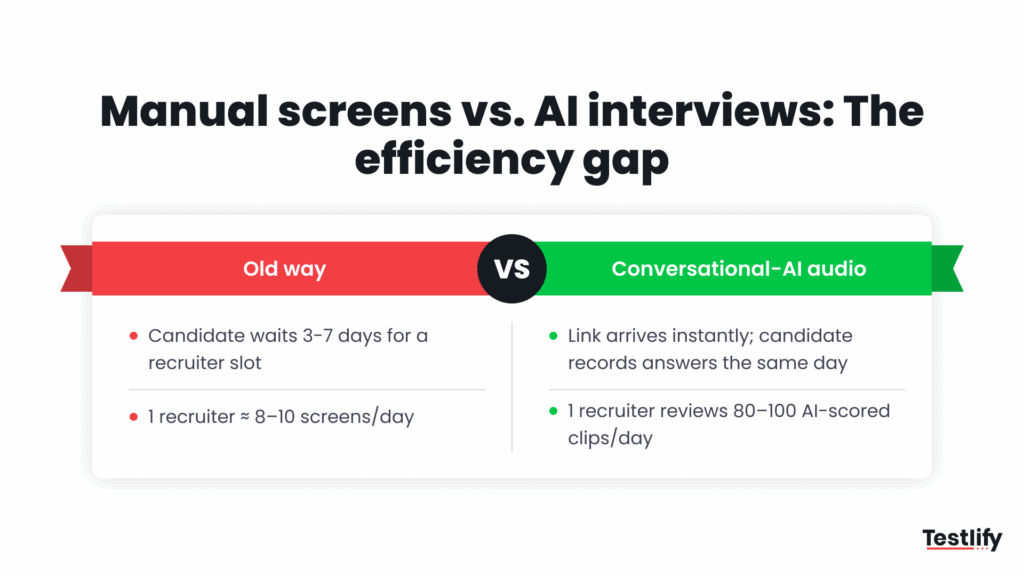
Voice interviews are 6X faster than live phone screens, thanks to parallel processing and self-service scheduling.
2. Asynchronous flexibility drives higher completion rates
Live phone screens often clash with a candidate’s current work schedule, especially in regions where frontline workers juggle multiple jobs. But conversational AI audio interviews are asynchronous.
Candidates record answers when they’re free. Records indicate that in enterprise deployments, this flexibility increases screening completion rates by 32%, particularly among night-shift applicants and caregivers.
3. Speed without sacrificing evaluation quality
The misconception that faster equals sloppier doesn’t apply here. While AI handles the heavy lifting, recruiters still review audio highlights, not raw data. Think of it as moving from long phone calls to a curated reel of answers.
Commonly tracked traits include:
- Tone: Is the candidate calm, confident, and customer-friendly?
- Pacing: Can they articulate ideas without rushing or rambling?
- Keywords: Do they mention essential tools or customer-service phrases?
4. Time-to-hire cuts that impact the bottom line
In the contact center world, every unfilled agent seat creates a ripple effect: higher hold times, missed SLAs, lower CSAT, and rising burnout among the active team.
Here’s how it plays out in real numbers:
- A 500-seat call center operating at 10% vacancy = 50 empty headsets
- The average agent handles 50 calls per day, and that’s 2,500 missed customer interactions per day.
- Every day shaved off hiring = 2,500 more customers served, fewer complaints escalated, and less overtime paid.
Now multiply that across 10 days saved by switching to conversational AI audio interviews.
In a nutshell, speed not only helps talent acquisition meet targets but also enables Operations to meet Service Level Agreements (SLAs).
That’s a strategic advantage your competitors won’t see coming until your agents are already trained and on the phones.
5. Reduced candidate drop-off
Speed is also a key factor in enhancing the candidate experience. When interviews happen instantly, applicants feel seen, valued, and respected. That matters because 42% of job seekers drop out when the hiring process drags.
Testlify was built for precisely this kind of high-volume agility.
Its Conversational AI Audio Interviews allow you to engage 1,000+ candidates instantly, capture responses in any timezone, and generate recruiter-ready, bias-audited insights within 24 hours.
Why conversational AI audio interviews raise the fairness bar
Every candidate now hears the same voice prompts and is graded by the same rubric. Behind the scenes, accent-trained speech models cut mis-transcription for US, Filipino, and Caribbean English, so clarity drives scores.
Testlify goes a step further. Its AI system is trained to recognize various accents, such as US English or Filipino speech. If it detects that any group (based on region or gender) has a pass rate that drops by 4% or more, it immediately flags it.
Additionally, recruiters initially review the text transcripts, not the voice, so their decisions aren’t influenced by accent or tone.
How do conversational AI audio interviews scale for peak-season hiring surges?
When holiday traffic or a new product launch triples call volume, recruiters can’t afford week-long backlogs.
A 2024 seasonal-staffing snapshot found U.S. service centers added almost half a million customer-service jobs between October and December alone in 2017.
Conversational-AI audio interviews turn a surge into a batch job:
- Instant, unlimited invites: 1,000 links can go out overnight; completion rates stay high because candidates record on their own schedule. Chipotle’s CX team, for example, saw an 85 % application-completion rate after switching to AI scheduling ahead of “burrito season.”
- Elastic review capacity: Recruiters review AI-scored highlights, not hour-long recordings, so that a single TA pro can triage 80–100 candidates a day.
- Auto-prioritized shortlists: Speech analytics rank responses by clarity, empathy, and key phrases, pushing the best voices to the top.
- No integration drag: Platforms like Testlify stream transcripts and scores straight into your ATS, with a record of zero extra IT tickets when volumes spike.
Fortune recently reported that KPMG has announced a similar AI bot that cut interview-scheduling time by 60% and saved over 1,000 recruiter hours during a single peak cycle.
How do you implement conversational AI audio interviews without disrupting the floor?
Follow this six-step playbook and you’ll launch in weeks, not quarters:
- Secure the coalition: Put TA, Ops, IT-security, and Legal in the same kickoff call. Agree on success metrics such as time-to-hire, pass-rate parity, and cost-per-hire.
- Run a four-week pilot on one high-volume role: Invite 200–300 applicants, retain the legacy phone screen for a control group, and benchmark completion, drop-off, and hiring speed side by side.
- Integrate once, reuse forever: Plug Testlify’s AI platform into your ATS through a single webhook: resumes in, transcripts, and scores out. Testlify ships pre-built connectors for Workday, Greenhouse, and over 100 others, so IT’s lift is typically one sprint.
- Calibrate with recruiters first: Have three recruiters score 50 anonymized transcripts, compare them to the AI’s rankings, and fine-tune thresholds. This builds trust and catches rubric gaps before go-live.
- Bias-audit early, not after HR gets a subpoena: Export pass-rate dashboards by gender, accent, and disability flag; Legal signs off, EEOC sleep lost = zero.
- Communicate with candidates like customers: Provide plain-language consent, offer a re-record option, and send a 24-hour deadline text to their phone. In short, a frictionless UX equals higher completion rates and a better employer brand.
Follow the checklist, and your first full ramp can move from idea to ROI in a single quarter, with Testlify’s onboarding team smoothing every step.
Final words
Call-center success now hinges on three variables: speed, fairness, and scale. Conversational voice AI delivers all three.
The companies that move first won’t just fill seats faster; they’ll also protect CSAT, reduce overtime, and prevent agents from burning out.
Testlify turns that promise into a plug-and-play reality. In one sprint, your ATS feeds it resumes; 24 hours later, you have a ranked, audit-ready shortlist. Additionally, the data loops to coach agents long after they’re hired.
Ready to hear the difference? Book a 15-minute Testlify demo and see how voice AI can staff your next ramp before the competition even hits “dial.”
Frequently asked questions (FAQs)

B2B SaaS Content Writer
Rishav Kumar is a B2B SaaS content writer with 4 years of experience. He loves crafting engaging content. Always exploring fresh ideas, he's passionate about helping businesses grow through impactful writing.
LinkedInRelated resources
View all
Enterprise hiring
How enterprises can reduce candidate drop-off with smarter assessments

Enterprise hiring
How are chat simulations shaping the future of enterprise hiring?

Enterprise hiring
How to craft effective coding skills tests for tech recruitment?

Enterprise hiring
Enterprise Recruitment: Process, Challenges and Software in 2026

Enterprise hiring
Return migration: Hiring strategies targeting professionals reshoring to Asia

Enterprise hiring
Culture-first hiring: Why engagement is becoming the #1 hiring criterion for U.S. firms
Get started.
Hire on proof, not resumes.
Run your first skills-based assessment free — no credit card required.