
What is predictive hiring and why does it matter?
Learn how predictive hiring uses data and analytics to improve hire quality, reduce bias, and streamline your recruitment process.

Predictive hiring is a data-driven recruitment approach that utilizes predictive analytics to forecast candidates’ job success. It leverages historical hiring outcomes, advanced machine learning algorithms, and assessment science to effectively identify top talent.
According to LinkedIn’s Global Talent Trends Report, 70% of talent professionals acknowledge that data analytics is crucial for recruiting efficiency, underscoring the rising importance of predictive hiring.
The rise of predictive hiring is a strategic move that enables organizations to stay ahead in the competition for top talent. With the increasing demand for efficiency and accuracy in recruitment, predictive hiring has become a necessity.
So, how does it work? Let’s explore.
 ChatGPT
 Gemini
 Claude
 Grok
Grok Perplexity
What is Predictive hiring?
Predictive or analytical hiring applies predictive analytics to the recruitment process. Predictive hiring utilizes historical data, machine learning, and assessment science to forecast a candidate’s likelihood of success in a specific role.
Predictive hiring utilizes data sources, including past hiring outcomes, performance metrics, and cognitive assessments, to forecast future job performance.
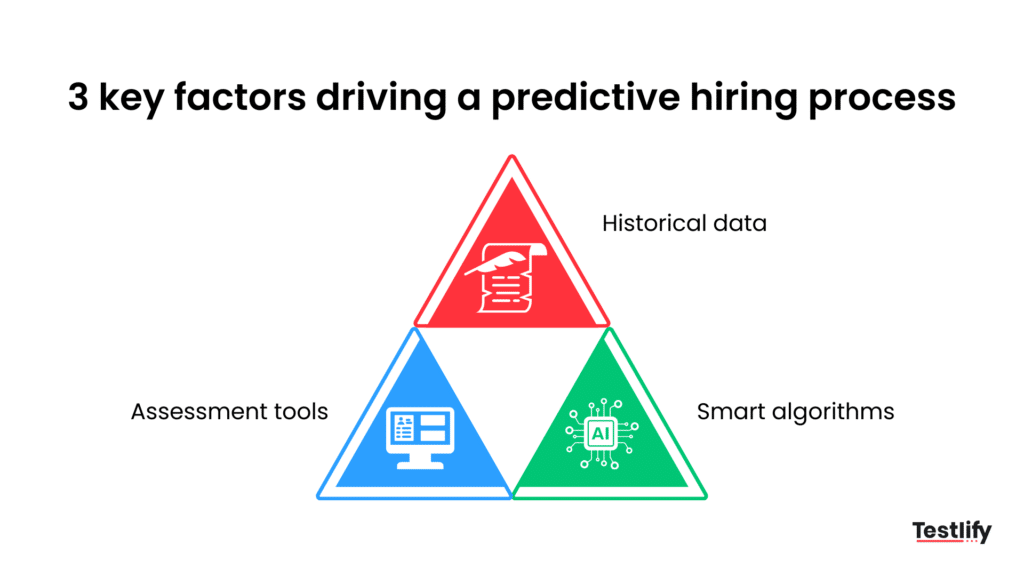
The predictive hiring process relies on three key factors,
- Historical data: Insights from past recruitment cycles to identify patterns and success indicators.
- Intelligent algorithms: These algorithms analyze many candidate attributes, helping hiring managers make more informed and data-driven decisions.
- Assessment tools: These are tools that evaluate skills, cognitive reasoning, and other characteristics to align candidates with company goals and culture.

How does predictive hiring work?
Predictive hiring relies on data and analytics to streamline and improve recruitment. Let’s walk through how it functions step-by-step:
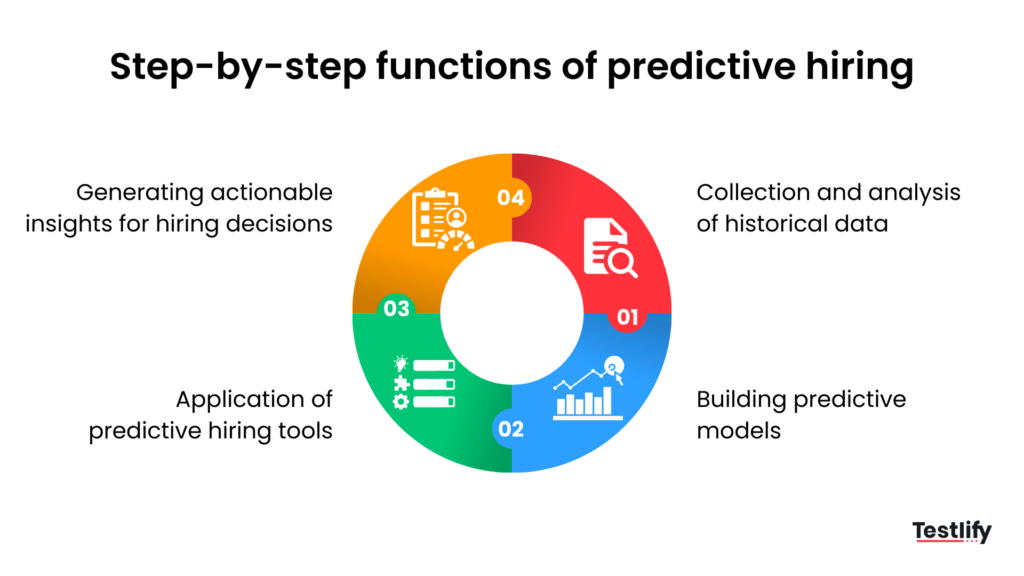
1. Collection and analysis of historical data
The first step involves gathering and analyzing past recruitment data. This includes information such as employee performance metrics, the success rates of previous hires, and details on probation outcomes.
Understanding historical patterns can help companies predict which candidates are likely to excel. Questions such as “How many employees have successfully passed probation?” or “What is the average tenure of our hires?” can provide critical insights.
2. Building predictive models
With historical data in hand, companies create predictive models using advanced algorithms. These models seek to identify patterns that correlate specific skills or traits with job success.
3. Application of predictive hiring tools
Next, predictive hiring tools come into play. These tools utilize data-driven algorithms to score and rank candidates based on how well they align with the job’s success indicators.
Psychometric testing, for example, assesses cognitive abilities, behavior, and workplace personality traits to evaluate a candidate’s fit. Pre-employment assessments provide a clear view of each candidate’s ability. This helps to determine the potential for both performance and cultural fit.
4. Generating actionable insights for hiring decisions
Once candidates are scored, predictive hiring tools generate detailed insights. These insights inform hiring managers about a candidate’s strengths and areas for improvement.
For example, if a candidate demonstrates solid analytical skills but requires training and development in leadership, the tool will highlight this, facilitating informed strategic decision-making.
Advanced platforms like Testlify significantly enhance hiring. Testlify’s AI-powered pre-employment assessments offer detailed evaluations of candidates’ skills, cognitive abilities, and cultural fit.
Its new video interviewing capability further enriches candidate analysis by allowing hiring managers to assess non-verbal cues and communication skills in real-time, making predictive analytics even more precise and actionable.
- Testlify: AI-powered talent assessment and video interview tool
- HireVue: AI-powered assessments and video interviews.
- Pymetrics: Neuroscience-based games to evaluate soft skills.
- Harver: Pre-employment assessments focused on cultural fit.
- Eightfold.ai: AI-powered talent intelligence for optimized recruiting.
The benefits of predictive hiring
Predictive hiring transforms recruitment by helping you make smarter, data-driven decisions. Here are a few benefits of predictive analytics.
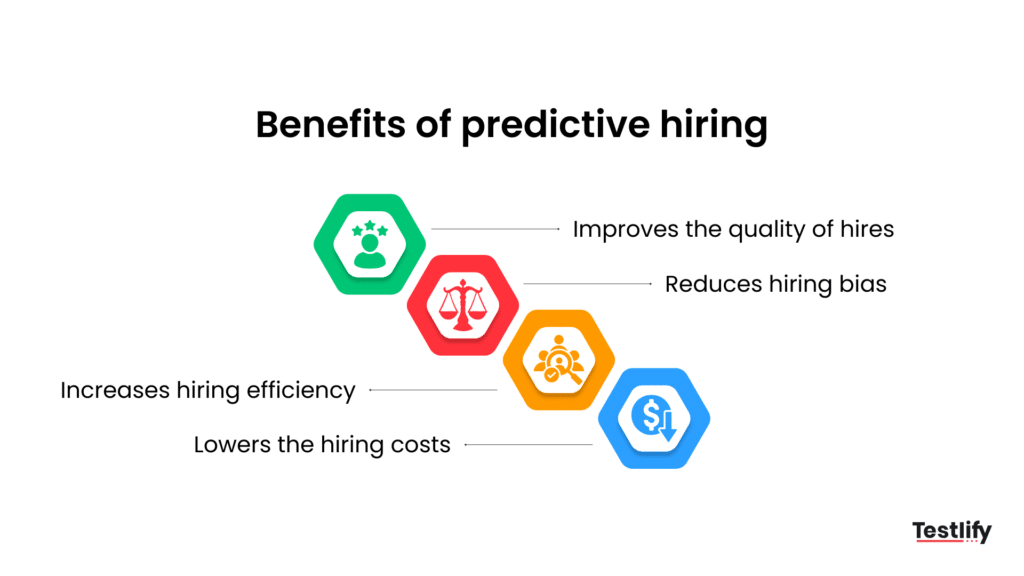
1. Higher quality hires
Predictive hiring tools analyze diverse candidate attributes to accurately predict job performance. According to Deloitte, companies that use predictive analytics report up to a 40% improvement in hiring quality. This approach can help recruiters improve the quality of hires.
2. Reduced hiring bias
Bias, whether conscious or unconscious, can significantly impact hiring decisions. Objective, data-driven evaluations significantly minimize hiring biases, fostering diverse and inclusive workplaces. Gartner found that predictive analytics reduced bias-related hiring issues by up to 50%.
3. Increases hiring efficiency
Speed matters in recruitment, especially when top talent is often off the market in less than 10 days. With predictive hiring, resume screening, and candidate ranking, these processes can be automated. This leads to cutting down the time it takes to identify strong candidates.
Traditional recruitment takes an average of 58 hours per hire. Predictive analytics can cut this by nearly half.
4. Lowers the recruitment costs
Hiring the right candidate the first time minimizes turnover costs, which can be as high as 150% of an employee’s annual salary. This means a more cost-effective recruitment strategy that keeps your budget in check.
Predictive hiring tools give hiring managers valuable insights into candidate behavior and potential. You can tailor your offers, identify skill gaps, or forecast future hiring needs.
Why does predictive hiring matter in today’s job market?
In today’s hyper-competitive job market, top candidates don’t wait around. Research shows that the best talent is typically off the market in just 10 days. Predictive hiring provides that edge by using data-driven insights to pinpoint and secure the best-fit candidates quickly.
But it’s not just about speed; it’s about strategy. Building a solid talent pool has become essential for long-term success.
Predictive hiring uses predictive analytics to identify future top performers. This ensures your organization has a steady pipeline of quality candidates ready to fill job openings.
Why predictive hiring is a game changer –
- Accelerates hiring – Make informed, faster decisions and secure top candidates before your competition.
- Helps build a future-ready talent pool – Maintain a proactive approach by creating a robust pipeline of potential hires.
- Reduces costly turnover – Save significantly by hiring the right talent the first time.
- Enhances company culture – Select candidates who align well, leading to increased job satisfaction and productivity.
How to implement predictive hiring in your organization
Implementing predictive hiring may seem daunting, but breaking it down into manageable steps can make the transition seamless. Here’s how to get started,
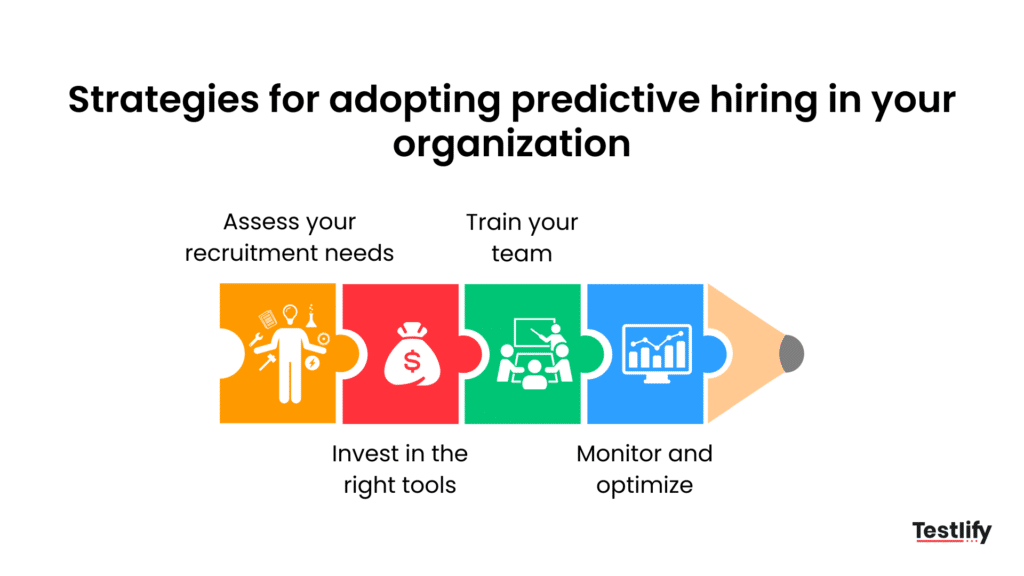
Step 1: Assess your recruitment needs
The first step is to evaluate your current recruiting process. Analyze where inefficiencies or biases may exist and identify areas that need improvement.
Are you spending too much time on manual resume screening? Is your hiring process resulting in high turnover or low employee engagement? Understanding these pain points will help you define clear goals for implementing predictive hiring.
Step 2: Invest in the right tools
Selecting the right predictive hiring solution is crucial. Platforms like Testlify offer scalable and intuitive solutions ideal for businesses of any size, from startups to large enterprises.
Its integration with over 100 Applicant Tracking Systems (ATS) ensures smooth transitions, centralized data management, and seamless operation within existing HR workflows.
Step 3: Train your team
Even the best tools are only as effective as the people using them. Training your hiring managers and HR teams on data-driven practices is crucial. This includes understanding how to interpret predictive analytics and integrate them into hiring decisions.
Workshops or certifications in data literacy can be helpful. Remember, successful implementation relies on everyone being on the same page.
Step 4: Monitor and optimize
Predictive hiring isn’t a set-it-and-forget-it process. Regularly track key metrics like time-to-hire, quality of hires, and employee retention rates to evaluate the effectiveness of your hiring strategy.
Predictive validity: the metric behind accurate predictive hiring
Predictive hiring tools are only as good as the science backing them, and that science has a name: predictive validity. Predictive validity is a psychometrics and statistics concept that measures how well a test or assessment tool predicts future behavior or job performance. In other words, it's the evidence that a "high scorer today" actually becomes a "strong performer later."
Predictive validity works by examining the relationship between two factors: test results and future performance. The strength of that relationship is expressed as a correlation coefficient — a number that shows how closely test scores track with actual job success. A correlation coefficient of 0.7 or above is generally considered strong, indicating a reliable predictor of future performance. This concept is used across recruitment, education, and psychology, but for recruiters it's the difference between an assessment that's just "impressive on paper" and one that's actually proven to forecast on-the-job success.
A report published by forbes found that a bad hire can cost a company up to 30% of the employee's annual salary, or as much as $240,000 for senior roles — underscoring why forecasting success before hiring matters so much.
How testlify's assessments ensure high predictive validity
- Built on science and data: testlify's tests are grounded in psychometrics and data-backed methodologies, designed to measure the exact skills and traits linked to job success.
- Tailored for every role: rather than generic testing, Testlify offers role-specific assessments that evaluate the unique demands of each job.
- Actionable insights, not just scores: recruiters get detailed reports showing how a candidate's performance aligns with the role's requirements, not just a raw score.
- Constantly validated for accuracy: Testlify continuously validates its assessments against real-world performance data to keep them accurate and relevant as roles evolve.
How to measure predictive validity
Measuring predictive validity starts with identifying a criterion variable — the specific outcome you want to predict, such as retention, sales performance, or customer satisfaction. Test scores are recorded at the time of hire, and the candidate's real-world performance is tracked over time against measurable data (kpis, sales targets, and similar benchmarks). The relationship between the two is then examined through a correlation coefficient: the higher the positive correlation (for example, 0.8), the more reliably the test predicts future success. Because market conditions and job roles change, predictive validity should be rechecked at regular intervals rather than treated as a one-time exercise.
Predictive validity vs. concurrent validity
These two validation methods are often confused, but they answer different questions:
Aspect | Predictive validity | Concurrent validity |
Focus | Predicts a candidate's future behavior or performance. | Measures the relationship between test results and current performance. |
Timing | Test scores are collected before hiring; performance is evaluated later. | Test scores and performance data are collected simultaneously. |
Purpose | Forecasts long-term job success and reduces hiring risk. | Validates whether a test aligns with existing performance benchmarks. |
Example | A sales aptitude test predicts how well a candidate will meet sales targets after joining. | A leadership test correlates current managers' scores with their performance reviews. |
Best use case | Recruitment, for building a future-ready workforce. | Internal assessments, such as promotions or skill evaluations. |
Predictive validity is the better choice when hiring for future roles, since it aligns with long-term organizational goals; concurrent validity is better suited to validating a test quickly against performance data that already exists.
Case studies
Several industry leaders have leveraged predictive hiring to enhance recruitment efficiency and quality significantly. Here are compelling examples illustrating how predictive hiring can transform your organization’s talent acquisition strategies:
1. Unilever’s data-driven hiring success
Unilever transformed its recruitment process using predictive analytics, automating initial screening through algorithms analyzing video interviews and cognitive games. This reduced hiring time from four months to four weeks and saved over 50,000 recruiter hours, all while improving hire quality and retention.
2. Hilton’s improved retention rates
Faced with high turnover in customer service roles, Hilton utilized predictive hiring to match candidates’ traits with job demands. The result was a 40% reduction in turnover, accompanied by increased employee satisfaction and productivity.
3. IBM’s use of AI for candidate selection
IBM utilized AI to analyze historical data, boosting hiring accuracy and reducing recruitment costs. This resulted in a 25% increase in hiring efficiency, ensuring that new hires were a strong fit for their roles.
These examples highlight the tangible benefits of predictive hiring. It also showcases how data-driven recruitment can transform your hiring strategy.
Final thoughts
Predictive hiring isn’t just about keeping pace—it’s about strategically leading your industry by acquiring top talent efficiently.
Companies like Unilever, Hilton, and IBM have proven the power of predictive analytics in revolutionizing recruitment.
If your organization is ready to boost recruitment efficiency, improve hire quality, and reduce turnover, it’s time to leverage predictive hiring solutions. Platforms like Testlify can empower your recruitment strategy, ensuring you stay ahead in securing the best talent.
Is your organization ready to adopt predictive analytics and transform hiring outcomes?
Frequently asked questions (FAQs)

B2B SaaS Content Writer
Rishav Kumar is a B2B SaaS content writer with 4 years of experience. He loves crafting engaging content. Always exploring fresh ideas, he's passionate about helping businesses grow through impactful writing.
LinkedInRelated resources
View all
HR & recruitment
Top 8 HR communities recruiters should join

HR & recruitment
10 best recruitment books every recruiter should read in 2026
HR & recruitment
What is talent intelligence? Definition, benefits, and implementation guide

HR & recruitment
What is a job leveling matrix? 3 powerful reasons to use it

HR & recruitment
Hire the best nursing talent with these 3 recruitment strategies

HR & recruitment
Finding the right fit when recruiting for high-demand healthcare roles
Get started.
Hire on proof, not resumes.
Run your first skills-based assessment free — no credit card required.