
6 Stages of the performance management cycle
Learn about the performance management cycle, its stages, and best practices to improve employee growth and productivity in your organization.

Performance management is essential to the success of any organization. It’s not merely about assessing employee performance but entails constant support, feedback, and improvement processes. The Performance Management Cycle is one such effective method for managing employee performance.
According to Gallup, companies with highly engaged workforces achieve 23% higher profitability compared to their competitors.
In this blog post, we’ll take you through the performance management cycle, outline its stages, and show how companies can utilize it to build a positive, high-performing workplace.
 ChatGPT
 Gemini
 Claude
 Grok
Grok Perplexity
What is the performance management cycle?
The performance management cycle is an ongoing process organizations employ to measure and improve the performance of employees. It is a structured process that enables managers and employees to synchronize their objectives, track progress, give feedback, and obtain desired results.
Imagine it more like a feedback loop that continues to get better and better over time. Rather than waiting for a yearly performance review, the cycle focuses on constant improvement, open communication, and frequent check-ins.

6 Stages of the performance management cycle
Although the specific stages can differ based on the organization, a common performance management cycle follows these important steps:
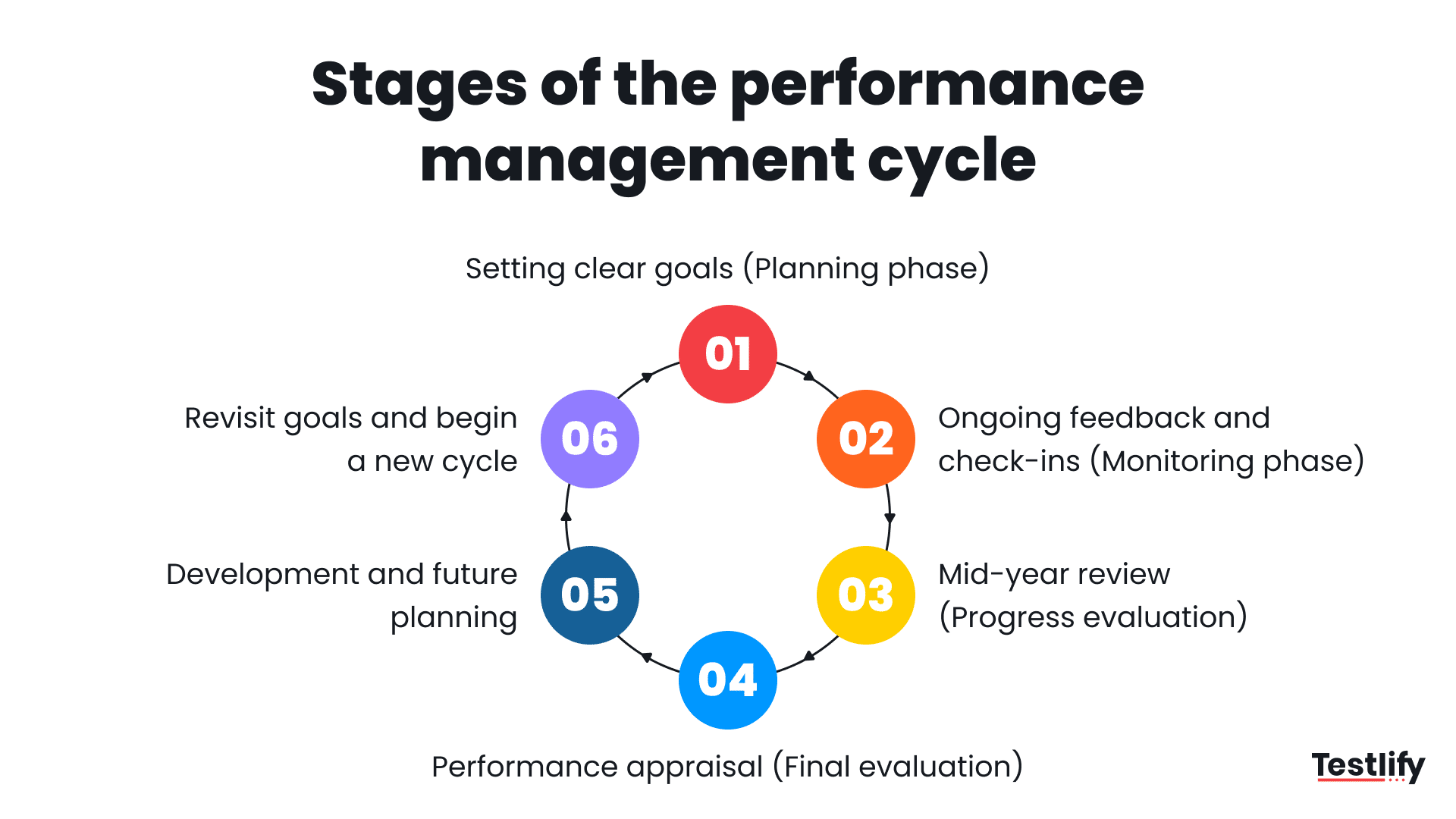
1. Setting clear goals (Planning phase)
The initial step of the cycle is establishing clear, specific, and measurable goals. This is where managers and workers sit down and talk about what is expected of the worker in a specific time frame (most commonly a year or quarter).
Clear goals are important for employees’ success because they give them direction. Employees must know what they are supposed to do, why, and how it will help the organization.
Example:
Suppose you are a salesperson. Your goal could be: “Boost sales by 15% within the next quarter.” This is measurable and specific.
2. Ongoing feedback and check-ins (Monitoring phase)
The second phase is continous monitoring. Rather than waiting until the final performance period, there should be regular feedback. This allows employees to remain on course and make corrections if necessary.
Check-ins enable managers to determine how employees are doing toward their objectives. They can indicate where employees are doing well and where improvements need to be made. Continuous feedback is essential because it forestalls issues getting out of hand and maintains alignment in the process.
Example:
Suppose you’re a manager, and during a monthly check-in, you see that an employee is not achieving their goals. You can provide guidance, propose solutions, or even modify the targets if necessary.
3. Mid-year review (Progress evaluation)
The mid-year review is halfway through the Performance Management Cycle. In this stage, both managers and employees step back to review progress.
It’s an excellent chance to see what’s going right and what isn’t. This is also a good time for employees to request additional support, resources, or guidance.
Example:
Suppose an employee is lagging behind on achieving their goal to drive sales. The mid-year review may help understand training or mentoring possibilities that can enhance performance during the latter half of the year.
4. Performance appraisal (Final evaluation)
At the close of the cycle, there is a formal performance appraisal. This is where the actual evaluation of the employee’s performance is done. Managers will then compare the outcome with the established goals and expectations.
Performance appraisals must be complete, objective, and based on the feedback accumulated during the cycle. It’s also a moment to acknowledge achievements, recognize strengths, and discuss areas of improvement for future growth.
Example:
Suppose that an employee completed 60% of the target for sales. During the performance review, the manager may recognize their excellent performance and recommend actions to bridge the gap.
5. Development and future planning
Following the performance appraisal, it’s time to consider the future of the company.. Development plans must be drawn up to solve areas for improvement and to assist the employee in attaining new objectives. This may involve training courses, fresh challenges, or stretch assignments.
The development phase assists employees to grow in their job and upskill. It also ensures they are always motivated to do their best in the subsequent cycle.
Example:
According to the performance review, an employee can choose to enhance their negotiation skills by attending a workshop to increase sales in the next year.
6. Revisit goals and begin a new cycle
Performance management cycle is a recurring process. New targets are established, expectations are made clear, and employee performance is tracked again. This way, both the individual and the company are continuously bettering themselves.
Example:
An employee who performed well in growing sales may have a more demanding target for the next cycle, e.g., enhancing customer retention or growing their territory.
Why is the performance management cycle important?
The Performance Management Cycle is not only an instrument to measure employee performance. It is essential to the personal and organizational development. Let us consider some of the most important advantages.
1. Clear expectations and direction
With the first goal-setting stage, employees know precisely what is required of them. They know where to direct their efforts and can coordinate their activities with the organization’s goals.
2. Continuous feedback for improvement
Regular feedback enables employees to improve continuously throughout the year rather than waiting for an annual review. This minimizes the likelihood of problems or misunderstandings going undetected.
3. Motivation and engagement
Regular check-ins and performance conversations keep employees motivated and engaged. When employees are valued and given constructive feedback, they are more likely to be committed to their work.
4. Employee development
The Performance Management Cycle is not only about assessing employees but also about helping them grow. By establishing development plans and training, employees can enhance their skills and progress in their careers.
5. Better decision-making for promotions and raises
The information collected during the Performance Management Cycle can help organizations make better decisions when it comes to promotions, raises, and other career advancements. Having a clear picture of an employee’s performance ensures that these decisions are based on merit.
Best practices for managing the performance management cycle
In order to utilize the Performance Management Cycle to the best of one’s abilities, one must employ certain best practices.

1. Be transparent and clear
Make sure managers and employees are on the same page. Make sure you being transparent regarding objectives, expectations, and measurement criteria. Clarity helps in removing ambiguity and brings confidence into the process.
2. Foster two-way communication
The feedback should not be a one-way street. The employees must feel free to give feedback to managers, as managers give feedback to employees. Two-way communication brings better understanding and effective development.
While providing feedback, it’s crucial to maintain constructive feedback. It should focus on how the employee can improve and provide actionable solutions, instead of simply mentioning faults.
4. Set SMART goals
SMART goals (Specific, Measurable, Achievable, Relevant, and Time-bound) work better because they are explicit and measurable. When creating goals, make them realistic and achievable to prevent discouragement.
5. Use technology to streamline the process
There are numerous performance management software applications that can assist in streamlining the process. These applications can monitor goals, feedback, and progress, allowing for easier handling of the cycle.
6. Provide recognition
Everyone loves to be recognized for their hard work. Make sure to acknowledge employees’ achievements during the performance cycle. Recognition boosts morale and motivates employees to keep striving for success.
Challenges of the performance management cycle
Although the Performance Management Cycle is very helpful, it has challenges.
1. Lack of training for managers
Not all managers are equally skilled in providing feedback or performance reviews. Without training, managers can fail to implement the cycle successfully.
2. Bias in evaluations
At times, assessments can be biased by personal opinions, leading to unjust evaluations. It’s important to make sure that performance appraisals are objective-based.
3. Employee resistance
Employees might resist feedback or be uneasy with performance reviews. Creating a culture of trust and openness can overcome this issue.
4. Overcomplication
The Performance Management Cycle must be a continuous process, but if it grows too complex or takes too much time, its usefulness is lost. Keep it simple and lean for maximum benefit.
Conclusion
The Performance Management Cycle effectively drives employees and organizations’ success is an effective driver of success for employees and organizations. It enables to set clear objectives, promotes constant improvement, and facilitates communication between the employee and manager.
Through a systematic cycle, companies can ensure that their employees are engaged, motivated, and constantly developing. When well implemented, the Performance Management Cycle can lead to improved employee performance, improved productivity, and ultimate success for the company.
Frequently asked questions (FAQs)

Content Writer
Yashika Khandelwal is a Content Writer with 3+ years of experience creating research-backed content on hiring, talent assessment, and HR technology. She is a registered Organizational Psychologist and subject matter expert who combines behavioral science with practical recruitment insights to produce accurate, evidence-based content.
LinkedInRelated resources
View all
Hiring Guide
Recruitment vs talent acquisition: Key differences

Hiring Guide
How to succeed at recruiting generation Z employees?

Hiring Guide
Heuristic Bias in Hiring: Types and How to Reduce It

Hiring Guide
5 high volume recruitment strategies to adopt in 2026

Hiring Guide
Talent matching: what it is and how it works

Hiring Guide
What is interview scheduling and how to do it?
Get started.
Hire on proof, not resumes.
Run your first skills-based assessment free — no credit card required.