
Executive hiring playbook: a step-by-step guide
Discover a step-by-step executive hiring playbook for HR leaders to attract, assess, and onboard top leadership talent effectively.

Executive hiring is the structured process of finding, assessing, and onboarding senior leaders, the VPs, directors, and C-suite officers who set strategy and shape culture. Get it right, and one person can lift a whole division. Get it wrong, and the bill is brutal: Gallup puts the cost of replacing a leader or manager at up to 200% of their salary before you count the stalled projects and the team churn that follow a bad hire.
So the goal is not to fill the seat fast. It is to choose with evidence. This executive hiring playbook walks through every step, from writing a sharp role scorecard to a 30-60-90-day onboarding plan, and shows where structured assessment replaces gut feel. Follow it, and you hire smarter, cut risk, and give each new leader a real shot at succeeding.
 ChatGPT
 Gemini
 Claude
 Grok
Grok Perplexity
TL;DR
- Executive hiring covers senior leadership roles (VP and above) and runs 60 to 130 days, far longer than a standard hire.
- The stakes are high: replacing a leader can cost up to 200 percent of their salary, so a structured, evidence-based process pays for itself.
- Run six steps: define the role, build a leadership profile, source passive talent, assess with structure, run a clean interview process, and then make the offer and onboard.
- Score every finalist on the same criteria. Structured interviews and role-relevant assessments predict performance far better than a good conversation.
- Measure quality of hire after the fact, retention, ramp time, and 30-60-90-day goals, and feed what you learn back into the next search.

Why is executive hiring different?
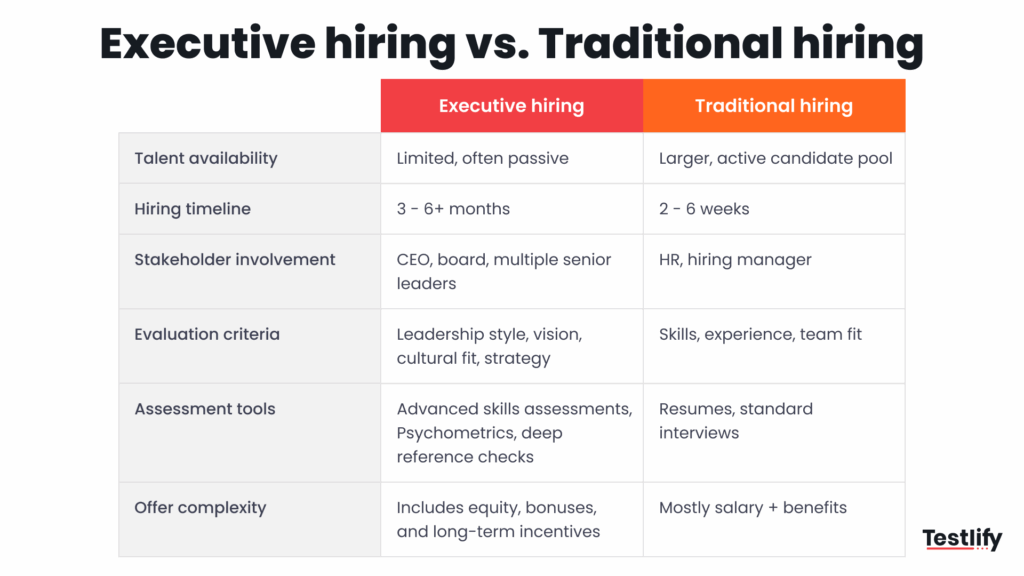
Executive hiring is not senior recruiting with a bigger budget. The math, the timeline, and the risk all change. Most executive searches take 60 to 130 days against roughly 44 for a standard role, and per-hire costs sit at the top of SHRM’s recruiting benchmarking because search fees, assessments, and multi-stakeholder time stack up. Three forces drive the difference.
The stakes are higher
Executives own strategy, budgets, and culture, so a miss ripples across every team they touch. A weak hire at this level can stall growth for a year and push out good people who did not sign up to work for them. That is why the extra weeks of assessment are cheap insurance, not bureaucracy.
The talent pool is smaller
The best candidates are almost never applying. They are performing well somewhere else, and roughly 60 to 80 percent of senior roles get filled through direct outreach, referrals, and board networks rather than a public posting. Reaching them takes a compelling story and a trusted introduction, not a job ad.
The process is longer and more political
More people weigh in on an executive hire, a CEO, the board, peers, sometimes investors, and each adds time and an opinion. Confidentiality matters too, since candidates are often still employed. A clear process keeps a slow, high-stakes decision from turning into a stalled one.
What are the 6 steps in executive hiring?
Here is the core playbook. Each step feeds the next, so skipping one (usually the role definition) is what breaks searches later.
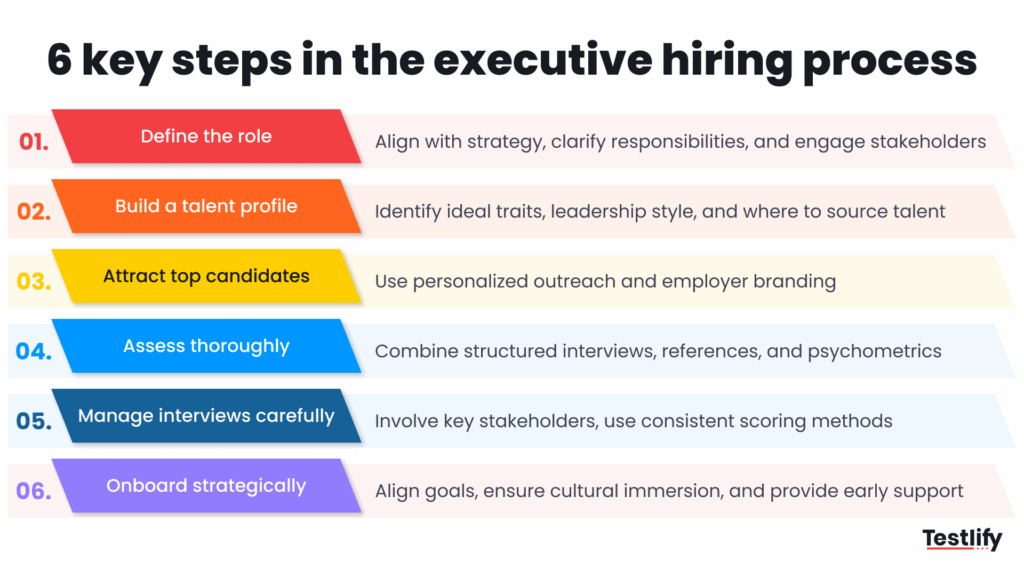
1. Define the role and success scorecard
Start with the problem, not the title. Write down what this leader must achieve in the first year, the three or four outcomes that define success, and the competencies each one demands. This scorecard becomes the yardstick every candidate is measured against, and it keeps the panel honest when a charming resume tempts them off track.
2. Build the leadership profile
Turn the scorecard into a profile: the experience, leadership behaviors, and values the role needs, plus the ones it does not. Separate the true must-haves from the nice-to-haves. McKinsey research makes the case for hiring on demonstrated skills and capability rather than pedigree or a familiar last employer, which widens a shrinking pool without lowering the bar.
3. Source and engage passive talent
Map the market for people already doing the work at a high level, then reach out directly with a specific, honest pitch. At this level discretion wins. A warm introduction from a mutual contact or board member almost always beats a cold message, so use your network before your inbox.
4. Screen and assess with structure
This is where most executive searches leak quality. Replace the free-form chat with a structured process: the same questions, the same scoring rubric, and role-relevant assessments for every finalist. Harvard Business Review has shown that structured interviews predict on-the-job performance far better than unstructured ones and cut bias at the same time. Pair them with a cognitive or leadership assessment and a work sample tied to the scorecard.
Pro Tip: Send finalists a short, realistic exercise drawn from the actual job, a board memo, a turnaround plan, and a 90-day operating plan. How a candidate frames the problem tells you more than any rehearsed interview answer.
5. Run a clean interview process
Keep the panel small and deliberate. Two focused conversations usually beat six scattered ones: first, the hiring manager, then a diverse panel of peers and stakeholders, each assigned specific areas to probe, so you are not asking the same five questions five times. Debrief with scores, not vibes, and decide quickly. Drag it out, and your top choice takes another offer.
6. Make the offer and onboard
Research the market before you name a number, then move fast on a competitive package. The hire is not done at the signature. Set 30, 60, and 90-day goals, introduce the key relationships early, and check in often. Executive transitions fail more often for weak onboarding and stakeholder gaps than for missing skills, so treat the first quarter as part of the hire. Our onboarding process guide covers the mechanics in depth.
Related Read: Executive Assistant
How do you assess executives fairly?
One interview, however good, is a fragile basis for a seven-figure decision. The fix is to judge senior candidates on several independent signals and then let people, not an algorithm, make the call. That is the idea behind the Testlify Human-Led Decision Scorecard: it gathers assessment results, structured interview scores, reference feedback, and reviewer ratings into one consistent view so a hiring committee can compare finalists on the same evidence instead of the loudest opinion in the room. AI helps organize and surface the evidence; the humans still own the decision.
In practice that means mapping each competency on your scorecard to a concrete signal: a leadership assessment for judgment, a structured interview for how they lead, a work sample for how they think, and references for how they actually behaved. A psychometric test or a cognitive assessment adds an objective read that a polished conversation can hide. Score each signal, weight them against the role, and the shortlist ranks itself on merit.
Getting this right also lifts quality of hire, the metric that actually matters once the confetti settles.
Executive vs standard hiring: what’s the difference?
The two processes share a vocabulary but little else. Here is how they compare on the factors that decide the outcome.
Factor | Executive hiring | Standard hiring |
|---|---|---|
Typical time to fill | 60 to 130 days | About 44 days |
Candidate pool | Small, mostly passive leaders | Larger, many active applicants |
Main sourcing channel | Direct outreach, referrals, networks | Job boards and inbound applications |
Cost of a wrong hire | Up to 200% of salary | Roughly 40% to 80% of salary |
Decision-makers | CEO, board, peers, investors | Hiring manager and recruiter |
Confidentiality | High, candidates often employed | Usually low |
Best practices in executive hiring
A few habits separate searches that land from searches that stall.
- Weigh values and culture as much as skills. A leader who clashes with how the company works can be technically perfect and still fail. Probe how they have led through change, not just what they have delivered.
- Protect confidentiality. Guard candidate names and internal details. A leak can cost someone their current job and cost you the hire.
- Build a diverse slate on purpose. Homogeneous shortlists produce homogeneous leadership. Widen sourcing early rather than bolting diversity on at the end.
- Keep communication tight. Senior candidates read silence as disorganization. Frequent, honest updates keep your top choice warm.
- Plan for the drop-out. Keep a viable second choice. At this level, offers fall through, and a restart costs months.
For related workflows, our guide to managing the hiring process breaks down how to keep any hiring process moving without losing candidates.
What are common executive hiring mistakes?
Most failed executive hires trace back to the same handful of errors. Name them early, and they are easy to avoid.
- Vague role definition. If the panel cannot agree on what success looks like, they cannot agree on a candidate. Fix it with the scorecard in step one.
- Hiring for pedigree over proof. A famous former employer is not evidence of fit. Assess the skills the role needs now.
- Ignoring cultural fit. Skills get someone hired; values fit keeps them effective. Skip it, and you risk an early, expensive exit.
- Letting the process drift. Every extra week raises the odds that a strong candidate will accept elsewhere. Move with urgency.
- Treating onboarding as optional. A leader dropped in without a plan is set up to stumble. Build the first 90 days before day one.
How do you measure hiring success?
You cannot improve a search you never grade. Track a small set of outcomes and review them honestly. Early signals: did the new leader hit their 30, 60, and 90 day goals, and are stakeholders confident? Longer term: retention past the first year, quality-of-hire ratings from their manager, and whether the team they inherited is performing better. Feed those findings back into the scorecard, the assessments, and the panel so each search beats the last. Strong onboarding and retention go hand in hand, so it helps to also track how you retain top leaders once they are in the seat.
Key takeaways
- Treat executive hiring as risk management, not seat-filling. A wrong hire can cost up to 200 percent of salary plus a year of stalled progress, so the weeks spent on structure return more than they cost.
- The scorecard is the whole game. Defining success and the competencies behind it up front is what keeps a multi-stakeholder panel aligned; skip it and every later step wobbles.
- Source proactively, because the best leaders are not applying. With 60 to 80 percent of senior roles filled through outreach and referrals, your network and a clear pitch matter more than any job ad.
- Structure beats charisma in the room. Same questions, same rubric, and role-relevant assessments predict performance far better than a great conversation, and they reduce bias, so score finalists on evidence.
- Keep decisions human but multi-signal. Combine assessments, structured interviews, and references on one scorecard, then let people decide; that is how you protect quality and defensibility at the same time.
- Onboarding is part of the hire. Most executive transitions that fail do so on weak onboarding and stakeholder gaps, so build the 30-60-90 day plan before day one.
- Measure and learn. Track ramp, retention, and quality of hire, then feed the results back into your process so each search is sharper than the last.
Frequently asked questions (FAQs)

Content Writer
Yashika Khandelwal is a Content Writer with 3+ years of experience creating research-backed content on hiring, talent assessment, and HR technology. She is a registered Organizational Psychologist and subject matter expert who combines behavioral science with practical recruitment insights to produce accurate, evidence-based content.
LinkedInRelated resources
View all
Hiring Guide
Talent recruitment trends that are influencing 2026

Hiring Guide
What’s holding your careers page back from attracting top talent

Hiring Guide
How upskilling can drastically improve workplace wellbeing

Hiring Guide
How should you handle sensitive information in the hiring process

Hiring Guide
Direct vs indirect hiring costs: A complete breakdown

Hiring Guide
The Role of HR in CMMS Implementation Success
Get started.
Hire on proof, not resumes.
Run your first skills-based assessment free — no credit card required.