
What is lateral hiring and why is it important?
Explore the lateral hiring process, its benefits, challenges, and strategies for hiring top experienced talent

Lateral hiring is what happens when you stop training someone to do the job and simply hire the person who already does it somewhere else. Same level, same kind of work, a different logo on the laptop.
It matters because it is the fastest way to buy a skill your team does not have. A campus hire needs a year before they carry real weight. A lateral hire is expected to carry it inside a quarter, which is exactly why the hiring bar has to be different too. You are not measuring potential any more. You are verifying a claim.
TL;DR / Key Takeaways
- Lateral hiring means recruiting an experienced professional into a role at roughly the same seniority they already hold elsewhere.
- It buys speed and a skill you cannot grow in time, and it costs more per hire than campus recruiting.
- Years of experience predict performance poorly, so a lateral process that only reads CVs is guessing.
- The fix is structured evidence: a work sample, a structured interview, and more than one reviewer scoring the same thing.
- Lateral candidates are employed and rarely desperate, so a slow or vague process loses them before the offer stage.
 ChatGPT
 Gemini
 Claude
 Grok
Grok Perplexity
What is lateral hiring? Meaning and definition
Lateral hiring is the recruitment of an experienced professional from outside your organization into a role at a similar level of seniority to the one they already hold. The hire brings proven skills and industry knowledge, so the company skips the long ramp-up that entry-level recruiting requires and expects contribution within weeks.
The word doing the work in that definition is similar. A move from senior analyst at one firm to senior analyst at another is lateral. A move from senior analyst to team lead is a promotion, and it is recruited differently because you are now betting on capability the candidate has not yet demonstrated.
Lateral hiring also happens inside a company, when someone moves sideways into a different function at the same level. Most of the time, though, the term means an external, experienced hire, and that is how this guide uses it.
Lateral hire and lateral applicant meaning
A lateral hire is the person themselves: the experienced professional who joins at a level comparable to their previous one. A lateral applicant is that same person before you make the offer, someone applying sideways rather than up. Both terms describe the direction of the career move, not the quality of the candidate. Neither implies a step down, which is a common misreading that costs teams good people when a recruiter frames the role clumsily.
You will also see lateral entry, used mostly in law firms, government and teaching for an experienced person entering an organization partway up the ladder rather than at the bottom.
What is lateral recruitment?
Lateral recruitment is the process that produces a lateral hire: defining the role against the skills you are missing, sourcing people who already perform it, assessing what they can actually do, and closing someone who was not looking for a job. Hiring is the outcome. Recruitment is the work that gets you there.
The practical difference from volume recruiting is sourcing. Lateral candidates are usually employed and passive, so they arrive through referrals, targeted outreach and your own careers page rather than through a job-board flood. Building those hidden talent pools before a role opens is what separates teams who fill senior roles in weeks from teams who take two quarters.

Why do companies hire laterally?
Because some skills cannot be grown fast enough to matter. Employers expect 39% of workers' core skills to change by 2030, according to the World Economic Forum's Future of Jobs Report 2025, which surveyed more than 1,000 employers representing over 14 million workers. That figure is down from 44% in 2023, so the churn is stabilizing, but it is stabilizing at a level where waiting 18 months for an internal candidate to be ready is a real business cost.
The other reason is supply. Median employee tenure in the United States fell to 3.9 years in January 2024, the lowest the Bureau of Labor Statistics has recorded since 2002, down from 4.1 years in January 2022. More experienced people are in motion than a decade ago. That cuts both ways, and the second cut is the one teams forget: the person you poach has a shorter average stay than your last generation of hires, so the payback window on a lateral hire is tighter than the business case usually assumes.
What teams actually buy with a lateral hire:
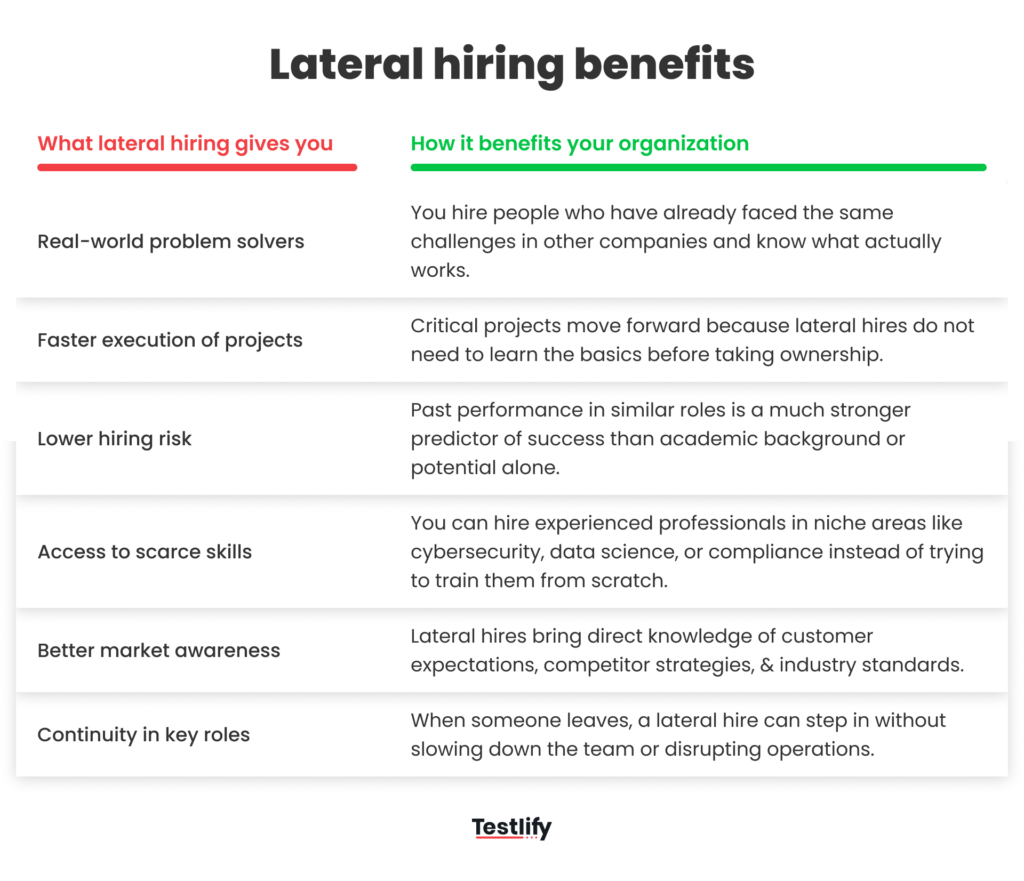
- Speed to contribution: The hire has done the work before, so onboarding covers your context rather than the craft.
- A specific missing skill: One person who has already solved the problem you are stuck on beats three who are willing to learn it.
- An outside view: Someone who has watched another company get this right will tell you what you are doing badly, if you make it safe to say so in the first month.
- A network: Experienced people arrive knowing vendors, tools and other candidates. That is a hiring channel in itself.
Lateral hiring vs campus hiring: which fits?
Lateral hiring targets experienced professionals for immediate capability, one role at a time. Campus hiring targets graduates in cohorts for long-term pipeline, accepting a training period before they contribute. Most teams need both: laterals for the roles that are on fire, campus for the bench you will need in three years.
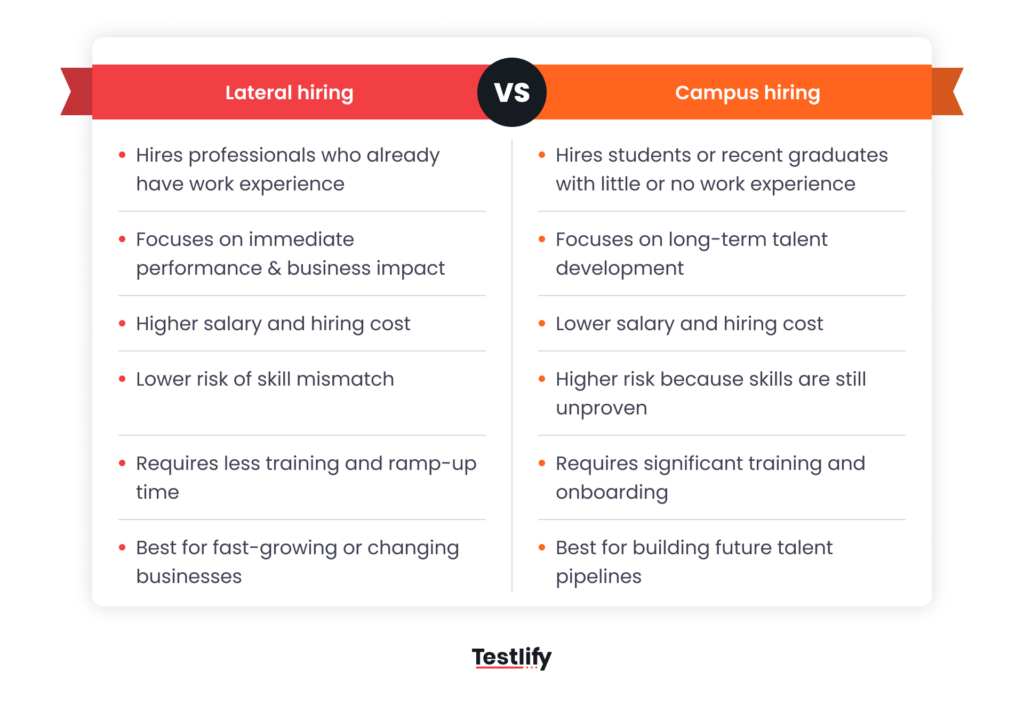
Dimension | Lateral hiring | Campus hiring |
|---|---|---|
Who you hire | Experienced professionals, typically 3 or more years in the role | Final-year students and recent graduates |
Hiring volume | One role at a time, often confidential | Cohorts, batch interviews, placement drives |
Time to productivity | Weeks, once your context is learned | 6 to 12 months of structured training |
Cost per hire | Higher, plus a salary premium to move someone | Lower per head, higher training investment |
What you assess | Demonstrated skill and judgment in the actual job | Aptitude, learning speed and cognitive ability |
Main risk | Overpaying for a resume that does not survive contact | Attrition before the training investment pays back |
Best used for | Urgent skill gaps, senior and niche roles | Repeatable entry roles and long-term pipeline |
The choice is rarely philosophical. If the role has a deadline attached and nobody internal can be ready for it, you hire laterally and pay the premium. If you are building a function that needs 20 people doing similar work in three years, campus is cheaper and produces better cultural cohesion.
What does a lateral hiring example look like?
The pattern repeats across sectors: a team needs a capability faster than it can build one.
Marketing and creative agencies
An agency wins a retainer that needs a paid-media lead who has run budgets at that scale before. Nobody on the team has. They hire a senior performance marketer from a competing agency, and the new hire is running the account in three weeks because the craft transfers even though the clients do not.
Accounting and professional services
A mid-sized firm picks up a run of clients in a sector it has never served. Rather than train three existing accountants on unfamiliar regulation, the partners bring in one senior accountant who has spent six years in that niche, and have them bring the rest of the team up to speed.
Construction and skilled trades
A contractor bidding on a larger project needs a site manager who has run something that size safely. This is the clearest case for lateral hiring, because the evidence is concrete: projects delivered, certifications held, safety record. The judgment that keeps a site running cannot be taught in a graduate program.
Technology and SaaS
A product team hits a scaling problem nobody has solved before and hires a senior engineer who has. One person who has already lived through it can save a quarter of engineering time.
Senior leadership
A founder-led company reaches the point where the CEO cannot personally approve everything. The first senior operations or finance leader is almost always a lateral hire, and it is the highest-stakes one a company makes, because a mis-hire at that level resets the org chart twice.
What does the lateral hiring process look like?
A lateral process is shorter than a graduate funnel and much less forgiving. Seven steps, in order:
- Define the gap, not the job title: Write down what the person must be able to do in their first 90 days. If two people on the panel describe that differently, you are not ready to open the role.
- Translate the gap into competencies: Turn "senior data analyst" into the four or five skills that actually decide the outcome, and agree how each will be evidenced before anyone sees a resume.
- Source where employed people are: Referrals, targeted outreach, your careers page, alumni of the companies that train this skill well. Job boards fill entry roles, not lateral ones.
- Screen on skills, not on the employer logo: A recognizable previous company is a proxy, and a weak one. What they personally shipped is the signal.
- Assess the actual work: A short work sample or role-relevant assessment tells you more in 40 minutes than a second interview does in an hour.
- Run a structured interview: Same questions, same order, same scoring rubric for every candidate. This is the step teams skip for senior hires, and it is the step the research says to keep.
- Decide as a group, then move fast: Two or more reviewers score independently before they discuss. Then close quickly, because your candidate has a job already and a counter-offer coming.
For the longer version of steps one and two, including how to plan roles a quarter ahead, see our guide to building a lateral hiring strategy.
How do you evaluate a lateral hire fairly?
Start from an uncomfortable finding. In the most-cited modern reanalysis of selection research, Sackett and colleagues (2022) place general years of experience among the weaker predictors of job performance, while structured interviews sit among the strongest. The exact coefficients are still argued over in the journals, but the ranking survives every reanalysis.
Read that next to how lateral hiring is usually run and the problem is obvious. The entire premise of a lateral hire is experience, the resume is mostly a record of experience, and experience is the thing that predicts performance least well. Nine years at a respected firm tells you someone kept a job for nine years. It does not tell you whether they were the person solving the problem or the person sitting next to them.
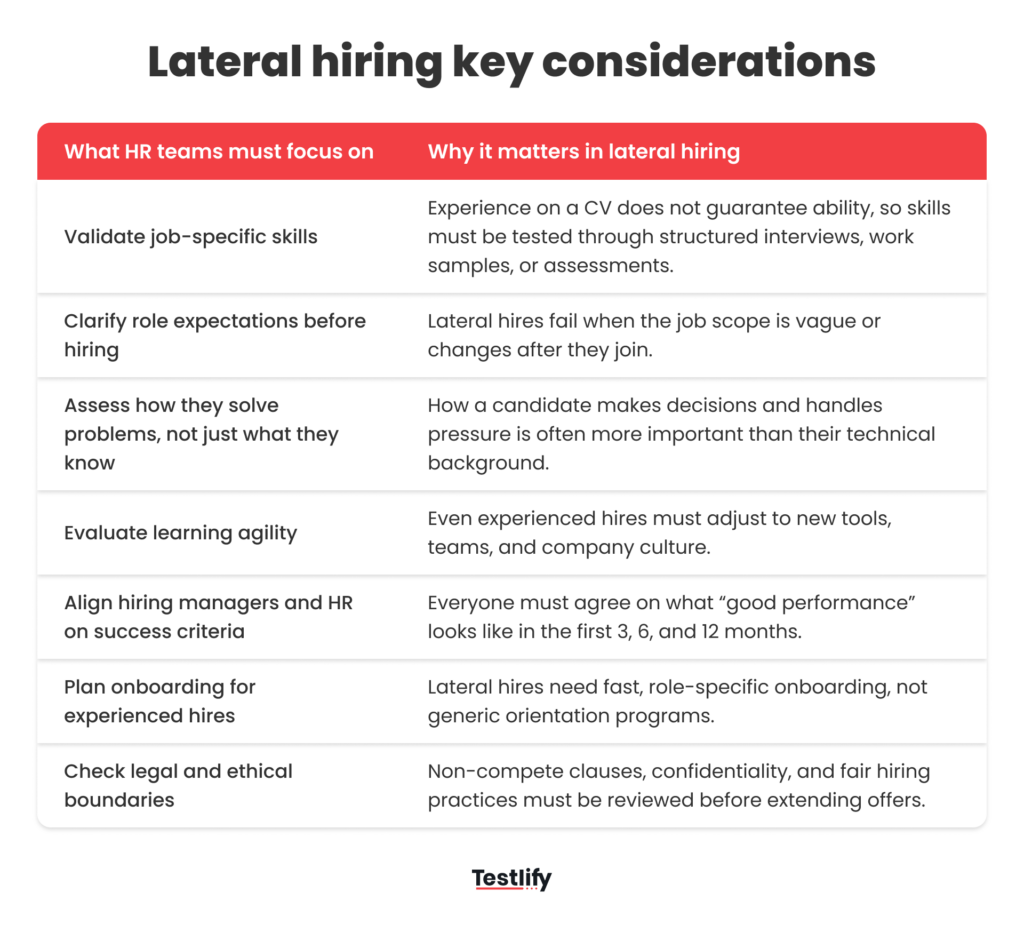
So evidence has to come from somewhere other than the CV. The Testlify Multi-Signal Talent Evaluation Model is the approach we use for this: combine several role-relevant signals rather than trusting one. A skills assessment or work sample for the craft, a structured interview scored against a rubric, reference evidence where it matters, and more than one reviewer rating the same candidate independently. One signal is fragile. Several pointing the same way is a decision you can defend.
What that looks like in practice for a senior role:
- A role-specific assessment or short work sample, scored against a benchmark rather than a gut feel.
- A structured interview where every candidate answers the same questions in the same order.
- Independent scoring by two or more reviewers before anyone compares notes, which stops the loudest voice in the debrief from deciding the hire.
- References treated as evidence collection, not a formality at the end.
Pro tip: Run the assessment before the first long interview, not after. It reverses the usual order, and it saves the expensive hour. If a candidate cannot do the work, you learn it in 40 minutes rather than after three panel rounds, and the candidates who do pass arrive at interview with something concrete to talk about.
Fairness is the other half of this. The same rubric applied to everyone is what makes a senior hiring decision explainable later, to a rejected candidate, to a regulator, or to the team that has to work with the person. AI can summarize and score, but the hiring call stays with a human who can explain it.
Why does candidate experience decide lateral hires?
Because lateral candidates are not job hunting. They have a job, a salary and a manager who probably likes them. Every friction point in your process is a reason to stop replying, and unlike an unemployed applicant, they lose nothing by ghosting you.
The failure mode is rarely rejection. It is silence: a candidate who goes quiet after round two because four weeks passed with no update and the role stopped feeling real.
Candidate experience on a careers site matters to lateral hires
An employed senior person almost always looks at your careers site before replying to a recruiter. What they are checking is whether the company is serious. Does the job description describe real work, or a list of adjectives? Is the salary range visible? Is it clear how many stages there are and how long they take? A vague posting reads as a vague company, and a passive candidate with no urgency simply closes the tab.
Three things fix most of it. Publish the range. State the number of stages up front and stick to it. Reply within a week, every week, even when the answer is that the panel is still deciding. None of that is expensive, and it is most of the difference between a lateral pipeline that converts and one that leaks.
What are the challenges of lateral hiring?
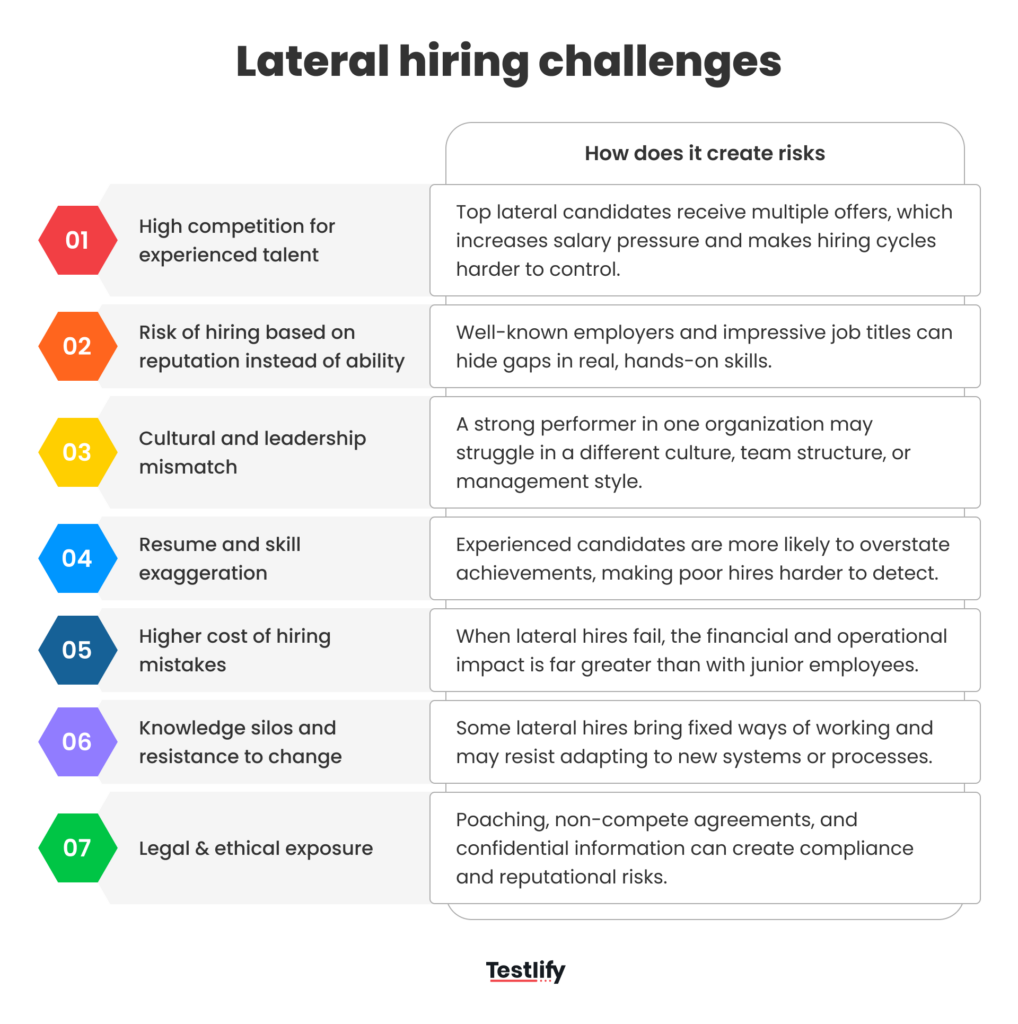
Pay compression: Market rate for a new hire is often above what a loyal internal person at the same level earns. Get this wrong and you buy one good hire while quietly annoying four people who already work for you. It is worth planning salary parity between new and existing staff before the offer goes out, not after someone compares notes.
Retention risk: Somebody who moved for you can move again. Gallup puts the cost of replacing an employee at one-half to two times their annual salary, which is the number that should govern how much effort goes into the first 90 days. The work of setting lateral hires up for success is not an HR nicety; it is how the premium you paid gets repaid.
Culture friction: The outside view you hired them for is the same thing that makes them say "at my old company we did this differently" in week three. That is not a defect. It becomes one when nobody tells them how decisions actually get made here.
Ethics and reputation: Hiring from a partner, a client or the same small industry circle carries consequences that outlast the role, including confidentiality questions about what a new hire brings with them. Worth reading on ethical considerations in lateral hiring before you go hunting in a small market.
Overcorrecting on the resume: The most common error is the one the research points at: paying a premium for tenure at a recognizable company and calling it diligence. Transferable skills matter more than the logo, and they have to be measured to be known.
Hire lateral talent on evidence, not resumes
If lateral hiring is the plan, the evaluation has to be better than a conversation about a CV. Testlify gives you role-specific skills assessments, coding and work-sample questions, AI-assisted interviews with human scoring override, and multi-reviewer scorecards, so an experienced candidate's claim gets checked the same way for everyone. It plugs into the ATS you already run, and there is a simple built-in hiring pipeline if you do not have one.
See how it works on our lateral hiring software page, or book a demo and bring a role you are struggling to fill.
FAQs

Related resources
View all
Hiring Guide
How to overcome challenges in healthcare industry hiring with pre-hire tests?

Hiring Guide
How to fix SaaS industry hiring bottlenecks with pre-hire testing?

Hiring Guide
How to build an engagement strategy that starts at hiring

Hiring Guide
Executive hiring playbook: a step-by-step guide

Hiring Guide
Talent recruitment trends that are influencing 2026

Hiring Guide
What’s holding your careers page back from attracting top talent
Get started.
Hire on proof, not resumes.
Run your first skills-based assessment free — no credit card required.