
Emerging trends in lateral hiring
Lateral hiring evolves with trends like digital transformation, data-driven recruitment, remote work, and a focus on soft skills, reshaping how organizations attract top talent.

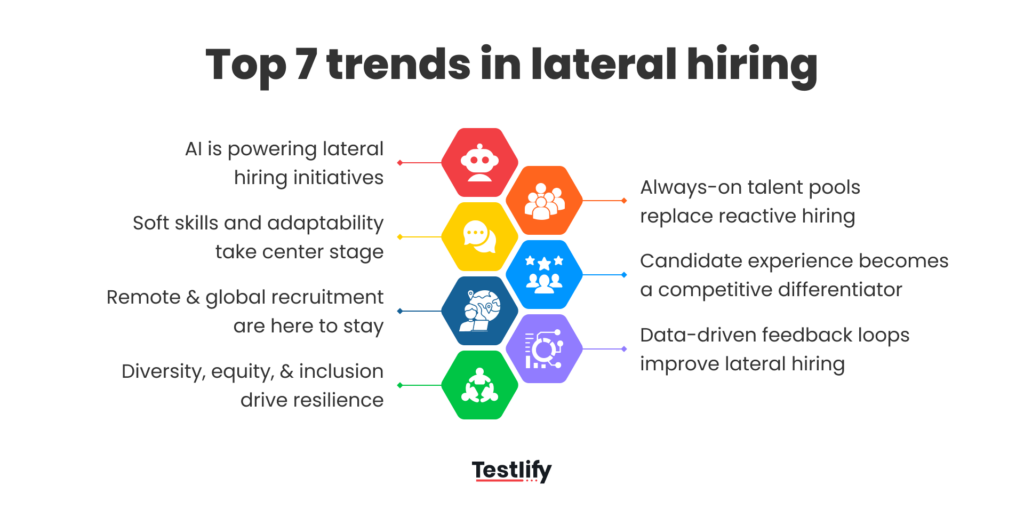
The emerging trends in lateral hiring are changing the rules of how experienced talent is found, evaluated, and brought into organizations. As business cycles accelerate and skill requirements evolve faster than job descriptions, traditional hiring signals such as job titles, years of experience, and pedigree are no longer sufficient to predict success.
As a result, HR teams are increasingly relying on role-specific assessments, job simulations, and structured interviews to validate candidate job skills. In lateral hiring, where new hires are expected to deliver results quickly, this approach leads to stronger hires while widening access to proven talent beyond traditional backgrounds.
In this article, we’ll look at the emerging trends in lateral hiring and how HR teams are adjusting their strategies to hire for impact, not just experience.
 ChatGPT
 Gemini
 Claude
 Grok
Grok Perplexity
1. AI is powering lateral hiring
AI is no longer an experimental add-on in lateral hiring and has become core infrastructure. Boston Consulting Group (BCG) predicts that over 70% of talent acquisition platforms will be AI-powered, embedding automation and intelligence across sourcing, screening, matching, and interview analysis. Adoption is already widespread, with the majority of organizations using AI in some form and most reporting measurable improvements in hiring outcomes.
How AI is improving lateral hiring
AI is reshaping lateral recruitment by shifting effort away from manual execution and toward higher-quality decision-making:
- Faster candidate identification: AI scans large talent pools to surface candidates with relevant and transferable skills in seconds, not days.
- Smarter ranking: Applicants are prioritized based on role fit and demonstrated capability, reducing reliance on résumé heuristics.
- More consistent evaluations: AI-driven skills tests and interview analysis apply uniform criteria, helping reduce variability across hiring teams.
- Improved recruiter focus: By automating repetitive tasks like résumé screening and candidate messaging, recruiters spend more time on strategic judgment and stakeholder alignment.
Related resources: How to use AI and ATS for efficient lateral hiring
The outcomes HR teams are seeing
Organizations adopting AI in lateral hiring report tangible gains:
- Higher quality of hire: Nearly three-quarters of companies using AI say it has improved hiring outcomes by better matching candidates to role requirements.
- Shorter time-to-hire: Automated screening and ranking significantly reduce early-stage hiring bottlenecks.
- Better prediction of success: Some organizations now use AI models to forecast which candidates are most likely to perform and stay in critical roles.
- Scalable hiring operations: AI enables teams to handle higher applicant volumes without sacrificing rigor or consistency.
Responsible use remains critical
As AI adoption accelerates, HR leaders are also strengthening governance:
- More than three-quarters of organizations now have ethical AI policies in place to address bias, fairness, and transparency.
- Human oversight remains essential, with AI supporting decisions and not replacing accountability.
The bottom line
AI has become the engine of modern lateral hiring. It enables faster, more data-driven decisions, improves hiring precision, and allows HR teams to scale without compromising quality. Organizations that treat AI as a strategic capability rather than a productivity shortcut are better positioned to build high-impact lateral talent pipelines.

2. Always-on talent pools replace reactive hiring
Lateral hiring is increasingly shifting from a reactive hiring activity to a continuous workforce development strategy. Instead of initiating a search only after a role becomes vacant, leading organizations are building always-on talent pools for roles that have a direct impact on business continuity, revenue, or customer experience.
What’s changing in practice
Always-on hiring shows up in very tangible ways inside HR teams:
- Roles are prioritized upfront: HR identifies 5–10 high-impact lateral roles that recur frequently or are business-critical.
- Candidates are assessed before demand exists: Shortlisted talent are made to complete role-specific skill assessments even when no immediate opening is available.
- Pipelines are segmented by capability: Candidates are grouped by skill depth, seniority, and readiness, not just job titles.
- Hiring managers stay aligned: Talent pools are reviewed periodically with business leaders to ensure relevance as role expectations evolve.
The outcomes HR teams are seeing
Organizations using an always-on talent pool experience clear, operational benefits:
- Time-to-fill drops sharply: When a role opens, recruiters engage candidates who are already screened and skills-validated.
- Fewer rushed decisions: Hiring managers choose from known, evaluated talent rather than settling for “best available” under pressure.
- More predictable hiring cycles: Recurring lateral roles are filled consistently without long sourcing gaps.
- Stronger candidate experience: Candidates move faster and with more clarity because expectations were set early.
How these talent pools are actively maintained
Always-on pipelines require disciplined upkeep, not passive databases:
- Continuous skill readiness checks: Candidates have complete short, role-specific reassessments or updated work samples every quarter to confirm their skills still meet current job requirements.
- Regular engagement cadence: HR teams keep candidates warm through scheduled touchpoints such as talent newsletters and periodic check-ins, ensuring ongoing engagement and up-to-date availability.
- Reactivation of silver-medalist talent: High-performing candidates from recent hiring cycles are flagged, reassessed for current needs, and directly reintroduced into active hiring workflows
- Data-driven pruning: Candidate activity, assessment results, and responsiveness are reviewed regularly to remove outdated profiles and keep talent pools accurate and actionable.
The bottom line
Always-on talent pools make lateral hiring faster, calmer, and more predictable. By shifting assessment and engagement upstream, HR teams reduce last-minute hiring pressure, improve decision quality, and ensure critical roles are filled with minimal disruption to the business.
3. Soft skills and adaptability take center stage
As roles evolve faster and organizations operate in increasingly fluid environments, lateral hiring is placing greater weight on how candidates think, communicate, and adapt to changing circumstances. While technical expertise remains essential, it is no longer sufficient on its own.
What’s changing in lateral hiring
Employers are broadening their evaluation lens to focus on human capability and learning potential:
- Greater emphasis on soft skills: Problem-solving, communication, collaboration, and leadership potential are being assessed alongside technical competence. Focus on adaptability: Candidates are expected to learn quickly, adopt new tools, and adjust to changing priorities.
- Reduced tolerance for misalignment: Cultural fit and behavioral alignment are now seen as critical to lateral success.
- Balanced skill evaluation: Hard skills validate readiness; soft skills determine long-term effectiveness.
The outcomes HR teams are seeing
Organizations that prioritize soft skills and adaptability report stronger hiring outcomes:
- Lower early attrition:78% of employers report hiring technically strong candidates who failed due to poor soft skills or cultural misfit.
- Improved team performance: Adaptable hires integrate faster and collaborate more effectively across functions.
- Higher long-term productivity: Employees with strong learning agility continue to add value as roles evolve.
- More resilient workforces: Teams become better equipped to handle change without constant rehiring.
How these skills are being evaluated
HR teams are adapting their hiring methods to assess beyond the résumé:
- Structured behavioral interviews: Consistent questions designed to reveal communication style, judgment, and decision-making.
- Soft skill assessment tests: Standardized evaluations that measure traits such as emotional intelligence, teamwork, resilience, and leadership potential.
- Conversational AI interviews: Structured AI-led interviews designed to measure how candidates think, articulate ideas, and respond to role-specific challenges.
- Multi-skill evaluations: Soft skills are measured alongside technical ability rather than treated as a secondary filter.
The bottom line
In lateral hiring, technical ability gets candidates through the door, but soft skills and adaptability determine whether they succeed once inside. By elevating these traits during evaluation, HR teams reduce costly hiring mistakes, improve retention, and build workforces capable of thriving amid constant change.
4. Candidate experience becomes a competitive differentiator
In lateral hiring, experienced candidates are evaluating employers just as closely as employers evaluate them. With multiple opportunities available, the quality of the hiring experience itself increasingly influences who wins top talent.
What’s changing in lateral hiring
Organizations are redesigning hiring journeys to remove friction and build trust:
- Hiring speed matters more: Lengthy, multi-stage hiring processes increase candidate drop-offs and raise the risk of losing top talent to faster-moving employers.
- Communication is non-negotiable: Candidates expect clear visibility into timelines, evaluation stages, and expectations at every step of the hiring journey.
- Flexibility is expected: Video interviews, asynchronous evaluations, and after-hours scheduling are becoming standard practices for senior and hard-to-fill roles. Ownership is centralized: Assigning a single recruiter or hiring contact ensures consistency, accountability, and a smoother experience for candidates throughout the process.
The outcomes HR teams are seeing
A strong candidate experience delivers measurable advantages:
- Higher offer acceptance rates: 66% of candidates say a positive interview experience directly influences their decision to accept an offer.
- Reduced candidate fallout: Poor communication and unclear expectations cause 26% of candidates to decline offers.
- Stronger employer perception: Respectful, transparent processes leave a lasting impression even among candidates who aren’t hired.
- Future talent advocacy: Candidates who feel valued are more likely to reapply, refer others, or speak positively about the brand.
How organizations are improving candidate experience
HR teams are operationalizing experience improvements through:
Related Read: 6 new and emerging trends in developer evaluation assessments
- Streamlined workflows: HR teams are reducing unnecessary handoffs, consolidating interview stages, and speeding up decision-making to shorten time-to-offer without compromising evaluation quality.
- Consistent communication: Candidates receive timely and predictable updates at every stage through recruiter touchpoints or automated notifications, eliminating uncertainty about next steps.
- Candidate feedback loops: Organizations actively gather candidate feedback through surveys and funnel analytics to identify drop-off points and continuously improve the hiring experience.
- Clear role expectations: Hiring teams set early clarity around role scope, success metrics, evaluation criteria, and decision timelines to align expectations and build trust from the first interaction.
The bottom line
Organizations that deliver fast, transparent, and respectful hiring journeys win more offers, strengthen their employer brand, and build long-term goodwill with experienced talent.
5. Remote and global recruitment are here to stay
Location is no longer a primary constraint in lateral hiring. With remote and hybrid work now firmly established, organizations are increasingly sourcing experienced talent across cities, regions, and countries rather than limiting searches to local markets.
What’s changing in lateral hiring
Global and remote recruitment are reshaping how lateral roles are filled:
- Geographic boundaries are fading: Roles that once required local hiring are now open to candidates across time zones and markets.
- Remote-first hiring processes: Virtual interviews, online assessments, and digital collaboration tools have become standard.
- Expanded talent access: Recruiters can target scarce or specialized skills globally rather than competing in oversaturated local pools.
- Flexibility as a hiring signal: Job postings increasingly emphasize remote or hybrid options to attract experienced candidates.
The outcomes HR teams are seeing
Organizations hiring globally are realizing significant advantages:
- Stronger quality of hire: Teams can select the best-qualified candidate regardless of location.
- Greater workforce diversity: Lateral hires bring varied geographic, cultural, and market perspectives. Faster hard-to-fill hiring: Access to global supply reduces delays caused by local talent shortages.
- Improved employer appeal: Flexibility strengthens employer value propositions for experienced talent.
How organizations are enabling global lateral hiring
HR teams are adapting their operations to support remote and cross-border recruitment:
- Virtual hiring infrastructure: Video interviewing platforms and online skills assessments enable consistent evaluation at scale.
- Global talent communities: Companies build international pipelines for recurring or critical roles.
- Cross-border compliance readiness: Hiring teams account for tax, labor laws, and employment regulations across regions.
- Global recruiting partnerships: External partners support sourcing and compliance in new markets.
The bottom line
Remote and global recruitment have shifted lateral hiring from a local exercise to a global strategy. Organizations that embrace location flexibility gain access to wider talent pools, build more diverse teams, and secure the skills they need without geographic limitations.
6. Data-driven feedback loops improve lateral hiring
Lateral hiring is becoming increasingly analytical, with organizations using real performance data to refine how they attract and evaluate experienced talent. Rather than treating hiring as a one-time decision, leading HR teams are building continuous feedback loops that link recruiting choices directly to on-the-job outcomes.
- Performance data informs recruiting: Organizations track metrics such as time-to-productivity, role-specific performance indicators, and retention at 6 and 12 months to understand what “success” actually looks like after hire.
- Source and assessment effectiveness is evaluated: HR teams analyze which sourcing channels, assessment methods, and evaluation criteria consistently lead to high-performing, long-tenured lateral hires.
- Hiring is treated as an iterative system: Each lateral hire generates new data that is fed back into the hiring process, enabling continuous refinement rather than one-off decisions.
The outcomes HR teams are seeing
Data-driven feedback loops deliver compounding benefits:
- Improved quality of hire: Recruiting criteria, assessment weightings, and role requirements are continuously adjusted based on real performance outcomes.
- Faster, more confident decisions: Evidence replaces intuition, reducing second-guessing and accelerating decision-making in lateral hiring.
- Lower attrition risk: Early performance and engagement signals help identify misalignment sooner, allowing corrective action before turnover occurs.
- Stronger hiring ROI: Resources are redirected toward sourcing channels, assessments, and strategies that consistently deliver measurable business value.
How organizations are operationalizing feedback loops
HR teams are embedding data into hiring workflows through:
- Closed-loop metrics tracking: Hiring inputs are directly linked to post-hire performance, engagement, and retention data to create end-to-end visibility.
- Regular pipeline analysis: Teams routinely review which candidate sources, assessment scores, and competencies correlate most strongly with success in specific roles.
- Refined role definitions: Job requirements are updated as insights reveal which skills or attributes were missing, overemphasized, or irrelevant.
- Recruiter enablement: Data insights are used to improve recruiter training, calibration across hiring teams, and consistency in evaluation and decision-making.
The bottom line
Data-driven feedback loops turn lateral hiring into a learning system. By aligning recruiting inputs with real performance outcomes, organizations make faster, smarter, and more repeatable hiring decisions that improve with every hire.
7. Diversity, equity, and inclusion drive resilience
Diversity, equity, and inclusion are no longer peripheral considerations in lateral hiring. They are increasingly recognized as core drivers of business performance, workforce resilience, and long-term adaptability.
What’s changing in lateral hiring
Organizations are embedding DEI directly into how lateral talent is sourced and evaluated:
- Inclusive pipelines by design: Hiring teams focus on building diverse candidate pools from the outset rather than correcting imbalance at the final stage.
- Bias-aware evaluation practices: Techniques such as blind résumé reviews, standardized interview questions, and diverse interview panels are becoming common.
- Targeted outreach strategies: Partnerships with organizations and communities that support underrepresented professionals expand access to overlooked talent.
- Shared accountability: Recruiters and hiring managers are jointly responsible for inclusive hiring outcomes.
The outcomes HR teams are seeing
A stronger focus on DEI is delivering measurable organizational benefits:
- Improved business performance: Research from McKinsey shows companies in the top quartile for gender diversity are 25% more likely to outperform peers on profitability.
- More resilient teams: Diverse teams bring broader perspectives, improving problem-solving and adaptability during change.
- Healthier workplace dynamics: Inclusive hiring contributes to higher engagement and lower attrition over time.
How organizations are operationalizing DEI in lateral hiring
HR teams are translating intent into execution through concrete actions:
- Representation tracking: Monitoring hiring metrics such as gender and ethnicity to measure progress and identify gaps.
- Structured candidate slates: Ensuring shortlists reflect diversity goals rather than defaulting to homogeneous profiles.
- Hiring manager enablement: Coaching interviewers to recognize bias and assess candidates consistently.
- Inclusive employer branding: Job descriptions and career messaging clearly communicate commitment to equity and access.
The bottom line
When DEI is embedded into lateral hiring and not treated as a checkbox, organizations build strong teams that perform admirably under pressure and stay aligned even when priorities shift.
Final thoughts
Taken together, these shifts point to a clear reality: lateral hiring is becoming more intentional, more evidence-driven, and far more focused on real-world performance. Organizations are moving faster, evaluating more fairly, and making better decisions by prioritizing skills over credentials and readiness over assumptions.
Keeping pace with these changes is no longer optional. The expectations placed on lateral hires are higher, and the margin for hiring mistakes is smaller. Success now depends on having clear proof of skills before decisions are made.
If you want your lateral hiring program to deliver job-ready talent with clarity and speed, Testlify helps HR teams assess real skills at scale and make objective, data-backed decisions. Book a demo to see how Testlify can strengthen your lateral hiring strategy.
Frequently asked questions (FAQs)

Content Writer
Yashika Khandelwal is a Content Writer with 3+ years of experience creating research-backed content on hiring, talent assessment, and HR technology. She is a registered Organizational Psychologist and subject matter expert who combines behavioral science with practical recruitment insights to produce accurate, evidence-based content.
LinkedInRelated resources
View all
HR & recruitment
How to measure the impact of your lateral hiring program

HR & recruitment
Beyond the big five personality test: Exploring niche assessments for specialized roles

HR & recruitment
How to create a B2B content strategy for higher ranking

HR & recruitment
5 creative strategies for retaining remote candidates

HR & recruitment
How to leverage AI for bias-free remote candidate screening

HR & recruitment
How to integrate personality tests into your workflow
Get started.
Hire on proof, not resumes.
Run your first skills-based assessment free — no credit card required.