
How does skills mapping enable skills-based organizations?
Learn how skills mapping helps HR build a skills-based organization, uncover talent gaps, and create a future-ready workforce.

The traditional corporate world is currently experiencing a “tectonic shift.” For decades, the “Job Description” was the sun around which the HR solar system revolved. We hired for jobs, promoted for jobs, and paid for jobs. But as the shelf-life of technical skills shrinks to less than five years, that rigid structure is cracking.
In a skills-based organization, the fundamental unit of work isn’t the job title; it’s the skill. Instead of hiring a “Marketing Manager,” you are looking for a combination of data storytelling, SEO strategy, brand positioning, and cross-functional leadership.
But how do you transition from a box-on-an-org-chart mindset to a fluid, skills-based hiring? You need a GPS. You need Skills Mapping.
Let’s explore why skills mapping is the mandatory first step for any HR leader aiming to build a future-proof workforce.
 ChatGPT
 Gemini
 Claude
 Grok
Grok Perplexity
TL;DR – Key takeaways
- The shift from job-based to skills-based organizations is essential as skills evolve faster than traditional roles.
- Skills mapping provides a clear view of existing capabilities, future needs, and critical skill gaps.
- It uncovers hidden talent within teams, enabling better internal mobility and smarter workforce utilization.
- Organizations become more agile by upskilling employees instead of relying only on external hiring.
- Hiring and L&D become more targeted, focusing on specific skills rather than generic roles or broad training.
- Ultimately, skills mapping improves employee engagement by offering flexible career paths and growth opportunities beyond job titles.
- A skills mapping framework only pays off once its insights are put into action, through personalized learning paths, mentorships, and internal mobility woven into recruitment, performance management, and succession planning.

What is skills mapping?
At its simplest, skills mapping is the process of creating a visual or digital inventory of the skills your organization possesses versus the skills it needs to achieve its goals.
It involves three core components:
- The taxonomy: A standardized “dictionary” of skills so that everyone speaks the same language.
- The inventory: A database of who knows what, and at what level of proficiency.
- The gap analysis: A clear view of where your “talent debt” lies, the areas where your business strategy is outpacing your team’s current abilities.
Most organizations find it useful to group the skills in their taxonomy into a few broad categories: technical or role-specific skills, behavioral or soft skills, leadership and managerial capabilities, and digital or emerging skills. Within each category, skills can be broken down further, for example, under “communication” you might separate out presentation skills, active listening, and stakeholder management. Involving business leaders and subject matter experts at this stage helps avoid building a taxonomy that looks good on paper but doesn’t reflect what actually drives performance.
The difference between a resume and a skills map
A resume tells you where someone was. A skills map tells you what someone can do right now and where they are capable of going. While a resume is static, a skills map is a living, breathing dataset that evolves as your employees learn.
Why is the “job-title” era ending?
If you’re still relying on job titles to manage your workforce, you’re likely facing these three common HR headaches:
The “hidden talent” Trap
In a job-based world, skills are siloed. You might have a Customer Support representative who is a self-taught Python expert or a brilliant graphic designer. But because their job title is “Support Agent,” the company never utilizes those skills. Skills mapping “un-hides” this talent, allowing you to deploy people where they are most valuable.
Rigid response times
When a sudden market shift happens, like the rise of Generative AI, job-based organizations struggle. They try to hire new “AI Specialists,” which is expensive and slow. A skills-based organization looks at its map, identifies people with foundational data skills, and upskills them in weeks, not months.
The engagement crisis
Modern employees, especially Gen Z and Millennials, don’t want to stay in one “box” for five years. They want to grow. When you map skills, you show employees a path to growth that isn’t just “waiting for your boss to retire.” You show them how their skills can transfer to different departments, keeping them engaged and lowering turnover.
“At Testlify, we believe that hiring shouldn’t be a guessing game, it should be a process powered by insights and fairness,” said Abhishek Shah, Founder & CEO of Testlify. “Our mission is to equip every recruiter with the tools they need to assess real job skills, eliminate bias, and build high-performing teams with confidence.”
How does skills mapping act as the engine of the skills-based organization?
Skills mapping isn’t just a “nice-to-have” HR project; it is the infrastructure that makes a skills-based organization possible. Here is how it transforms key HR functions:
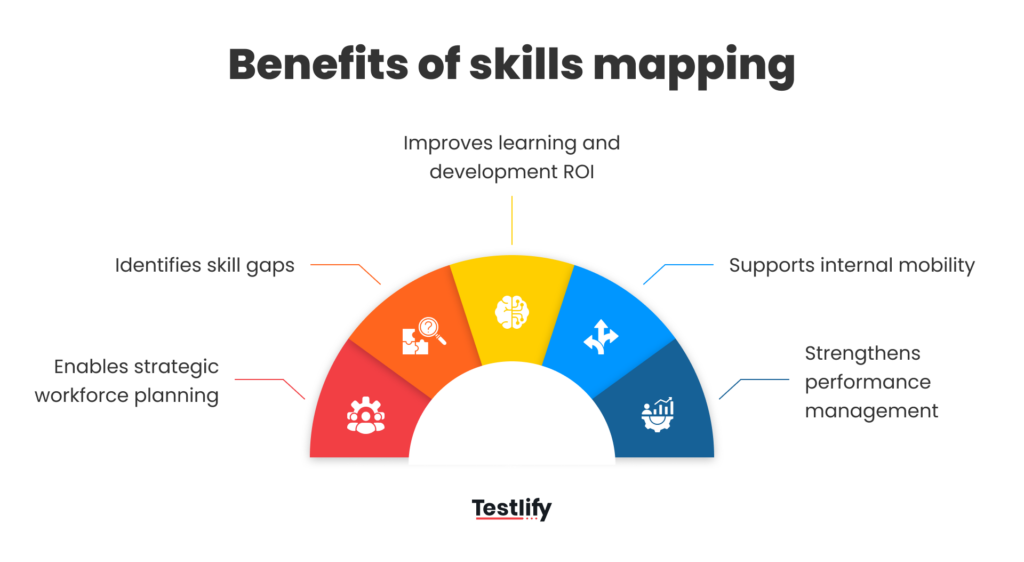
Dynamic talent acquisition
Instead of posting a generic job description, recruiters use the skills map to identify the specific 4–5 “must-have” skills for a project. This allows for precision hiring. It also opens the door to “adjacent hiring”, hiring someone who has 80% of the skills and a high “learnability” score for the remaining 20%.
You can use our job description generator that helps you create specific skills-based job descriptions.
The internal talent marketplace
Imagine a “Tinder for Projects” within your company. An internal talent marketplace uses the skills map to match employees with short-term projects (gigs), mentorships, or open roles based on their skills and interests.
- The benefit: You reduce the need for expensive external contractors.
- The result: Employees get to “test drive” new career paths without leaving the company.
Most L&D programs are “spray and pray”, you send everyone to the same leadership seminar and hope some of it sticks. With skills mapping, L&D becomes surgical. If the map shows a 15% gap in digital literacy within the Sales team, you provide exactly that training to exactly those people.
In practice, this means giving employees personalized learning paths based on their specific gaps, rather than generic company-wide training. Mentorship programs and stretch assignments are also effective ways to build skills hands-on. To stick, this can’t be a one-off project: the skills map should feed into core HR processes such as recruitment, performance management, and succession planning on an ongoing basis, since skills evolve and business needs change.
Constructing your map: A step-by-step guide
Building a skills map for a whole company can feel overwhelming. Don’t try to boil the ocean. Follow this roadmap:
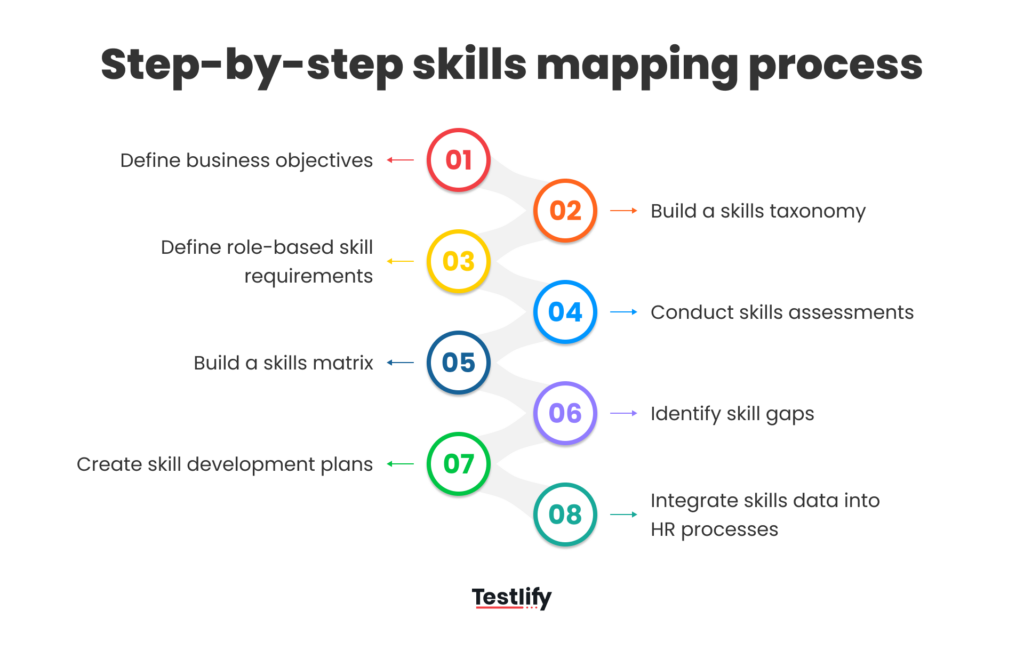
Step 1: Build your skills taxonomy
You need a common language. Does “Communication” mean public speaking or technical writing? Create a library that defines skills and sets Proficiency Levels (e.g., Level 1: Beginner, Level 2: Intermediate, Level 3: Advanced, Level 4: Expert).
Vague proficiency descriptions lead to inconsistent assessments, so define what each level actually looks like in practice. Instead of saying someone has “good analytical skills,” describe the observable behavior: for example, the ability to interpret data, identify trends, and make recommendations independently. A given proficiency level should mean roughly the same thing across the organization, even when the underlying skills differ.
Step 2: Choose your technology
Gone are the days of the “Skills Excel Spreadsheet” (which is out of date the moment you hit save). Modern HR uses Skills Intelligence Platforms. These tools use AI to scan employee resumes, LinkedIn profiles, and work history to automatically populate a skills database.
Step 3: Skill validation
Data is only good if it’s accurate. Use a “triangulation” method to validate skills:
- Self-assessment: Let employees claim their skills.
- Manager validation: Managers confirm the proficiency levels.
- Skill tests/badges: Use objective assessments for technical skills like coding or data analysis.
Peer feedback is also worth adding to the mix in some organizations, since it gives a more rounded view of an employee’s capabilities than self- and manager-assessment alone. The goal isn’t perfect accuracy, it’s a reasonably reliable picture of the workforce that’s good enough to act on.
Step 4: Map the future state
Work with your executive team to map the skills needed for three years from now. If the company is moving toward automation, you’ll need more “Systems Thinking” and “Process Design” skills. This is your Strategic Workforce Plan.
Step 5: Define business objectives and scope first
Before any of the steps above, it helps to be explicit about why you’re mapping skills in the first place, many skills mapping initiatives fail because they start with tools or templates instead of purpose. Are you trying to improve hiring, enable internal mobility, or prepare for digital transformation? The objective should connect to business strategy: expanding into new markets calls for more strategic and cross-cultural skills, while prioritizing automation calls for more digital and analytical skills. Keep the initial scope manageable, start with one function or a set of critical roles rather than the whole organization, so you can test and refine the approach before scaling.
Step 6: Map skills to roles
Once skills and proficiency levels are defined, connect them to specific roles by building role profiles. A useful role profile spells out the core skills required to do the job, the supporting skills that enhance performance, and the expected proficiency level for each skill. It also helps to distinguish “must-have” skills from those that can be developed on the job, a distinction that becomes especially useful in hiring and internal mobility decisions.
Step 7: Identify skill gaps and opportunities
With role requirements and current capabilities mapped side by side, patterns start to emerge. Gaps can show up at the individual level (one person missing a key skill), the team level (a department missing a critical capability), or the organizational level (skills needed for future growth that don’t exist yet). If multiple teams struggle with the same skill, that usually signals a need for organization-wide training rather than a one-off fix. Not every gap needs immediate action, prioritize the ones that are most critical to performance and strategy first.
Conclusion
The journey to becoming a Skills-Based Organization is a marathon, not a sprint. You don’t need to map every single person on day one. Start with a pilot department, perhaps IT or Marketing, and prove the value there.
When you map skills, you aren’t just filling roles; you are unlocking the full potential of your human capital. You are moving from a world of “What is your title?” to a world of “What can we achieve together?”
A skills-based organization starts with accurate, real-time data, and that’s exactly where a talent assessment tool makes the difference.
With the right platform, you can validate skills, identify gaps instantly, and make smarter hiring and upskilling decisions, without guesswork.
Sign up for Testlify and see how we can help you hire better, develop faster, and unlock the full potential of your workforce.
Frequently asked questions (FAQs)

Content Writer
Yashika Khandelwal is a Content Writer with 3+ years of experience creating research-backed content on hiring, talent assessment, and HR technology. She is a registered Organizational Psychologist and subject matter expert who combines behavioral science with practical recruitment insights to produce accurate, evidence-based content.
LinkedInRelated resources
View all
Skill assessment
Skills mapping vs competency mapping
Skill assessment
Free skills mapping template

Skill assessment
Top skills mapping tools

Skill assessment
Best pre-hire assessments when hiring for top roles in the financial industry

Skill assessment
Top 10 job roles that need pre-hiring assessments
Skill assessment
Skills and abilities: What’s the difference?
Get started.
Hire on proof, not resumes.
Run your first skills-based assessment free — no credit card required.