
How do skills assessments correlate with on-the-job performance?
Learn why skills assessments correlate strongly with on-the-job performance and help teams improve their retention rate and quality of hire.
Recruiters face a strange paradox in 2026. LinkedIn’s research shows that 52% of workers are actively job hunting, yet 66% of recruiters say finding qualified talent is harder than ever.
Application volume has surged, but quality has not kept pace. SHRM reports that nearly 70% of organizations still struggle to fill full-time roles. Skills assessments solve this signal-to-noise problem.
A skills assessment is a standardized test that evaluates a candidate’s abilities, knowledge, and behaviors against the real demands of a job. Validated assessments outperform resumes, unstructured interviews, and years of experience as predictors of on-the-job performance.
 ChatGPT
 Gemini
 Claude
 Grok
Grok Perplexity
How skills assessments outperform traditional hiring signals
Three signals dominate most hiring funnels: resumes, interviews, and years of experience. Skills assessments beat all three on predictive accuracy, and the data make the gap impossible to ignore.
Resumes lose to skills tests
Resumes describe the past, while skills assessments measure the present. LinkedIn’s data shows that recruiters using skills filters in their search make 12% more quality hires
Companies that pair AI-assisted messaging with skills-based search land 9% more quality hires on top of that lift.
Interviews are subjective
Unstructured interviews depend on the interviewer’s mood, biases, and snap judgments. SHRM’s 2026 research consistently flags interview-only processes as a top driver of inconsistent quality of hire.
Skills assessments standardize the evaluation. Every candidate solves the same problems under the same conditions, which strips bias out of the early funnel.
Related resources: Testlify’s guide on preventing bad hires details how this standardization protects your team.
Cognitive ability tests predict learning speed
A cognitive ability test measures reasoning, problem-solving, and pattern recognition. These tests carry a 0.51 correlation with job performance across roles, levels, and industries.
People who score higher learn job-specific skills faster, and that compounds into stronger performance over the years.
Related resources: Testlify’s ultimate guide to cognitive ability tests helps you walk through the mechanics.

The measurable impact of skills-based hiring
Skills assessments deliver measurable wins across three dimensions: performance, retention, and speed. Each gain compounds on the others. Better fit drives stronger performance, stronger performance drives longer retention, and the combined effect drops cost-per-hire across the funnel.
Performance gains
Skills assessments drive measurable performance gains. SHRM’s research confirms that organizations using skills-first practices report higher quality of hire and stronger business outcomes than peers who rely on credentials.
Related resources: Testlify’s guide to improve quality of hire outlines how skill-based assessments, performance tracking, and cultural fit directly impact retention, productivity, and hiring efficiency.
Retention gains
Stronger job-person alignment leads to better retention. When hiring decisions are based on demonstrated skills rather than proxy credentials, candidates are more likely to succeed in the role and stay longer.
Related resources: For a closer look at how this improvement plays out across teams and industries, explore Testlify’s guide to improving quality of hire
Speed and cost gains
LinkedIn’s 2026 research highlights a clear efficiency shift: recruiters using AI-powered skills assessments save over four hours per role and review 62% fewer profiles before making a hire. The result is faster decisions, fewer wasted screening cycles, and a measurable reduction in cost-per-hire.
Related resources: For a deeper breakdown of how these gains translate into real financial impact, explore Testlify’s blog on the ROI of smarter hiring.
Five mechanisms that drive the correlation between assessments and job performance
Skills assessments do not predict performance by accident. Five specific design choices create the correlation, and each one strengthens the next. Strong assessment platforms build all five into every test, but the weak platforms skip one or two and watch the predictive power collapse.
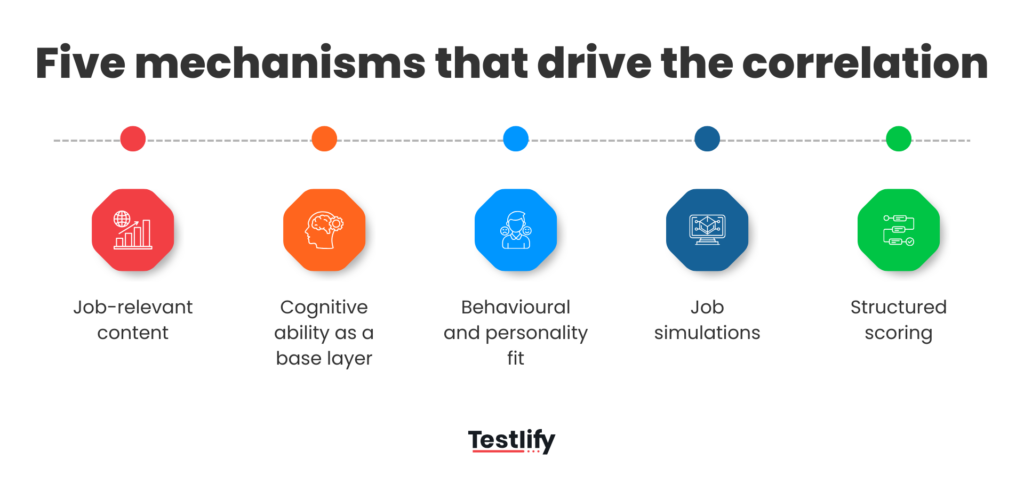
1. Job-relevant content
Good assessments use tasks that mirror the actual work. For example, a coding test for a developer simulates the kind of problem they will solve on day one.
Researchers call this property content validity. The closer the test mirrors the work, the tighter the correlation with on-the-job output.
2. Cognitive ability as a base layer
Cognitive ability predicts how fast a new hire absorbs training, processes ambiguous information, and adapts to new tools. Korn Ferry’s research confirms that 73% of talent leaders rank critical thinking as their top recruiting priority.
Cognitive ability tests give you a numeric reading on that exact trait.
Related resources: Testlify’s blog on the 7 reasons to use cognitive ability tests explains where they fit in the funnel.
3. Behavioral and personality fit
Personality assessments predict how a candidate will handle stress, conflict, and collaboration. These traits drive long-term retention more than raw skill.
When you combine cognitive and personality measures, the correlation with performance rises to roughly 0.67.
Related resources: Testlify’s analysis of personality tests in hiring covers the tradeoffs.
4. Job simulations
Simulations put candidates inside a realistic work scenario. They reveal how a person thinks, prioritizes, and executes under conditions that match the role.
Simulations rank among the strongest predictors of performance because they shrink the gap between test and task.
Related resources: Testlify’s blog on the types of skills assessment tests explains when to use each test and how they can be effectively utilized in the recruitment process.
5. Structured scoring
Structured scoring rubrics force every evaluator to grade the same evidence the same way. This consistency converts a good assessment into a reliable predictor of job performance.
Related resources: Testlify’s hiring metrics guide outlines the metrics that prove a scoring system works.
Where skills assessments fall short
Skills assessments are not a silver bullet. SHRM has flagged that knowledge tests measure a candidate’s current state, and the half-life of learned skills now sits around five years.
A snapshot test alone underweights long-term potential. Smart teams pair skills tests with cognitive and personality assessments that capture learning ability and motivation.
Korn Ferry’s 2026 report also reminds talent leaders that critical thinking and judgment matter more than narrow technical skills in many roles. A modern assessment stack measures both layers.
How to build an assessment that correlates with on-the-job performance?
A good assessment that predicts true job performance takes deliberate design, rigorous validation, and ongoing governance. Random tests cobbled together will not predict performance, no matter how polished the platform looks.
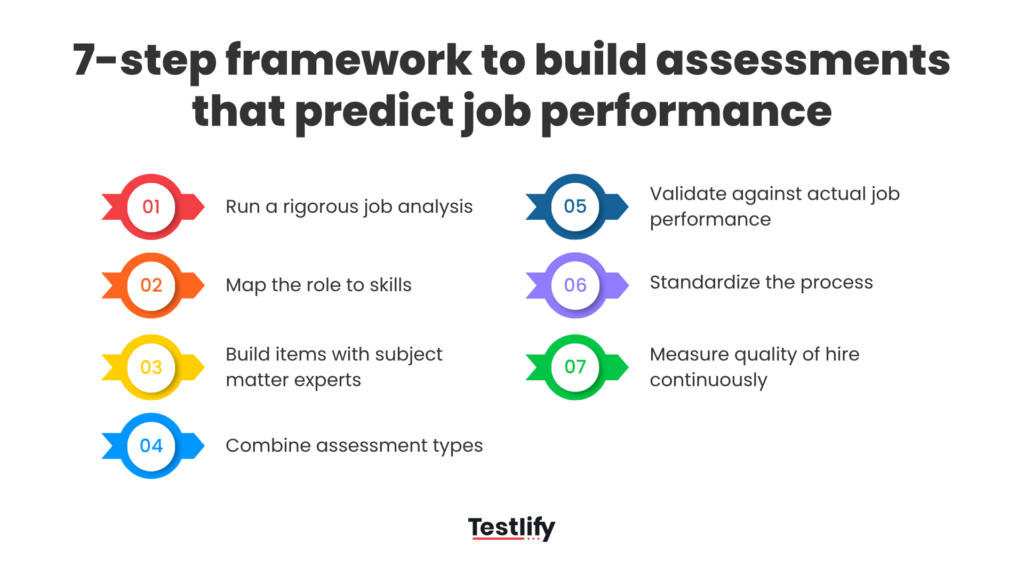
Step 1: Run a rigorous job analysis
A job analysis is the structured study of what a role actually requires. It captures the tasks, the conditions, the tools, and the outcomes that define success in the position.
Skip this step, and the entire assessment loses its anchor. Every test item should trace back to a documented task or competency from the job analysis.
Use a mix of methods to build the picture. Interview top performers, shadow the role for a day, review performance reviews, and analyze customer or output data.
Document the critical incidents that separate strong performers from weak ones. These incidents become the source material for simulation and behavioral test items.
Step 2: Map the role to skills
List the five to seven skills that most directly drive performance in the role. If you cannot tie a skill to a measurable outcome, drop it from the assessment.
Related resources: Testlify’s skill gap analysis guide will help you walk through this skills mapping process step by step.
Step 3: Build items with subject matter experts
Subject matter experts are people who currently perform the role at a high level. Their input keeps test content grounded in real work, not theory.
Run item-writing workshops with three to five subject matter experts (SMEs) per role. Have them draft items that mirror real tasks, then review every item for accuracy, difficulty, and relevance.
Pilot every item before deploying it at scale. Run the test on a sample of current employees and check whether item scores correlate with their existing performance ratings.
Step 4: Combine assessment types
A single test never captures the full performance picture. Build a layered battery that combines a cognitive test, a role-specific skills test, and a personality or behavioral measure.
Each layer captures a different driver of performance. Cognitive ability predicts learning speed, role-specific skills measure current capability, and behavioral traits predict fit and retention.
The combined battery delivers a 0.65 to 0.70 correlation with performance, far above any single test. Testlify’s guide on integrating cognitive ability tests into the hiring process shows how to layer them without bloating the funnel.
Add a job simulation for senior or high-stakes roles. Simulations rank among the highest-correlation methods because they shrink the gap between test and task.
Step 5: Validate against actual job performance
Track new hire performance ratings, retention, and productivity for at least six months. Compare those outcomes to assessment scores.
Refine the test mix based on what actually predicts performance. Drop any component that fails to correlate with real outcomes.
Step 6: Standardize the process
Apply the same assessments to every candidate for the same role. Score every response with the same rubric and the same evaluators, where possible.
Inconsistent administration is the silent killer of predictive validity. A test that runs differently across recruiters cannot deliver a stable correlation with performance.
Lock down the test environment with timed sessions, controlled access, and proctoring tools. These controls keep conditions equal across candidates and protect score comparability.
Train every interviewer on the rubric before they grade open responses. Inter-rater reliability above 0.80 is the threshold for credible structured scoring.
Step 7: Measure quality of hire continuously
SHRM’s 2026 Talent research stresses that quality of hire is the single most important hiring metric. Tie assessment scores to performance ratings, retention, and hiring manager satisfaction.
Use a simple formula and track it quarterly. Testlify’s free quality of hire calculator gives you the math in one place.
What employers should watch out for in 2026
The assessment landscape is shifting fast in 2026. Three forces are reshaping how teams design, run, and trust their skills tests this year. Hiring leaders who track these shifts will keep their correlation strong, whereas those who ignore them will watch their assessment quality erode.
AI changes the assessment game
Korn Ferry’s 2026 Talent Trends Report finds that 84% of talent leaders plan to use AI in their workflow. AI now scores open responses, monitors for cheating, and adapts test difficulty in real time.
This raises the bar on test integrity. Choose platforms that combine AI proctoring with validated skill tests.
Critical thinking outranks AI skills
Research from Korn Ferry has revealed that talent acquisition leaders rank critical thinking as number one, with 73% naming it their top priority. This is because AI tools change every six months, while critical thinking compounds across an entire career.
The half-life argument decides this debate. SHRM reports that learned technical skills now have a half-life of roughly five years, but reasoning ability holds its predictive power across decades.
A candidate who scores high on critical thinking can learn any new AI tool the company adopts. The reverse rarely holds, which is why narrow AI proficiency without reasoning ability ages badly.
Critical thinking also acts as the last line of defense against AI errors. When generative AI hallucinates a number, fabricates a source, or misreads a contract, only the human with strong reasoning catches it.
The implication for assessment design is direct. Build a validated cognitive ability and reasoning test into every battery, not just senior roles. The cost is low, and the predictive lift on performance is the highest of any single test type.
Soft skills become measurable
LinkedIn’s Workplace Learning report confirms that 91% of learning and development professionals see soft skills as more critical than ever.
Modern assessments now use AI insights to quantify communication, collaboration, and emotional intelligence. These measures correlate strongly with team performance and retention.
Related resources: Testlify’s case studies on hiring efficiency with talent assessments show how leading teams adapt.
Final thoughts
Skills assessments correlate with on-the-job performance more strongly than any other single hiring signal. The 2026 data from SHRM, McKinsey, Korn Ferry, LinkedIn, and Deloitte confirms the pattern across industries and roles.
Resumes describe history. Interviews capture impressions. Skills assessments measure proof.
The best 2026 hiring teams build assessment stacks that combine cognitive ability, role-specific skills, and behavioral fit. They validate every component against real performance and refine the stack over time.
The result is a hiring process that picks the right person the first time. Productivity rises, retention improves, and the cost of a bad hire disappears from the budget.
Book your Testlify demo today
Stop guessing about who can actually do the job. Testlify gives you 3,500+ validated assessments, AI-powered conversational interviews, and integrations with 100+ applicant tracking systems, all built to lift your quality of hire.
Book a demo with Testlify and see how a skills-first hiring stack can transform your team’s performance in 2026 and beyond. Your next great hire is one assessment away.
Frequently asked questions (FAQs)

Related resources
View all
Skill assessment
How does skills mapping enable skills-based organizations?

Skill assessment
Skills mapping vs competency mapping
Skill assessment
Free skills mapping template

Skill assessment
Top skills mapping tools

Skill assessment
Best pre-hire assessments when hiring for top roles in the financial industry

Skill assessment
Top 10 job roles that need pre-hiring assessments
Get started.
Hire on proof, not resumes.
Run your first skills-based assessment free — no credit card required.