
Skills and abilities: What’s the difference?
Discover the key differences between skills and abilities, and why understanding both is crucial for effective recruitment and talent management.
Skills are learned. Abilities are the underlying capacity that makes learning them possible. That one distinction decides whether you hire someone who can do the job on Monday or someone who will grow into a job that has not settled yet, and most job ads blur it badly.
The confusion is not just semantic. It shows up in the wrong test, the wrong interview question, and a shortlist full of people who look qualified on paper and stall in month three. Here is what separates skills, abilities, interests, qualities, and knowledge, and how each one is measured.
TL;DR / Key takeaways
- Skills and abilities are not interchangeable, and the taxonomy is settled. O*NET puts abilities with the worker and skills with the job requirements. Using the words loosely leads to job ads that ask for the wrong evidence, so fix the vocabulary before fixing the process.
- Interests answer a different question entirely. They predict persistence and fit, not capability, which means an interest inventory should never be used to decide who can do the job. Use it to understand who will still want to.
- The predictor rankings moved in 2022. Structured interviews at 0.42 now sit ahead of cognitive ability at 0.31 in the revised estimates. If your interview is unstructured, you are throwing away your strongest signal and leaning on your second.
- Train-versus-buy is the decision underneath all of this. If the skill takes under 90 days to teach and someone on the team can teach it, hire the ability. Otherwise hire the skill, because potential does not close a gap nobody has time to close.
- Company size changes the answer. Below roughly 200 employees the ramp cost lands on people who are already stretched, so the same role can justify a different hiring bar at a 40 person company than at a 4,000 person one.
- Match the instrument to the attribute. Work samples for skills, aptitude measures for abilities, structured interviews and references for qualities. A single general test that claims to cover all of it is measuring one thing and calling it three.
 ChatGPT
 Gemini
 Claude
 Grok
Grok Perplexity
What is the difference between skills and abilities?
A skill is a learned proficiency at a specific task, built through training and practice, and it can be demonstrated on request. An ability is a broader, more stable capacity that shapes how well and how fast someone performs across many tasks. Skills are taught. Abilities are developed slowly and measured indirectly.
This is not a matter of opinion. The O*NET Content Model, the occupational taxonomy the US Department of Labor maintains, splits the two into different domains. Abilities sit under Worker Characteristics, described as natural talents and capabilities that affect how well someone can perform work. Skills and knowledge sit under Worker Requirements, the things a person needs to learn for the job. Characteristics describe the person. Requirements describe what the work demands of them.
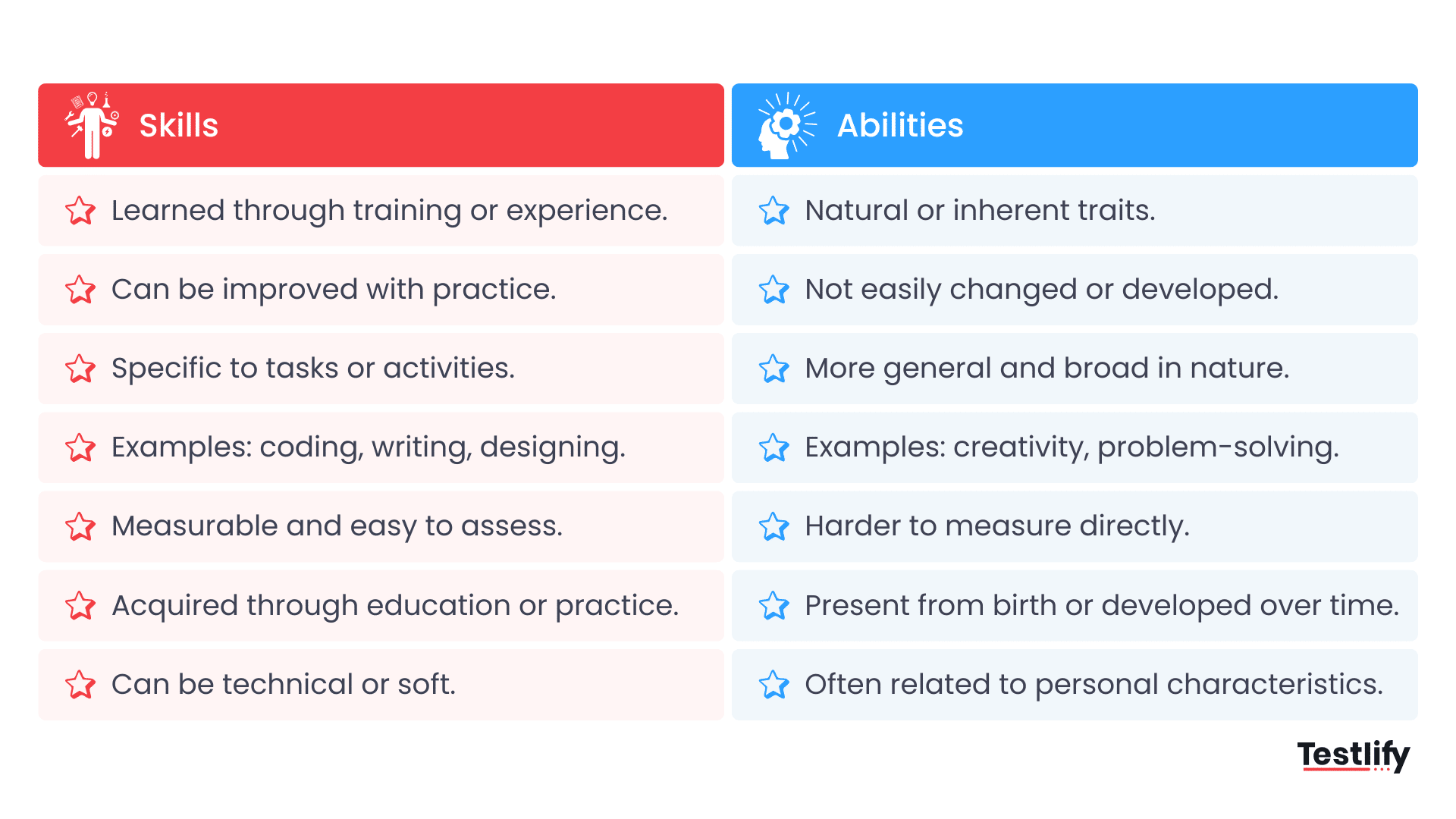
O*NET splits abilities four ways: cognitive, psychomotor, physical, and sensory. That breakdown matters more than it sounds. A warehouse role and a financial analyst role both carry ability requirements, but almost nothing about them overlaps, and one general test flatters both while measuring neither.
Attribute | What it is | Where it comes from | How stable | How it is measured |
|---|---|---|---|---|
Knowledge | Facts and principles in a domain | Study and experience | Grows, and goes stale | Knowledge tests, work samples |
Skill | Learned proficiency at a task | Training and practice | Improves with use, decays without it | Practical tests, simulations, work samples |
Ability | Underlying capacity to perform | Partly innate, shaped over years | Slow to change | Cognitive, psychomotor, physical, sensory tests |
Interest | The kind of work someone is drawn to | Personality and exposure | Fairly stable by adulthood | Interest inventories |
Quality | Character trait or temperament | Disposition and habit | Stable, context sensitive | Behavioral evidence, references, structured interviews |

What is the difference between interests and abilities?
An interest is what someone is drawn to. An ability is how well they can actually perform. O*NET counts both as worker characteristics but keeps them apart, because a person can be pulled toward work they are not yet good at, and be highly capable at work that bores them. Interest predicts persistence. Ability predicts ceiling.
The Department of Labor runs its own instrument for the interest half, and the O*NET Interest Profiler manual documents how it works: 60 items describing real work activities, sorted into six interest types (realistic, investigative, artistic, social, enterprising, and conventional), which produce a three letter code. No part of it measures how well anyone does anything. That is deliberate. It is an interest inventory, not an ability test, and the two get swapped constantly in career advice.
Do interests matter for performance? Some. A meta-analysis of 60 studies and roughly 568 correlations, published in Perspectives on Psychological Science in 2012, found interests are related to performance and persistence at work and in study. The stronger finding was about fit: how well a person's interests matched their environment predicted performance better than interest scores on their own.
So the honest version is not "follow your passion" and not "interests are irrelevant". Interest tells you who is likely to stay. Ability tells you how high they can climb while they are there. They answer different questions, and a hiring process that only asks one of them is guessing at the other.
What is the difference between skills and qualities?
A skill is something a person can do. A quality is something a person is. Skills are learned proficiencies that can be demonstrated on request, like writing SQL queries or running a payroll cycle. Qualities are character traits such as reliability, patience, or curiosity, and they surface over time rather than in a test.
Job ads bundle them into one list, which is where the confusion starts. "Excel, stakeholder management, attention to detail, and a positive attitude" mixes a skill, a skill, an ability-adjacent trait, and a quality, and each one needs completely different evidence. The practical test: if you can ask a candidate to show you, it is a skill. If you can only learn it from how they behaved when nobody was checking, it is a quality, and that is what references and structured interviews are for.
How do knowledge, skills, and abilities differ?
Knowledge is what someone knows. Skill is what they can do with it. Ability is the capacity that determines how far they can take it. HR shorthand bundles the three as knowledge, skills, and abilities, and public sector job descriptions have used that structure for decades.
An example makes it concrete. A tax accountant knows the current filing rules (knowledge). They can prepare a return in the firm's software without supervision (skill). They can hold several interacting conditions in their head at once while spotting the one line that does not reconcile (ability). Change the tax code and the knowledge expires overnight. The skill survives with an update. The ability is untouched, which is exactly why it is the thing you want when the work keeps changing.
Why the difference matters when you hire
Get this wrong and you buy the wrong thing. Screening for skills alone fills the role with people who can do today's version of the job, which is fine until the tools change. Screening for abilities alone gets you people who could learn the job, in a role that needed someone productive in week two.
There is also a live argument in selection science that most hiring content has not caught up with. For more than two decades the received wisdom, set by a 1998 meta-analysis, was that cognitive ability is the strongest single predictor of job performance. A 2022 re-analysis in the Journal of Applied Psychology argued that decades of range restriction corrections had systematically overstated those numbers. When the professional body for industrial and organizational psychology walked through the revised estimates, structured interviews came out at 0.42 and cognitive ability tests at 0.31, putting the interview ahead.
Read that carefully, because it is easy to over-correct. Cognitive ability tests did not stop working; a 0.31 correlation is still one of the more useful signals available for a screening stage that costs minutes per candidate. What changed is the ranking, and the practical implication is that a structured, consistently scored interview is not the soft, second-rate step it often gets treated as. It is evidence, if you actually structure it.
Pro tip: before writing a single interview question, decide for each requirement whether you are hiring the skill or the ability. If the skill takes under 90 days to teach and your team already teaches it, screen for the ability and train the skill. If it takes longer than that, or nobody internally can teach it, screen for the skill and stop pretending potential will cover the gap.
Company size changes the math here. Under about 200 people, there is usually nobody whose job is to train new hires, so the cost of hiring raw ability lands on a founder or a team lead who is already stretched. Larger organizations can absorb a longer ramp. A skills gap analysis is worth running before you write the job ad, because it tells you which gaps your team can close internally and which ones you have to buy.
How do you assess skills and abilities?
Use different evidence for each. Skills are measured directly through work samples, practical tasks, and role specific tests. Abilities are measured indirectly through cognitive, psychomotor, physical, or sensory assessments. Interests and qualities need their own instruments again. One test does not cover all five.
The Testlify Competency-to-Evidence Matrix exists for exactly this problem: start with the role, map it to the competencies that matter, then connect each competency to a source of evidence rather than to a gut feel. It runs in five steps.
- Define the role, not the test. Write down what a person must produce in the first 6 months.
- Split each requirement into knowledge, skill, ability, or quality. Be strict. Most job ads collapse under this step.
- Attach evidence to each one. A skill gets a work sample. An ability gets an aptitude measure. A quality gets a structured interview question and a reference.
- Weight them. Not every competency deserves equal say in the decision.
- Score consistently, then let humans make the call with the evidence in front of them.
Testlify supports that split directly. The test library covers cognitive ability, role specific skills, psychometric, situational judgement, coding, language, software skills, simulation, and blue collar categories, which maps onto the ability and skill halves rather than forcing everything through one score. More than 25 question types are available, from single select through to coding tasks in an embedded VS Code editor and Microsoft Excel or Google Sheets work samples, so a skill can be tested by having the candidate do the actual work.
Two things are worth knowing before you read any score. Personality and cultural tests are qualitative and carry no total score, by design, so nobody should be ranked on them. And AI scoring in Testlify is advisory: the product's own wording is that AI scores and insights are for guidance only and that human judgment makes the final decision, with a toggle to keep the AI score out of the final average entirely. Item level statistics (difficulty index, discrimination index, and a quality risk flag) are exposed per question, so a test that is not measuring what you think it measures can be caught rather than trusted.
For the quality and interest halves, structured interviews and references do the work that a test cannot. Testlify handles references as a linked reference assessment rather than a contact form, triggered by score threshold or stage, which keeps the evidence in the same record as everything else. If you want the fuller map of what to use when, the guide to types of assessment tests breaks it down by hiring stage, and the soft skills entry covers the traits that resist direct testing.
Ready to separate the two in your own hiring? Book a demo and bring one open role, or start with a free trial and build a single assessment that tests the skill and the ability separately. Most teams find the exercise of splitting their own job ad more useful than the test results.
FAQs

Related resources
View all
Skill assessment
What is skills management? Definition, process, and benefits

Skill assessment
How to efficiently evaluate hard and soft skills in 2026?
Skill assessment
What is an interview scorecard and how to create one?
Skill assessment
Learning Agility: What It Is and How to Assess It (2026)
Skill assessment
What are power skills and how to assess them?

Skill assessment
Organizational Skills Test: How to Assess Candidates in 2026
Get started.
Hire on proof, not resumes.
Run your first skills-based assessment free — no credit card required.