
Pros and cons of cross-training employees in 2026
Explore the pros and cons of cross-training employees in 2025, including benefits for efficiency, flexibility, and potential challenges for your business.

Cross-training employees is one of the most effective strategies to maximize your team’s potential. Instead of outsourcing or hiring new talent, cross-training allows you to channel skilled employees into departments or teams that need support.
Yet, despite its benefits, studies show that only 45% of companies offer cross-training programs. So why are so many businesses missing out on this game-changing opportunity? Do the benefits overpower the disadvantages? Let’s find answers to these questions in this blog post.
 ChatGPT
 Gemini
 Claude
 Grok
Grok Perplexity
What do cross-training employees mean?
Cross-training employees refers to training staff to perform tasks outside of their everyday responsibilities. In some instances, employees might also be trained to work in different roles, expanding their skill sets.
Implementing cross-training in the workplace enables employees to learn new skills to work on a team or department they didn’t intend to qualify for.
Another term for cross-training employees is multiskilling. It means teaching employees different skills beyond their regular job tasks, helping them become more flexible and able to take on various roles within the company.
For example, you could train a customer service representative to assist in the sales department and vice versa. This way, you can switch employees between teams when there’s a staff shortage or when one department is very busy.
Cross-trained employees can change between departments and help the company run without outsourcing or crisis training others.
Related: Staff augmentation vs outsourcing – knowing the basics

Cross-training employees examples
Cross-training looks different depending on the industry and job function. Here are a few real-world examples that show how it’s done across sectors:
- Retail sector: A cashier is trained to manage inventory when the stockroom staff are absent.
- HR department: A recruiter learns to manage onboarding in the absence of the HR coordinator.
- IT teams: A front-end developer is trained to handle basic DevOps tasks during deployment emergencies.
- Healthcare: A nurse is cross-trained to assist in both pediatric and emergency departments.
- Manufacturing: A machine operator is trained to troubleshoot maintenance issues if the technician is unavailable.
These examples of cross-training employees in the workplace reflect the growing need for role fluidity and proactive problem-solving.
Benefits of cross-training employees
Below are some of the pros of cross-training employees that you need to know.
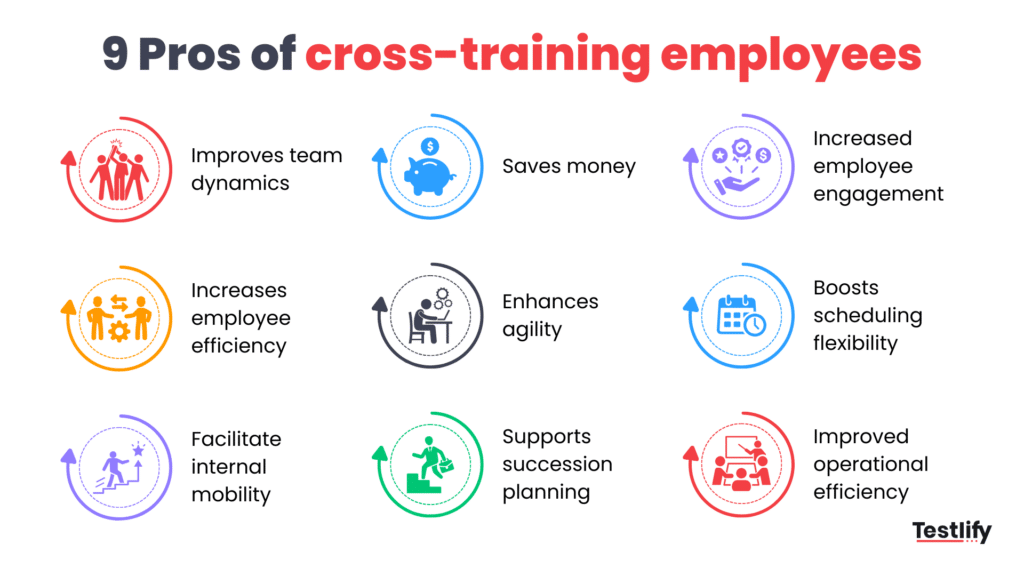
Improves team dynamics
Introducing someone with a wider skill set into an existing team leads to better team dynamics. Existing employees can learn and grow by sharing knowledge with the new member, who also gains valuable experience working on different projects.
Related: 5 methods to improve team dynamics and employee behaviors
However, individuals who specialize in one area might find it harder to collaborate effectively. Teamwork tends to thrive when everyone has a broad understanding of different aspects of the company.
Assesses a candidate’s practical knowledge and experience in communication, conflict management, problem-solving, and critical thinking using Testlify’s teamwork test.
Saves money
Outsourcing or hiring employees takes a significant amount of time and money. If you already have a skilled staff willing to work on more projects, that’s a golden opportunity as an employer.
The average time to hire is 44 days in 2024. In addition, companies spend $15,000 on average to replace an existing employee. All these extra costs can be avoided if you upskill or cross-train your existing employees.
Increased employee engagement
If employees feel stuck in a job with no future, they’ll lose motivation, even in a field they like. Studies show that top employees are more likely to stay in jobs that offer good benefits, like health insurance, work-life balance, and opportunities to learn new skills.
Related: How to measure work-life balance?
Not just that, research shows that engaged employees increase the profitability of the business by 23%. Also, companies that priortize employee engagement witness an 18% decrease in turnover. Hence, it’s also crucial that employees feel valued.
They often start looking for other jobs when they don’t see opportunities to grow or advance. Cross-training employees help by offering them opportunities to grow both personally and professionally.
Increases employee efficiency
Every department should have key skills that can be shared with others. When employees gain more skills, overall productivity and efficiency improve across teams. Cross-training employees help develop these skills, making your business operations smoother and more efficient.
Enhances agility
While employees are often hired for specific skills, cross-training can uncover hidden talents that benefit the company. With expanded skill sets, employees can better contribute to achieving business goals.
Employees like being challenged at work, as it helps them learn new skills. Staff working in new roles can discover strengths, skills, and talents they didn’t know they had. This will lead to self-discovery and renewed excitement, improving their agility.
Boosts scheduling flexibility
Employees can step into different roles when cross-trained, making handling last-minute absences or vacation requests easier. This ensures smooth operations during staff shortages or increased workloads.
Facilitate internal mobility
Cross-training helps companies improve internal mobility by providing career advancement opportunities for employees.
Studies show that 94% of employees stay in companies that provide learning opportunities. This helps create a pool of top candidates within the company for succession planning.
Related: An HR’s guide to internal mobility
Supports succession planning
Promoting from within is often more efficient than hiring externally. Cross-training equips employees with the skills to step into key roles, ensuring a smooth transition when positions open up.
It also helps identify individuals with the ambition and drive to grow, even if immediate promotions aren’t possible.
Additionally, cross-trained teams are more adaptable, making handling workflow fluctuations easier. This flexibility is invaluable for succession planning, as it prevents bottlenecks and ensures that operations continue seamlessly during changes in leadership or staffing.
Related: 5 steps to succession planning
Improved operational efficiency
When each department identifies the key skills to include in a cross-training program, they must carefully evaluate what’s essential and the best way to teach them. This process naturally boosts efficiency, especially in small businesses where employees often have multiple roles.
Businesses can streamline operations and improve overall performance by focusing on the most important skills and finding the most effective way to share them.
Cons of cross-training employees
Though cross-training employees has many benefits, all of those are only beneficial if it is done correctly.
Poor cross-training practices could lead to a situation with too many generalists. Company revenue could be disastrous without experts in a particular niche or subject.
In certain cases, companies cross-train employees to avoid hiring an additional member. This, again, could fuel job dissatisfaction and harm the whole workplace.
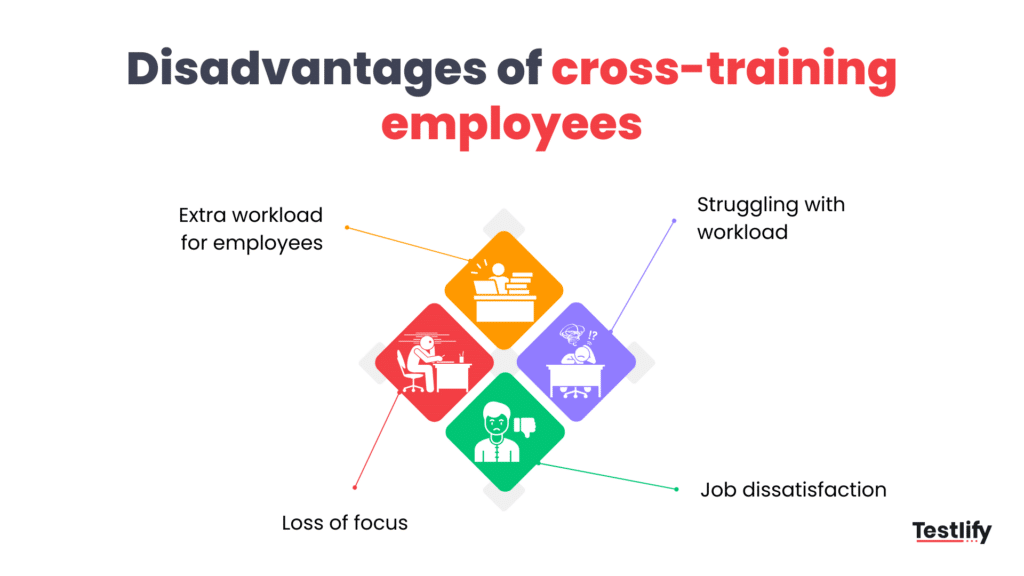
Other disadvantages of cross-training employees are as follows:
Extra workload for employees
Not all companies need to cross-train employees, but when it’s necessary, the staff should be clearly informed.
Research shows that about 79% of employees actively seek out additional tasks. Hence, employers must explain the purpose of cross-training to the selected employees to avoid misunderstandings.
Without transparency, employees might feel their workload is being unfairly increased without additional pay, leading to frustration and poor performance, ultimately hurting the company.
Struggling with workload
Cross-training means learning new skills and taking on different tasks. This can be difficult, especially when employees already have a full workload. Companies must ensure workers don’t get too stressed or overworked, or they might lose them.
Organizations should offer clear guidance on managing workload effectively during cross-training to prevent this and ensure employees have enough time and resources to complete their regular duties.
It’s also important to encourage open communication so workers feel comfortable discussing their stress levels and workload.
Loss of focus
Another challenge of cross-training employees is that there is a high chance for workers to lose their specialized skills or focus. For example, if someone is trained to perform many different roles, they may spread themselves too thin.
As they gain more general knowledge, they may lose the deep, specialized skills they had in their original role. This can make employees less effective in their core jobs and reduce their expertise in a specific area.
Job dissatisfaction
When employees are bombarded with more tasks than the ones they signed up for, they are more likely to be dissatisfied with their jobs. A 2024 report suggests that 74% of workers are dissatisfied with their jobs, and about 54% are actively looking to switch jobs.
Though there could be different reasons, feeling overburdened with additional responsibilities is one of the most common factors contributing to growing job dissatisfaction.
Resistance to change and unclear role boundaries
Two additional risks worth planning for: some employees resist cross-training outright, especially if they fear it signals upcoming job changes or simply added responsibility without recognition. And when role definitions blur across cross-trained staff, accountability can suffer, it becomes less clear who owns a task when several people are trained to do it. Setting clear expectations and managerial support up front helps offset both risks.
Difference between upskilling and cross-training
Upskilling and cross-training aim to develop employee capabilities but focus on different areas. Upskilling involves improving employees’ existing skills or teaching them advanced techniques within their current role, helping them become more proficient and efficient.
In contrast, cross-training employees involves teaching staff skills outside their regular job duties, enabling them to take on different organizational roles.
While upskilling helps employees become more skilled in their current jobs, cross-training makes them more flexible by teaching them how to do different tasks or work in other company areas.
Steps to design an effective cross-training program
Creating a successful cross-training plan requires thought, structure, and communication. Here’s a practical step-by-step guide HR teams can follow:
- Identify critical roles and skills: Start with roles that are crucial to daily operations and have limited backups.
- Map overlapping responsibilities: Look for tasks that others can easily pick up with minimal training.
- Select the right employees: Pick team members who are open to learning, flexible, and eager to grow.
- Develop structured training modules: Use job shadowing, SOPs, video tutorials, or peer mentoring to transfer knowledge.
- Set timelines and goals: Define how long the training will take and what outcomes you expect from it.
- Provide ongoing support: Let employees practice the new role under supervision until they are confident.
- Evaluate performance regularly: Track how well employees are adapting and adjust the training if needed.
- Recognise and reward participation: Make sure employees feel valued for stepping up and taking on extra duties.
Over to you
Cross-training employees may initially lead to a brief dip in productivity because it might take time to get used to it, but the long-term benefits far outweigh this short-term challenge.
Teaching employees multiple skills creates a more adaptable workforce that can step into various roles when needed, especially during absences or busy periods.
This flexibility helps cover unexpected situations and increases overall productivity as employees become more versatile and efficient.
Beyond covering for sick days or vacations, cross-training strengthens teamwork and helps reduce employee turnover by keeping employees engaged and providing opportunities for skill development.
Cross-training builds workforce resilience and opens career development pathways that help organizations attract and retain top talent. A data-driven hiring plan reduces mis-hire risk, while strong talent acquisition practices focused on skills-based hiring help organizations attract and retain top talent. Organizations using pre-employment assessments ensure every hire is grounded in verified skills.
Frequently asked questions (FAQs)

Related resources
View all
HR & recruitment
How to use reverse mentoring to make it work?

HR & recruitment
How talent acquisition teams can benefit from citizenship investment programs

HR & recruitment
Recruiter burnout: causes, symptoms, and how to prevent it

HR & recruitment
How to create a strategic HR roadmap?

HR & recruitment
What is the buddy system in the workplace? Benefits, steps, and 2026 guide
HR & recruitment
10 game-changing HR innovation examples you need to know
Get started.
Hire on proof, not resumes.
Run your first skills-based assessment free — no credit card required.