
White Collar vs Blue Collar Jobs: Key Differences (2026)
Explore the key differences between white-collar and blue-collar jobs, including education, pay scales, skill requirements, and legal regulations.

White-collar jobs are office-based roles built around knowledge work, like accounting, software, or management. Blue-collar jobs are hands-on roles built around manual or technical work, like welding, plumbing, or running machines. The real difference is the kind of work and the skills it takes, not the worth of the people doing it. This guide compares the two on pay, training, overtime, automation risk, and hiring, and shows why a growing number of teams have stopped sorting candidates by collar at all.
 ChatGPT
 Gemini
 Claude
 Grok
Grok Perplexity
TL;DR
- White-collar means office and knowledge work; blue-collar means manual and technical work. The split describes the task, not the person.
- Pay overlaps more than the stereotype suggests. Management roles had a median wage of $122,090 in May 2024, but skilled trades can out-earn many salaried desk jobs.
- The labels are getting blurry. Grey-collar and new-collar roles mix hands-on work with technical skill, so the old two-box model misses a lot.
- Degrees are a weak signal of job readiness. After firms dropped degree rules, hiring of non-degree workers rose just 3.5 points, because old habits stuck.
- Trade demand keeps climbing even as AI reshapes office work. The U.S. Bureau of Labor Statistics projects about 72,700 electrician job openings a year through 2035, a 9 percent growth rate, well above the average for all occupations, according to BLS employment projections.
- The better filter for both collars is the same: test the skills the role actually needs, then interview the people who pass.
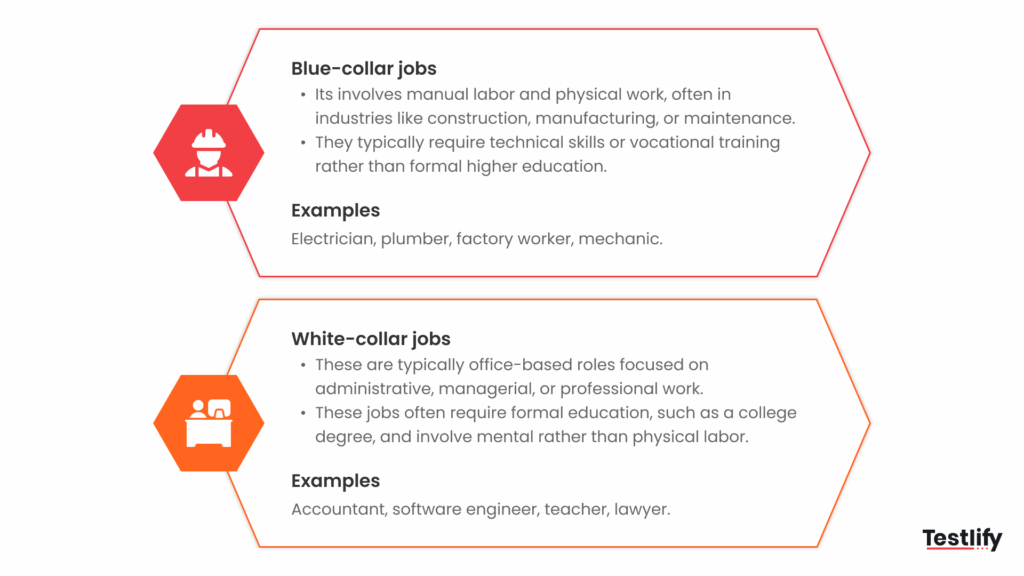

What are white-collar jobs?
White-collar jobs are roles that center on knowledge, administration, or management, usually done in an office, remotely, or in a hybrid setup. The work is mostly mental rather than physical: analyzing data, advising clients, writing code, or running teams. The term goes back to the 1930s, when office staff wore white dress shirts. A white-collar worker is typically paid a salary.
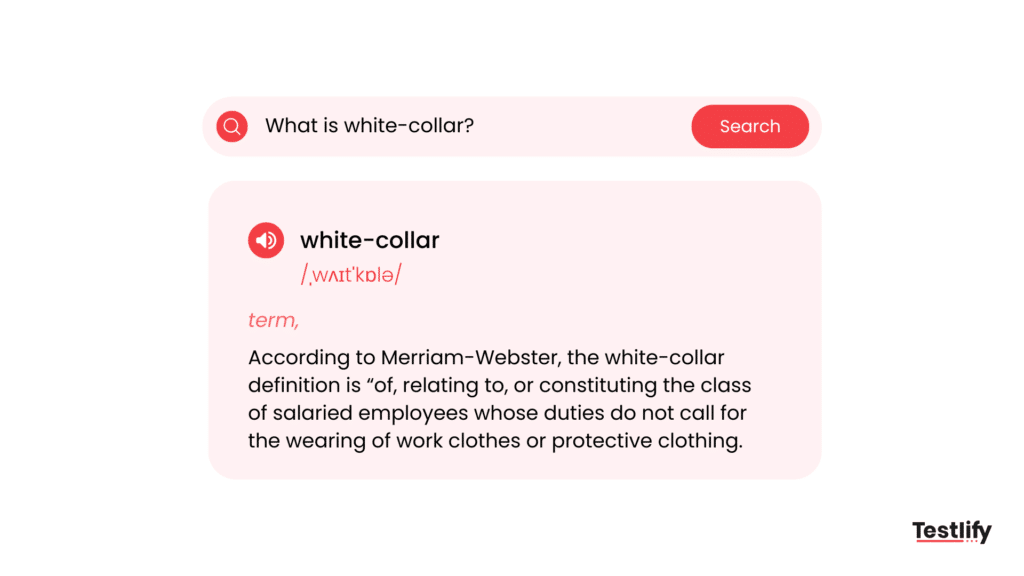
Examples of white-collar jobs
- Accountants, financial analysts, and auditors
- Software developers, data analysts, and IT staff
- Lawyers, consultants, and marketers
- HR managers, recruiters, and operations leads
- Doctors, teachers, and other licensed professionals
What are blue-collar jobs?
Blue-collar jobs are roles built around manual or technical work, done on a site, in a factory, in the field, or in a workshop. The work is hands-on and skill-heavy: building, fixing, installing, operating equipment, or producing goods. The name comes from the durable blue uniforms that held up to physical labor. A blue-collar worker is more often paid by the hour, with overtime.
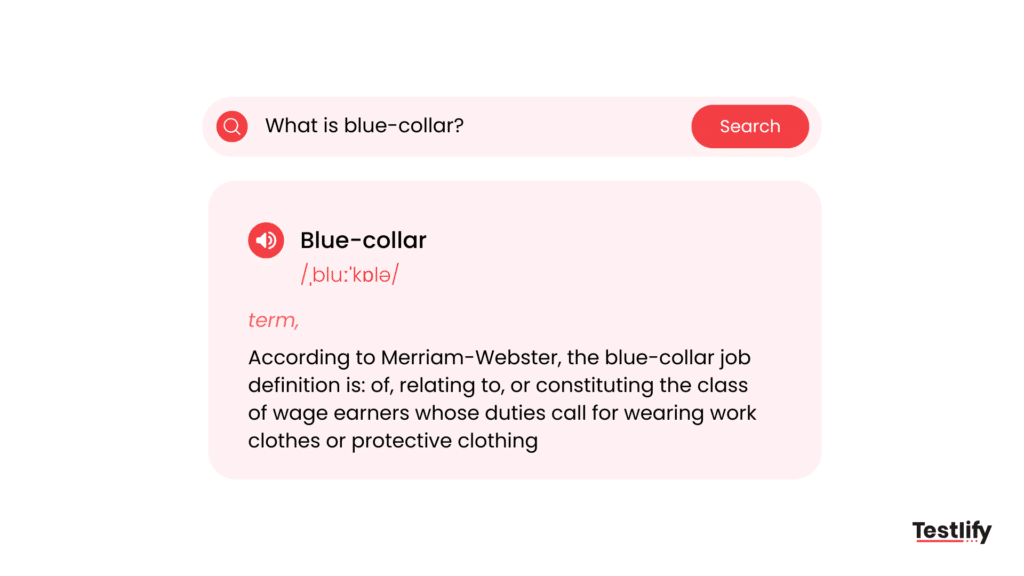
Examples of blue-collar jobs
- Electricians, plumbers, and HVAC technicians
- Welders, machinists, and CNC operators
- Construction workers, carpenters, and roofers
- Truck drivers, warehouse staff, and forklift operators
- Mechanics, line workers, and maintenance crews
White collar vs blue collar jobs: what is the difference?
The core difference is the type of work: white-collar roles lean on knowledge and judgment, while blue-collar roles lean on physical and technical skill. That one split ripples into how people train for the job, how they get paid, how overtime law treats them, and even how exposed the role is to automation. Here is how the two stack up.
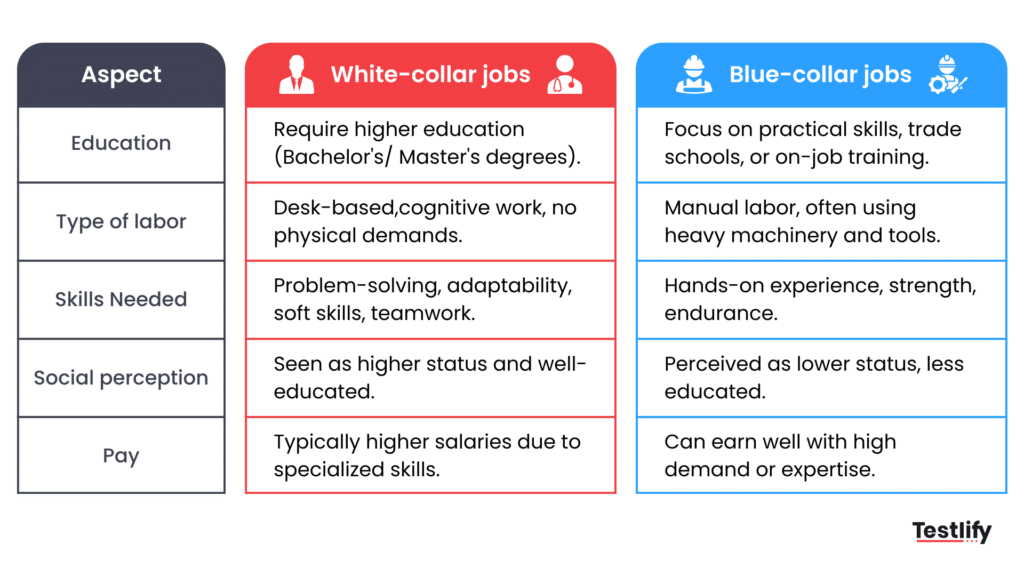
Dimension | White-collar jobs | Blue-collar jobs |
|---|---|---|
Type of work | Knowledge, administrative, and managerial tasks | Manual, technical, and hands-on tasks |
Typical setting | Office, remote, or hybrid | Site, factory, field, or workshop |
Common entry path | College degree or professional certification | Apprenticeship, vocational training, or on-the-job learning |
How pay is structured | Usually a fixed salary | Often hourly, with overtime |
Overtime status (U.S.) | Often exempt from overtime | Usually non-exempt, so overtime applies |
Automation exposure (2026) | Higher for routine, computer-based tasks | Lower where physical presence and hands-on judgment are required |
Core skills to test | Cognitive ability, communication, role-specific software | Technical skill, safety judgment, dexterity, problem-solving |
Example roles | Accountant, software developer, HR manager | Electrician, welder, machine operator |
One distinction trips up new managers: overtime. In the U.S., many salaried white-collar roles are exempt from overtime, while most hourly blue-collar roles are non-exempt and must be paid extra past 40 hours a week. The rules sit in the federal overtime law, and getting them wrong is a common payroll mistake.
How much do white-collar vs blue-collar workers earn?
On average, white-collar work still pays more, but the gap is narrower than most people think, and it flips for skilled trades. Management occupations had a median annual wage of $122,090 in May 2024, far above the $49,500 median for all U.S. jobs, according to the Bureau of Labor Statistics. Construction and extraction work had a $58,360 median over the same period, per BLS wage data.
Averages hide the interesting part. A licensed electrician, elevator installer, or crane operator can out-earn plenty of entry-level office staff, because pay tracks scarcity and skill, not the collar. As skilled-trade shortages grow, that pull only gets stronger. For hiring teams, the takeaway is simple: do not assume a blue-collar req is the cheap one, and do not assume a degree justifies a bigger salary band. Postings that still price trade roles like 2015 entry-level jobs lose skilled candidates to competitors that priced the role correctly.
Are blue-collar jobs more resistant to AI and automation than white-collar work?
Early evidence says yes, directionally. Automation and generative AI tend to replace routine, computer-based tasks faster than physical, on-site work that needs judgment and dexterity. Blue-collar trades are not automation-proof, but demand for skilled trade labor keeps climbing even as AI reshapes many white-collar workflows.
The clearest signal is hiring, not headlines. If routine cognitive work is the first target for AI tools, on-site trade work that depends on physical presence and hands-on judgment is proving harder to automate away, at least so far.
That does not make either collar safe by default. AI is already reshaping white-collar workflows like drafting, coding, and first-pass analysis, and blue-collar sites are adopting more automation of their own. The safer bet for hiring teams is the one that runs through this whole comparison: test for the specific skills a role needs today, and revisit that list as the work itself changes.
Is white-collar or blue-collar work better?
Neither is better as a category, and treating one as the smart choice is how good candidates get overlooked. White-collar paths can offer flexibility, remote options, and clear promotion ladders. Blue-collar paths can offer faster entry, lower student debt, strong pay in high-demand trades, and work that is hard to offshore or automate. The honest answer is that fit depends on the person and the role, not the label.
The labels also carry baggage. Calling one type of work “higher” than another is a bias that shrinks your talent pool and bruises your employer brand. The teams we see hire best treat both as skilled work that simply needs different proof.
Other job collars: grey, pink, and new-collar
The two-box model is showing its age. Plenty of modern roles do not fit neatly in either bucket, which is why newer labels keep appearing:
- Grey-collar: hands-on work that also needs technical knowledge, like medical technicians, aircraft mechanics, and HVAC specialists. See our guide to grey-collar jobs.
- Pink-collar: service and care roles such as nursing, teaching, and support work. Our pink-collar jobs breakdown has examples.
- New-collar: tech roles, like cloud support or cybersecurity, that reward certifications and demonstrated skill over a four-year degree.
Each new label makes the same point: the collar is a rough proxy. What actually predicts performance is the specific mix of skills a role needs, and those cut across every color.
How to hire white-collar and blue-collar roles well
Start with the role, not the resume. For an office hire you might weigh cognitive ability, communication, and software fluency; for a trade hire you might weigh technical skill, safety judgment, and reliability. Both can be measured before an interview, and measuring beats guessing from a degree or a job title.
That is the idea behind the Testlify Competency-to-Evidence Matrix: map each role to the competencies that matter, then connect every competency to measurable evidence through assessments, simulations, structured interviews, and reference checks. It works the same way for a financial analyst and a forklift operator. AI helps surface and structure that evidence, but your hiring team still makes the final call.
Leaning on degrees is the habit to break. When firms removed degree requirements, the Burning Glass Institute and Harvard Business School found hiring of workers without a bachelor’s degree rose by only 3.5 percentage points, because many companies announced the change but kept screening the old way. A skills test closes that gap by giving you a readiness signal a credential cannot. If you are convinced, our case for prioritizing skills over degrees goes deeper.
Automation gives hiring teams one more reason to keep skills tests current. A software developer’s core competencies now include working alongside AI coding assistants, and a machinist’s competencies increasingly include running automated or robotic equipment. Testing for today’s version of a role, rather than a five-year-old job description, keeps the hiring bar accurate as both collars keep changing.
Pro tip: Run the same skills-first process for office and trade roles, but change what you test. For blue-collar hiring, weight practical and safety judgment over typing speed; our notes on skills assessments for blue-collar roles and the future of blue-collar work cover what to screen for.
Hire for skills, not for the collar
Whether the role wears a suit or steel-toe boots, the question is the same: can this person do the work? Testlify lets you build a role-specific skills assessment for office and trade roles alike, so you shortlist on proven ability before the first interview.
Key takeaways
- The collar describes the work, not the worth. White-collar is knowledge work, blue-collar is manual or technical work, so treating either as superior is a bias that quietly shrinks your candidate pool.
- Pay overlaps, and trades can win. Management roles had a $122,090 median wage in 2024, but scarce skilled trades out-earn many desk jobs, so budget and seniority should follow skill, not the label.
- Overtime law splits along the line. White-collar roles are often exempt and blue-collar roles usually non-exempt, so misclassifying a role is a payroll and compliance risk worth checking early.
- The two-box model is breaking. Grey-collar, pink-collar, and new-collar roles mix skill types, which means a hiring process built only around “office vs trade” will mis-sort modern candidates.
- Degrees are a weak readiness signal. Dropping degree rules moved non-degree hiring just 3.5 points because habits held, so a skills test, not a credential, is what tells you if someone can do the job.
- One hiring method fits both collars. Map the role to competencies, test for the evidence that matters, then interview the people who pass, and apply it to office and trade hires alike.
Frequently asked questions (FAQs)

Related resources
View all
Hiring Guide
Practical tips for HR to optimize working days

Hiring Guide
What is involuntary turnover? Formula, types, best practices
Hiring Guide
What is talent optimization and what are its 4 key phases?

Hiring Guide
A guide on how digital adoption is revolutionizing employee recruitment

Hiring Guide
The role of big data in predictive hiring: insights for talent management

Hiring Guide
What is a hiring process checklist? A step-by-step guide
Get started.
Hire on proof, not resumes.
Run your first skills-based assessment free — no credit card required.