
ROI of Smarter Hiring: Cut Cost and Lift Quality of Hire
Discover how Testlify’s smarter hiring approach boosts job performance, reduces costs, and transforms recruitment ROI for your business success.

The ROI of smarter hiring is simple to state and hard to fake: every role you fill should return more value than it costs to find, screen, and keep that person. Get the screening right and the gains compound across cost, speed, and performance. Get it wrong and one weak hire quietly drains a team for months.
 ChatGPT
 Gemini
 Claude
 Grok
Grok Perplexity
TL;DR
- Smarter hiring means scoring candidates on real job skills before the first interview, not after three rounds of gut feel.
- The average US hire costs about $5,475 (SHRM), and replacing the wrong person can cost one-half to two times their salary (Gallup). That gap is where ROI lives.
- Quality of hire is the lever that moves the number. Gallup links highly engaged, well-matched teams to 23% higher profit and 18% higher sales productivity.
- Measure ROI on four metrics together: cost per hire, time to fill, first-year retention, and on-the-job performance.
- A test-first shortlist cuts wasted interview hours in the first cycle; the retention payoff reads a quarter or two later.

What is ROI in smarter hiring?
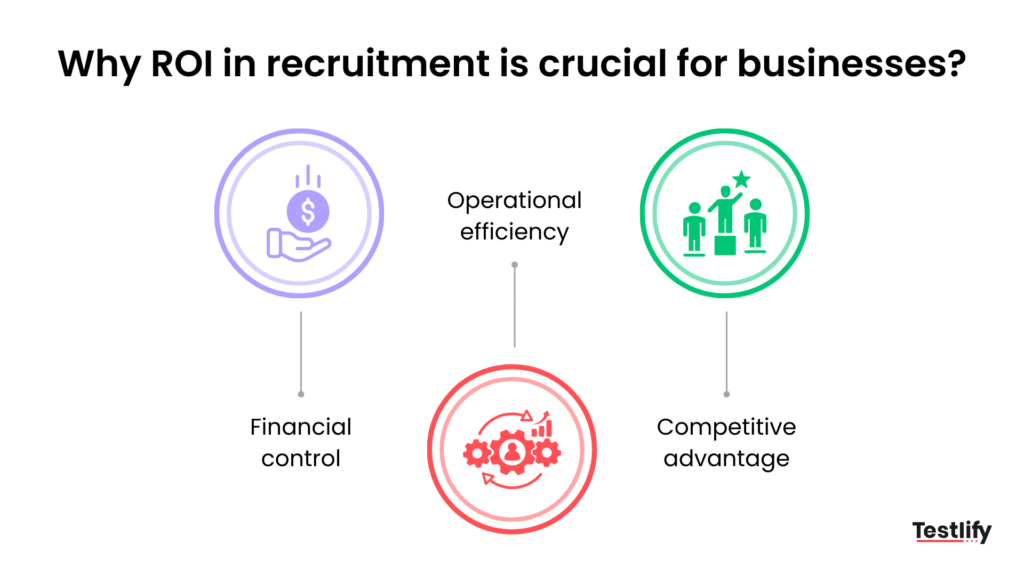
In recruiting, return on investment (ROI) measures the value a hire brings compared with the cost of hiring them. This includes the revenue or productivity they generate, the problems they solve, and the time and resources invested in recruiting, assessments, interviews, and onboarding.
A higher ROI means your hiring process is helping you find people who deliver greater value. A lower ROI can signal inefficiencies in areas such as sourcing, assessment, or hiring decisions.
Why ROI beats cost-per-hire
Cost-per-hire tells you what you spent. ROI tells you what you got back.
- Cost-per-hire: Measures the average cost to fill a role, including sourcing, recruiting, assessments, and other hiring expenses.
- ROI: Measures whether the person hired delivers enough value to justify that investment, through productivity, revenue, retention, or other business outcomes.
Why it matters: A cheaper hire isn’t necessarily a better hire. Cutting hiring costs can improve cost-per-hire while increasing the risk of poor performance, early turnover, or longer time to productivity.
Example:
Hiring Candidate A costs $2,000 and Candidate B costs $3,000. If B reaches productivity faster, performs better, and stays longer, the additional $1,000 may generate significantly more value.
Bottom line: Cost-per-hire helps you control recruiting spend. ROI helps you understand whether that spend is creating business value.
COST-PER-HIRE → What did we spend?
QUALITY OF HIRE → Who did we hire?
ROI → What value did they create?
What does a bad hire really cost?
A bad hire costs far more than the salary you paid. The average US hire already runs about $4,700 before anyone starts work, according to SHRM benchmarking data. When that hire does not work out, you pay it twice: once to recruit them, and again to replace them. Gallup puts the replacement cost at one-half to two times the person’s annual salary, and pins voluntary turnover at roughly $1 trillion a year for US businesses.
The damage is not only money. The bills are easy to count. The quiet costs are worse: the manager hours spent coaching someone who was never a fit, the deadlines that slipped, the strong people on the team who started updating their resumes because they were tired of covering the gap. Those do not show up on an invoice, but they are real, and they last.
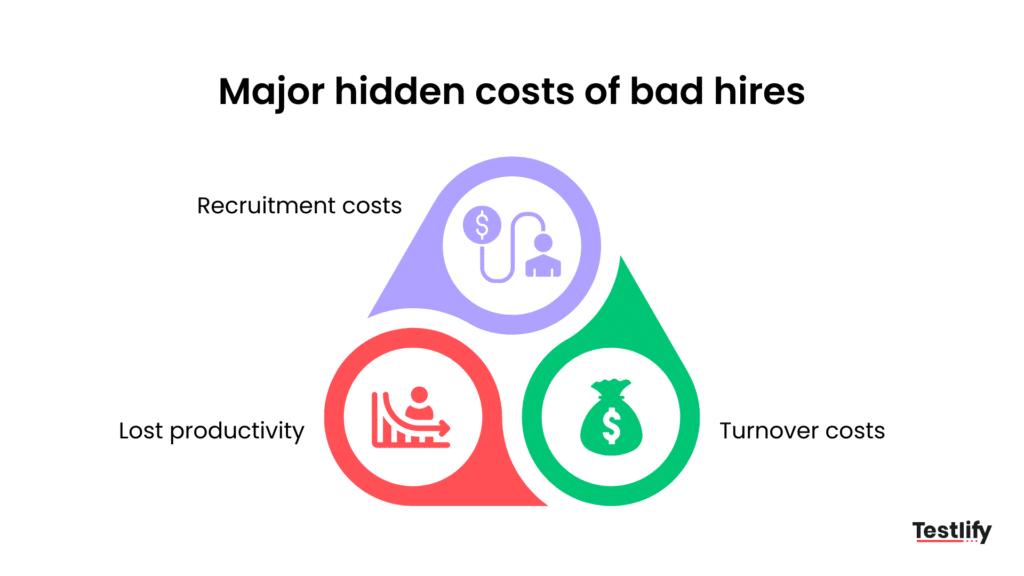
Replacement cost is not flat, either. Gallup’s breakdown shows it climbs with the role: about 40% of salary for a frontline worker, near 80% for a technical professional, and up to 200% for a leader or manager. So the more senior the seat, the more a screening miss hurts, and the more a scored, evidence-based shortlist is worth.
Key takeaway: The cost of a wrong hire is mostly invisible and mostly back-loaded. You feel it in month four, not week one. That is exactly why front-loading the evidence, before the offer, pays off.
How does smarter hiring lift job performance?
Smarter hiring lifts performance by matching skills to the role before the offer, so people contribute sooner and stay longer. When you hire someone who can already do the core work, they ramp in weeks instead of months, lean less on teammates, and need fewer corrections. That match is the engine behind the ROI: Gallup’s meta-analysis ties the best-matched, most engaged teams to 23% higher profitability, 18% higher productivity in sales, and 41% fewer quality defects than the weakest teams.
Here is the part most job descriptions get wrong. Performance is not just about raw talent; it is about fit between what the role needs and what the person actually does well. A brilliant engineer who hates ambiguity will struggle on a zero-to-one team. Screening for the real demands of the job, not a degree or a polished resume, is how you find people who thrive in the seat you are filling, not just an impressive seat somewhere.
Quality of hire: the metric that moves ROI
Quality of hire measures the value a new employee brings, judged on performance, contribution, and how long they stay. It is the metric ROI rests on, and the hardest to game. You can hire fast and cheap and still lose money if the people do not perform. The fix is to gather evidence of ability early, then check your predictions against what actually happens on the job.
How to put a number on quality of hire
A scorecard turns a vague hunch into a number you can defend. Testlify scores each candidate before the first call on three things: role-specific skills, cognitive ability, and job fit. You set the weighting per role, run the shortlist against it, then revisit those scores after 90 days against real performance. Over a few cycles the scorecard tells you which signals actually predicted success for your roles, so the next hire is sharper than the last.
Metric | Gut-feel hiring | Smarter, scored hiring |
|---|---|---|
Cost per hire | ~$4,700 average, repeated on every mis-hire | Same upfront cost, far fewer repeats |
Quality of hire | Judged on interviews and resumes | Scored on skills, cognitive ability, and fit |
Slowed by extra interview rounds | Shortlist scored before the first call | |
First-year retention | Exposed to early exits and 0.5x to 2x salary replacement cost | Higher fit, lower early turnover |
Pro tip: Set your quality-of-hire baseline before you change anything. Record today’s cost per hire, time to fill, and 12-month retention. Without that snapshot you cannot prove the ROI later, and the win becomes a story instead of a number.
How do you measure smarter-hiring ROI?
Measure smarter-hiring ROI by comparing the value a hire produces against the full cost of landing them. The plain formula is value added minus total hiring cost, divided by total hiring cost, read as a percentage. The trick is being honest about both sides: count recruiter hours and assessment costs on the spend side, and count retention and ramp speed on the value side, since an early exit wipes out the rest.
- Set a baseline. Capture current cost per hire, time to hire, and first-year retention before you change the process.
- Score every shortlist. Run candidates through role-based assessments so each one carries a comparable, evidence-based score.
- Track performance at 90 days. Compare assessment scores against real output and manager reviews to see what predicted success.
- Recalculate quarterly. Quarterly reviews catch decay and improvement faster than an annual look, so you adjust while it still matters.
Where Testlify fits in your hiring process
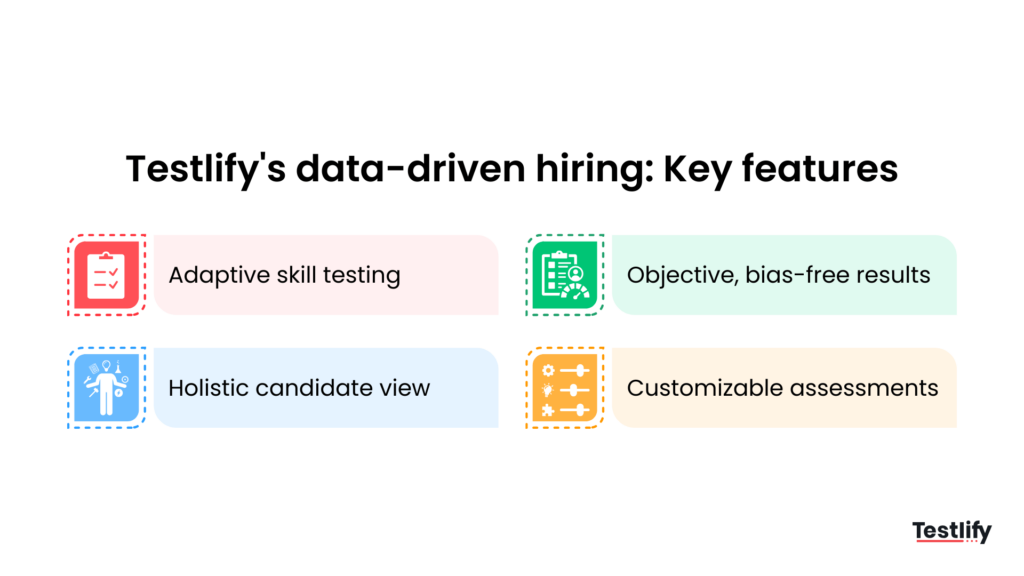
Testlify sits at one specific step: screening and assessment. It scores candidates on job-specific skills, cognitive ability, and role fit using a large test library and role-based assessments, with anti-cheat proctoring to keep results honest. It is not an ATS, an HRIS, or a background-check tool, and it does not pretend to be. It plugs into the rest of your stack and does the one job well: telling you, with evidence, who can actually do the work before you spend interview time on them.
This is also where skills-based hiring widens your options. LinkedIn’s Skills-First research found that a skills-first approach expands the talent pool by roughly 10x, and raises the share of women in roles where they are underrepresented by 24%. When you screen on what people can do instead of where they studied, you see candidates a resume filter would have thrown out, and some of them turn out to be your best hires.
A quick example
Picture a 500-person software company hiring 20 engineers a quarter. If they run a coding assessment before the first call, the recruiter only books interviews with people who already cleared the bar. That alone can drop two interview rounds per role. Multiply across 20 hires and the saved hours, plus the mis-hires avoided, are the ROI. This is an illustrative scenario, not a reported result, but the mechanics are exactly how scored screening pays for itself.
How fast does smarter hiring pay off?
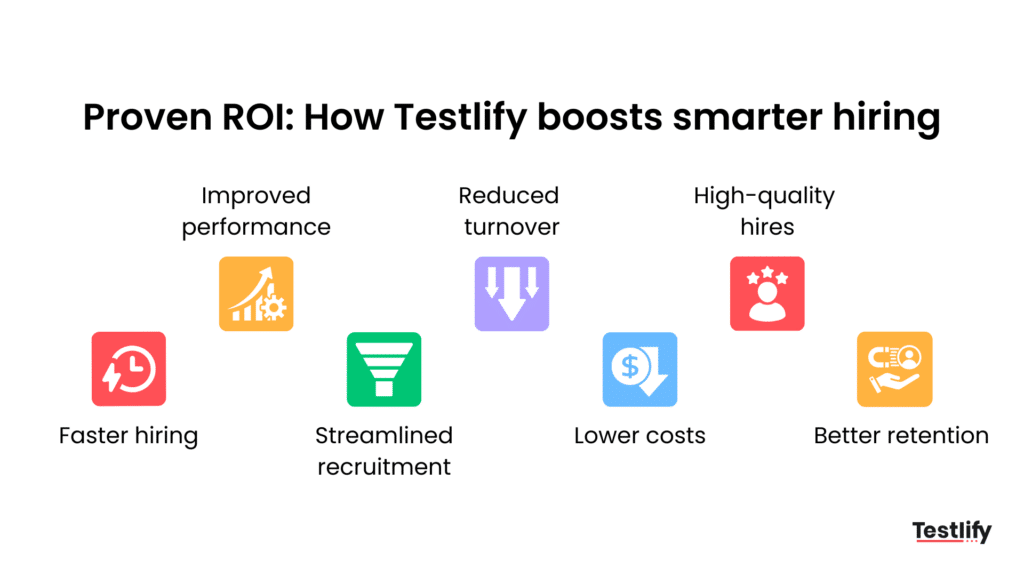
The first gains show up inside the first hiring cycle, because a scored shortlist removes interview rounds right away and fills roles faster. A quicker time to hire means less lost output from an empty seat. The deeper payoff, lower early turnover and stronger performance, reads a quarter or two later, once you have real on-the-job data to compare against your scores. That is why the baseline matters so much: it is what makes the slow win visible.
One honest caveat. Assessments improve your odds; they do not promise a perfect hire every time. A great score with a bad manager, a vague role, or a weak onboarding still ends badly. Screening is the highest-impact step you control, but it works best as part of a process that also gets the role definition and the first 90 days right. Treat it as the start of quality, not the whole of it.
For more on the screening side of this, see our guide to the benefits of using hiring assessments and how structured interviews compare with unstructured ones once a candidate clears the assessment stage.
Frequently asked questions

B2B SaaS Content Writer
Rishav Kumar is a B2B SaaS content writer with 4 years of experience. He loves crafting engaging content. Always exploring fresh ideas, he's passionate about helping businesses grow through impactful writing.
LinkedInRelated resources
View all
Hiring Guide
How to future-proof recruitment process with AI in hiring?

Hiring Guide
How does Testlify prevent cheating in AI pre-hire assessments?
Hiring Guide
Why are hiring and training employees essential in 2026?
Hiring Guide
Internships in Talent Acquisition: A 2026 Strategy Guide
Hiring Guide
Top 9 people management skills and how to assess them
Hiring Guide
How to create a recruitment dashboard that drive results?
Get started.
Hire on proof, not resumes.
Run your first skills-based assessment free — no credit card required.