
How to efficiently evaluate hard and soft skills in 2026?
Learn how to effectively evaluate hard and soft skills during hiring to build a strong, well-rounded team that drives success and growth.

As roles evolve and business pressures rise, HR teams need assessment techniques that reveal how candidates think, collaborate, adapt, and deliver in real-world conditions. Hard skills show what someone can do; soft skills show how they do it, and both matter for long-term success.
Modern assessments now blend data, behavioural science, and job-specific simulation to give a clearer picture of true potential.
This breaks down the principles, tools, and best practices HR leaders can use to evaluate skills accurately, fairly, and at scale in 2025.
 ChatGPT
 Gemini
 Claude
 Grok
Grok Perplexity
Why has using assessments for hiring become important now?
Two big forces make assessment a top HR priority in 2025. Skills are shifting faster than qualifications. Employers report wide talent scarcity and skills gaps as they adapt to new tech and new ways of working.
For example, SHRM research shows roughly three out of four organizations are finding it hard to fill roles because candidates lack the needed skills.
The business value of human skills has climbed. Leaders increasingly say that durable human skills, communication, collaboration, and critical thinking influence outcomes like retention, innovation, and customer satisfaction.
If assessments don’t measure what actually matters at work, hiring is guesswork.

Hard skills vs soft skills
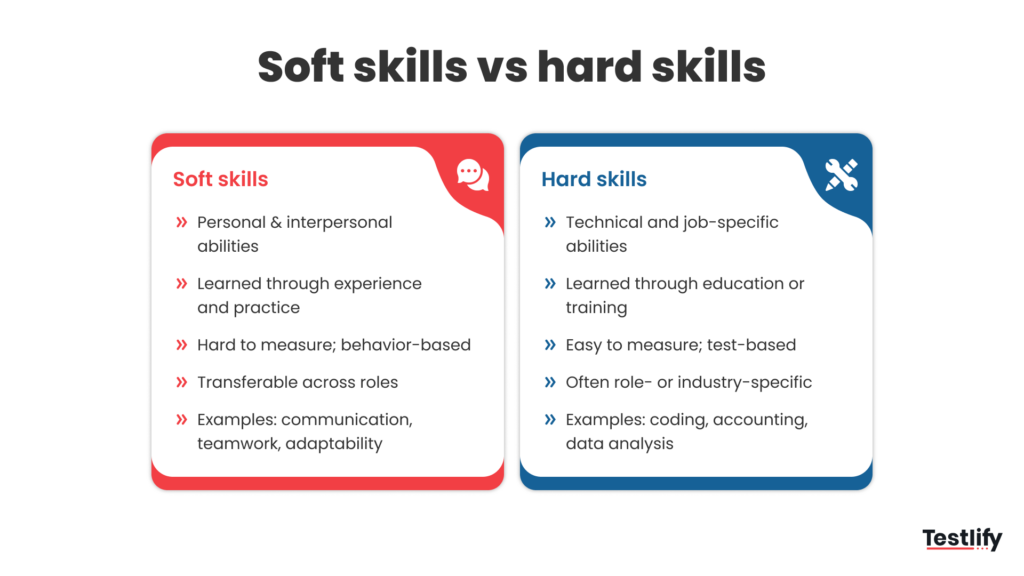
Hard skills are measurable, teachable technical abilities, e.g., SQL, CAD, Java, financial modelling, and regulatory knowledge. Usually demonstrated by work samples, tests, certifications.
Soft skills (a.k.a. human or durable skills): Interpersonal and cognitive behaviours, e.g., communication, problem-solving, resilience, collaboration, adaptability. Harder to measure but strongly predictive of performance in many roles.
Hard skills and soft skills both matter. The trick is how you measure each, so assessments are valid, consistent, and equitable.
Principles of good assessment
Before choosing tools or methods, agree on four non-negotiables:
Job-centred design (validity)
Effective assessments start with a clear understanding of the role. Every test or interview must directly connect to real job outcomes and day-to-day tasks. Conduct a thorough job analysis to identify success drivers, technical requirements, and collaboration needs. When assessments mirror actual work, they produce more accurate, defensible hiring decisions and reduce irrelevant evaluation steps.
Reliability and consistency
A strong assessment process produces consistent results, no matter who evaluates the candidate. This requires structured rubrics, standardized scoring, and interviewer calibration. When expectations and scoring guidelines are aligned, assessments become more objective, reducing “gut-feel hiring.” Consistency ensures fairness across candidates and helps organizations make confident, repeatable hiring decisions rooted in measurable evidence.
Fairness and bias mitigation
Fair assessments are intentionally designed to minimize bias and broaden access. This includes clear language, accessible formats, and accommodation for neurodiversity or technology constraints.
Organizations should regularly review data to identify unintended adverse impact on any demographic group. Proactive bias mitigation builds trust, strengthens diversity efforts, and ensures that hiring decisions are legally compliant and ethically sound.
Practicality and candidate experience
Assessments should balance accuracy with efficiency. They must be easy to administer at scale, respect candidate time, and clearly communicate expectations. A smooth, transparent process improves employer branding and reduces drop-offs. In competitive markets, candidate experience is a differentiator, practical, well-designed assessments help you hire faster while ensuring candidates feel respected and engaged throughout the process.
Assessment techniques (what works in 2026)
Below are techniques, when to use them, pros/cons, and best practices.
Work samples
Work samples mirror real job tasks and are among the strongest predictors of performance because they reveal applied skills, reasoning, and communication. Use clear rubrics, automated checks where relevant, and human review for nuance. Keep assignments short (1–3 hours) to reduce fatigue and ensure fairness for candidates with limited time.
Structured behavioral interviews
Structured interviews use consistent, competency-based questions and anchored scoring to reduce bias and increase predictive validity. Interviewers should probe for evidence using STAR-based prompts and score responses uniformly. Adding panel scoring and anonymized notes further boosts fairness. When executed well, structured interviews reliably uncover communication, decision-making, and collaboration strengths.
Situational Judgment Tests (SJTs)
SJTs present realistic workplace scenarios to evaluate judgment, prioritization, and values alignment. They’re scalable, efficient, and less resource-heavy than full simulations. To ensure accuracy, scenarios should be based on real role challenges and validated against responses of high performers. SJTs work well as early-stage filters for behavioural competence.
Simulations and assessment centres
Assessment centres combine multiple exercises, role plays, case tasks, in-baskets, group discussions, to generate deep behavioural insights. Ideal for leadership roles, they reveal communication style, stakeholder management, and adaptability. Though resource-intensive, they offer rich, reliable data when facilitated by trained assessors and multiple exercises to triangulate candidate behaviour comprehensively.
Micro-assessments & job auditions
Micro-assessments are short, focused tests like quick coding tasks, spreadsheet fixes, or SQL snippets. They’re fast, scalable, and reduce candidate drop-off. Instead of relying on one large test, combine several micro-assessments to build a rounded view of technical capability. Job auditions extend this by testing real skills in real work settings.
Cognitive and personality measures
Cognitive and personality tests can provide additional insight into reasoning, attention, and behavioural tendencies. However, they must be role-validated, transparent, and used only as part of a broader evaluation mix. Overreliance can introduce bias, so HR should use these tools carefully and ensure candidates understand their purpose and relevance.
Peer and manager work trials
Work trials involve candidates doing short paid tasks or shadowing teams to demonstrate capability in real conditions. They provide direct evidence of hard and soft skills, how candidates collaborate, solve problems, and handle ambiguity. When legally and operationally feasible, work trials offer the most accurate picture of real performance expectations.
AI-assisted simulations and automated scoring
AI tools can evaluate coding, analyse written responses, or simulate customer interactions at scale. They’re useful for speed and consistency, but only when transparent, validated, and explainable. HR must avoid black-box scoring and ensure human oversight for high-stakes decisions. AI should enhance, not replace, judgment, fairness, and ethical hiring practices.
Designing an assessment strategy step-by-step
Here’s a practical roadmap HR teams can use right away.
Start with job analysis and competency mapping
Begin by defining what success in the role looks like. Identify the key outcomes and convert them into 6–8 measurable competencies covering both hard and soft skills. This ensures assessments stay tightly aligned with real job demands. For example, a product manager may require skills in user research, prioritization, and stakeholder communication.
Choose the right technique for each competency
Select assessment methods that best match each competency. Use work samples or technical micro-tests for hard skills, SJTs or case tasks for reasoning, and structured interviews or group simulations for communication and collaboration.
Leadership roles benefit from assessment centres or 360 feedback. Aligning techniques to competencies increases accuracy and reduces unnecessary evaluation steps.
Match techniques to competencies:
- Hard/technical: work samples, micro-tests, certifications.
- Problem solving & reasoning: case exercises, SJTs.
- Communication & collaboration: structured interviews, group simulations, reference checks.
- Leadership: assessment centres, 360 feedback, situational exercises.
Build rubrics and scoring guides
Create clear, anchored scoring scales, typically 1 to 5, defining what strong, average, and weak performance looks like. Provide examples and train evaluators using real submissions to ensure consistent interpretation. Calibration sessions help interviewers and assessors align expectations, reducing bias and increasing scoring reliability across teams.
Pilot and validate
Run a pilot using current employees to test whether the assessment predicts actual performance. Compare results across high and average performers and check for correlation with metrics like time to productivity or manager ratings. Piloting uncovers flaws early and ensures the assessment is both predictive and job-relevant before full rollout.
Scale with fairness safeguards
As you expand the assessment, ensure it remains fair and bias-free. Use validated tools, anonymise data where feasible, and monitor pass rates across demographic groups. Investigate any discrepancies to prevent adverse impact.
Fairness safeguards protect both candidates and your organization, ensuring equitable and defensible hiring decisions at scale.
Iterate
Treat your assessment process as a living product. Continuously gather data, candidate feedback, hiring manager input, and post-hire performance results, to identify improvements. Update tasks, refine rubrics, and adjust scoring as roles evolve. Regular iteration ensures your assessments stay relevant, predictive, and aligned with business needs over time.
What to look for before buying assessment tools
Tech can help, but vendor choice must be disciplined.
- Validation evidence: Vendors should provide independent validation studies and fairness audits.
- Explainability: Especially for AI scoring, demand transparency about features and reasoning.
- Integration: ATS and L&D integration for closed-loop learning (assessment → development).
- Candidate privacy & compliance: GDPR/CCPA compliance and secure data handling.
- Accessibility: Support for assistive tech and multiple languages.
Useful tool types
- Coding sandboxes with unit testing
- SJT/Situational platforms
- Video interview platforms that only analyze content (not facial traits)
- Assessment-centre orchestration tools
- Learning platforms that accept assessment outputs to recommend personalized learning paths
Do pilots. Don’t buy a shiny product because it’s new, buy it because it measurably improves hiring accuracy or speed.
Testlify is a one-stop solution. With coding, role-specific, psychometric assessments to video, audio, chat interviews, you can get all at one place.
Final thoughts
In 2025, the organizations that win on talent will be those that measure what matters, not what’s easiest to measure. That means:
- Prioritising job-centred assessments (work samples, simulations)
- Measuring soft skills with rigour (structured interviews, SJTs)
- Using tech wisely and ethically (validate, explain, human-in-the-loop)
- Turning assessment into development (closing the hiring ↔ learning loop)
Assessment is no longer an HR back office. It’s a strategic capability that reduces hiring risk, improves productivity, and helps organizations adapt faster. Build it with evidence, test it with rigor, and iterate like a product.
Frequently asked questions (FAQs)

Wordpress Developer
Yash Patel is a Wordpress and SEO Specialist at Testlify with 3+ years of experience in technical SEO, on-page optimization, and content strategy. He works on improving Testlify's organic presence and produces content focused on hiring, talent assessment, and HR technology.
LinkedInRelated resources
View all
Skill assessment
What is an interview scorecard and how to create one?
Skill assessment
Learning Agility: What It Is and How to Assess It (2026)
Skill assessment
What are power skills and how to assess them?

Skill assessment
Organizational Skills Test: How to Assess Candidates in 2026
Skill assessment
Types of skills assessment tests

Skill assessment
How to assess skills fairly and effectively
Get started.
Hire on proof, not resumes.
Run your first skills-based assessment free — no credit card required.