
Moonlighting: How can HR detect & prevent it? (Top methods)
Discover what moonlighting is, how to detect it, its impact on businesses, and the best strategies to prevent and manage employees engaging in dual employment.

As an employer, you invest in top talent and trust your employees to give their best. But what if, behind the scenes, some of them are working a second job or freelancing for a competitor?
This phenomenon is called moonlighting, and it has become a growing concern for employers in recent years. While some employees see it as a way to earn extra income, businesses often view it as a breach of trust.
But is moonlighting really unethical? Should companies ban it outright or find a way to manage it? We’ll answer your question; keep reading!
 ChatGPT
 Gemini
 Claude
 Grok
Grok Perplexity
What is moonlighting?
When an employee takes up a second job or side gig while still working full-time for their primary employer, this practice is called moonlighting. Employees usually keep this a secret and work without informing their primary employer.
For example, an employee working as a freelance graphic designer in the evenings while holding a full-time marketing position during the day would be considered moonlighting.
According to United States Census Bureau data, the percentage of U.S. employees juggling multiple jobs increased to 8.3% in 2019.
The term “moonlighting” comes from the idea that employees work these extra jobs after regular office hours, often late at night, under the “moonlight”.
Moonlighting can create serious business issues, such as security risks and conflicts of interest. We’ll discuss this in a bit; for now, let’s understand the different types of moonlighting.

What are the different types of moonlighting?
Employees engage in different side jobs based on their work schedules and ethical considerations. Below are the four main types of moonlighting that employers should be aware of:
Blue moonlighting: Occasional side gigs
This happens when employees take up extra work once in a while. Employees engage in it when they need extra cash or have a short-term goal, like saving for a vacation. Since it’s not a regular commitment, it often goes unnoticed by employers.
Quarter moonlighting: Regular part-time work
Employees who engage in quarter moonlighting take on a steady side hustle but for limited hours, such as working 5-10 hours a week as a freelancer or instructor.
While this might not immediately affect their main job, it can become problematic if it starts clashing down the productivity of the primary employment.
Half moonlighting: Significant time commitment
Employees spend much of their free time on secondary employment in half moonlighting. Employees engaged in it have hardly any time left for personal commitments. It reduces an employee’s focus and energy in their primary job.
Full moonlighting: Working two full-time jobs
When an individual holds two full-time jobs simultaneously, that practice is called full moonlighting. It’s intense and is difficult to be sustained for too long. This type of dual employment is particularly concerning for businesses because:
- It can breach employment contracts, especially if both jobs are in the same industry.
- Employees may use company resources to work on their second job.
Why is moonlighting on the rise?
Moonlighting has become far more common in recent years. Several factors drive this trend, making it a growing concern for businesses. Here’s why more employees are approaching for dual employment today:
- The rise of remote work – Employees have more flexibility with work-from-home and hybrid models. Without daily office supervision, some professionals find time to take on side projects or even an extra job.
- Rising living costs – Many employees feel their primary salary isn’t enough for them. To maintain their lifestyle or manage expenses, they turn to moonlighting.
- Career diversification – Some employees moonlight not just for money but to explore new career opportunities. They even consider it as a stepping stone to entrepreneurship.
- Access to the gig economy – Platforms like Upwork, Fiverr, and Freelancer have made it easy for professionals to take on side gigs without leaving their full-time jobs. Now, employees can pick up projects on their schedule.
- Job insecurity & uncertain markets – Employees may take on a second role as a safety net in industries with frequent layoffs or unstable job markets. This is especially common in IT sectors, where workforce reductions happen regularly.
How does moonlighting affect organizations?
When employees divide their time between multiple jobs, their focus, energy, and commitment to their primary employer often take a hit. Below are some points that will help you understand how dual employment impacts businesses:
- Drop in productivity and performance: Juggling two jobs stretches employees too thin, decreasing efficiency. They may struggle to meet deadlines or deliver low-quality work, ultimately impacting team performance.
- Conflict of interest & security concerns: Employees taking on side jobs in the same industry may leak company strategies or trade secrets.
- Higher risk of burnout & absenteeism: Balancing multiple jobs often results in physical and mental exhaustion, which may increase the risk of burnout. This can also lead to higher absenteeism, affecting the other team members.
- Retention challenges: For some employees, moonlighting starts as a side hustle but eventually replaces their full-time job. They may quit once they realize their second job is more fulfilling or financially rewarding. Hiring again can double up your expenses.
- Client poaching: Some might steal clients from their primary employer to benefit their side business.
How can HR detect moonlighting by employees?
Detecting moonlighting can be challenging, especially in remote and hybrid work setups. However, certain behavioral and performance patterns can signal dual employment.
A noticeable decline in engagement and work quality can be one of the first signs. Employees juggling multiple jobs often struggle to meet deadlines and appear fatigued.
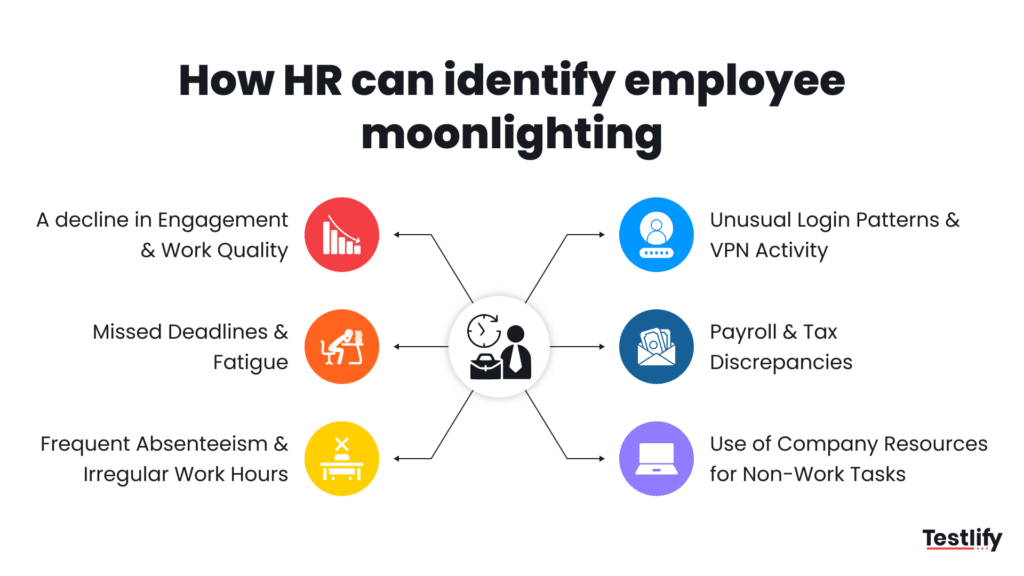
Frequent absenteeism, sudden requests for flexible work hours, or irregular logins outside of normal work schedules may also indicate that an employee is balancing another job.
Employers can also monitor payroll discrepancies, tax filings, or VPN login activity to identify unusual work patterns. If an employee logs in from different locations or uses company resources for non-work-related tasks, that’s a possible red flag.
The best way to detect it early is to perform a background check before onboarding. With background verification, you can analyze the candidate’s past activities and conclude any unethical practices or involvement in dual employment.
Detection methods are useful, but organizations should balance monitoring efforts with privacy considerations to maintain trust in the workplace.
How to prevent moonlighting by employees?
Preventing moonlighting requires a balanced approach. Below are some effective ways to avoid dual employment in your organization:
- Offer better salaries and incentives – Many employees moonlight because their salary isn’t enough to meet their financial needs. Providing fair compensation and benefits reduces the motivation to look elsewhere.
- Set clear HR policies – Companies should set clear guidelines on non-compete clauses and conflict-of-interest policies. Employees should fully understand whether moonlighting is permitted and, if so, under what conditions.
- Encourage open communication – Employees often hesitate to discuss financial concerns or career aspirations. A workplace that develops trust allows employees to express their needs, making them less likely to moonlight.
- Conduct regular performance reviews – A decline in work quality or frequent tiredness could indicate an employee is overcommitted. Regular performance evaluations help managers identify and address such issues before they escalate.
- Ensure strict data security measures – In industries where security is critical, dual employment can pose risks. Companies should enforce cybersecurity policies and educate employees about ethical concerns.
How to deal with moonlighting employees?
While some moonlighting cases may not directly harm the company, others could lead to severe consequences.
Businesses should approach the situation fairly and transparently instead of taking immediate disciplinary action. Here’s how to handle moonlighting employees effectively:
- Assess the severity of the situation – Not all moonlighting cases impact business operations similarly. Some employees may take on side projects that don’t interfere with their work. Employers should gather all relevant facts before deciding on further action.
- Have a direct and professional conversation – Managers should have an open and honest discussion with the employee instead of making assumptions. Understanding their reasons for moonlighting can help determine the best course of action.
- Check company policies and employment contracts – HR should review employment agreements to determine whether employees have violated moonlighting policies. If the company doesn’t have clear guidelines, now is the time to establish them.
- Ensure employees understand the policy – Many employees may not be fully aware of company rules on dual employment. Employers should communicate their stance through employee handbooks or onboarding sessions to prevent misunderstandings.
- Share the consequences with employees – Employees should be informed about the risks and repercussions of moonlighting, especially if it affects company interests. This includes potential disciplinary action, loss of trust, and even legal consequences if confidential information is compromised.
- Use employee activity monitoring software – Offer alternatives or internal opportunities. Some employees moonlight because they want extra income or professional growth. Companies can provide internal freelancing opportunities, skill-building programs, or performance-based incentives to keep employees engaged.
- Enforce disciplinary actions if necessary – If moonlighting violates company policies or affects business operations, appropriate action must be taken. This could range from a formal warning to termination, depending on the severity of the case.
- Strengthen workplace culture – Employees are less likely to moonlight if they feel valued and well-compensated. Companies should focus on competitive pay and employee well-being to increase employee satisfaction and loyalty.
Bottom line
Moonlighting is a complex issue that requires a balanced approach. Instead of strict bans, companies should focus on clear policies, fair compensation, and open communication.
When employees feel valued and engaged, they are less likely to seek outside work—creating a win-win situation for both businesses and their workforce.
Is your organization ready to tackle moonlighting the right way?
Frequently asked questions (FAQs)

B2B SaaS Content Writer
Rishav Kumar is a B2B SaaS content writer with 4 years of experience. He loves crafting engaging content. Always exploring fresh ideas, he's passionate about helping businesses grow through impactful writing.
LinkedInRelated resources
View all
HR & recruitment
Employee onboarding checklist: Steps, templates and best practices (2026)

HR & recruitment
On-demand recruitment: what it is, how it works, and when to use it (2026)
![Employee evaluation forms: How to create one [Free templates]](/api/media/file/Employee-evaluation-forms-2.png?dpl=dpl_6Z8Gzi5dgny5ePrnCfPbRPCRYCA7)
HR & recruitment
Employee evaluation forms: How to create one [Free templates]

HR & recruitment
Writing Assessments for Hiring: Identify Top Talent

HR & recruitment
Affiliative leadership: Importance, tips and benefits

HR & recruitment
HR hiring cycle: steps, tools, and best practices
Get started.
Hire on proof, not resumes.
Run your first skills-based assessment free — no credit card required.