
Natural language processing in recruitment: uses, risks and setup
How hiring teams use NLP to parse resumes, match candidates, write fairer job ads and screen at scale, plus the risks and laws to plan for.

A single open role can bring hundreds of resumes, and no recruiter can read each one with the same care. Natural language processing in recruitment fixes part of that: AI reads resumes, job ads, chats and interview answers so people do not start from zero.
Used well, it gives your team a shortlist backed by evidence, with recruiters still making the final call. This guide shows where NLP helps, where it fails, which laws apply and how to roll it out.
TL;DR:
- Natural language processing (NLP) in recruitment turns resumes, job ads, chats and interview answers into structured data a hiring team can search, compare and score.
- The five common uses are resume parsing, candidate matching, job description review, candidate chatbots and interview analysis.
- Semantic matching reads meaning, so "led a team of 12" can count as people management even when the resume never says "manager". Keyword filters miss that.
- LinkedIn's Future of Recruiting 2025 found teams using generative AI save about 20% of their work week, and 35% spend that time on candidate screening.
- Trust is the weak spot: a 2025 Gartner survey found only 26% of candidates trust AI to evaluate them fairly.
- NYC Local Law 144 requires a yearly bias audit for automated hiring tools, and the EU AI Act lists AI that filters job applications as high-risk.
- Start with one high-volume role, run the tool next to your current process, and check its picks against recruiter decisions before you let it rank anyone.
 ChatGPT
 Gemini
 Claude
 Grok
 Perplexity
What is natural language processing in recruitment?
Natural language processing in recruitment is a branch of AI that lets hiring software read, interpret and generate the language found in resumes, job descriptions, applications, messages and interview answers. It changes unstructured text into fields, scores and summaries, so recruiters can screen and compare candidates faster and on the same criteria.
Most of what a hiring team handles is language. A single requisition can bring hundreds of resumes, each in a different format, plus cover letters, screening answers, recruiter notes and interview transcripts.
NLP is the layer that makes that text usable by software. For the plain definition of the term, see the HR glossary entry on natural language processing.
NLP is not a product on its own. It sits inside tools hiring teams already buy: the ATS that parses resumes, the AI resume screener that ranks applicants, the chatbot that answers candidate questions, and the AI interviewer that scores answers.

How does natural language processing work in hiring?
Natural language processing works in hiring in four steps: it takes in the text or speech, breaks it into units it can read, applies a task such as extraction, matching or scoring, and passes the result to a person or workflow. Each step can fail, so good tools show their work at every stage.
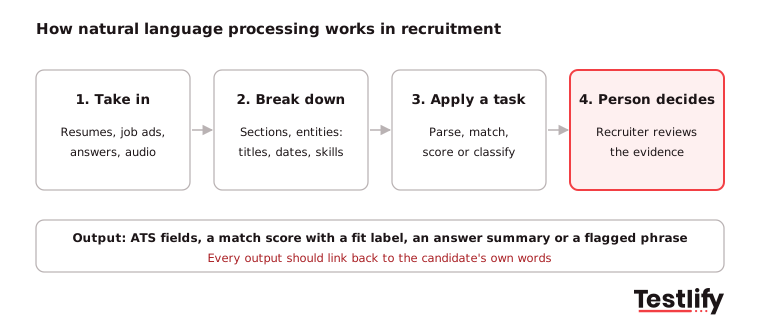
- Take in the language: The tool collects resumes, job descriptions, application answers, chat messages or interview audio. Audio is turned into text with speech recognition first.
- Break it into units: The text is split into sections, sentences and words. Named entity recognition finds employers, job titles, dates, skills, degrees and locations.
- Apply a task: The tool runs the job it was built for: filling ATS fields, comparing a candidate to the job description, scoring an answer against a rubric, or classifying a message.
- Hand the result to a person: The output becomes a match score, a fit label, a summary or a flagged phrase. A recruiter reviews it and decides what happens next.
Modern tools use large language models for step 3, which is why they handle synonyms and context far better than the keyword parsers of a few years ago. The trade-off is that a confident summary can still be wrong, so step 4 matters more, not less.
Pro tip: Ask any vendor to show the evidence behind a score, such as the resume line or the answer that earned it. A score you cannot trace back to the candidate's own words is hard to defend to a hiring manager or a regulator.
Where is NLP used across the hiring process?
NLP is used at five points in the hiring process: writing the job ad, parsing and matching resumes, screening through chat, analyzing interviews and supporting the final decision. Resume parsing and matching are the most common, because they remove the slowest manual step in high-volume hiring.
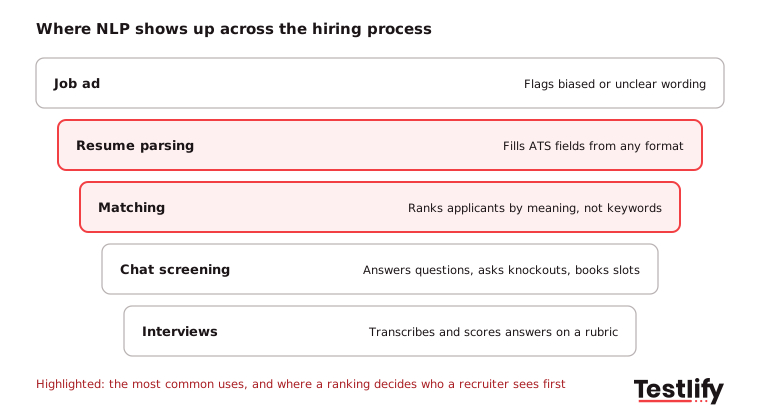
Hiring stage | What NLP does | What the hiring team gets | What to check |
|---|---|---|---|
Job description | Flags gendered, exclusionary or jargon-heavy wording and unneeded degree requirements | Clearer ads that reach a wider pool | Suggestions still fit the real job |
Resume parsing | Pulls contact details, work history, skills and education into ATS fields | Searchable profiles without manual data entry | Accuracy on scanned, two-column and non-English resumes |
Matching and ranking | Compares each profile to the job description by meaning, not exact words | A ranked shortlist with a match score | Ranking logic is explainable and audited for bias |
Chat screening | Answers candidate questions, asks knockout questions, books interviews | Screening that runs outside office hours | Candidates can reach a person and ask for an alternative |
Interviews | Transcribes answers and scores them against a rubric, suggests follow-ups | Comparable evidence for every candidate | Scores map to job skills, never to tone or accent |
Job descriptions: NLP reviews the ad before it goes live and points out words that put some groups off, long requirement lists and unclear duties. The output is a suggestion, so the hiring manager still owns the final wording.
Resume parsing: Parsing is the oldest NLP job in hiring. Testlify's guide to what resume parsing is covers the mechanics.
The common failure is layout: tables, columns and image-based PDFs still trip up some parsers.
Matching and ranking: Ranking is where NLP saves the most time and carries the most risk, because a ranking decides who a recruiter looks at first. The next section explains how semantic matching differs from keyword filters.
Chat screening: A recruitment chatbot uses NLP to understand free-text questions such as "Is this role remote?" and to collect screening answers in a conversation instead of a form.
Interviews: In AI interviews, NLP turns spoken or typed answers into text, tags each answer to the skill it covers and scores it against the same criteria for every candidate.
How is semantic matching different from keyword screening?
Semantic matching compares the meaning of a resume with the meaning of a job description, while keyword screening only checks whether exact words appear. Semantic matching finds qualified people who describe their work in different words.
Keyword screening rejects those people, and it rewards resumes stuffed with the right terms.
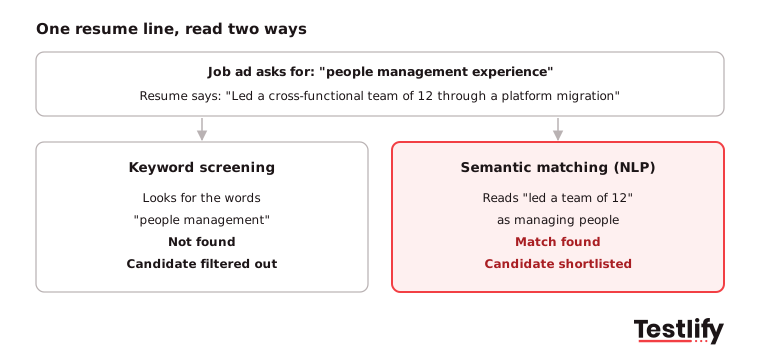
Take a job description that asks for "people management experience". A candidate writes "led a cross-functional team of 12 through a platform migration".
Aspect | Keyword screening | Semantic matching (NLP) |
|---|---|---|
How it reads | Exact words and synonyms someone listed | Meaning of the sentence in context |
Misses | Career changers, non-native writers, unusual job titles | Fewer, but can over-read vague claims |
Easy to game | Yes, by copying the job ad's words | Harder, though AI-written resumes still blur signals |
Explains its result | Clearly: the word was there or not | Only if the tool shows the matching evidence |
Upkeep | Constant synonym lists | Model updates and regular accuracy checks |
Semantic matching is only as good as the job description behind it. A vague job ad produces a vague match, so tighten the must-have skills before you trust any ranking. For more ways to sort applicants, see these resume screening techniques.
What are the benefits of NLP for hiring teams?
The benefits of NLP for hiring teams are faster screening, more consistent evaluation, better use of recruiter time and wider candidate pools. The biggest gain shows up in high-volume roles, where reading every resume or answer by hand is the bottleneck that slows time-to-hire.
- Time back for recruiters: LinkedIn's Future of Recruiting 2025 report found that teams using generative AI save about 20% of their work week, roughly a full day.
- Time spent on judgment, not admin: In the same LinkedIn survey of 1,271 talent professionals, 35% said saved time goes into candidate screening and 26% into skills assessment.
- Same criteria for every candidate: Structured scoring asks every applicant to clear the same bar, which is hard to hold by hand on the 300th resume.
- Wider pools: Semantic matching surfaces career changers and candidates with uncommon job titles that keyword filters drop.
- Faster responses: Chat screening answers questions and books interviews at any hour, which matters for hourly and contact center roles where candidates accept the first offer they get.
Adoption is still early. LinkedIn found 37% of organizations were actively integrating or experimenting with generative AI in hiring, up from 27% a year before, so most teams are still setting their rules.
Key takeaway: NLP pays off when it removes a manual bottleneck you can measure today, such as hours spent on first-pass resume review. Measure that number before you start, so you can prove the gain later.
What are the risks and limits of NLP in recruitment?
The risks of NLP in recruitment are biased rankings learned from past hiring data, misread resumes, scores that nobody can explain, privacy gaps and low candidate trust. None of these is a reason to avoid NLP, but each needs a check before a tool ranks or rejects real applicants.
- Bias learned from history: A model trained on past hires can copy past preferences for certain schools, employers or wording. Removing names and gender does not remove proxies such as postcode or university.
- Misreads: NLP still trips on abbreviations, negation ("no experience with SAP"), overlapping dates and specialist terms. A wrong parse quietly drops a good candidate.
- Unexplained scores: If a recruiter cannot see why a candidate scored 62, they cannot challenge the score or explain it to the candidate.
- Tone and accent: Scoring tone, sentiment or "enthusiasm" in interviews has no clear link to job performance and can penalize non-native speakers and disabled candidates. Score the content of the answer instead.
- Privacy: Some tools collect more personal data than the job needs and keep it too long.
- Candidate trust: A 2025 Gartner survey of 2,918 job candidates found only 26% trust AI to evaluate them fairly, and 52% believe AI already screens their application.
- AI on the candidate side: The same Gartner research found 39% of candidates used AI in their applications, so polished resumes and answers say less about the person than they used to.
The UK Information Commissioner's Office audited AI recruitment tools between 2023 and 2024 and made 296 recommendations. According to its November 2024 outcomes report, the most common problems were a lack of accuracy testing and collecting personal data the tool did not need.
Which laws apply to NLP hiring tools?
Laws that apply to NLP hiring tools include New York City Local Law 144, the EU AI Act, UK and EU data protection law, and general anti-discrimination law in every market. An NLP tool that screens, ranks or scores candidates is usually treated as an automated decision tool, so the employer carries the duty, not only the vendor.
- New York City Local Law 144: An automated employment decision tool needs a bias audit within one year of use, a public summary of the results and a notice to candidates 10 business days before use. The NYC Department of Consumer and Worker Protection has enforced it since July 5, 2023.
- EU AI Act: Annex III lists AI systems used "to analyse and filter job applications, and to evaluate candidates" as high-risk, which brings duties on human oversight, logging, transparency and risk management for both providers and employers that deploy them.
- UK GDPR and EU GDPR: Employers need a lawful basis, a data protection impact assessment for high-risk processing and clear information for candidates on how AI processes their data. The ICO's 2024 audit stressed all three.
- Anti-discrimination law: In the US, Title VII still applies when software makes or shapes the decision. A biased outcome is the employer's problem even when the vendor built the model.
Ask every vendor for its most recent bias audit, the data it trains on, where candidate data is stored and how a candidate can ask for a human review. Testlify publishes its own NYC bias audit for its Matching Model.
How do you roll out natural language processing in recruitment?
Rolling out natural language processing in recruitment works best in five steps: pick one high-volume role, define the skills that matter, run the tool next to your current process, compare its picks with recruiter decisions, then scale with regular audits. A parallel run is the step most teams skip and the one that catches problems early.
- Pick one role: Choose a role with many applicants and a clear skill profile, such as customer support, sales development or junior engineering.
- Define the criteria first: Write the must-have skills and the evidence that proves each one. NLP ranks against whatever you give it.
- Run it in parallel: For two to four weeks, let recruiters screen as usual while the tool scores the same applicants. Do not let it reject anyone yet.
- Compare the results: Check where the tool and recruiters disagree, and look at pass rates by gender, age band and ethnicity where you can lawfully collect that data.
- Scale with guardrails: Turn on auto-advance before auto-reject, keep a human review for every rejection near the threshold, and repeat the bias check at least once a year.
Before you sign, ask the vendor these questions:
- Evidence: Can a recruiter see the resume line or answer behind every score?
- Accuracy: How does parsing perform on scanned, multi-column and non-English resumes?
- Bias: When was the last independent bias audit, and is the summary public?
- Data: Is candidate data used to train shared models, and can you choose the storage region?
- Fit: Does it sync both ways with your ATS, so recruiters do not work in two systems?
Is an NLP test the same as using NLP to screen applicants?
An NLP test and NLP screening are different things. An nlp test is a skills assessment that checks whether a candidate can build language systems, covering text preprocessing, embeddings, transformers and model evaluation. NLP screening is the use of language AI to review any applicant for any role.
Teams hiring NLP engineers, data scientists or AI specialists use the test to check the technical skill itself. The natural language processing engineer hiring guide walks through that full process. Everyone else meets NLP as a feature inside their screening tools, which is what the rest of this guide covers.
How does Testlify use NLP in screening?
Testlify uses NLP in its AI resume screener, its AI interviews and its candidate reports, with human review built into each step. The aim is a ranked shortlist backed by evidence from the candidate's own words, followed by skills tests that check what the resume claims.
- AI resume screener: The AI resume screener pulls resumes from your ATS, gives each one an explainable match score with a High, Medium or Low fit label, and can auto-advance or auto-reject by a threshold you set before syncing results back. It is free with Greenhouse.
- AI interviews: Chat AI, Voice AI and Video AI interviews ask every candidate the same role-based questions and score each answer against the same criteria. See how Chat AI interviews work.
- Candidate insights: Reports break scores down by skill, add AI-written pros and cons, and suggest follow-up questions for the next round.
- Skills over claims: Because AI-written resumes are now common, Testlify pairs screening with skills tests from a library of 3,500+, including communication skills tests, so the shortlist rests on proof rather than wording.
- Fit with your stack: Assessments run in 15+ languages and connect to 100+ ATS and HRIS tools.
Ready to screen on evidence, not keywords?
NLP gets candidates to the right recruiter faster. Skills tests and structured interviews tell you who can do the job. Book a demo to see the AI resume screener and AI interviews on one of your open roles, or browse the Testlify test library to find tests for the skills that matter. You can also start a 7-day free trial, no credit card needed.
Frequently asked questions (FAQs)

Head of Assessments
Usha brings a rare depth of expertise to Testlify’s assessment function, over 40 years of multidisciplinary experience spanning banking, insurance, healthcare, automotive, IT services, manufacturing, pharmaceuticals, and enterprise software. At Testlify, she ensures that every assessment, scoring methodology, and competency structure meets the highest standards of enterprise-grade transparency, fairness, and consistency, the kind that holds up under audit and earns the trust of the world’s most rigorous hiring teams.
LinkedInRelated resources
View all
AI in recruitment
Role simulations in hiring: how to design, run and score them

AI in recruitment
What tools offer AI-generated questions for custom assessments?

AI in recruitment
How does Testlify’s AI scoring handle open-ended answers and code quality?

AI in recruitment
How to use AI in recruiting using Testlify

AI in recruitment
AI recruitment platforms: Buyer’s guide

AI in recruitment
Will AI replace recruiters in 2026? The real answer
Get started.
Hire on proof, not resumes.
Run your first skills-based assessment free — no credit card required.