
Grey collar jobs: what they are, examples, and how to hire [2026]
Grey-collar jobs are in high demand, blending hands-on skills with tech expertise. Explore their rise, salaries, and how to hire the best talent today!
![Grey collar jobs: what they are, examples, and how to hire [2026]](/api/media/file/What-are-grey-collar-jobs-2.png?dpl=dpl_6EF1e1bbhYuseK7CKKJE2ZCuSqYD)
Grey collar jobs are roles that combine technical expertise with hands-on work. They typically require specialized skills, certifications, or vocational training but not necessarily a four-year college degree. Common examples include technicians, healthcare workers, IT support specialists, manufacturing supervisors, electricians, and skilled trades professionals.
As industries adopt new technologies and automation, demand for grey collar workers continues to grow. These employees bridge the gap between traditional blue collar and white collar roles, making them essential in sectors such as manufacturing, healthcare, logistics, construction, and technology. Hiring them, however, requires evaluating practical skills, technical knowledge, and job readiness, not just resumes or educational qualifications.
In this guide, you’ll learn what grey collar jobs are, how they differ from blue- and white-collar roles, examples across industries, the skills employers should look for, and best practices for hiring and assessing grey collar talent.
 ChatGPT
 Gemini
 Claude
 Grok
Grok Perplexity
TL;DR
- Grey collar jobs sit between blue collar and white collar work. They pair hands-on, physical tasks with specialized technical knowledge, and most are entered through certifications or apprenticeships rather than a four-year degree.
- Think HVAC technicians, paramedics, wind turbine techs, surgical technologists, and IT support. The collar is grey because the work is both manual and cognitive at the same time.
- Grey collar work is the fastest-growing slice of the labor market. Wind turbine service technicians are projected to grow 49.9% between 2024 and 2034, the single fastest-growing US occupation, and nurse practitioners 46% through 2033.
- The World Economic Forum expects 39% of workers’ core skills to change by 2030, so the technical layer inside these roles keeps getting deeper, and the degree keeps mattering less.
- Because a resume rarely proves whether someone can actually do grey collar work, a short, structured skills assessment is the most reliable way to screen for it. Map the role’s real competencies, then test for them before the first interview.

What are grey collar jobs?
Grey collar jobs are occupations that combine manual work with specialized technical knowledge in the same role. They demand both physical ability and trained expertise, usually gained through vocational programs, apprenticeships, or certifications rather than a four-year degree. The category covers healthcare, skilled trades, energy, transportation, manufacturing, and technology support.
The term borrows from the older colors of work. You already know how white collar and blue collar work compare: white for offices and knowledge, blue for hands and labor. Grey is the overlap. A grey collar worker is not sitting at a desk all day, and is not doing purely repetitive manual work either. The role sits in the middle, and that middle is where a lot of the modern economy now lives.
Grey collar vs gray collar jobs: same thing?
Yes. Grey collar jobs and gray collar jobs are the same thing, spelled two ways. “Grey” is the British and international spelling; “gray” is the American one. Both point to identical work: roles that blend physical tasks with technical skill. If you search “gray collar jobs” or “grey collar workers,” you land on the same set of occupations, so do not read anything into which spelling a source uses.ld service engineer drives to a site, reads a diagnostic, and fixes the machine. The knowledge is real, and so is the physical work.
Examples of grey collar jobs
Grey collar jobs span multiple industries and combine practical work with technical expertise. These roles typically require vocational training, certifications, apprenticeships, or specialized technical skills rather than a traditional four-year degree.
Industry | Examples of grey collar jobs | Key skills required |
|---|---|---|
Healthcare | Paramedic, radiology technician, medical laboratory technician, pharmacy technician | Patient care, medical equipment, compliance, technical procedures |
Information Technology | IT support specialist, network technician, computer repair technician, help desk analyst | Troubleshooting, networking, hardware, customer support |
Manufacturing | CNC machinist, industrial maintenance technician, quality control inspector, robotics technician | Machine operation, diagnostics, automation, quality assurance |
Construction & Skilled Trades | HVAC technician, electrician, plumber, elevator mechanic, solar panel installer | Installation, repair, safety standards, technical expertise |
Automotive | Automotive service technician, EV technician, diesel mechanic, diagnostic specialist | Vehicle diagnostics, electrical systems, repair, maintenance |
Telecommunications | Fiber optic technician, telecom field engineer, cable installer | Network installation, signal testing, troubleshooting |
Logistics & Supply Chain | Warehouse automation technician, fleet maintenance technician, logistics coordinator | Equipment maintenance, inventory systems, process optimization |
Energy & Utilities | Wind turbine technician, power plant operator, utility line technician, water treatment operator | Equipment maintenance, safety, monitoring systems, regulatory compliance |
Aviation | Aircraft maintenance technician, avionics technician | Aircraft systems, inspections, safety regulations |
Public Safety | Firefighter, emergency medical technician (EMT), police communications specialist | Emergency response, technical equipment, crisis management |
What does grey collar work involve?
Grey collar work involves applying a specific technical skill through physical, on-site tasks. It is diagnosis plus repair, care plus procedure, operation plus judgment. The common thread is that the worker cannot do the job from a keyboard alone, and cannot do it with muscle alone either. A wind turbine technician climbs the tower and also interprets vibration data. A biomedical equipment technician calibrates a ventilator and also documents it to a regulatory standard.
That dual nature is why grey collar work is hard to fake and hard to screen on paper. Two candidates can hold the same certificate and perform very differently on the actual task. The work rewards competence you can demonstrate, not credentials you can list, which is the whole reason a hands-on assessment beats a resume here.
Grey collar vs blue collar and white collar jobs
The clearest way to place grey collar jobs is next to the two categories they sit between. Blue collar work is primarily manual. White collar work is primarily cognitive and desk based. Grey collar work is both, in one role. The table below shows how the three compare on the traits that matter when you are writing a job description or planning how to assess candidates.
Comparison factor | Blue collar jobs | Grey collar jobs | White collar jobs |
|---|---|---|---|
Nature of work | Primarily physical or manual labor requiring hands-on tasks. | Combines practical, hands-on work with technical expertise and specialized knowledge. | Primarily knowledge-based, administrative, managerial, or professional work performed in an office or remote setting. |
Primary skills | Physical ability, equipment operation, craftsmanship, and trade-specific skills. | Technical proficiency, troubleshooting, digital literacy, problem-solving, and practical execution. | Analytical thinking, communication, strategy, management, and business or professional expertise. |
Typical education | High school diploma, vocational training, or on-the-job learning. | Technical certifications, vocational education, apprenticeships, licenses, or associate degrees. | Bachelor’s degree or higher, depending on the profession. |
Common industries | Construction, manufacturing, agriculture, warehousing, transportation, and maintenance. | Healthcare, manufacturing, IT support, telecommunications, utilities, automotive, logistics, and field services. | Finance, marketing, consulting, law, HR, software development, education, and corporate management. |
Example roles | Electrician, welder, warehouse associate, machine operator, construction worker. | HVAC technician, paramedic, radiology technician, industrial maintenance technician, IT support specialist. | Accountant, software engineer, marketing manager, HR specialist, financial analyst. |
Best hiring approach | Practical work samples, trade tests, and safety assessments. | Technical skills assessments, job simulations, scenario-based evaluations, and certification verification. | Cognitive ability tests, role-specific assessments, structured interviews, and case studies. |
Use of technology | Limited to moderate, depending on the role and equipment used. | High—regularly uses specialized tools, software, diagnostic systems, or automated equipment. | Extensive use of business software, digital collaboration tools, analytics, and office applications. |
Career progression | Supervisor, foreperson, skilled trades specialist, or operations lead. | Senior technician, field engineer, technical supervisor, specialist, or operations manager. | Team lead, manager, director, executive, or subject matter expert. |
Blue collar jobs still exist in large numbers, and the line moves over time as tools get smarter. A warehouse role that adds robotics and inventory software starts drifting toward grey. For a fuller picture of the classic categories, see our explainer on what counts as a blue collar worker and the way pink collar roles fit the same color system.
Why are grey collar jobs growing so fast?
Grey collar jobs are growing because technology is adding a technical layer to work that used to be purely manual, and because employers are dropping degree filters that never predicted performance well. Three forces are driving it.
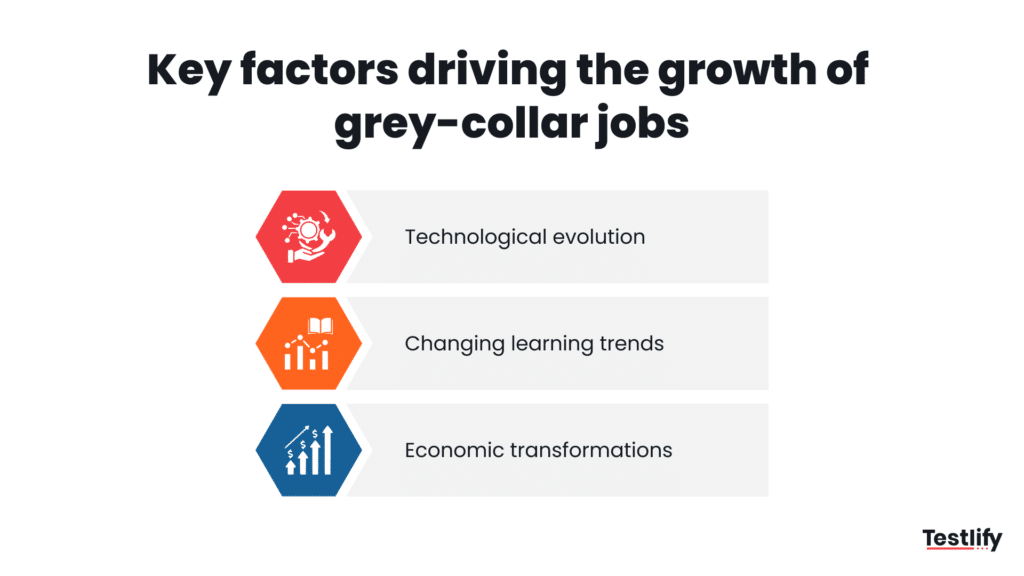
Skills are changing under everyone’s feet. The World Economic Forum expects 39% of workers’ core skills to change by 2030, and 59% of the workforce to need reskilling or upskilling before then (Future of Jobs Report 2025). When the skill mix shifts, the roles that combine hands and knowledge feel it first, because they have to absorb new tools and stay physical at the same time.
The green and healthcare booms are grey collar booms. The fastest-growing US occupation is a grey collar one: wind turbine service technicians are projected to grow 49.9% between 2024 and 2034, at a median wage of $62,580. Healthcare tells the same story: nurse practitioner roles are projected to grow 46% through 2033, adding more than 135,000 jobs at a median of $129,210.
The degree filter is falling. A majority of US job postings on Indeed, 52% as of January 2024, no longer mention any formal education requirement, up from 48% five years earlier, while the share demanding a college degree slipped to 17.8%. As degrees stop being the gate, certifications and demonstrated skill move to the center, which is exactly where grey collar hiring already lives.
Here is the honest caveat, though. Dropping a degree line from a job post is not the same as changing who gets hired. When firms remove the requirement, the share of hires without a bachelor’s degree rises only about 3.5 percentage points, because many stop at the announcement and keep screening the old way. The employers who actually capture this talent are the ones who replace the degree filter with a real test of skill, not the ones who just delete a line and hope.
Which grey collar jobs are most in demand in 2026?
The most in-demand grey collar jobs cluster in healthcare, clean energy, skilled trades, and technology support, where demand is high and the required skills are specific. Here are representative roles and what makes each one grey rather than blue or white.
- Wind turbine and solar technicians: climb, inspect, and repair hardware while reading diagnostics and following strict safety protocols. This is the fastest-growing corner of the labor market.
- Nurse practitioners, paramedics, and surgical technologists: deliver hands-on care that depends on clinical judgment, monitoring, and fast decisions under pressure.
- HVAC, elevator, and industrial maintenance technicians: diagnose faults with software and sensors, then fix the physical system on site.
- IT support and field service engineers: troubleshoot networks and devices, then handle the cabling, installs, and hardware swaps in person.
- Automotive and aircraft mechanics: run computerized diagnostics and carry out precision repairs that carry real safety and compliance weight.
- Biomedical and lab technicians: operate, calibrate, and document complex equipment to a regulated standard.
What unites the list is that every role needs a proven skill you can watch someone perform. A candidate either reads the diagnostic correctly or does not. That is good news for hiring teams, because it means you can test for the job instead of guessing from a resume.
What skills do grey collar workers need?
Grey collar workers need a blend of technical skill, hands-on competence, and the softer skills that keep both safe and reliable. The exact mix changes by role, but four groups show up everywhere.
- Technical and tool skills: the core craft, from reading a wiring diagram to running diagnostic software or clinical equipment.
- Physical and safety skills: stamina, dexterity, and disciplined adherence to safety and compliance rules, which are not optional in these roles.
- Problem-solving: the ability to diagnose an unfamiliar fault and reason through a fix, not just follow a fixed script.
- Communication and documentation: explaining an issue to a customer or team, and recording work accurately for compliance and handover.
Digital fluency now runs through all four. The tablet, the sensor, and the diagnostic app are part of the toolkit, which is why skills-based hiring fits grey collar roles so well. You are not asking whether someone owns a certificate. You are asking whether they can do the specific things the job needs, and that is a testable question.
How to hire grey collar workers with skills assessments
To hire grey collar workers well, define the exact competencies the role needs, then test each one with a structured assessment before you interview. A resume tells you where someone worked; it does not tell you whether they can read a fault code or hold a sterile field. A short, role-based skills test does, and it does so for every candidate on the same scale.
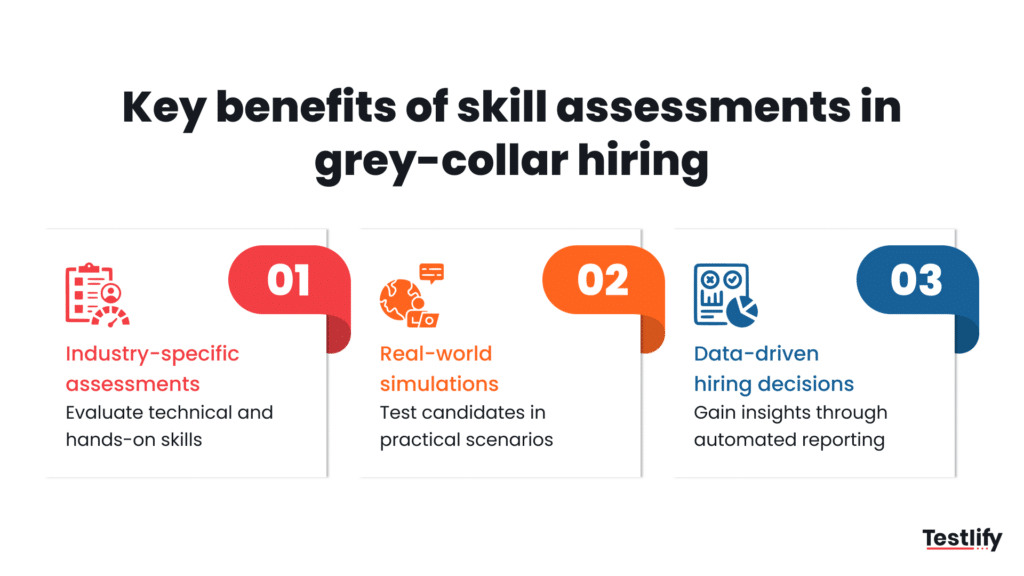
A useful way to structure this is using Testlify’s skills assessment. Instead of starting with a test, you start with the role: list the competencies that actually matter (technical skill, safety discipline, problem-solving, communication), then connect each one to a concrete piece of evidence, whether that is a skills assessment, a work simulation, a structured interview question, or a reference check. The matrix keeps the process honest, because every requirement has to produce measurable proof rather than a gut feeling.
In practice that looks like a shortlist scored before the first call. A 500-person facilities employer hiring 15 maintenance technicians a quarter can send a 30-minute assessment covering electrical fundamentals, fault diagnosis, and safety judgment, then interview only the candidates who clear the bar. The screening loop drops from weeks of resume sorting to a ranked list you can act on in days, and every hire is backed by evidence you can defend. AI can help score and summarize that evidence, but the hiring call stays with your team.
Key takeaways
- Grey collar work is a mix, not a middle tier. These roles need physical skill and technical knowledge together, which is why a resume alone cannot tell you if someone can do the job. Screen for the blend, not one half of it.
- The spelling does not matter. Grey collar and gray collar are the same category. Chase the skills, not the dictionary; British and American sources describe identical work.
- This is where growth is. The fastest-growing US occupation (wind turbine technicians, up 49.9% to 2034) and one of the fastest in healthcare (nurse practitioners, up 46% to 2033) are both grey collar, so competition for this talent will only intensify.
- Degrees are fading as a filter. With 52% of Indeed postings dropping formal education requirements, certifications and demonstrated skill now carry the signal a diploma used to. Design your hiring around proof of skill.
- Test the competency, then hire. Map each role to the competencies that matter, assess every candidate on the same scale before interviewing, and keep the final decision human. That is how you turn a slow, resume-heavy process into a fast, evidence-backed one.
Frequently asked questions (FAQs)

B2B SaaS Content Writer
Rishav Kumar is a B2B SaaS content writer with 4 years of experience. He loves crafting engaging content. Always exploring fresh ideas, he's passionate about helping businesses grow through impactful writing.
LinkedInRelated resources
View all
Hiring Guide
6 Stages of the performance management cycle

Hiring Guide
Recruitment vs talent acquisition: Key differences

Hiring Guide
How to succeed at recruiting generation Z employees?

Hiring Guide
Heuristic Bias in Hiring: Types and How to Reduce It

Hiring Guide
5 high volume recruitment strategies to adopt in 2026

Hiring Guide
Talent matching: what it is and how it works
Get started.
Hire on proof, not resumes.
Run your first skills-based assessment free — no credit card required.