
Return migration: Hiring strategies targeting professionals reshoring to Asia
Return migration is fueling Asia’s talent boom, with professionals returning to their home countries in search of new opportunities. Discover how HR leaders can tap into this growing trend and hire top talent.

Asia has emerged as a powerhouse in the global economy, and it is increasingly drawing back its diaspora of skilled professionals. In fact, Asia’s economies accounted for 57% of global GDP growth between 2015 and 2021 and now host 56% of the world’s middle-class households.
This growth has fueled a demand for talent that outstrips local supply in many countries. As a result, a wave of “return migration” of highly skilled professionals returning to their homelands after studying or working abroad is underway.
Employers across Asia are recognizing the value of these returning professionals and are developing targeted hiring strategies to attract and retain them.
This article examines the return migration trend in Asia, the benefits and challenges it brings, and effective strategies that organizations can use to attract and retain professionals coming home.
 ChatGPT
 Gemini
 Claude
 Grok
Grok Perplexity
The rise of return migration in Asia
Return migration is not a new phenomenon, but it has gained momentum in recent years. Improved economic and social conditions in Asia, combined with shifting global dynamics, have made returning home more attractive for many expat professionals.
A Canadian policy study noted that many Asian diaspora professionals are lured back by booming opportunities in China, India, and Southeast Asia, especially if they feel “glass ceiling” limitations in the West.
Importantly, Asian employers are increasingly eager to capitalize on this influx of global talent. A survey by Hays found that eight in ten hiring managers in Asia are keen on employing overseas returnees.
Hong Kong and Mainland China were the most enthusiastic (88% and 87% of employers, respectively), while even the least keen (Japan) still showed a solid majority interest (55%). The rationale is clear: returnees bring a wealth of international experience, new perspectives, and often much-needed skills into local labor markets.
This “brain gain” is being actively encouraged by both companies and governments. China’s Thousand Talents Program is a well-known example of a state-backed initiative, launched in 2008 to attract 2,000 top overseas Chinese scholars and experts, a goal it surpassed by recruiting 4,000 returnees within ten years.
India, which has the world’s largest expatriate population, has been openly courting its diaspora as well. Recent surveys indicate significant interest among the Indian diaspora: 33% of Indian Americans said they would like to move back to India.
Other countries have rolled out incentives, too. Malaysia’s Returning Expert Programme (REP), for instance, offers returning Malaysian professionals a 15% flat income tax rate and other perks, and has successfully facilitated 4,673 diaspora returns from 2011 to mid-2024.
Likewise, Vietnam, South Korea, the Philippines, and others have introduced tax breaks, fast-track residency, and research grants to entice their nationals home.
All these factors have converged to make Asia one of the most dynamic regions for returning talent. For recruiters and HR leaders, the rise of return migration represents both an opportunity and a challenge, one that requires strategic approaches to fully leverage.

The shifting landscape of U.S. immigration and its effects on global talent flow
While Asia is seeing a brain gain from return migration, the United States is experiencing a brain drain, particularly in relation to the H1-B visa program. Recently, the U.S. government has implemented restrictions on the entry of certain non-immigrant workers, which could impact both international talent and global hiring trends.
In September 2025, the White House issued a Presidential Proclamation restricting the entry of certain nonimmigrant workers, especially those on temporary work visas like the H1-B visa, which has historically allowed skilled foreign professionals to work in the U.S. for up to six years.
According to the proclamation, the U.S. aims to protect its workforce and create more opportunities for American citizens by curbing the influx of foreign workers, particularly in sectors like technology and engineering, where there is a high demand for specialized talent.
This move has sparked considerable controversy, especially among tech companies, universities, and other industries that have traditionally relied on foreign workers to fill critical talent gaps.
These visa restrictions are likely to make it more challenging for companies to hire skilled talent from countries like India and China, two of the biggest providers of H1-B visa holders.
Interestingly, this policy shift could accelerate the trend of return migration to Asia. Thus, the U.S. visa restrictions could lead to a double-edged scenario: while the U.S. may lose some of its best foreign talent, Asia stands to benefit from this trend, with countries aggressively courting professionals who had previously been drawn to Western markets.
Why returning professionals are in demand
Asian organizations view returning professionals, sometimes called “sea turtles” in China or “boomerangs” elsewhere, as a high-value talent pool. These individuals often possess a blend of global experience and local familiarity that can be difficult to find in domestic candidates.
According to the Hays report, the top advantages employers cited in hiring returnees were: different perspectives on business (79% of respondents), cross-cultural awareness (76%), and overseas commercial experience (55%). In a globalized economy, such attributes can translate into better problem-solving, innovation, and international market understanding for the company.
Returnees also tend to bring strong language skills and regional networks. A Forbes analysis observed that across various Asian markets, companies are actively seeking such traits in returnee hires.
For example, China has a high demand for returnees with tech and logistics expertise (fueled by its booming e-commerce sector), and Singaporean companies are keen on professionals like internationally experienced lawyers to support their growth.
These examples reflect how returning talent can fill critical skill gaps, whether in technology, management, or industry-specific domains, while also enhancing a company’s cultural and linguistic competencies.
Beyond hard skills, returnees contribute to the diversity of thought and leadership potential. Having worked in more mature markets or different corporate cultures, they often introduce new management approaches and creativity.
Apple co-founder Steve Jobs famously once said,“It doesn’t make sense to hire smart people and then tell them what to do; we hire smart people so they can tell us what to do,” – a quote that underscores the value of hiring talent with fresh ideas.
By adding returnees, companies inject people who can challenge conventional wisdom and bring global best practices, which can be a catalyst for change within the organization.
From a macro perspective, the return of experienced professionals can also be a competitive boon for Asian economies. It helps reverse the “brain drain” of past decades, converting it into “brain gain.”
Each returning engineer, scientist, or executive can contribute not only through their work but also by mentoring others, starting new ventures, or strengthening local industries.
However, capturing these benefits requires understanding and addressing the unique challenges that accompany hiring professionals who are returning from abroad.
Challenges in attracting and retaining returnees
While the case for recruiting returning professionals is compelling, HR leaders must be mindful of several challenges. Managing expectations on both sides is a primary concern. Professionals returning to Asia often bring high career expectations. They may anticipate faster promotions, bigger responsibilities, or compensation packages commensurate with what they earned abroad.
Indeed, returning expats typically have very high workplace expectations when they come home, and if those expectations are not met, they can quickly become disengaged. Vistra, a global mobility firm, notes that unmet expectations can lead returning professionals to feel frustrated and start looking for new opportunities (sometimes with a competitor).
On the other hand, some returnees (especially those from relatively lower-paying foreign markets or those motivated by non-monetary factors) might be open to local-equivalent salaries, as was seen in Singapore, where nearly 45% of returnees were willing to accept the same pay as they had overseas.
HR must strike a balance between fiscal prudence and competitive offers; if a substantial pay cut is involved in returning, it must be offset by other career or lifestyle benefits.
Another major challenge is cultural and organizational integration. It’s easy to assume someone simply “fits back in” to their home country, but many returnees experience reverse culture shock upon repatriation.
Workplace norms and hierarchies in Asia may have changed during their time away, or they may differ markedly from the Western environments where these professionals honed their skills.
For instance, a manager returning to India from Silicon Valley might struggle with more hierarchical decision-making, or a Chinese professional coming back from Europe might miss the open communication style.
Employers sometimes overlook these re-assimilation challenges. The result can be a sense of alienation; some returning professionals feel they neither fully belong in the foreign culture they left nor immediately re-bond with the local corporate culture.
Retention of returning talent is a related challenge and one that data suggests is acute. Studies have found that attrition rates for repatriated employees are notably higher than for those who never went abroad.
Even at the low end, that’s a worrying figure, and some industries or locations might see turnover at the higher end of that range. Another analysis by a mobility firm noted that more than 25% of international assignees leave their employer within two years of returning home.
Such departures represent a lost investment for the employer and can also dampen the morale of other prospective returnees. High turnover often stems from returnees feeling underutilized or stagnated. For example, if they return to find their role is not as challenging as the one they left, or that peers who stayed home have leapfrogged them in seniority.
Finally, there are practical challenges in sourcing and identifying returning professionals. Unlike campus recruiting or local job fairs, the talent pool of diaspora returnees is diffuse and harder to pin down.
Some returnees come back on their own initiative, job search in hand, while others might consider returning if approached with the right opportunity. Employers may need to proactively map where their target talent abroad is and build connections before those candidates even relocate.
Without the right channels (such as alumni networks, diaspora professional associations, or dedicated returnee programs), companies risk missing out on great candidates simply because they don’t know they exist or are open to moving home.
Strategies to attract returning professionals
Crafting effective strategies to tap into the returnee talent pool requires a multi-faceted approach. Below are several key strategies, along with practical tips for implementation, that can help organizations in Asia successfully recruit and integrate professionals who are coming home:
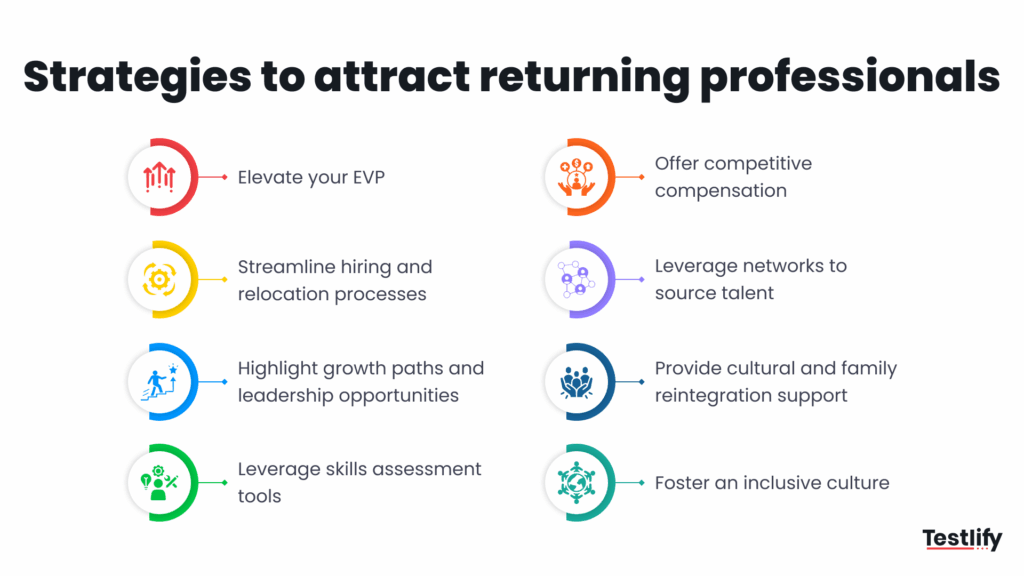
Elevate your Employer Value Proposition (EVP) for returnees
It’s crucial to recognize that returning professionals often have options in both local and international markets. Craft a compelling narrative about why they should join your organization. Emphasize the impact they can have in their home country or region, and a sense of mission can be a powerful draw.
Many returnees are motivated by the idea of contributing back to their homeland, echoing Mukesh Ambani’s sentiment of serving the nation. Showcase projects that improve local communities or high-innovation initiatives that might appeal to diaspora looking to make a difference.
Also, highlight any global roles or regional expansions where their experience and knowledge would be an asset. Essentially, help returnees see that by joining you, they won’t be ‘giving up’ their global career but rather amplifying it in a familiar context.
Offer competitive compensation and benefits
While not every organization can match a New York or London salary, a thoughtful compensation package can tip the scales for a returnee. Benchmark critical roles to ensure you’re paying at or above market for local talent, and be open to negotiating for exceptional candidates.
If budget is a constraint, consider creative benefits: relocation allowances, temporary housing, children’s school fee assistance, or extended health insurance that covers family members (many returnees move with spouses/children who also need support to resettle).
Stock options or retention bonuses vesting over 2-3 years can incentivize longer-term commitment, addressing retention concerns.
Remember that some governments provide incentives, so ensure eligible hires take advantage, as it effectively boosts their take-home pay at no cost to the company. The goal is to make the proposition financially feasible and attractive, even if the pure salary number differs from what the candidate earned abroad.
Streamline the hiring and relocation process
Time and ease matter. Returning candidates often coordinate a big move alongside their job hunt, which can be stressful. Companies that provide a concierge-like experience will stand out.
Assign a dedicated recruiter or relocation specialist to guide the candidate through visa paperwork (if their spouse or children are foreign citizens, for example), provide advice on local housing, and connect them with real estate agents and schools.
If your organization has the resources, consider sponsoring “look-see” trips for high-value candidates, where you fly them in for final interviews and to reacquaint them with the city and office. Such gestures not only help the candidate prepare for life back home but also signal the company’s serious interest.
Leverage networks and partnerships to source talent
Finding returning professionals requires casting a wide net and thinking beyond traditional job ads. Tap into alumni networks both of universities and of your own company (former employees who went abroad). Many diaspora professionals stay connected through alumni chapters or professional associations.
For instance, tech communities of Indian engineers in Silicon Valley or finance professionals from China in Hong Kong can be rich hunting grounds. Social media platforms like LinkedIn have groups dedicated to expatriate Indians, Chinese, Filipinos, etc., discussing opportunities back home.
Engaging with these groups by sharing content or job postings can draw interest. An Employee referral program is another powerful tool; encourage your current staff to refer friends or former colleagues abroad who might be interested in returning.
Some organizations even host “diaspora career days” or participate in government-organized job fairs for overseas nationals (like Malaysia’s MyHeart Career Fest, which helped connect nearly 1,500 Malaysians abroad with local employers upon return.
By being visible and proactive in diaspora communities, you make your company a first stop when people weigh moving home.
Highlight growth paths and leadership opportunities
One big concern for returnees is whether their career progression will continue upwards after coming home. To address this, emphasize the growth opportunities at your organization. If a returnee has gained new skills abroad, demonstrate how they can leverage this expertise to lead local initiatives.
They could spearhead a new regional market expansion, drive a transformation project, or mentor a team working on international business. Map out a potential career path: for example, “Your experience in the U.S. market could make you our ideal APAC marketing strategy lead within 12 months.”
Where appropriate, involve senior leaders in the recruitment process – having a returnee meet a C-suite executive or department head who values their foreign experience can reassure them that the company takes their future seriously.
If you can’t promise an immediate promotion that some expect, be transparent yet optimistic about timelines and what milestones could accelerate advancement. It can also help to connect would-be returnees with other employees who have successfully repatriated and grown in the company.
Provide cultural and family reintegration support
Recognize that you’re not just hiring an employee, you’re often resettling a person (and possibly a family). To prevent personal adjustment issues from spilling into work performance, lend a hand where you can.
Some leading companies set up “repatriation mentors” (colleagues who are perhaps returnees or globally experienced employees) to act as a buddy for the new hire, answering questions about local work norms and helping navigate day-to-day aspects, such as where to buy certain goods or how to handle local services.
Offering a few sessions of cultural reorientation or counseling (similar to how companies provide cross-cultural training when sending employees abroad) can validate the challenges of returning and equip the employee with coping strategies.
Family matters too: if the candidate’s spouse needs to find local employment, consider leveraging your HR network to provide job search assistance or introductions. If their children need schooling, an HR team member might be able to share information on popular schools or childcare options.
These “soft” supports have a hard impact: they can significantly reduce the stress of return and allow the professional to focus on excelling in the new job rather than being distracted by personal logistics. Ultimately, a smoother reintegration leads to higher retention.
Leverage skills assessment tools
When recruiting from a global talent pool, biases can creep in. Some hiring managers may undervalue a candidate’s foreign experience, while others might overvalue credentials without probing actual fit. To ensure fairness and find the best talent, use a comprehensive skill assessment tool that also supports conversational AI interviews.
Tools like Testlify can be invaluable in this regard. They allow you to evaluate candidates on relevant competencies through role-specific tests, coding tests, and conversational AI interviews.
As a bonus, utilizing such platforms can significantly speed up screening: many companies report being able to hire top talent faster and more accurately with these assessments, which is crucial when diaspora candidates might have multiple offers.
Foster an inclusive culture that values global experience
Retaining returnees for the long haul means creating an environment where they feel their international exposure is an asset, not a liability. Make it clear in your culture and communications that diverse experiences are celebrated.
This could be as simple as inviting returnees to share insights from their time abroad in team meetings or internal newsletters, or as formal as including “global mindset” in your leadership competencies framework.
Ensure managers are trained to utilize returnees’ knowledge rather than trying to mold them to a purely local way of doing things. For example, if a returning professional proposes a new process they learned in a different market, give it genuine consideration.
Embedding such openness in the culture helps turn returnees into innovation bridges within your company, connecting local teams with international best practices. It also boosts their job satisfaction, as they feel heard and valued for their uniqueness.
As Virgin Group founder Richard Branson has said, “Clients do not come first. Employees come first. If you take care of your employees, they will take care of the clients.” By valuing their background, you can take care of returning employees, which in turn will help them deliver their best work for your clients and business.
Final thoughts
As Asia continues its ascent on the world stage, return migration of talent will likely accelerate. Companies that act now to refine their returnee hiring strategies will not only fill immediate skill gaps but also build lasting organizational capability.
In the end, hiring a returning professional is not just filling a vacancy; it’s reclaiming a bit of the nation’s own investment in human capital and infusing new energy into the enterprise.
With foresight and empathy, recruiters and HR leaders can turn the brain gain into tangible business gain, ensuring that both the professionals and their organizations thrive in this homecoming journey.
At Testlify, we help organizations assess returning professionals with precision, speed, and fairness through our skills-based assessments. If you’re looking to build a strong pipeline of globally experienced talent, book a demo with Testlify today.
Frequently asked questions (FAQs)

People and Talent Partner
Arushi Shah runs day-to-day talent acquisition and candidate experience at Testlify. She writes on interviewing, structured hiring, and giving candidates a fair, fast process.
LinkedInRelated resources
View all
Enterprise hiring
Culture-first hiring: Why engagement is becoming the #1 hiring criterion for U.S. firms

Enterprise hiring
Conversational AI audio interviews for call center hiring: Faster, fairer, and more scalable recruitment

Enterprise hiring
How enterprises can reduce candidate drop-off with smarter assessments

Enterprise hiring
How are chat simulations shaping the future of enterprise hiring?

Enterprise hiring
How to craft effective coding skills tests for tech recruitment?

Skill assessment
What skills-based hiring data shows beyond the US and UK
Get started.
Hire on proof, not resumes.
Run your first skills-based assessment free — no credit card required.