+1 (844) 755 8378

The entire Netflix recruitment process takes around 4-5 weeks and follows four main stages: a recruiter phone screen call, technical or role-specific interview, multiple rounds of onsite interviews (sometimes up to 10), and a final behavioral or culture fit screening.
Unlike other FAANG companies, Netflix interview process places equal weight on cultural alignment as on technical skills, using rigorous skills assessments and interviews to filter for “Dream Team” talent.
This guide is written for recruiters and talent leaders, but also useful for candidates who want a realistic view of the Netflix interview process.
Summarise this post with:

TLDR: At a glance
- Interview stages: Recruiter prescreen, technical/role-specific interview, multi-round onsite, final behavioral/culture-fit round.
- Timeline: Typically 4–5 weeks end to end; some roles take 8–12 weeks due to volume and scheduling.
- Difficulty: High with heavy focus on real-world problem solving and culture alignment, not textbook questions.
- Acceptance rate: Very low (≈1–2%), making Netflix one of tech’s most selective employers.
- Recruiter takeaway: Shift skills and culture assessments earlier and use structured interviews to improve efficiency.

Overview of Netflix
Founded by Reed Hastings and Marc Randolph on August 29, 1997, as a small DVD-by-mail business, it is now the world’s leading media and entertainment company. Netflix continues to transform how people consume content.
Netflix reached 301.6 million global subscribers as of 2024, and added 19 million new users in 2024 Q4 alone. The estimated subscriber count of Netflix is about 310 million users worldwide in 2025 Q1.
The company employs 14,000-17,000 globally across all departments, and surprisingly, the Netflix interview timeline is roughly 36 days. This is less than Google and Microsoft’s hiring process.
Yet, Netflix has the highest employee retention when compared to other major tech giants, consistently outperforming industry averages and peers. Netflix’s employee retention rate is at 95% or higher, with an annual attrition rate of about 3-4% and overall turnover rates at 11%.
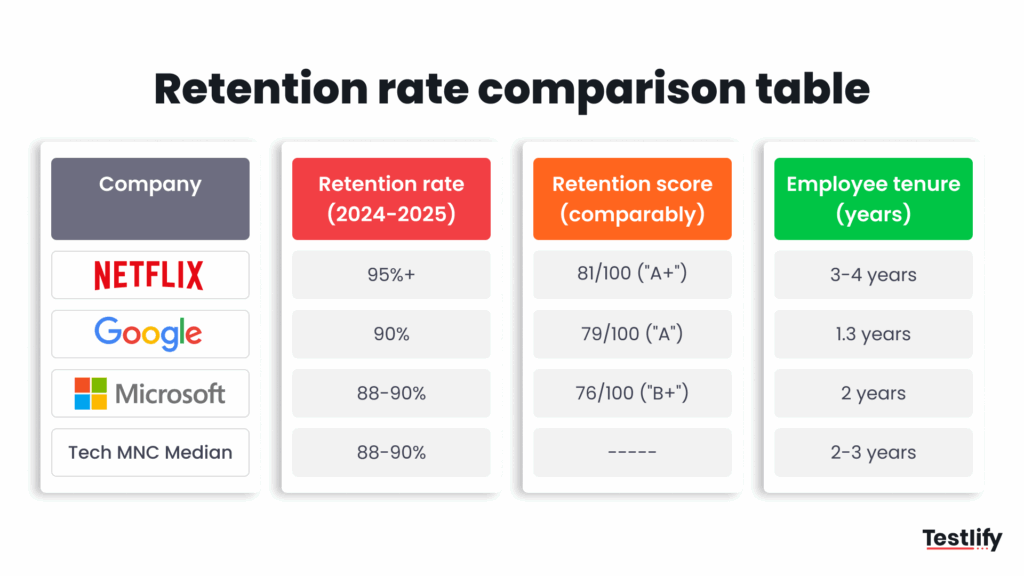
The company’s internal retention score in 2025 is about 81/100, making it the top 5% among companies of its size and first among big tech rivals like Meta, Amazon, Google, Apple, and Hulu.
The platform is a global household name for films, TV series, documentaries, and mobile games, all available in 30+ languages across 190+ countries. Netflix is preferred over 66.7 million other streaming platforms in the U.S., and 44% of streaming customers worldwide.
The company receives thousands of employee feedback annually, reflecting a culture of transparency, continuous improvement, and a responsibility to employee voice.
With nearly $40 billion in annual revenue and an $18 billion content budget in 2025, Netflix invests in talent and culture at a scale that matches its growth ambitions. This makes every candidate ask the same question: how hard is it to get into Netflix?
Short answer: a bit hard because Netflix’s job acceptance rate remains among the lowest in the industry, with only 2% of over 350,000 applicants successfully landing a role (according to 2019 research).
Despite these factors, the company still uses a skills assessment platform like Testlify as the base.
These different types of skills assessments enable recruiters to create role-specific tests that evaluate thousands of candidates simultaneously, assessing both hard and soft skills, including culture, psychometrics, and behavioral traits.
Testlify comes with built-in features like plagiarism checks, anti-cheating tools, auto-grading, and even AI-powered scoring to ensure fair and unbiased results.
Also read: How Google hires tech talent: What recruiters should know
Netflix interview process
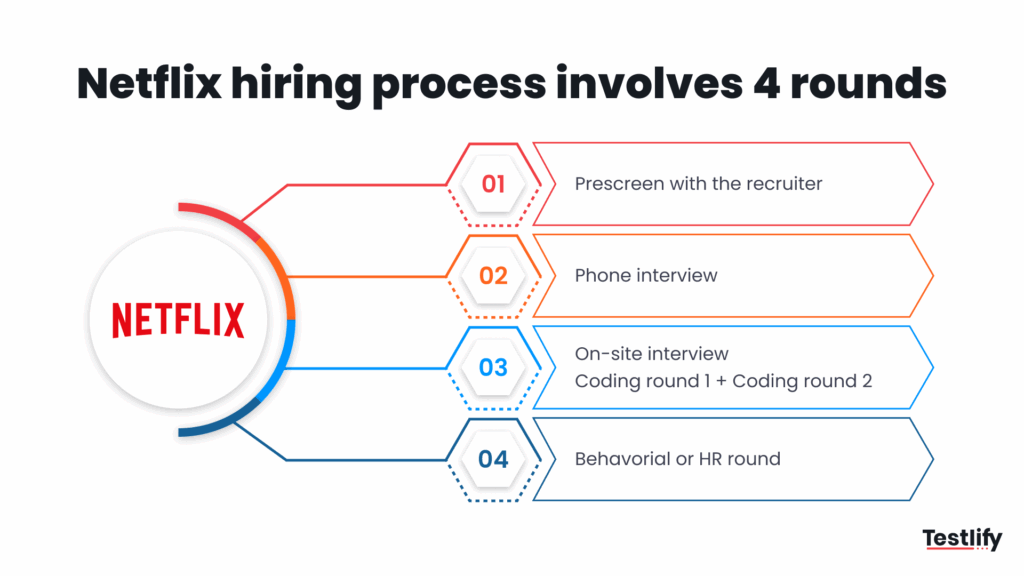
The Netflix interview process consists of 4 main rounds, with the third round featuring two sub-rounds.
The general recruitment process at Netflix includes
- a prescreen with a recruiter,
- a phone interview,
- an on-site interview (which provides for two coding rounds for engineering candidates),
- and a final HR interview.
The interview process at Netflix varies across roles and teams, but hiring is highly decentralized. A candidate can only move forward if the entire interview panel unanimously agrees to hire them.
Step 1: Prescreening with a recruiter (30-40 mins)
The first step involves a phone interview with a recruiter to understand candidates’ skills and educational qualifications. Recruiters also check the cultural fitness of candidates by asking questions related to their resume and past work experience.
The talent acquisition team at Netflix sends Netflix’s core values to candidates before the screening stage so that candidates will be aware of the company’s policies.
This initial stage mainly evaluates candidates’ motivation, experience, and cultural alignment with Netflix’s “Dream Team” philosophy.
Duration: 30–40 minutes.

Step 2: Technical or phone interview (40-50 mins)
The first stage is a technical phone interview designed to assess core technical knowledge.
Typically conducted by an engineering manager or a member of the software development team, this round includes both direct and open-ended questions covering computer science and engineering concepts.
Hiring managers ask about major topics and apply theoretical knowledge to practical scenarios.
Duration: 40–50 minutes
How does the technical screen for engineer roles look at Netflix?
The Netflix interview process for technical roles like engineering involves live coding challenges, algorithm questions, or take-home projects such as microservice design or product evaluations. Netflix doesn’t test LeetCode-style problems.
Live technical screening for engineering roles includes mid-level coding questions and practical problem-solving tasks. Role-specific tests will be used to evaluate candidates’ coding ability.
For data roles at Netflix, candidates are assessed on SQL, probability, and experimentation, along with their ability to discover insights and present findings effectively.
Difficulty level for engineer roles: Medium
How does Netflix interview process non-technical roles look?
The Netflix interview process for non-technical roles differs somewhat from the process for engineering and data science roles.
Instead of coding, marketing, sales, product, and business-related roles are assessed based on behavioral, psychometric, role-specific, case-study, and cross-functional collaborations.
Non-technical roles at Netflix will be screened based on their soft skills more than their hard skills.
What can other companies learn from this?
What’s notable here for recruiters is the level of rigor early in the funnel.
Instead of filtering out later, Netflix ensures candidates demonstrate real problem-solving ability upfront, sometimes within just 5–6 hours of receiving an assignment.
Think about where in your process you validate hard skills. Moving this step earlier can save time, reduce weak later-stage interviews, and help hiring managers focus only on high-signal candidates.
Step 3: Interviews with role-specific skills tests (45 mins)
This interview stage can either be virtual or in-person, depending on the candidates’ location and role.
A detailed skills test assesses both technical knowledge and cultural fitness of candidates through multiple interviews with stakeholders.
The stage usually involves two rounds of technical and behavioral interviews.
Technical interviews (4-5 coding rounds with whiteboard exercises)
Face-to-face interactions with engineering leaders and managers provide hiring teams with multiple perspectives on the same candidate. The two rounds of technical interviews include:
- Round 1: Candidates tackle medium-to-hard problems in algorithms and data structures.
- Round 2: Shifts focus to system design on both high-level and low-level.
What’s important here is that Netflix layers in whiteboard problem-solving and culture-fit conversations simultaneously. This gives a fuller view of how candidates think under pressure, communicate, and connect their decisions back to business needs.
On-site technical interviews are often intense, involving questions about candidates’ experience, projects, and other relevant work. These conversations allow candidates to show their expertise.
Step 4: Behavioral and cultural tests
Behavioral assessments are the final stage of Netflix interview process. This part involves 3 shorter interview sessions with HR, hiring managers, and leadership, engineering, or product managers.
The whole focus of behavioral assessments will be on cultural alignments covering Netflix’s core values, collaboration, communication, leadership, and inclusion.
While it might look “softer” on the surface, it’s actually one of the most critical filters in Netflix’s process.
Here, the emphasis is on:
- Personality alignment with team values.
- Communication style and adaptability.
- Problem-solving approach in ambiguous or high-stakes scenarios.
Common Netflix interview questions include:
- Where do you see yourself in five years?
- How would you add value to Netflix if selected?
- How do you handle criticism or difficult feedback?
- Describe a time you took on a task outside your expertise.
- What’s the hardest part of maintaining work-life balance?
Notice how these aren’t just fluffy “get-to-know-you” questions.
They’re designed to uncover self-awareness, growth mindset, and emotional intelligence, all of which tie back to Netflix’s emphasis on talent density and culture.
Check your candidate’s behavioral and cultural fitness with a simple test.
For candidates: what to expect in each stage?
At the recruiter prescreen, the candidate and recruiter talk through the candidate’s resume, motivations, and how they line up with Netflix’s values. This gives the recruiter a quick read on whether it makes sense to move forward.
In the technical or role-specific interview, the candidate works through real problems on coding, system design, or portfolio/case work. This lets the recruiter and hiring team see true, job-ready skills instead of relying on puzzles.
During the onsite loop, the candidate meets several interviewers in one day, covering hard skills, collaboration, and communication. Recruiters can use this model to collect multiple viewpoints quickly.
In the final behavioral conversations, the team digs into how the candidate makes decisions, gives and receives feedback, and fits the culture. This shows why culture needs its own structured, scored stage, not a last-minute gut call.
What recruiters should know about the Netflix hiring process?
Netflix believes in conducting regular organic conversations rather than formal performance reviews. Also, the company is well-known for its compensation package, so employees are less likely to seek higher salaries elsewhere actively.
Netflix also believes in an unlimited holiday policy. The company lives by the slogan “Act in Netflix’s best interest”.
The real driver of its hiring success is the type of people it hires, which the company terms as “fully formed adults” who take ownership, care about the company’s interests, and are motivated to do great work.
By trusting employees to act responsibly, the need for strict rules is minimized, creating a culture built on accountability and high trust.
This environment is further reinforced through strong hiring decisions and continuous manager-employee feedback loops that keep performance consistent and allow potential issues to be addressed early.
For other organizations, the lesson isn’t to copy Netflix outright but to adapt what makes sense for their own context. Building trust, attracting the right talent, and shaping a sustainable culture takes time, and sudden changes could even unsettle existing top performers.
A “one-size-fits-all” approach rarely works, and what fits at Netflix may not fit elsewhere.
Companies that treat employees like responsible adults, trust them with meaningful decisions, and recognize their commitment will naturally inspire people to work harder and align themselves with the success of the business.
How does Netflix hire people?
Netflix culture deck, a PowerPoint presentation written by Patty McCord and Reed Hastings explaining Netflix’s culture from 1998 to 2012, became viral, garnering more than 5 million views, making it the most important document that came out of Silicon Valley.
The 127 slide deck suggests that instead of investing time and resources in creating numerous HR policies to prevent employee issues, they would rather avoid hiring such individuals in the first place.
“If you’re careful to hire people who will put the company’s interests first, who understand and support the desire for a high-performance workplace, 97% of your employees will do the right thing,” denotes Patty McCord, Chief Talent Officer at Netflix.
Netflix also has a policy where, instead of focusing on the time or days someone has worked, they focus on the output. The company prefers that people work independently rather than being micromanaged or controlled.
If employees can link their job to the company’s goals, that’s well and good. If employees fail to deliver high-quality work, they will be let go with a generous severance package.
Netflix talent acquisition challenges
Netflix’s talent acquisition team faces unusually complex recruitment challenges because they’re not just hiring skilled people, they’re hiring for extreme performance and cultural alignment.
Recruiters must identify candidates who can thrive in a high-autonomy, high-candor environment where expectations are intense and feedback is constant. This means screening for traits like ownership, resilience, and comfort with ambiguity, which are far harder to assess than technical skills.
The hiring process itself is long and demanding, leading to frequent candidate drop-offs, especially among those intimidated by Netflix’s “keeper test” culture and lack of structured career paths.
Recruiters also have to work closely with hiring managers who are deeply involved in sourcing and expect a consultative partnership rather than transactional support.
As Netflix expands globally, scaling this unique culture across regions adds another layer of complexity, making consistency, communication, and employer-brand clarity critical and often difficult to maintain.
What makes Netflix hiring process unique compared to other FAANG companies?
Netflix hiring process differs from other FAANG/MAANG companies due to its strong emphasis on cultural fitness and focus on high talent density.
Around 45%-50% of the company’s interview process is dedicated to testing candidates’ alignment with Netflix’s core values, maybe more than hard skills.
Netflix uses the Keeper Test, an all-cash compensation model, and a “Dream Team” mindset throughout the hiring process. This philosophy fosters a close, family-like culture, leading to unique system design questions that test scaling, security, and availability.
Some key differences in the hiring process of Netflix include:
- Keeper test: Netflix hiring team and managers ask themselves if they would fight to keep a candidate on their team. This ensures they only hire talented people who align with their culture.
- Transparent communication: Netflix openly shares its cultural deck and expectations with candidates earlier in the process.
- Work over hours spent: Netflix believes employees shouldn’t be micromanaged, but trusted and held accountable for their results. This freedom-and-responsibility model is a key reason why many people are drawn to work at Netflix.
One major distinction between Netflix and other MAANG companies is that Netflix tends to favor candidates with a minimum of 3+ years of relevant experience (for engineering roles specifically), while other firms are more open towards fresh graduates.
This doesn’t mean that Netflix doesn’t hire new graduates; they do, but the percentage is less (about 20%). Historically, Netflix hires mostly mid-to-senior-level professionals, but new graduate opportunities have been growing recently due to internship programs and talent demands.
Also read: How Google hires tech talent: What recruiters should know
What skills and traits does Netflix prioritize when hiring talent?
Netflix prioritizes a combination of technical and cultural skills. The company heavily focuses on candidates who align with their policies, like:
- Selflessness and collaboration: Exceptional teamwork and collaboration that prioritizes helping others succeed over self-promotion.
- Good judgment skills: The ability to make smart, autonomous decisions in a fast-paced culture.
- Communication: Clear, direct, strong communication skills.
- Courage: Willingness to put forth opinions and decisions openly and respectfully.
- Inclusion: Values diversity and different perspectives, creating a safe environment where everyone can thrive.
- High performance: Netflix consistently aims to hire only top performers who significantly contribute beyond expectations, emphasizing impact over effort.
- Adaptability and creativity: Able to think beyond the box with no external handholding.
How do recruiters at Netflix manage decentralized hiring across multiple teams?
Netflix’s decentralized hiring process operates with a partnership between recruiters and hiring managers. Hiring managers lead the process end-to-end, from sourcing and interviewing to final selection, with full autonomy and accountability for building their teams.
Recruiters, on the other hand, act as strategic partners rather than order-takers. They design tailored recruiting strategies, manage sourcing pipelines, run engagement campaigns, and guide managers through the process.
This “driver and navigator” relationship ensures hiring is fast, collaborative, and closely aligned with team needs.
Such a model works on transparency and shared ownership. Hiring managers have direct access to ATS tools and recruitment data, allowing them to make quick and informed decisions.
At the same time, HR and recruiters provide standardized tools, compliance support, and frameworks to maintain consistency across the company.
By treating hiring as a company-wide priority and giving managers both freedom and accountability, Netflix sustains a culture where recruiting is seen as everyone’s responsibility and not just the job of HR.
Also, the role-specific nuances help both hiring managers and recruiters to come to a common, unanimous decision.
- For an engineering position, Netflix focuses on system design, coding, and scalability.
- For Data/ML, the focus is on SQL, experimentation, and metrics.
- For creative/content, the company relies on portfolio, storytelling, and collaboration skills.
- For sales and marketing, the hiring process relies on market strategy, decision-making, and growth impact.
Such a distinctive role-by-role insight helps both parties align without dumping it all in one bucket.
Ready to hire like Netflix with Testlify?
Netflix’s hiring process is fairly simple, relying heavily on skills assessments. It’s a practice any recruiter from any company can adopt.
Whether you’re looking for cultural alignment or technical roles, Testlify can help you build your dream team with a ready-to-use library of 4000+ solid assessments.
Try our technical and cultural skills test for free.
Key takeaway for recruiters
How Netflix hires people is surprisingly simple, and recruiters can easily learn from their hiring strategy.
Start by openly sharing your culture and values early in the process. Netflix sends its core values to candidates before interviews so they self-select, saving recruiters time and ensuring better alignment.
Prioritize skills assessments early to filter high-signal candidates. By testing technical and behavioral skills upfront, Netflix reduces weak later-stage interviews and speeds up hiring decisions.
Culture fit is non-negotiable: Netflix dedicates nearly half of its interview process to testing alignment with its “Dream Team” values. Recruiters should make cultural fitness a structured, measurable part of screening.
Decentralize your process: Netflix gives hiring managers full ownership, while recruiters act as strategic partners. This speeds up decisions, creates role-specific interviews, and increases accountability.
So, there you have it, the secret to Netflix interview process. Ready to start with the skills test? Contact Testlify.