
What is silent resignation and how can HR teams combat it?
Discover why companies must showcase career growth to combat quiet quitting by attracting the right employees.

“Silent resignation” or quiet quitting is the trend of employees doing no more than the bare minimum at work and has become too widespread for employers to ignore.
A recent Gallup global workplace report found that 59% of the world’s workforce could be categorized as “quiet quitters,” meaning they are not engaged at work.
Studies also confirm that a lack of career advancement is one of the major drivers behind this behavior. For example, Paychex research notes that quiet quitting (silent resignation) can stem from feeling undervalued or “lack of career growth opportunities” in one’s current job.
Such rampant disengagement is a red flag for HR leaders, signaling a need to rethink employer branding and the employee value proposition. One clear lesson from this trend is that today’s employees crave growth and development opportunities.
 ChatGPT
 Gemini
 Claude
 Grok
Grok Perplexity
Top signs of silent resignation/quiet quitting
For HR leaders, recognizing silent resignation early is crucial to protecting team morale and productivity. It often shows up gradually through subtle changes in behavior rather than dramatic shifts. Here are the most common red flags:
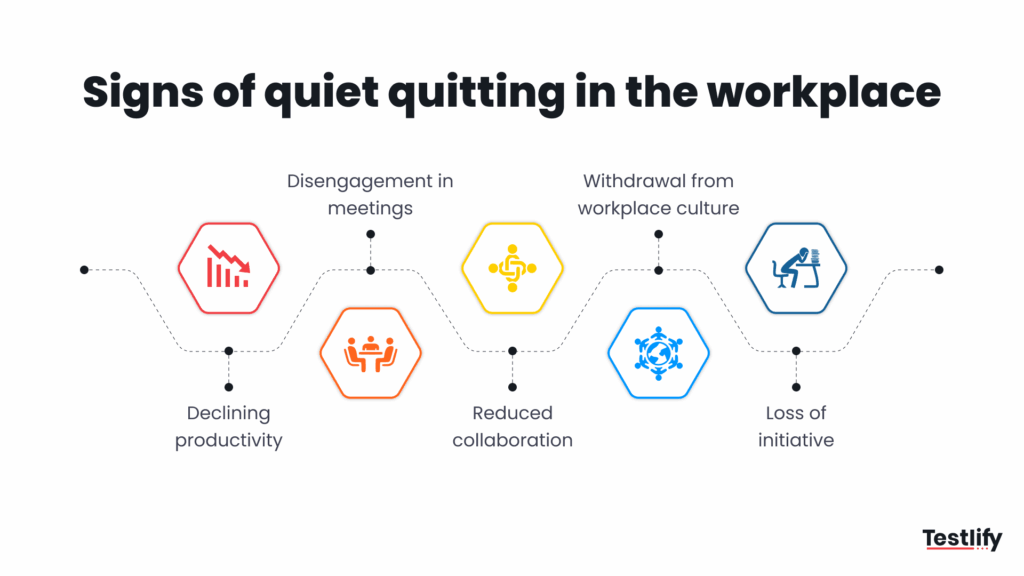
1. Declining productivity
Employees still deliver on their job requirements, but output starts to feel mechanical or rushed. They may miss deadlines more frequently, stop looking for efficiencies, or no longer contribute creative solutions. Work is technically done, but the discretionary effort of going beyond thejob descriptiondiminishes. Over time, this creates bottlenecks for teams that rely on collaboration and innovation.
Tip for HR Leaders: Prevent declining productivity before it starts by setting clear expectations. Use our Free Job Description Generator to craft inclusive, well-defined roles that attract engaged and motivated talent. |
|---|
2. Disengagement in meetings
In hybrid and remote environments, disengagement is especially visible. Employees may keep cameras off during video calls, avoid speaking up, or give one-word responses. In in-person settings, they may sit silently or seem distracted. This kind of withdrawal reflects a loss of belief that their ideas have value, serving as a clear indicator of waning engagement.
3. Reduced collaboration
A hallmark of silent resignation/quiet quitting is “working in a silo.” Employees who once offered to help teammates or took part in cross-functional projects may now limit themselves strictly to their assigned tasks. This avoidance of teamwork not only hurts productivity but also damages workplace culture, as others perceive them as unapproachable or disinterested.
4. Withdrawal from workplace culture
Employees begin opting out of activities that foster connection. They may skip team lunches, town halls, or social events they once attended. This absence suggests that they no longer feel a sense of belonging, which can eventually erode trust and camaraderie across the team.
5. Loss of initiative
Previously proactive employees may stop volunteering for stretch assignments, leadership opportunities, or problem-solving. Instead, they wait for direct instructions and contribute no more than what’s asked. This lack of initiative is often rooted in the perception that extra effort won’t be rewarded with recognition, promotion, or growth.

How employer branding can combat the silent resignation epidemic
To attract and retain top talent in the wake of silent resignation, recruiters are increasingly spotlighting career growth prospects in their job postings and employer branding efforts.
Traditionally, companies often touted perks, company culture, or brand prestige in their recruitment marketing. But if those messages ignore career development, they may ring hollow.
In a survey by Paychex and Executive Networks, employees’ top reasons for staying at a company (aside from pay) included job stability, meaningful work, and career growth opportunities, whereas factors like company brand or reputation ranked among the least important.
Many employers realized that simply promoting a fun culture or strong brand isn’t enough, as employees are prioritizing personal growth, learning, and advancement opportunities.
A survey by the Society for Human Resource Management (SHRM) found that declining engagement in recent years was closely linked to drops in feeling cared about and having opportunities to learn and grow at work.
In essence, a lackluster employer brand that fails to promise development can breed disengagement. On the other hand, organizations that visibly invest in their people’s growth tend to see higher engagement and loyalty.
This has prompted many HR leaders to adjust their employer branding messages. They are shifting from a perks-centric narrative to one that emphasizes purpose, mentorship, learning, and career trajectory within the company.
The goal is to communicate to candidates and employees alike: “Culture isn’t just one aspect of the game; it is the game. In the end, an organization is nothing more than the collective capacity of its people to create value” — Louis V. Gerstner Jr., former CEO of IBM
Career growth: A top priority for today’s talent
Gartner’s latest candidate survey (2025) revealed that after salary, the next most important factor for job seekers weighing offers was more opportunities for career growth (cited by 47% of candidates). Opportunities to learn new skills (39%) were also high on the list.
Even in markets where stability is valued, growth still ranks among the top considerations for accepting a job. And during the height of the “Great Resignation,” lack of advancement was repeatedly identified as a key driver of turnover.
For HR leaders, the message is loud and clear: career growth is top-of-mind for employees at all levels, and ignoring that can directly undermine retention and engagement.
Infusing career growth into job postings
Given how critical development is to candidates, recruiters are adapting their job postings and recruitment messaging accordingly. The days of job ads that read like dry task lists or corporate boilerplate are fading.
Today, job postings explicitly market the role’s growth potential and, by extension, the employer’s commitment to employee development. This might include career pathing (e.g., potential next roles or promotion timeline), highlighting mentorship programs, and showcasing success stories of employees who advanced internally.
For example, mentioning that the company offers education stipends, leadership training, regular upskilling workshops, or a defined promotion track for that role.
By explicitly highlighting career progression opportunities and learning & development benefits, an employer can attract more ambitious, high-performing candidates who are looking for long-term growth.
Strengthening employer brand through growth opportunities
Beyond individual job ads, companies are weaving the theme of growth into their overall employer brand narrative. This means showcasing, at every touchpoint, that employees are able to grow, evolve, and build a career within the organization.
Employer branding content from career site videos to social media posts now often features testimonials of employees who rose through the ranks or talk about the learning culture.
By doing this, organizations present themselves as a place where talent is nurtured. This is not just a marketing move; it’s increasingly an expectation among the workforce. As younger generations (Millennials, Gen Z) advance in their careers, they are looking for employers who will invest in them.
A strong growth-oriented Employee Value Proposition (EVP) pays dividends in multiple ways. Internally, it helps combat silent resignation by keeping current employees engaged as they see a future for themselves and are less likely to mentally check out.
Externally, it bolsters recruiting. Companies known for promoting from within or providing continuous learning tend to attract more applicants and enjoy a better reputation. This, in turn, creates a virtuous cycle: hiring growth-minded employees who then thrive and advance, reinforcing the company’s image as a career growth incubator.
How does Testlify help HR leaders combat silent resignation?
Combatting silent resignation by adapting to this employer branding shift isn’t just about words and promises; it also involves retooling the hiring process to deliver on those promises. This is where Testlify comes into play.
Testlify is an AI-powered skills assessment and conversational interviewing platform that helps companies hire the best talent quickly and without bias. Here’s how the platform addresses and counteracts the travesty known as silent resignation:
1. Hire for role–culture fit
When hiring, it’s critical to find candidates who match both the role requirements and the company culture. With Testlify, recruiters can use a combination of the following skill tests to ensure a perfect fit:
- Situational judgment tests: Testlify offers situational judgment tests, which are designed to evaluate your employees’ decision-making abilities in high-pressure work-related situations.
- Role-specific tests: Testlify features role-specific tests that measure the exact job skills candidates need to succeed. They also ensure that new hires are well-prepared to meet the demands of their roles from day one, reducing onboarding time and boosting early engagement.
- Psychometric tests: Testlify offers psychometric tests designed to measure various aspects of an individual’s cognitive abilities, emotional intelligence, and personality. This helps predict how well candidates will thrive within the company’s culture.
- Behavioral management tests: Testlify features behavioral management tests to help recruiters assess how candidates have handled situations in past jobs, shedding light on their work ethic, collaboration skills, and leadership potential.
- Cultural fit tests: Testlify features cultural fit tests to evaluate whether a candidate’s values align with the organization’s culture, ensuring that they will integrate well with the team and adapt to the company’s working style.
By using these tests, HR can hire candidates who not only meet the technical requirements of the role but also align with the organizational values, reducing the likelihood of disengagement later on.
2. Set clear expectations upfront
One of the leading causes of silent resignation is misalignment between employee expectations and actual job experiences. With Testlify’s skills assessments, recruiters can:
- Set clear performance benchmarks: Define exactly what success looks like in the role by using data from skills assessments to establish key expectations.
- Provide role clarity from the start: Candidates will know the skills required and how they will be assessed during their time with the company.
- Clarify behavior and culture fit expectations: Using behavioral and cultural tests, recruiters can define not only the skills needed but also the behaviors and cultural fit that will make employees successful.
Clear expectations reduce confusion and frustration, ensuring that employees have a roadmap for success and growth, which in turn minimizes the likelihood of disengagement.
3. Skills gap analysis
Once employees are onboarded, continuous development becomes key to maintaining engagement and reducing silent resignation. Testlify helps HR leaders:
- Identify skills gaps: Regular assessments allow HR to pinpoint where employees may need further development. This ensures employees are always learning and evolving in their roles.
- Offer targeted upskilling opportunities: Based on the results of skills gap analysis, HR can recommend specific training or development programs tailored to each employee’s needs, fostering a sense of progress and growth.
- Support career growth: By identifying areas for improvement and providing the tools for skill enhancement, HR can help employees develop and advance, addressing the root causes of silent resignation, i.e., lack of career progression.
Providing employees with clear paths for upskilling and advancement helps them feel valued and fulfilled in their roles, reducing the risk of disengagement.
4. Spot early disengagement signals
Proactive management of disengagement is crucial in preventing silent resignation before it escalates. Testlify enables HR teams to:
- Conduct skills tests regularly: By assessing employee skills on an ongoing basis, HR can track changes in performance or engagement levels. Declines in test scores or stagnation can be early signs of disengagement.
- Spot potential issues early: By comparing current assessment results to baseline data, HR can identify employees who may be losing motivation, offering timely interventions like coaching, mentorship, or role adjustments.
By catching disengagement early, HR can prevent silent resignation from becoming a larger issue, ensuring employees stay engaged and fulfilled in their roles. In essence, Testlify enables recruiters to back up their employer branding promises with action: by enabling HR leaders can build more resilient, growth-oriented teams through skills-based hiring.
Final thoughts
Silent resignations have forced organizations to hold a mirror up to their engagement practices, and the reflection made it evident that career stagnation was hurting engagement. The most forward-thinking companies have responded by transforming how they present themselves to potential hires.
HR leaders who prioritize clear growth pathways, mentorship, and development in their branding are seeing better success in attracting talent and preventing the kind of disengagement that leads to silent resignation.
Ready to strengthen your employer brand and attract growth-minded talent?
Book a demo today to discover how our platform can help you streamline hiring and showcase your commitment to career development.
Frequently asked questions (FAQs)

Related resources
View all
Employer branding
How to stay connected with top talent when not hiring

Employer branding
Mastering the art of employer branding on job sites

Employer branding
5 active listening techniques for employers

Employer branding
How communication can impact your employer brand?

Employer branding
The importance of employer branding in talent acquisition

Employer branding
8 ways to easily scale your business with automated solutions
Get started.
Hire on proof, not resumes.
Run your first skills-based assessment free — no credit card required.