
Why Employer Value Proposition (EVP) is your talent magnet in 2026?
Discover how a strong Employer Value Proposition (EVP) attracts top talent, boosts retention, and aligns with business goals in a competitive market.

86% of HR professionals say recruiting is becoming more like marketing. That means it’s no longer enough to offer competitive pay or a stylish office; you need a compelling story that tells candidates why your company is worth joining.
That’s where your Employer Value Proposition (EVP) comes in.
But what exactly is an EVP? Why does it matter so much? And more importantly, how can you craft one that truly resonates and turns your organization into a talent magnet?
Let’s break it all down.
 ChatGPT
 Gemini
 Claude
 Grok
Grok Perplexity
What is an employer value proposition (EVP)?
Employer Value Proposition (EVP) is the unique set of benefits, values, and experiences your company offers to employees in exchange for their skills, capabilities, and performance.
Think of your EVP as your company’s promise to current and future employees. It answers the question: “Why should someone work here instead of somewhere else?”
A compelling EVP includes both tangible rewards like compensation and benefits, and intangible elements like career growth, culture, purpose, and workplace environment.

Why is an EVP important for an enterprise?
In a saturated talent market, job seekers have countless options. They’re no longer just looking for a paycheck they want purpose, alignment, flexibility, and value. An authentic and well-articulated EVP can help:
- Attract the right candidates who align with your mission and values.
- Increase employee retention by reinforcing what makes your company a great place to work.
- Boost engagement because employees feel connected to something bigger.
- Enhance employer branding by making your organization stand out..
In short, your EVP is a strategic asset that speaks directly to the hearts and minds of your workforce.
How does EVP drive business success?
A well-crafted EVP doesn’t just make HR’s life easier, it’s a direct cause of business success.
Here’s how:
Reduces cost-per-hire
An EVP reduces your reliance on expensive recruitment channels and third-party agencies. When potential candidates clearly understand what your company stands for and what they can expect, they’re more likely to apply organically. This means less spending on job ads, fewer recruiter fees, and a more efficient hiring pipeline.
Additionally, when your EVP resonates with the right audience, your recruitment funnel becomes more targeted, reducing the time and resources spent filtering through unqualified candidates.
Improves quality of hire
It serves as a natural filter that invites the right people to apply and dissuades those who are not a good fit. This self-selection reduces the risk of bringing in the wrong people, ensuring that the individuals who join your company share your values, culture, and objectives.
Consequently, these employees perform better, fit into teams more easily, and take less time to ramp up. Better-quality hires also contribute more significantly, retain longer, and assist in lifting overall team performance.
Boosts employee performance
When workers identify with the purpose, values, and rewards defined in your EVP, they’re more engaged and motivated. A great EVP builds a sense of belonging and shared mission, which compels discretionary effort the kind of above-and-beyond work that sparks innovation and progress.
Engaged workers are also more inclined to collaborate, take initiative, and remain loyal to company objectives, contributing directly to better business results and a healthier, high-performance workplace culture.
Enhances reputation
Your EVP is one of the biggest drivers of your employer brand, and well executed, can powerfully increase your organization’s reputation. Internally, it reinforces trust and openness with employees. Externally, it informs how job applicants, customers, and investors perceive your organization.
Organizations with a strong EVP are perceived to be employers of choice, which brings in top talent and deepens relationships. A credible reputation based on a believable EVP also fosters long-term sustainability and competitive edge in the marketplace.
EVP isn’t just about hiring it’s about building a resilient, performance-driven culture from the inside out.
How does EVP differ from other business terms?
It’s easy to confuse EVP with similar concepts like mission, vision, values, or employer branding. Here’s how they differ:
- Mission & Vision speak to what your company does and where it’s going.
- Core Values define the beliefs and principles guiding your behavior.
- Employer Branding is how you market your EVP externally.
- EVP is the substance behind your employer brand. It’s the real deal, the offer.
Think of it this way: if employer branding is your company’s dating profile, EVP is what your employees actually experience after they swipe right.
Components of an effective EVP
In order to construct a strong EVP, you must have a well-balanced mix of tangible and intangible aspects. The strongest EVPs generally have:
Compensation
Compensation is the backbone of any EVP it’s the most direct and quantifiable value an employee gains. This comprises base pay, performance-based incentives, stock options, and equity schemes. A competitive pay package reflects your company’s appreciation of employee effort and assists in recruiting top talent.
But it’s not only about the numbers. Clarity, fairness, and transparency in how compensation is calculated are equally important. When workers believe their pay accurately represents their value, it creates trust and satisfaction.
Benefits
Today’s employees want more than a paycheck they want robust benefits that help them thrive in all aspects of their lives. These include health insurance, dental and vision care, retirement programs, life insurance, paid time off, and parental leave. Progressive businesses also provide wellness initiatives, mental wellness assistance, and financial planning assistance.
A good benefits package is an indication that your company has an interest in employees beyond productivity, which reinforces loyalty and job satisfaction. It’s a huge differentiator in sectors where such benefits are normal.
Career development
Growth and development opportunities are one of the key reasons individuals join and remain with a company. Providing clear career progression, mentorship schemes, leadership development, and regular training demonstrates your dedication to making employees successful.
Whether technical upskilling, cross-functional assignments, or reimbursement for tuition, effective development programs give employees the confidence to drive their own careers. This not only creates a more skilled workforce but also indicates that your organization invests in people for the long term.
Work environment
Your employees’ day-to-day experience is dominated by the work environment in your company. It is composed of leadership, teamwork, communication climate, and corporate culture. Is the culture encouraging and respectful? Is there an open feedback loop? Do workers feel psychologically secure?
An inspiring work environment brings collaboration, innovation, and trust, leading to increased productivity and morale. Healthier cultures at companies cause their employees to stick around longer and have superior performance from the teams overall.
Work-life balance
Employees today anticipate flexibility regarding when, where, and how they work. From remote options and hybrid models to liberal time-off policies, work-life balance is no longer a nicety for many job applicants but rather a requirement. Supporting balance prevents burnout, promotes mental well-being, and increases job satisfaction.
It also allows employees to take their best self to the job. Organizations that encourage boundaries, respect individuals’ time, and provide family-friendly policies are regarded as more human and ultimately more desirable to top-tier talent.
Purpose & impact
Employees are more than ever seeking to work with organizations that they feel they can stand for something more than just profit. A strong EVP involves a sense of purpose whether that be through a mission-based business model, social responsibility initiatives, or sustainability efforts.
When staff feel that they are working on something purposeful, they’re more engaged and more proud of their work. Emphasizing your organization’s wider impact on communities, the environment, or industry can also assist in recruiting values-driven employees who are incentivized by more than their paychecks.
Employee value proposition vs. Employer value proposition
These two terms are often used interchangeably, but they’re subtly different:
- Employee Value Proposition focuses on what employees receive from the company.
- Employer Value Proposition is the broader strategic narrative the company builds to attract talent.
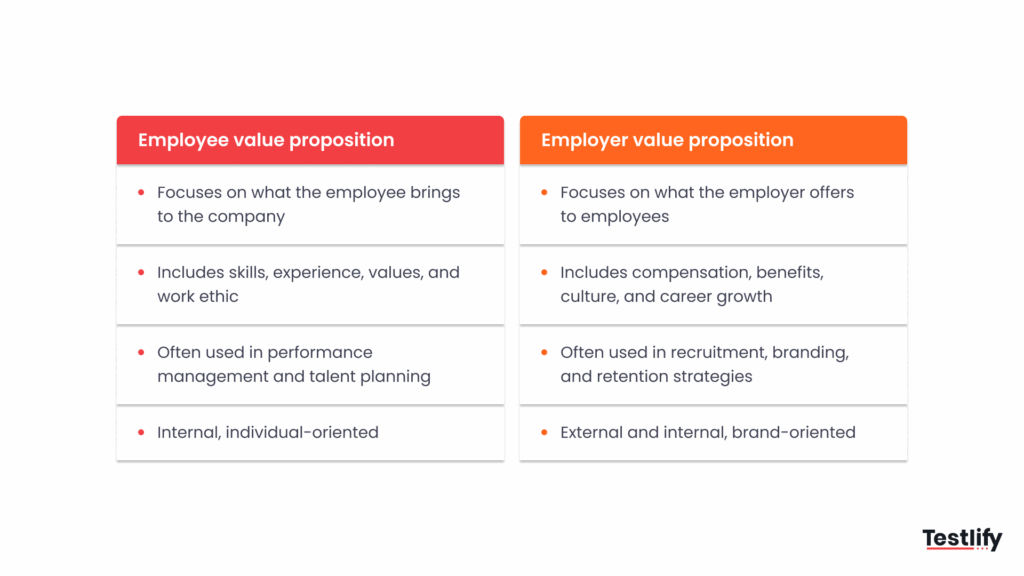
In practice, though, both refer to the same essential idea: the mutual value exchange between employer and employee. The key is to keep the proposition grounded in employee reality.
EVP and employer branding: What’s the difference?
Here’s the simplest way to distinguish the two:
EVP is what you offer. Employer branding is how you communicate it.
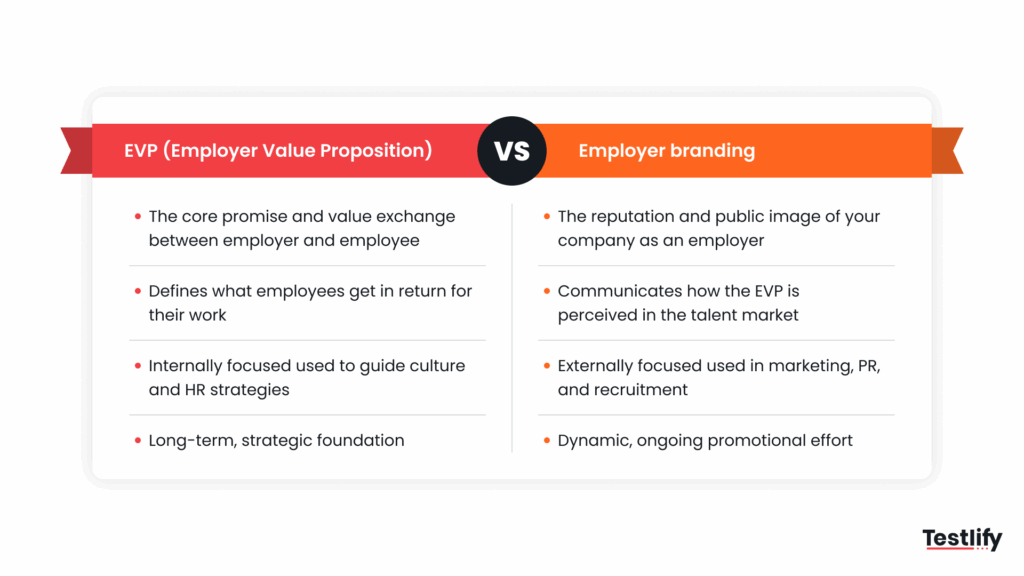
Your EVP forms the foundation of your brand strategy. Without a clear and compelling EVP, your employer branding efforts are just marketing fluff. On the flip side, an excellent EVP with poor branding won’t get you the attention it deserves.
Together, they form a one-two punch that attracts, engages, and retains top talent.
How to define your company’s employee value proposition (EVP)?
How to define your company’s employee value proposition (EVP)?
Defining your EVP doesn’t happen in a vacuum. It’s a process of listening, reflecting, and aligning.
Here’s a step-by-step approach:
Conduct internal research
Start by gathering honest feedback from your existing employees. Ask them why they joined, what keeps them here, and what truly motivates them. Use anonymous surveys, small focus groups, and in-depth one-on-one interviews to uncover real insights. Don’t presume you know the answers listen attentively to their lived experiences.
This step uncovers what your existing EVP currently is (if defined or not) and assists you in understanding what employees highly value, and this is essential to defining a credible and authentic proposition.
Start by asking your employees:
- Why did they join?
- Why do they stay?
- What motivates them? Use surveys, focus groups, and one-on-one interviews.
Analyze competitor offerings
To differentiate, you have to know you’re competing with. Study the way competition positions itself on career sites, job postings, social media, and review sites. What benefits and culture are they emphasizing? Are there opportunities you can leverage or areas where your organization already provides more value?
Competitive analysis informs you of what’s typical in your marketplace and, more importantly, where you can differentiate. It also keeps your EVP from getting lost in a sea of me-too promises.
Identify strengths and gaps
With internal data and external comparisons in hand, look at where your organization excels and where it needs to get better. Are employees singing the praises of career development but complaining about benefits? Is your culture lauded but your flexibility wanting?
Identify the differentiators in your employee experience and determine if they’re being effectively sold. This clarity will enable you to create an EVP that’s grounded in truth and continuous improvement while also ensuring it resonates with the right talent.
Align with leadership
Your EVP needs to align with your company’s strategic direction, brand promise, and leadership vision. Bring in senior leaders early in the process to gain buy-in and consistency across messaging. If your business is focused on innovation, for example, your EVP should highlight creativity, agility, and learning opportunities.
If you’re scaling globally, emphasize diversity, mobility, and growth. Leadership alignment ensures that your EVP doesn’t just live in HR it becomes a strategic narrative that supports long-term business success.
Create employee personas
Not all employees are motivated by the same things. To make your EVP both inclusive and targeted, build in-depth employee personas. These must represent your key talent segments like recent graduates, senior engineers, frontline managers, or customer-facing positions.
Each persona must cover demographics, objectives, pain points, and motivational drivers. Once you know what each group cares most about, you can frame your EVP messaging around it. This makes your EVP more personalized, relevant, and engaging to different roles and teams.
How to create an effective EVP?
Once you’ve gathered your insights, it’s time to shape your EVP.
Be authentic
Authenticity is non-negotiable when it comes to EVP. Candidates and employees can quickly spot exaggerations or empty promises. If your EVP promotes flexibility, for instance, but managers don’t support remote work, your credibility takes a hit. Your EVP should reflect the actual day-to-day employee experience, not just aspirational ideals.
Emphasize strengths you can reliably provide. When your EVP matches up with reality, it instills trust and strengthens a culture where employees feel seen, valued, and respected for all the right reasons.
Be clear
Clearness makes your EVP understandable and memorable. Refrain from corporate buzzwords, jargon, and generalities that sound nice but don’t amount to much in real life. Rather than resort to trite, clichéd language about what workers really care about: growth, effect, balance, pay, and culture.
Maintain concise messaging Keep it lean resist the temptation of trying to be all things to all people. The more articulate your message is, the easier it will be for prospects as well as incumbent employees to align with it, transmit it, and invest in it.
Be unique
To differentiate, find what sets your business apart and lean into it. Do you have an unusually rapid growth trajectory? Is your culture heavily invested in innovation, creativity, or social impact?
Emphasize the things that only your business can provide. This distinctiveness brings in talent who share your values and long-term strategy, and makes your brand a destination in preference to another hire on the list.
Be inclusive
Diversity and inclusion is not merely a value it’s a competitive strength. Your EVP has to mirror the wide-ranging experiences, identities, and requirements of your workforce. Think about how various groups of employees along gender, race, age, ability, and others perceive your culture and benefits.
Does your EVP resonate with all of them equally? Seek input from diverse voices and make sure your messaging doesn’t inadvertently exclude or generalize. An inclusive EVP makes more individuals feel welcome, supported, and empowered, enabling you to attract and retain a wider range of top talent.
Employee value proposition examples
Looking for inspiration? Here are a few real-world examples of standout EVPs:
1. Google- “Do cool things that matter.”
Google’s EVP speaks directly to ambitious, mission-driven professionals who want to make an impact. It highlights innovation, creativity, and the opportunity to work on transformative technologies that affect billions of lives.
Google also emphasizes continuous learning, autonomy, and access to world-class talent and resources. This EVP resonates strongly with top tech talent who value both challenge and purpose. It sets Google apart as a place where you don’t just build products you build the future.
2. Salesforce- “We’re not a company, we’re a family.”
Salesforce’s EVP reflects its deep commitment to values-based leadership, community engagement, and inclusive culture. The company promotes a sense of belonging and shared mission, creating a work environment where employees feel cared for and connected.
Their “Ohana” culture, rooted in trust and equality, is at the heart of their employer brand. This proposition appeals to candidates who prioritize human connection, diversity, and making a difference both inside and outside of the organization.
3. Unilever- “A better business. A better world. A better you.”
Unilever’s EVP presents a holistic employee experience that balances business performance with social responsibility and personal development. It attracts people who want to work for a purpose-led brand that’s committed to sustainability, ethical practices, and global citizenship.
At the same time, Unilever offers strong career development programs, flexible work options, and leadership opportunities. This EVP resonates with professionals seeking meaningful work in a company that invests in both individual growth and global impact.
How to promote your employee value proposition (EVP)?
An excellent EVP is useless if no one can see it.
1. Embed it in your careers page
Your careers page is usually the first area candidates visit when they are considering your company. Utilize this area tactically to communicate your EVP in an easy-to-read and engaging manner. Include a brief EVP statement, supplemented by supporting images, videos, and testimonials from existing employees.
Keep it simple to navigate and mobile-friendly. Your careers page must not simply list jobs but narrate a compelling story about what it’s like to work at your company and why someone should want to be part of it.
2. Leverage employee stories
There’s nothing more powerful than real voices from within your organization. Use employee testimonials, day-in-the-life videos, and blog posts to showcase authentic stories that reflect your EVP in action. Highlight different departments, roles, and backgrounds to show the diversity of experiences within your company.
When potential hires hear directly from people like them, they’re more likely to trust what you’re offering. These personal stories build emotional connections and make your EVP feel tangible and credible.
3. Activate social media
One of the quickest and most efficient ways to broadcast your EVP to the world is on social media. Share behind-the-scenes stories, employee features, culture videos, and value-centric campaigns on sites such as LinkedIn, Instagram, and TikTok.
Ask employees to share their own stories on branded hashtags. Be consistent with tone and messaging across platforms. By proactively sharing your EVP on social channels, you drive your employer brand further and maintain your talent pipeline warm throughout the year.
4. Train hiring managers
Your hiring managers are frequently the initial human contact for candidates, so they need to be aware of and convey your EVP consistently. Train them to communicate key messages, respond to culture-related questions, and connect job responsibilities to more general company values.
Provide them with EVP talking points and sample stories they can utilize during interviews. When your recruitment team communicates clearly and with enthusiasm about what your organization has to offer, prospects are more inclined to be excited and have confidence in coming aboard.
EVP communication strategies
Effective communication is all about repetition and consistency.
Internal rollout
Prior to unveiling your EVP to the external world, unveil it to your internal groups. Leverage town halls, departmental meetings, email campaigns, and your intranet to communicate the message succinctly. Once employees comprehend and embrace the EVP, they become your greatest ambassadors.
Ask for feedback and encourage them to contribute their own stories connected to the EVP themes. An internal-first launch guarantees alignment throughout the company and fosters trust by proving that your EVP isn’t just a marketing slogan it’s a reality lived.
Visual storytelling
Visuals make your EVP come alive in a variety of ways that words simply can’t. Leverage high-quality video, employee photography, and infographics to make your message memorable and emotionally engaging.
A quick video walk-through of your office space, a highlight on team traditions, or a graphic on employee benefits can convey more in seconds than a paragraph ever can. Visual storytelling makes your employer brand more human and lets potential candidates imagine themselves as part of your organization making your EVP real and impactful.
Candidate touchpoints
Embed your EVP consistently throughout all phases of the candidate experience from job adverts to onboarding. Begin with concise, EVP-centric job descriptions that show your values and voice.
Reinforce those messages in interview discussions, offer letters, and onboarding sessions. This consistency sets realistic expectations and provides a cohesive story to new hires. When candidates see your EVP applied at all points of contact, it indicates genuineness and instills trust from the initial engagement.
Aligning your EVP with strategic business goals
Your EVP shouldn’t live in an HR silo. It must support your company’s overall direction.
- Launching a digital transformation? Highlight learning and development.
- Expanding globally? Emphasize international mobility and diversity.
- Trying to innovate? Showcase your culture of experimentation.
Aligning your EVP with your business strategy ensures that your workforce isn’t just aligned they’re empowered. It builds a talent brand that supports your growth narrative and ensures that every new hire is a contributor to your future, not just a filler for today.
Trends and the future of EVP
As the world of work evolves, so too must your EVP. Here are a few trends to watch:
1. Personalization
The days of a one-size-fits-all EVP are over. Employees expect tailored experiences that reflect their roles, career stages, and life priorities. Leading companies are segmenting their EVP by department, region, or even persona offering different benefits or messaging for, say, engineers in Berlin versus sales reps in New York.
Personalization helps make your EVP feel more relevant and meaningful, increasing its effectiveness in attracting and retaining diverse talent. It also shows employees that your company recognizes their individual needs and values.
2. Purpose-driven work
Today’s workforce, especially younger generations like Gen Z and Millennials, wants more than just a paycheck they want purpose. People are looking to join companies whose missions align with their own values, whether that’s sustainability, social equity, or innovation for good.
Your EVP needs to clearly communicate not just what you do, but why it matters. When employees feel they’re contributing to something bigger than themselves, they’re more engaged, loyal, and willing to go the extra mile for your organization.
3. Flexibility
Flexibility has gone from a nice-to-have to a core expectation. Remote work, hybrid models, and control over work hours are now essential components of a competitive EVP. Employees want the freedom to choose how, when, and where they work in a way that supports their personal lives and productivity.
Companies that offer true flexibility not just lip service will have a significant edge in attracting top talent, particularly in knowledge-based roles. It’s not just a benefit it’s a trust signal.
4. Employee wellness
Employee wellness has moved to the center of EVP design. From mental health support and workplace wellness programs to financial literacy and burnout prevention, wellness offerings signal that your company cares about employees as whole people. It’s no longer enough to provide basic health insurance today’s talent looks for holistic well-being initiatives.
Prioritizing wellness not only boosts productivity and retention but also helps prevent long-term issues like disengagement or absenteeism, making it a wise investment for any forward-thinking employer.
5. Data-driven EVP
The future of EVP is increasingly data-informed. Leading organizations are using people analytics, AI, and employee feedback tools to refine and optimize their value propositions. Data can reveal what employees actually value not just what HR thinks they want.
It can also help tailor messaging, track EVP effectiveness, and identify new opportunities to improve engagement. A data-driven EVP is agile, evidence-based, and better equipped to evolve alongside shifting workforce expectations and business needs.
Final thoughts
In a saturated market, your EVP is your secret weapon. It’s not just about perks or pay it’s about promise and purpose. When you get it right, your EVP becomes a magnet that pulls in the best talent, keeps them engaged, and helps your business grow stronger from within.
So if you haven’t looked at your EVP lately, now is the time. Your future workforce and your bottom line are counting on it.

Content Writer
Yashika Khandelwal is a Content Writer with 3+ years of experience creating research-backed content on hiring, talent assessment, and HR technology. She is a registered Organizational Psychologist and subject matter expert who combines behavioral science with practical recruitment insights to produce accurate, evidence-based content.
LinkedInRelated resources
View all
HR & recruitment
eSIM for HR and Global Talent Mobility: 6 Ways eSIM Transforms HR Management

HR & recruitment
How to evaluate professional certifications for recruiting success

HR & recruitment
What CTOs should know before hiring DeFi developers

HR & recruitment
Internal mobility vs. external hiring: Striking the right balance

HR & recruitment
Reviving cold talent: The goldmine sitting in your ATS

HR & recruitment
Hiring Funnel Bottlenecks: How to Stop Candidate Ghosting
Get started.
Hire on proof, not resumes.
Run your first skills-based assessment free — no credit card required.