
Career Pathing: How to Build Paths That Retain Talent
Learn what career pathing is, why it matters for retention, and how to build career paths that map real skills, not just titles.

In 2022, McKinsey surveyed more than 12,000 workers about why they quit, and the top answer was not pay. It was the lack of a way up, named by 41% of those who resigned. That same year, Gartner found just 25% of employees felt confident about their career where they worked, and separately that 44% of HR leaders admit their organizations lack compelling career paths. Read those numbers together and the problem is obvious. People leave when they cannot see where they are going, and most of them cannot see it.
That gap costs you your best people, the ones with options. And it is expensive to fix after they have already handed in notice. Career pathing is how you close it before that happens. By the end of this guide you will know what career pathing is, why it matters right now, the four types of paths to offer, and a six-step way to build paths that map to real skills, not job titles.
Career pathing is the process of mapping the roles, skills, and experiences an employee can move through inside your organization, so growth is visible and planned instead of left to luck. Instead of a vague promise to grow with the company, it names the next role, the skills that role needs, and how those skills get proven.
TL;DR
- Career pathing maps the roles and skills an employee can grow into, turning vague promises of growth into a plan they can see.
- It matters because people quit when they cannot see a future, and skills are changing faster than most teams can hire for.
- There are four main types of paths: vertical, lateral, hybrid, and dual. Most companies need a mix.
- You build a path in six steps, and the step most teams skip is defining the exact skills each move requires.
- Career pathing works best when each step ties to measurable evidence, so a promotion rests on proven skills instead of tenure or a good interview.
 ChatGPT
 Gemini
 Claude
 Grok
Grok Perplexity
What is career pathing?
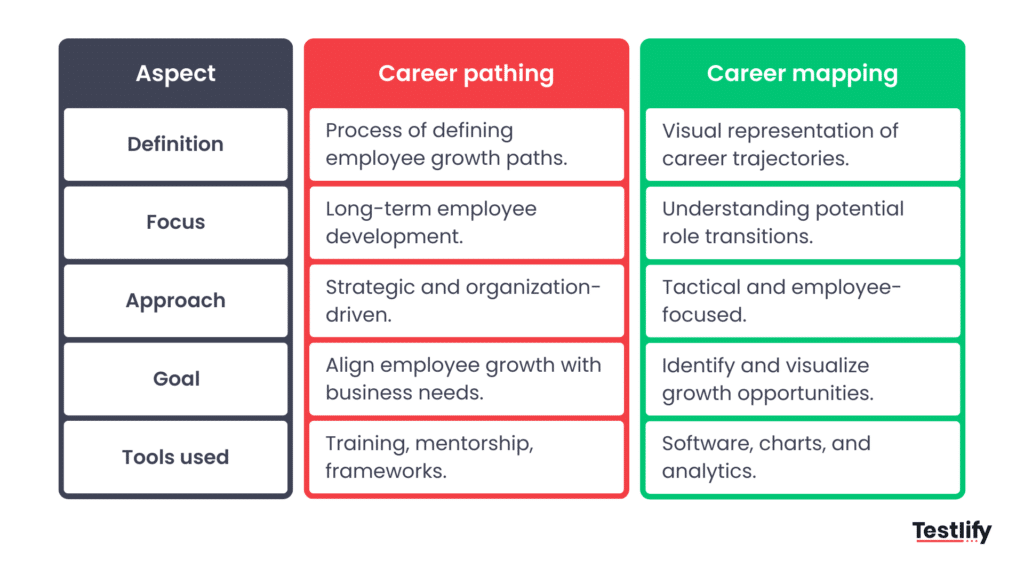
Career pathing is the process of laying out the roles, skills, and experiences an employee can move through inside your company. It defines the routes available, from an entry role to more senior or more specialized ones, and spells out what a person needs to learn to take each step. The goal is not to push everyone up a ladder. It is to give growth that fits both the person and the business.
People mix up two terms here, so it helps to split them. Career planning is the employee mapping their own goals. Career pathing is the structure you provide to make those goals reachable. One is personal, the other is organizational, and career pathing only works when the two line up in a real conversation.

Why does career pathing matter now?
Career pathing matters because it fixes the single most expensive people problem: losing talent you already trained. It also builds the skills you would otherwise have to buy on a tight market. Two forces make it urgent right now, retention and the speed of skills change.
It keeps the people you cannot afford to lose
When employees can see room to grow, they stay. When they cannot, they start looking. The clearest proof is internal mobility: LinkedIn found that people at companies with high internal mobility stay 53% longer than people at companies where sideways and upward moves are rare. This is the reason a clear retention strategy almost always includes development. The reverse is just as true: a strong performer who feels stuck is a resignation waiting to happen, and the cost of replacing them scales with seniority. Gallup found replacing a manager costs roughly 200% of their salary, a technical specialist around 80%, and a frontline employee about 40%, so moving someone up or sideways is almost always cheaper than replacing them.
Growth drives real engagement
People invest more when they know the effort leads somewhere. LinkedIn found that learners who set career goals engage with learning 4x more than those who do not, per its 2024 Workplace Learning Report. Career pathing gives people that goal to aim at, which is why it lifts both job satisfaction and output.
The skills you hired for keep changing
The World Economic Forum projects that 59% of workers will need reskilling or upskilling by 2030, and roughly 39% of today’s core skills will be reshaped in the same window, according to its Future of Jobs Report 2025. The same report expects 78 million net new jobs worldwide by 2030, with more than 120 million workers at medium-term risk if their skills are not refreshed. Career pathing is how you build those skills from the inside, tied to roles people actually want, instead of scrambling to hire them later.
Pro Tip: Do not roll career pathing out to everyone at once. Start with the two or three roles where turnover hurts most, prove the model works, then widen it. A path your best people can see beats a polished framework no one reads.
What are the main types of career paths?
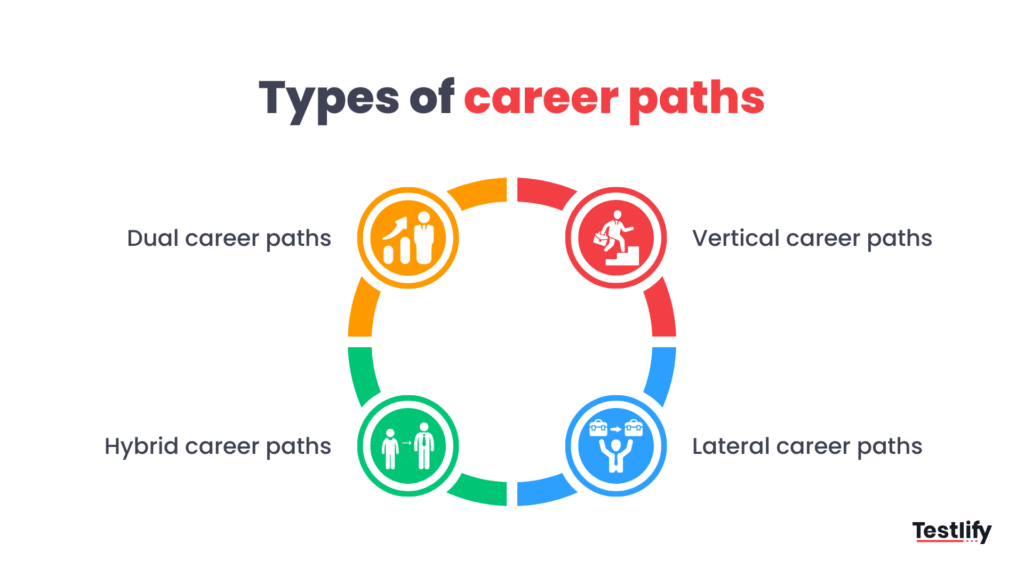
Most organizations offer four types of career paths. You rarely pick just one. A good program mixes them so people can move up, across, or deeper without leaving to find variety.
Path type | What the move looks like | Best for |
|---|---|---|
Vertical | Promotion to a higher role with more scope and pay | People aiming at leadership |
Lateral | A move across teams at a similar level | Building range and cross-team knowledge |
Hybrid | A mix of sideways and upward moves over time | Growing well-rounded future leaders |
Dual | Advancement through deeper expertise, not management | Technical experts who do not want to manage |
Vertical paths are the classic climb, an associate becoming a manager, then a director. Lateral paths let someone in finance move into operations to widen their skills. Hybrid paths combine the two, so a person zigzags across teams and then steps up with a broader base. Dual paths matter most in technical work: a strong engineer can grow to principal engineer through skill, never having to manage people to earn more.
Career path vs career ladder: what’s the difference?
A career ladder is the traditional straight climb up one function, entry role to manager to director, one rung at a time. A career path is broader. It includes that ladder plus lateral, hybrid, and dual moves, so growth is not limited to the handful of seats at the top. Every ladder is a path. Not every path is a ladder.
The modern version of this is the career lattice, a grid instead of a single line. On a lattice, a person can move up, sideways, or into a deeper specialty as the business shifts and their own goals change. That flexibility matters because most organizations do not have enough senior openings to promote everyone vertically, and a lattice keeps people learning while they wait for one. Offer a ladder alone and your strongest people stall the moment the rung above them is full, which is often the moment they start taking recruiter calls.
Structure | How growth moves | Best for | Main limitation |
|---|---|---|---|
Career ladder | One line up, a single rung at a time | Roles with a clear, linear hierarchy | Stalls the moment the rung above is full |
Career lattice | Up, sideways, or into a deeper specialty as goals shift | Organizations without enough senior seats for everyone | Needs active management or it stays invisible |
Career path | Ladder plus lateral, hybrid, and dual moves combined | Companies mixing all four path types across functions | Needs clear skill criteria per step, or it becomes directionless |
How do you build a career path?
You build a career path in six steps. Assess what you have, define the routes, map the skills each step needs, back those skills with evidence, offer learning to close gaps, and review often. The step most teams rush is the third one, and it is the one that makes the whole thing fair.
- Assess current development options. Look at your existing employee development programs and ask a blunt question: could a new hire actually name their next two roles here? If not, that is your starting gap.
- Define the routes across the organization. Map the moves for each function, both upward and sideways. A path might read associate, senior associate, team lead, manager, or it might cross from support into product.
- Map the skills each step needs. Name the specific skills, not vague traits. “Handles escalations without a manager” beats “strong communicator.” This is where the Testlify Competency-to-Evidence Matrix helps: you map each role to the competencies that matter, then tie each competency to evidence you can actually measure.
- Back the skills with real evidence. Confirm skills with proof, not a hunch. A short skills assessment or a work sample shows whether someone is ready for the next step, which keeps promotions defensible and fair.
- Offer learning that closes the gaps. Once you know the gap between where someone is and where they want to go, fill it with targeted training, mentoring, or a stretch project. Run a skills gap analysis first so the learning is aimed, not generic.
- Review progress and adjust. Paths are not set in stone. Business needs shift and so do people’s goals, so revisit each path in regular one-on-ones and update it. Career pathing that never gets revisited quietly dies.
Here is how that looks in practice. A 300-person insurance firm kept losing claims associates around the 18-month mark, right when they got good. Its team of 24 associates had no visible next step. So it built one path: claims associate to senior associate to team lead. For the team lead step, it defined four skills, including handling a complaint call and coaching a peer, and checked each with a short assessment before promotion. Within a year, internal promotions covered more of its lead openings, and the associates who once left at 18 months could finally point to their next role.
What challenges derail career pathing?
Career pathing fails in predictable ways. Knowing the three most common traps lets you design around them from the start.
Career pathing that no one can see
A path that lives in an HR file helps no one. If managers cannot explain a person’s next two moves in a one-on-one, the program does not exist for that employee. Make the paths visible and talk about them often.
Too few real openings
If everyone is aimed at the same handful of senior roles, most will stall. This is exactly why lateral and dual paths matter. They create real growth that does not depend on someone above leaving, and they keep people learning while they wait.
Paths too rigid to fit real people
A path locked to one rigid sequence ignores how careers actually go. Someone may want to go deep, then wide, then up. Build in enough flex to hold that, and tie each move to succession planning so the business gets ready leaders out of it too.
How does Testlify support career pathing?
Testlify strengthens career pathing at the step most teams get wrong: proving the skills behind each move. Testlify is a skills assessment platform, so it does not run your whole HR stack. What it does is answer one hard question with evidence, does this person actually have the skills the next role needs?
Using the Testlify Competency-to-Evidence Matrix, you map each role in a path to the competencies that matter, then confirm them with role-based skills assessments, work samples, and structured reviewer feedback. That gives managers a fair, consistent read on readiness for a promotion or a lateral move. The assessment supports the decision. A person still makes the call. That mix, evidence plus human judgment, is what keeps career moves both fair and defensible.
Build career paths your best people can see
Pick the one role where losing people hurts most. Map its next two steps, name the skills each step needs, and confirm those skills with a short assessment. That is a working career path, and it is small enough to ship this quarter. Do it once, prove it keeps people, then repeat it across the roles that matter.
See the skills behind every career step. Testlify’s role-based assessments show you which skills an employee already has and which ones stand between them and their next role. Map a path, confirm readiness with evidence, and promote with confidence.
Prefer to look around first? You can start a free trial and build your first skills assessment in minutes.
Key takeaways
- Career pathing is a retention tool, not a nice-to-have. A lack of advancement was the top reason people quit in McKinsey’s 2022 data, so a visible path directly protects the talent you already spent money to hire and train.
- The perception gap is the real problem. Employers think they offer growth while only 25% of employees feel confident about their careers, per Gartner, so the work is making paths visible, not just writing them down.
- Offer more than one type of path. Vertical, lateral, hybrid, and dual paths together give people ways to grow even when senior seats are full, which stops strong performers from stalling and leaving.
- Skills, not titles, should gate each step. Defining and measuring the skills a move requires makes promotions fair and defensible, and it prepares people for work that the World Economic Forum says will keep changing through 2030.
- Start small and prove it. Build one path for your highest-turnover role, confirm readiness with evidence, and expand once it works. A path people can see beats a framework no one opens.
Frequently asked questions (FAQs)

Content Writer
Yashika Khandelwal is a Content Writer with 3+ years of experience creating research-backed content on hiring, talent assessment, and HR technology. She is a registered Organizational Psychologist and subject matter expert who combines behavioral science with practical recruitment insights to produce accurate, evidence-based content.
LinkedInRelated resources
View all
HR & recruitment
Pros and cons of cross-training employees in 2026

HR & recruitment
How to use reverse mentoring to make it work?

HR & recruitment
How talent acquisition teams can benefit from citizenship investment programs

HR & recruitment
Recruiter burnout: causes, symptoms, and how to prevent it

HR & recruitment
How to create a strategic HR roadmap?

HR & recruitment
What is the buddy system in the workplace? Benefits, steps, and 2026 guide
Get started.
Hire on proof, not resumes.
Run your first skills-based assessment free — no credit card required.