
50 financial analyst interview questions
Fifty interview questions for financial analyst and analyst assistant roles, with answers to look for, red flags and a simple scorecard.

The best financial analyst interview questions test three things at once: command of the numbers (financial statements, modeling, valuation), the judgment to turn those numbers into a recommendation, and the plain-language skill to defend that call to people outside finance. Ask only technical trivia and you hire a spreadsheet operator who cannot tell the CFO what to do.
Below are 50 questions grouped by what they reveal, an answer key for the ones that matter most, the red flags to probe, and a 1 to 5 scorecard your panel can share. A short set for financial analyst assistant and junior roles is included, so one loop works for every level.
The role is worth getting right. The US Bureau of Labor Statistics puts the 2025 median pay for financial analysts at $103,570, projects 7% growth from 2025 to 2035 and expects about 29,500 openings a year. A strong hire is scarce, and a weak one is expensive to replace.
TL;DR:
- Good financial analyst interview questions mix five groups: general, technical, behavioral, situational and work style. One group alone tells you little.
- Technical questions should force reasoning, not recall. Ask how a $10 million equipment purchase moves all three statements and score the path, not just the final figure.
- Decide what a strong answer sounds like before the interview, then score every candidate 1 to 5 per competency, alone, before the debrief.
- Watch for red flags: no forecast they ever got wrong, models they only maintained, and "detail-oriented" with no example.
- For assistant and junior roles, test accuracy, Excel and learning speed. For senior roles, test modeling depth and influence.
- Run a scored financial analyst skills test before the interview, so the conversation is spent on judgment instead of basics.
 ChatGPT
 Gemini
 Claude
 Grok
 Perplexity
What should financial analyst interview questions test?
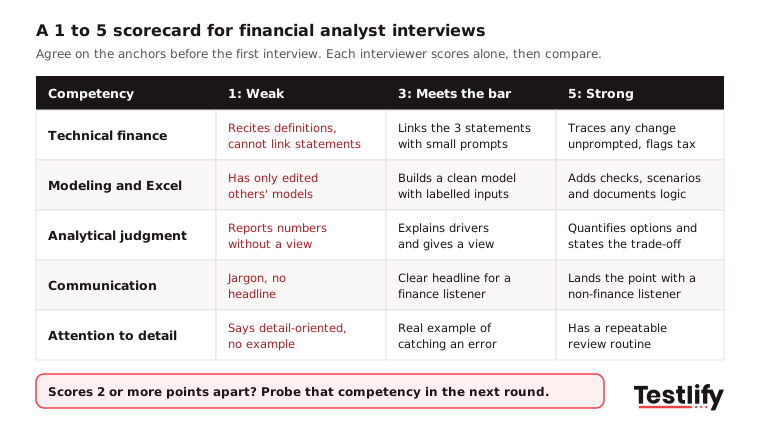
Financial analyst interview questions should test five competencies: technical finance knowledge, modeling and Excel fluency, analytical judgment, communication, and attention to detail. For each one, name the evidence you will accept before the interview, then choose the question or assessment that produces it.
Analytical thinking is also what employers want most. According to the World Economic Forum's Future of Jobs Report 2025, as reported by FM magazine, nearly 70% of employers consider it a core skill. The O*NET profile for financial and investment analysts adds the work styles that matter day to day: attention to detail, integrity, cautiousness and intellectual curiosity.
Pro tip: Do not weight every competency the same. For an FP&A hire, modeling and communication carry more weight. For a reporting-heavy role, attention to detail and technical knowledge do. Set the weights before the first interview, not after you meet a candidate you like.

Which general financial analyst interview questions should you ask?
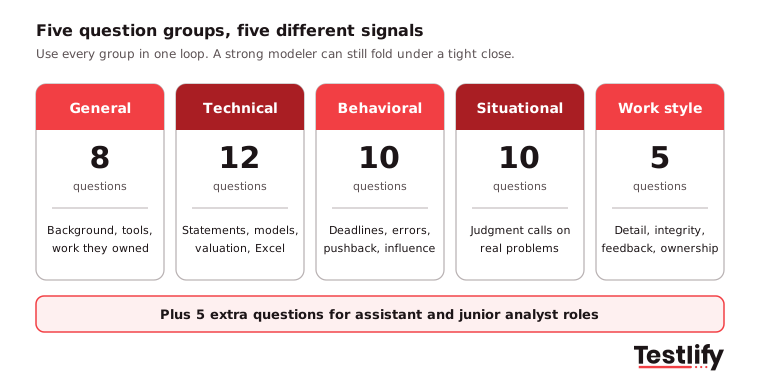
General financial analyst interview questions should uncover background, motivation and how a candidate frames the work. Listen for specifics: a named tool, a real deliverable, a number they owned. Eight openers:
- Walk us through your experience in financial analysis and forecasting. Which deliverables did you own from start to finish?
- Which financial reporting tools and systems have you used, and which did you go deepest on?
- How do you keep current on markets, economic indicators, regulation and your industry?
- What made you move from your last role toward this one?
- Describe the model or analysis you would show us first. What decision did it drive?
- How do you gather and validate data before you start an analysis?
- What does a good month-end close look like when you run it?
- How do you document assumptions so someone else can pick up your model?
Which technical interview questions for financial analyst candidates show real modeling skill?
Technical interview questions for financial analyst candidates work best when they force reasoning instead of recall. Anyone can memorize a definition of EBITDA. Only a working analyst can trace how one change ripples across the three statements. Ask candidates to think out loud and score the path. Twelve to try:
- Walk us through how a $10 million equipment purchase moves the income statement, balance sheet and cash flow statement.
- Depreciation goes up by $10 and the tax rate is 25%. What happens on each statement?
- What is the difference between EBITDA and operating cash flow, and when does the gap matter?
- Explain working capital and how a change in it hits free cash flow.
- Revenue is flat but receivables doubled. What does that tell you, and what would you check?
- How do you build a three-statement model so the balance sheet always balances?
- How would you value a company with negative earnings but strong revenue growth?
- When would you capitalize a cost instead of expensing it?
- How do you build sensitivity or scenario analysis into a forecast?
- Which Excel functions do you rely on most for lookups, scenario toggles and checks?
- What sanity checks do you run before you trust a model you did not build?
- How would you check whether a variance is a data error or a real business change?
Spreadsheet skill is not optional. The AFP's 2025 FP&A Benchmarking Survey found that 96% of FP&A teams use spreadsheets for planning, and 79% hire for specific technology skills such as business intelligence and dashboards. For a deeper modeling check, see how to evaluate financial modeling skills.
Which behavioral financial analyst interview questions show how candidates work under pressure?
Behavioral financial analyst interview questions show how a candidate behaves when deadlines are tight, data is missing and stakeholders dislike the answer. Ask for one specific past situation, then dig into what the candidate personally did and what changed because of it. Ten that travel well:
- Tell us about a time you faced a hard deadline on a close or a board deck. How did you deliver?
- Describe a moment when your analysis changed a leadership decision.
- Tell us about a forecast you got wrong. What drove the miss, and what did you change?
- Tell us about a mistake in a model or report. How did you catch and fix it?
- Describe a time you had to defend a number a senior leader disagreed with.
- Give an example of explaining a complex financial concept to a non-finance colleague.
- Describe a time you spotted a financial risk or opportunity before anyone else did.
- When did you have to adapt your analysis because new information arrived late?
- Tell us about combining data from several sources into one report. How did you keep it consistent?
- Tell us about a slow or manual process you improved.
Which situational questions predict on-the-job judgment?
Situational questions put the candidate inside a problem they will face in the job and ask what they would do. There is rarely one right answer: you are scoring what they ask first, how they reason and where they stop to check. Ten to test judgment:
- Revenue is up 8% but cash is down. Walk us through how you would investigate.
- A department overspent its budget by 12%. How do you find out why?
- Leadership wants a forecast by tomorrow and the data is incomplete. What do you deliver?
- You find a material error in a report already sent to the board. What now?
- Two data sources give two different numbers for the same metric. How do you reconcile them?
- You are asked to justify a cost cut you believe will hurt the business. How do you respond?
- A model you inherited gives a result that looks wrong. Walk us through your review.
- Sales wants to book a deal that helps this quarter but hurts next year. What do you flag?
- A one-time item is distorting a trend. How do you present the underlying number?
- You have 10 days to stand up recurring reporting from scratch. Where do you start?
Data questions deserve extra time. In the same AFP survey, 61% of FP&A practitioners said unreliable data was a challenge and 60% said limited access to data held them back. An analyst who reconciles before reporting is worth more than one who reports faster.
What work-style and personality questions fit a finance role?
Work-style questions for a finance role should probe detail, integrity, feedback and ownership, the traits that decide whether a technically strong analyst can be trusted with confidential numbers. Five that add signal without repeating the behavioral set:
- How do you handle sensitive financial information? Give an example of when you had to use discretion.
- How do you respond to criticism of your work? Tell us about feedback you acted on.
- Tell us about a decision you made with limited information. How did you approach it?
- How did you adapt to a change in accounting rules or reporting standards?
- Describe a project you owned without close supervision. How did you stay on track?
How should interview questions for financial analyst assistants and juniors differ?
Interview questions for financial analyst assistants and junior hires should test accuracy, core Excel, basic statement knowledge and learning speed, not deep modeling. Senior candidates should face harder modeling, valuation and influence questions. Five extra questions for assistant and entry-level roles:
- How do you check your own work for errors before you send it?
- Which Excel tasks can you do without looking anything up?
- How do you prioritize when several analysts send you requests on the same day?
- Tell us about a time you had to learn a new tool or process quickly.
- Explain the three financial statements in your own words.
Level | Focus the interview on | Example question | What good looks like |
|---|---|---|---|
Assistant / entry level | Accuracy, Excel, statement basics, coachability | "How do you check your own work?" | A concrete routine: tie-outs, totals, a second look |
Financial analyst | Modeling, variance analysis, clear explanations | "Revenue is up 8% but cash is down. Why?" | Asks about receivables, inventory and timing before guessing |
Senior financial analyst | Model design, valuation, influencing leaders | "Defend a number a senior leader disagreed with" | Quantifies the impact and shows how the leader was won over |
The aptitude test for financial analyst suits assistant and junior roles, where numerical reasoning and learning speed matter more than experience.
What do strong answers to financial analyst interview questions sound like?
Strong answers to financial analyst interview questions name a specific situation, show the reasoning step by step and end with a measurable result. Use this answer key for six questions that carry the most weight.
1. Walk us through a $10 million equipment purchase across the three statements.
Look for: Nothing hits the income statement on day one. Cash from investing falls by $10 million and property, plant and equipment rises by $10 million. Over the asset's life, depreciation lowers operating income, is added back in operating cash flow and creates a tax saving.
Red flag: The candidate puts the full $10 million through the income statement as an expense.
2. Depreciation goes up by $10 and the tax rate is 25%. What happens?
Look for: Net income falls by $7.50. Operating cash flow rises by $2.50, because the $10 is added back and taxes fall by $2.50. On the balance sheet, equipment falls by $10, cash rises by $2.50 and retained earnings fall by $7.50, so both sides drop by $7.50.
Red flag: The candidate says cash falls, or cannot make the balance sheet balance.
3. Tell us about a forecast you got wrong.
Look for: A real miss with a number attached, a named driver (pricing, volume, timing, a bad assumption) and a change the candidate made afterward, such as a new check or a driver-based model.
Red flag: No miss at all, or a miss blamed entirely on sales or "the market".
4. Describe a time you identified a financial risk or opportunity through data analysis.
Look for: A clear trigger in the data, the analysis behind it and a business result. One example: noticing that a raw material was bought from several suppliers at different prices, consolidating to one supplier and cutting cost while checking supply risk.
Red flag: A vague story with no number and no decision that followed.
5. How do you explain a complex analysis to a non-finance audience?
Look for: A headline first, then two or three drivers, plain words instead of jargon, one simple chart, and a check that the listener understood. Ask the candidate to explain EBITDA to you as if you ran operations.
Red flag: More detail as the answer, or acronyms the candidate never unpacks.
6. How do you handle tight deadlines without losing accuracy?
Look for: Prioritizing by impact, breaking the work into milestones, protecting time for a final review and telling stakeholders early when something will slip.
Red flag: "I just work harder" with no review step, which is how errors reach the board deck.
Key takeaway: Score the reasoning, not the polish. A candidate who pauses, asks a clarifying question and reaches the right answer is a better bet than one who recites a memorized script.
What are the red flags in a financial analyst interview?
The main red flags in a financial analyst interview are vague experience, no ownership of mistakes, numbers without explanations and accepting output without checking it. Push once with a follow-up before you judge, because nerves can hide real skill.
Red flag | What it may mean | Follow-up to ask |
|---|---|---|
Has "maintained" models but never built one | Template user, not a modeler | "Which tab would you build first, and why?" |
Reports a variance without a driver | Describes numbers, does not analyze them | "What would you check first to explain it?" |
No forecast ever went wrong | Low self-awareness or little real exposure | "Which assumption would you change today?" |
"Detail-oriented" with no example | A claim with no evidence | "Tell us about the last error you caught." |
Strong on valuation, weak on working capital | Studied for interviews, light on operations | "What happens to cash if customers pay 30 days later?" |
Accepts AI or system output as final | Weak review habits | "How would you check this number before sending it?" |
How do you score financial analyst candidates consistently?
Financial analyst candidates are scored consistently when every interviewer uses the same questions, the same 1 to 5 anchors per competency and scores alone before the debrief. A structured interview format makes two analysts comparable on evidence rather than on who interviewed more smoothly.
- Pick four to six competencies: Use the table above and weight them for the role.
- Write the anchors: Describe what a 1, a 3 and a 5 sound like for each competency before the first interview.
- Score alone: Each interviewer rates every competency 1 to 5 with a line of evidence, before talking to the panel.
- Compare and probe: Where two scores sit 2 or more points apart, probe that competency in the next round.
- Decide on evidence: Add the weighted scores, then discuss the gaps, not the overall impression.
Consistency also saves time when hiring is hard. SHRM's 2025 Talent Trends found that nearly 70% of organizations still struggle to recruit for full-time roles, so a loop that reaches a confident decision faster is a real advantage. For a ready template, see what an interview scorecard is and how to build one.
When should you add a skills test or work sample?
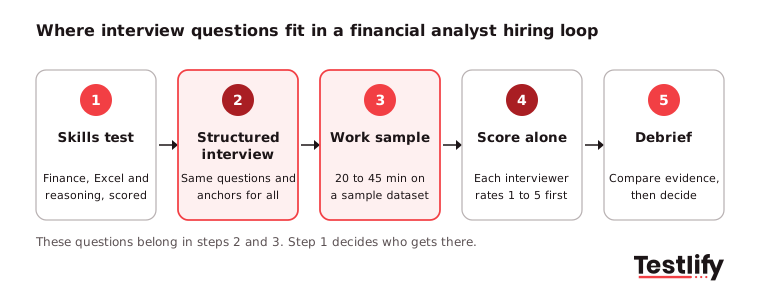
A skills test belongs before the interview whenever you have more than a handful of applicants, and a short work sample belongs inside the final rounds. Interviews read judgment and communication well, but they rank raw skill poorly at volume.
- Before the interview: A scored financial analyst skills test covering financial reasoning, data analysis and Excel ranks the shortlist on evidence, so the conversation starts with people who can already do the work.
- During the final round: Give a 20 to 45 minute work sample, such as a small dataset with a variance to explain or two sources that do not tie. Watch whether the candidate checks inputs before building.
- For Excel-heavy roles: Add an advanced Excel assessment so lookups, pivots and scenario work are scored, not claimed.
Testlify supports this flow in one place: 3,500+ tests, including finance and Excel tests, structured interview templates, AI interviews that score every answer against the same criteria, and 20+ proctoring checks to keep remote results honest.
The financial analyst hiring guide covers sourcing and the job description, and related roles such as financial reporting analyst interview questions shift the competency weights again.
Ready to hire your next financial analyst?
Stop guessing from resumes. Send every applicant a scored financial analyst skills test, let the results build your shortlist, then use these 50 questions to test judgment in the room. Start a 7-day free trial of Testlify, no credit card required, or book a demo to see the finance tests on a real role.
Frequently asked questions (FAQs)

People and Talent Partner
Arushi Shah runs day-to-day talent acquisition and candidate experience at Testlify. She writes on interviewing, structured hiring, and giving candidates a fair, fast process.
LinkedInRelated resources
View all
HR & recruitment
40 account management interview questions and answers

HR & recruitment
45 Content Writer interview questions to ask job applicants

HR & recruitment
45 Talent Acquisition Specialist interview questions to ask job applicants

HR & recruitment
45 UI/UX Designer interview questions to ask job applicants.

HR & recruitment
Customer Success Representative Interview Questions (2026 Guide)

HR & recruitment
45 Account executive interview questions to ask job applicants
Get started.
Hire on proof, not resumes.
Run your first skills-based assessment free — no credit card required.