
Why should recruiters use programming tests?
Discover why recruiters in large organizations should use programming tests to hire faster, reduce bias, and improve the quality of tech hires.

Software is now core to how most companies operate. That’s why hiring developers feels riskier than it used to. One bad hire can impact customer experience and burn a lot of time in rework.
The basic problem is that resumes don’t tell you enough about the candidate. A candidate can list the right tech stack in their resume and still struggle with the basics for the role.
This is where coding tests help. A well-prepared, role-based coding assessment can give you a clearer picture of real programming skills early on, before you invest hours in interviews.
In this blog, I’ll share the key benefits of coding tests and explain why programming tests have become a practical part of modern tech hiring.
 ChatGPT
 Gemini
 Claude
 Grok
Grok Perplexity
TL;DR – Key takeaways
- Coding tests validate real skill early, beyond what resumes claim.
- They speed up shortlisting and cut wasted screening and interview rounds.
- Standardized scoring reduces bias and keeps evaluation consistent across teams.
- Role-based tests predict job performance better than puzzle-heavy questions.
- Async online tests support remote/global hiring and improve candidate experience when kept short and clear.

Coding tests show real skill beyond the resume
Resumes tell you what a candidate claims they’ve done. A 2025 Crosschq analysis reports that the IT industry has the highest resume‑fraud rate, with 55% of employees admitting to falsification. That gap is exactly where hiring goes wrong in tech.
Here, a coding test gives a clear picture of the candidate’s abilities. Not based on titles, project names, or a long tech stack list, but based on how the candidate thinks and writes code. Even a simple task can tell you a lot:
- Does the candidate understand the basics?
- Can they break a problem into steps?
- Can they write code that actually works?
This matters a lot because two resumes can look equally strong, but the on-the-job output can be completely different.
A role-based coding assessment helps you catch false positives early, and you can carry out deeper evaluations in the interviews.
They help you shortlist faster and save time
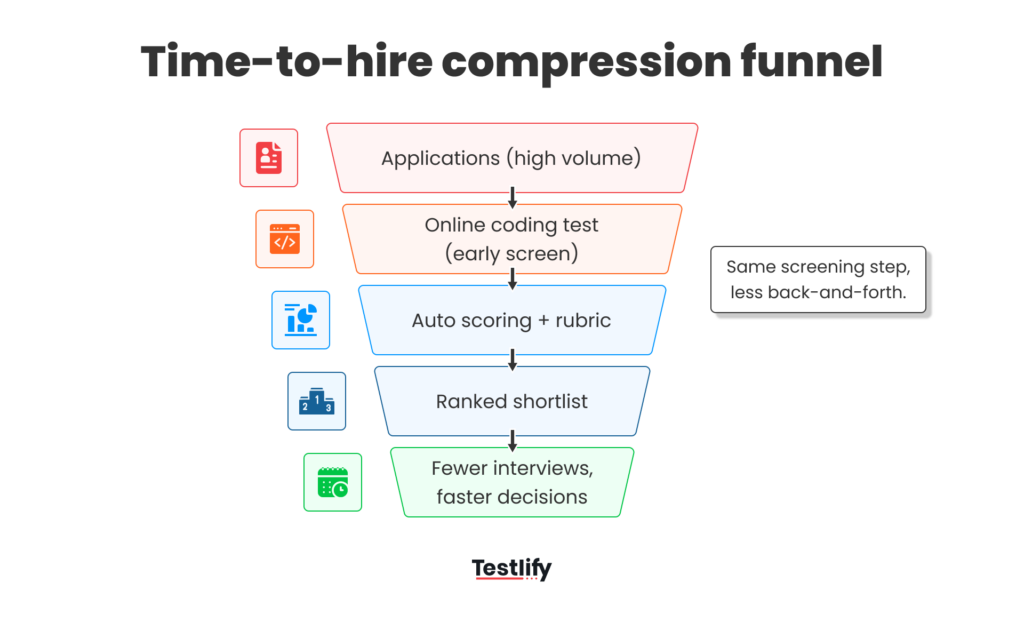
For recruiters, time-to-hire is a very crucial KPI. To improve it, you need to shortlist faster without hurting the quality of hire.
In tech hiring, timelines can easily stretch beyond 40 days. Benchmarks show around 29 days for smaller companies and 43 days for larger ones.
This is where programming skills tests save real time. Instead of manually reviewing hundreds of resumes based on keywords, you can send a coding test early in the workflow and quickly identify who meets the baseline for the role. The screening phase, which usually drags on, can move much faster because scoring is structured and consistent.
You can invite 50 candidates to take a test simultaneously. The platform grades them instantly. You wake up to a ranked list of candidates who have already shown they can do the job.
And this doesn’t just speed up shortlisting; it also reduces wasted rounds. If you’re implementing coding tests, you can reduce 30-50% of total interview hours per hire because you avoid interviewing unqualified candidates early. In fact, case studies from coding assessment platforms show even bigger reductions in live technical interviews when automated screening is used upfront.
Quick safeguard (so quality doesn’t drop): keep the assessment role-based and use a simple rubric/cutoff to filter for job-relevant skills, not trick questions.
Coding assessments make hiring fairer and reduce bias
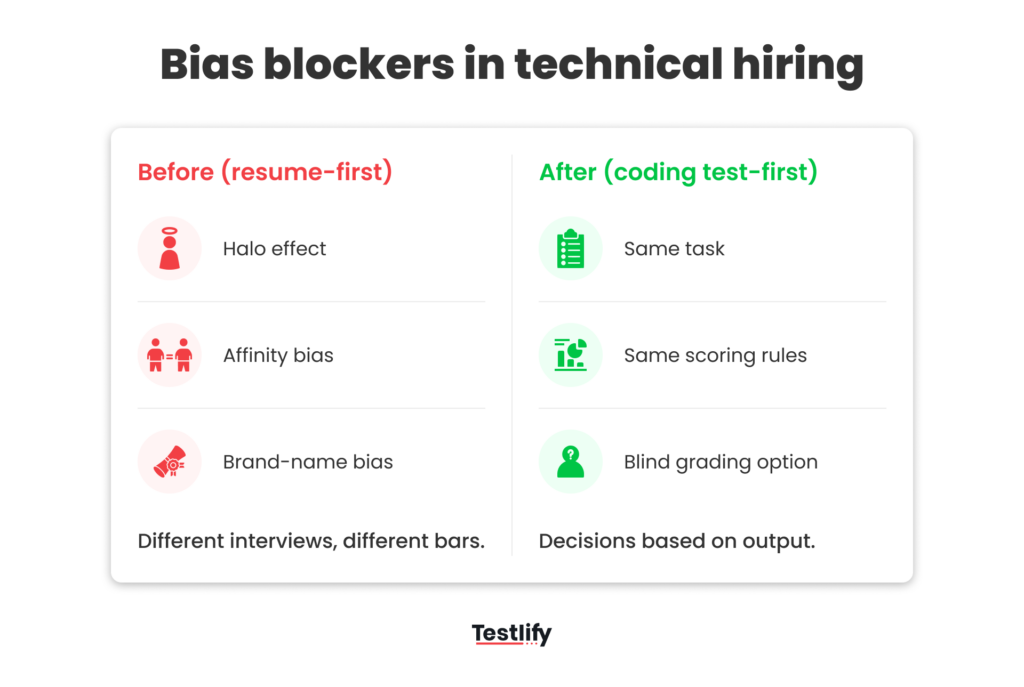
Recruiters can unintentionally fall for the halo effect. If a candidate has Google or Amazon on their resume, people often assume they’re strong. But if they’re self-taught or from a lesser-known college, they don’t always get the same benefit of the doubt.
Coding tests have always proved to be useful in these cases. A code editor doesn’t care where someone studied. It only reflects whether the solution works and how well it performs. That’s a win for recruiters and for genuine candidates who might otherwise get overlooked.
Programming tests also facilitate “Blind Hiring.” The evaluator can review the logic, approach, and output before seeing the candidate’s name, gender, or photo. That pushes decisions towards performance rather than background.
And compared to manual screening, tests bring consistency. In interviews, one candidate might get softer questions because the interviewer likes or knows them, while another gets grilled on hard topics. With a standardized assessment, everyone gets the same task and is scored on the same rules.
The result is a fairer process for candidates from non-traditional backgrounds, too. If someone can write clean, working code, they can move forward even if their resume doesn’t look “perfect.”
Role-based tests predict on-the-job performance better
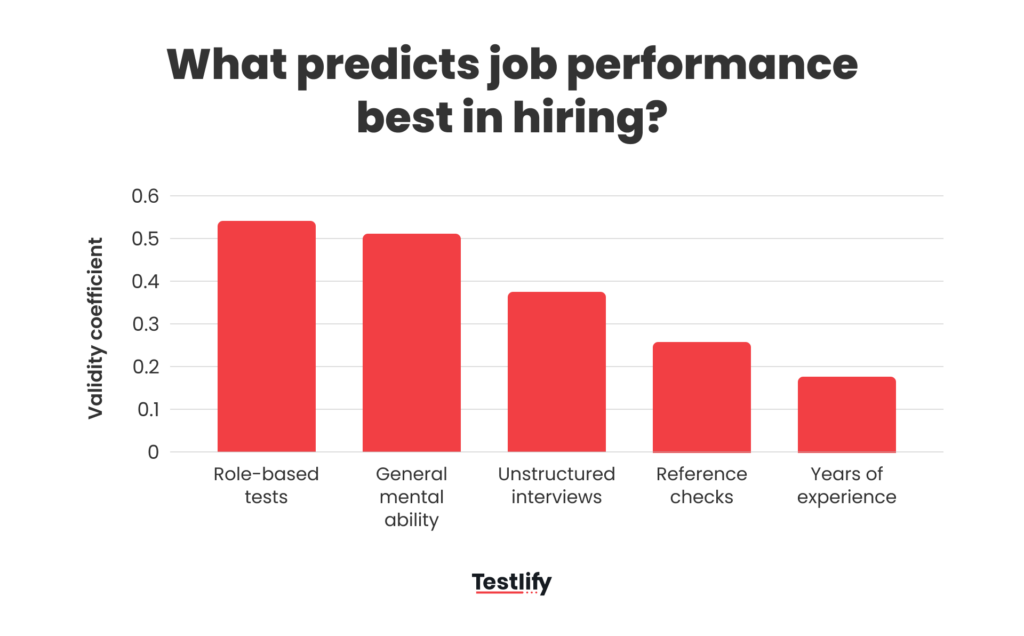
There’s good research behind this. A major meta-analysis on hiring methods (Schmidt & Hunter’s work, later updated by Schmidt & Oh) shows that work-sample tests (tests that mirror the actual job) are among the strongest predictors of future job performance. In their summary, work-sample tests show a validity of around 0.54.
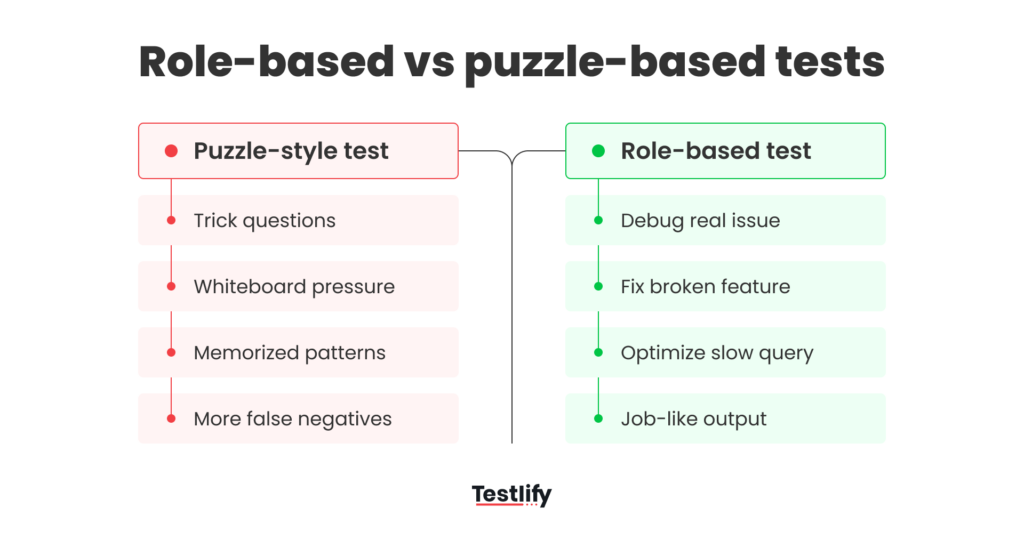
This is also why many companies moved away from brainteasers. Google was once known for puzzle-style questions, but later dropped them after internal data showed they didn’t predict job performance. Laszlo Bock (Google’s former SVP of People Operations) has spoken publicly about this shift.
The issue with puzzle-heavy interviews is simple: they often reward people who prepared for that format, not people who can actually build software day to day. That’s why many teams are now leaning towards more realistic assessments rather than “whiteboard-only” screening.
A role-based test fixes this by simulating real work. For example:
- Frontend: Instead of a puzzle, give a broken React component and ask them to fix a rendering/state issue.
- Backend: Instead of a random algorithm, give a slow SQL query and ask them to improve it, or debug an API bug.
Role-based tests usually check:
- Debugging and fixing real issues
- Code readability and maintainability
- Handling edge cases and constraints
- Practical problem-solving, not trick puzzles
This approach reduces false negatives, too, where strong developers get rejected just because they’re not great at puzzles. And overall, it gives a much clearer picture of how someone will perform once they’re actually on the job.
Online coding tests bring a uniform hiring standard
One of the biggest challenges in tech hiring is inconsistency. When different recruiters and interviewers are involved, the process can start to vary without anyone noticing. One person focuses on DSA, another focuses on frameworks. One interviewer is strict; the other is lenient. Over time, the “bar” becomes unclear.
Online coding tests help fix this by giving every candidate the same starting point. Everyone gets the same role-based task, the same time limit, and the same scoring criteria. That makes the first layer of evaluation far more consistent, especially when you’re hiring across multiple teams or locations.
This standardization becomes even more important in global and remote hiring. A candidate in Bangalore and a candidate in Berlin should be evaluated on the same baseline, not on two different interview styles. With a structured coding assessment, your shortlist is built on comparable signals, not on who happened to get which interviewer.
It also helps internally. When hiring managers review results, they’re looking at the same score reports and the same outputs. That makes hiring discussions faster and less opinion-driven.
They make it easier to hire remote talent
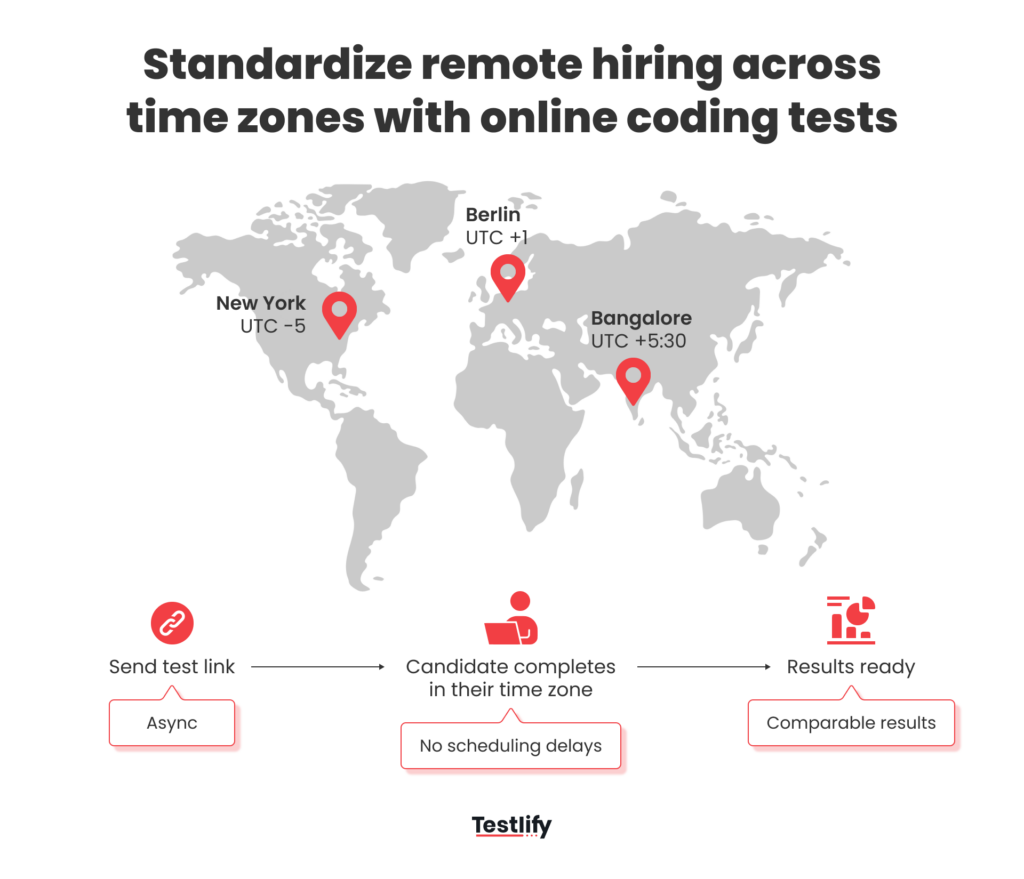
The biggest challenge for remote hiring is calendar coordination. Around 35% of recruiters’ time is spent on interview scheduling, making it one of the single most time‑consuming tasks in the hiring process.
To schedule a simple screening across different time zones, it takes recruiters days because of the back-and-forth scheduling. An online coding test removes that friction because it’s asynchronous. You share the link when it works for you. The candidate takes it when it works for them.
It also helps you tap into “dark” talent pools. Global candidates may not have familiar college names or brand-name companies on their resumes. With a coding test, you don’t need to guess the value of someone’s background. You’re looking at output: does the solution work, and does it match the role’s baseline?
And in a global market, speed is a real advantage. Good candidates don’t sit in pipelines for weeks. When you can move someone from “Applied” to “Interview-ready” quickly (because the first screen doesn’t depend on schedules), you’re more likely to stay ahead of competitors.
Good tests improve the candidate experience
Most developers don’t hate assessments. They hate bad assessments. If your test feels like random puzzles, takes 2–3 hours, or has unclear instructions, candidates drop-off or leave with a bad impression.
But a short, role-based coding test does the opposite. It shows you respect their time and you’re evaluating what actually matters for the job.
Good assessments are usually simple. They have three core elements:
- Clear instructions
- Realistic tasks
- A reasonable time limit.
Candidates know what they’re being judged on, and they feel it’s fair. Even people who don’t clear the round walk away thinking, “At least this process made sense.”
And that’s the branding part. A smooth, job-relevant test demonstrates that your hiring process is structured and thoughtful, making strong candidates more likely to stay in your pipeline.
Coding tests help you spot adaptability skills
A few years ago, much hiring was about syntax and speed. Today, tools like Copilot and ChatGPT can generate code in seconds. So the real question has changed: does the candidate understand what the code is doing, and can they take responsibility for it?
A good coding test can quickly surface that difference.
One strong approach is to include a “review & fix” task. Give candidates a working-looking solution (or an AI-generated snippet) with a subtle bug, a risky assumption, or a security issue, and ask them to spot it and correct it. This mimics real work now.
Research and surveys on GenAI use also highlight why critical review matters, since models can produce fluent but wrong outputs.
Some platforms are also starting to support AI-assisted assessments, where candidates can use an AI helper, and you evaluate how they use it. That’s useful because you’re not only measuring “time to solution”, but also the quality of the final output and the choices they made.
Finally, add one constraint-based question that forces first-principles thinking (like a limitation on libraries, time, or edge cases). Tools change every month, but the ability to reason under constraints stays relevant.
Recommended reading: Programming Tests: A Complete Guide for Recruiters
For further reading, explore Tips For Conducting Remote Programming Tests In Recruitment.
Final thoughts
Coding tests work best when they do one simple thing: show real job-ready skills early, without wasting anyone’s time.
Used well, they help you shortlist faster, reduce bias, run a consistent process across teams, and hire confidently even when candidates are remote.
The key is not “more testing”. It’s better testing:
- Keep it role-based (real tasks, not random puzzles)
- Keep it short and clear
- Score it with a simple rubric
- Use it as an early filter, then go deeper in interviews
If you’re hiring developers this quarter, start with one role-based coding test for your most common role (frontend, backend, or full-stack). Run it for the next 20 or 30 applicants and compare the quality of the shortlist and interview time. If you’re evaluating platforms, book a demo to see how a role-based test would fit into your workflow.
Frequently asked questions (FAQs)

Co-Founder and CTO
Jiten Modi is Testlify's CTO and leads a 50-person engineering organization. He writes on technical hiring, evaluating developers with real-world assessments, and building engineering teams.
LinkedInRelated resources
View all
Programming tests
Programming tests: A complete guide for recruiters

Programming tests
How to administer programming tests effectively

AI in recruitment
Best practices for hiring data analysts using assessments?

Candidate assessment
What tools support voice responses for language proficiency testing?

Candidate assessment
How do ATS-integrated assessments streamline hiring workflows?

Candidate assessment
How to assess financial modeling and accounting skills pre-hire?
Get started.
Hire on proof, not resumes.
Run your first skills-based assessment free — no credit card required.