
Programming tests: A complete guide for recruiters
Programming tests help recruiters see how developers actually code, think, and solve problems, instead of relying only on resumes or interviews.

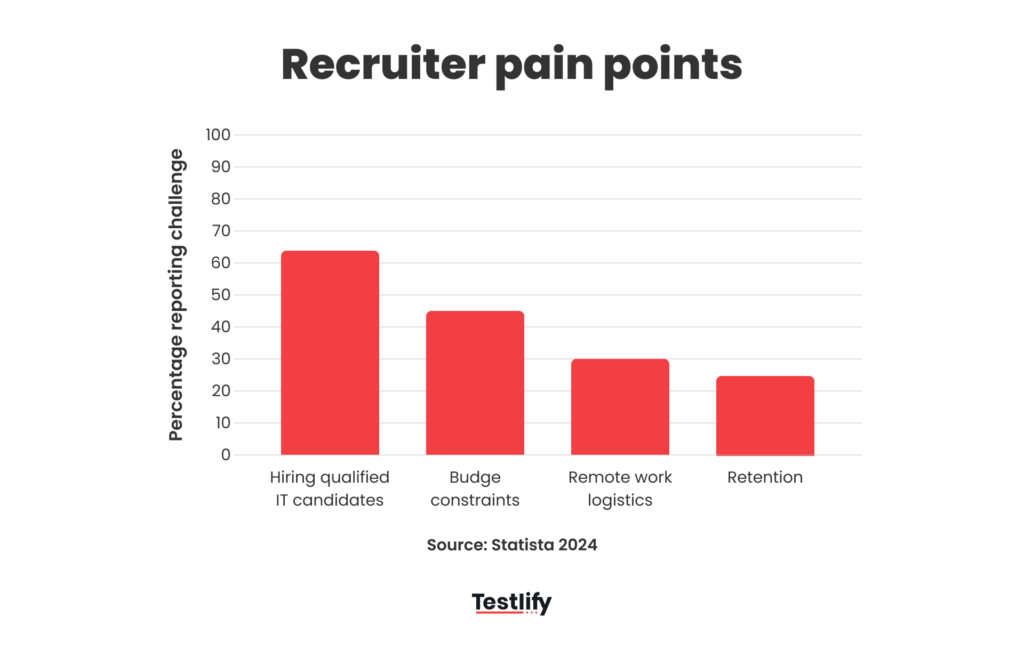
For hiring a developer, you can’t rely solely on resumes to verify skills. According to Statista in 2024, 64% of recruiters worldwide reported that hiring qualified candidates in the IT industry was their biggest hiring challenge.
Traditional recruiting methods often fall short because they don’t accurately reflect a candidate’s real coding ability. That’s why programming tests have become a very useful tool for recruiters for hiring developers.
 ChatGPT
 Gemini
 Claude
 Grok
Grok Perplexity
TL;DR – Key takeaways
- Resumes and interviews alone aren’t enough to judge real coding ability.
- Programming tests help objectively verify skills through real tasks.
- Different test types work better at different stages of the hiring process.
- Role-specific, real-world assessments lead to better hiring decisions.
- When used well, coding tests improve hiring quality without slowing the process.

What are programming tests?
Programming tests, or online coding tests, are evaluations used to assess programming skills, problem-solving logic, knowledge of DSA (data structures & algorithms), and other core competencies required of developers and programmers.
Resumes highlight the experience or claimed skills, while interview questions are often focused on communication and theoretical knowledge. Programming tests, however, allow recruiters to see how a candidate actually writes and structures code.
They reveal how a candidate approaches a problem and applies logic to solve it. Adding programming tests in your hiring workflow makes skill verification more objective and reliable.
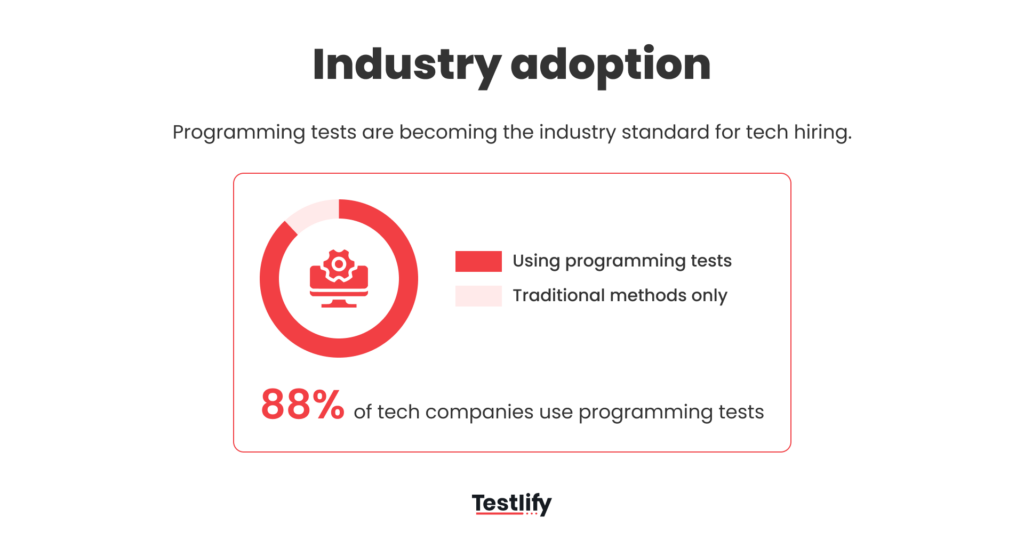
Programming tests act as a top-of-the-funnel filter for recruiters. Instead of relying on resumes, recruiters increasingly use coding assessments early in the hiring process. Around 88% of tech companies say they use programming tests, including role-relevant assessments such as coding challenges and technical tasks.
In a nutshell, programming tests help recruiters identify candidates who can perform on the job, not just talk about it. That’s why it’s becoming the core part of modern developer hiring.
Benefits of using online coding tests to hire developers
The real value of programming tests lies in the outcomes they deliver. Several direct benefits become clear once you start using them in your hiring workflow. Let’s explore them below.
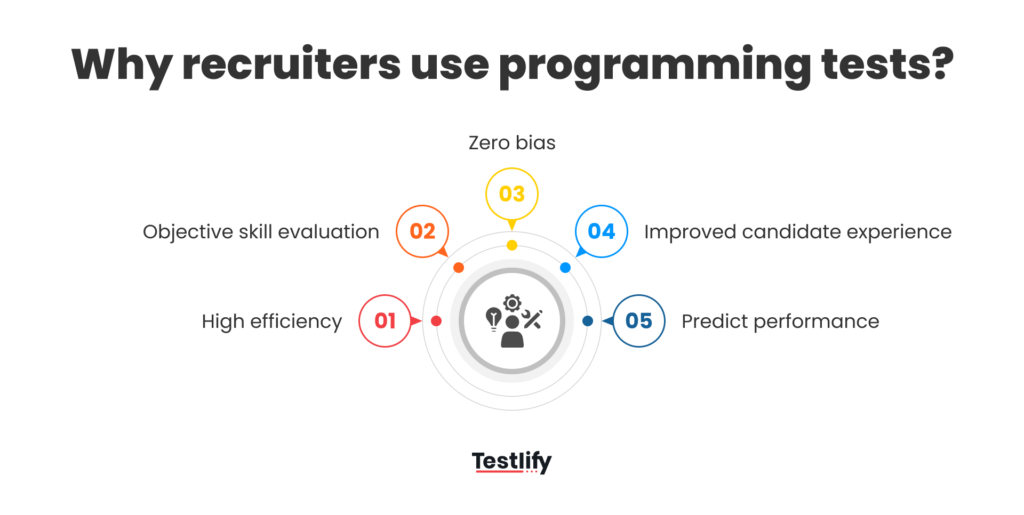
Objective skill verification
Traditional interview questions can be highly subjective and are often influenced by “vibe” or prestigious names on a CV. The programming test provides a standardized benchmark.
They allow recruiters to make data-driven decisions after getting a clear numerical score based on logic and performance. On top of that, this also creates a level playing field for candidates. As a result, a self-taught developer from a non-traditional background can demonstrate programming or coding skills that are just as strong as those of a computer science graduate.
Efficiency and scalability
A recruiter or a hiring manager often receives hundreds of applications for a single role. It takes a long time to review each application. Additionally, phone screening is time-consuming when done for each candidate.
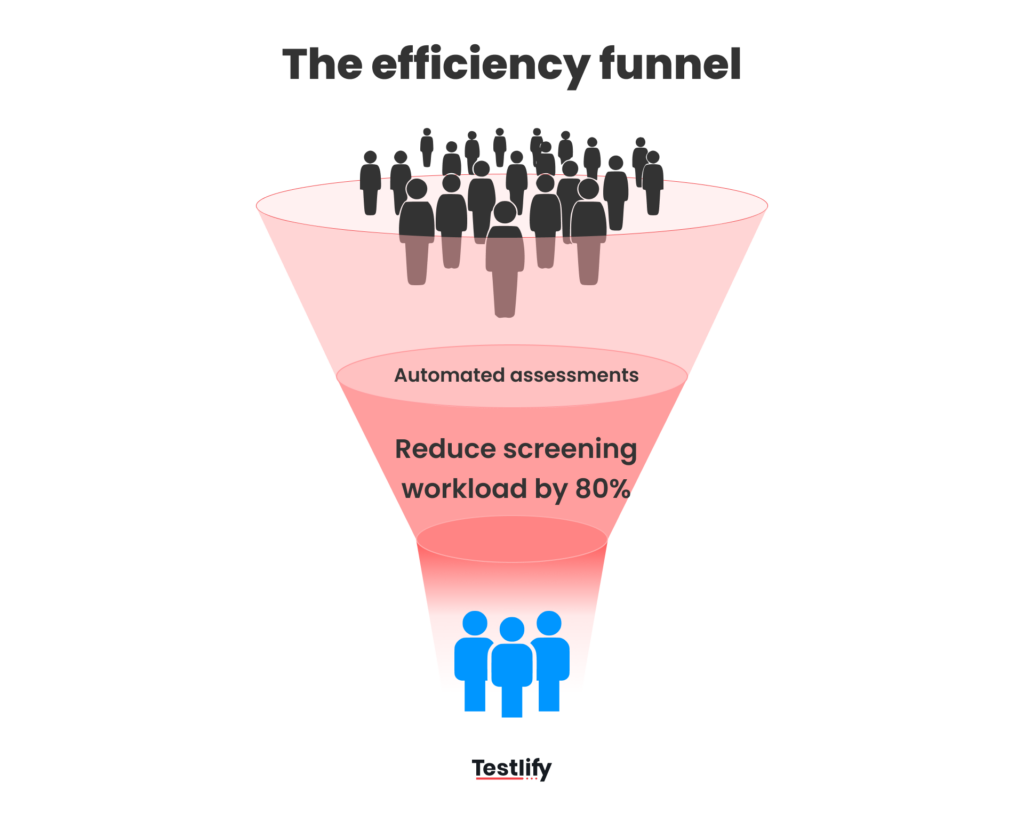
As discussed previously, automated tests at the very beginning of the hiring workflow can instantly filter out candidates who lack basic syntax or logical reasoning skills. This helps reduce the candidate pool by up to 80% before a recruiter or hiring manager even speaks to them.
One of the most important aspects of automated testing is that candidates can take the test on their own time, and recruiters can review results when it fits their schedule.
Also Read: How to analyze and interpret programming test results?
Predictive of on-the-job performance
Setting up well-designed coding assessments focusing on practical scenarios rather than abstract puzzles can simulate the actual work environment. Through this, recruiters learn about their debugging skills, which is a major part of a developer’s daily life. Recruiters can even check if a candidate writes maintainable, readable, and well-documented code.
Additionally, several candidates fall back on problem-solving under pressure during the process. IT basically reveals how a candidate breaks down complex requirements into smaller, logical steps.
Reduced hiring bias
Unconscious bias is a significant hurdle in tech. Online coding tests help mitigate this by focusing strictly on output.
Recruiters are now adapting blind grading. Blind grading is an evaluation method in which a candidate’s identity and background details are hidden during assessment, so decisions are based solely on performance rather than factors such as name, education, or past employer.
Improved candidate experience
Some developers dislike “LeetCode style” puzzles. Therefore, preferring structured assessments makes the process smoother and engaging for the candidates.
Through coding assessment, candidates feel they are being given a fair shot to demonstrate their expertise. Fairness is what gets delivered through coding assessments.
Know More: Why should recruiters use programming tests?
Types of programming tests used in hiring
While hiring developers, the correct type of test depends on the size of the applicant pool. You might be screening 500 applicants or making a final decision between two senior engineers. In each case, the approach should be different.
Understanding the different types of programming tests will help you choose the right one for each hiring scenario.
Automated screening tests
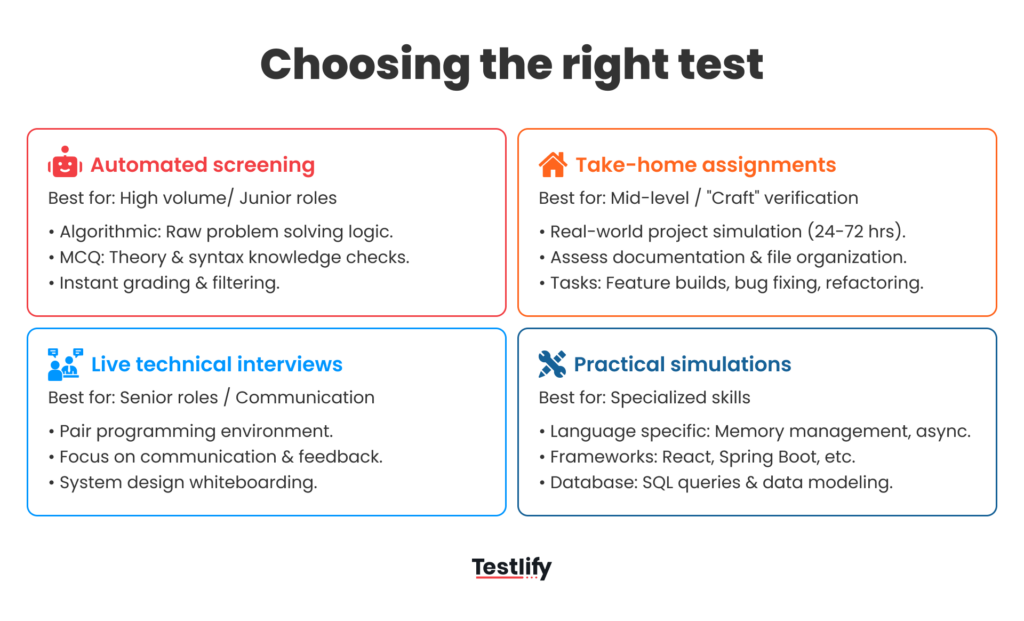
These tests are especially useful if you are hiring at scale. Here, recruiters can send a test link to candidates, and the platform automatically handles grading. There are two common subtypes of automated screening tests:
- Algorithmic/Data structure tests: These assessments require candidates to solve logic-based problems. This test is best suited for Junior roles or volume hiring. The goal of this test is to evaluate raw problem-solving ability.
- Multiple-choice (MCQ) & quiz tests: These tests assess theoretical knowledge of a specific programming language (e.g., “What is the output of this Python decorator?”) or framework. It is useful for quickly verifying that a candidate hasn’t just “keyword-stuffed” their resume.
Take-home assignments
In this approach, candidates are given a project or an assignment to complete in their own environment, usually within 24-72 hours. These assignments can include:
- Small feature build
- Bug fixing
- Refactoring
Hiring managers may ask a candidate to build a REST API or React App. Alternatively, they can provide a messy code base and ask the candidate to fix three or four specific bugs and improve the overall code structure.
The key benefit of take-home assignments is that they closely mimic real-world scenarios. They allow recruiters and hiring managers to evaluate how candidates organize files, write documentation, and handle errors and edge cases.
Live technical interviews
These tests take place in real time, with recruiters and candidates interacting through a shared coding environment. Many hiring teams are increasingly adopting a new approach known as pair programming. Here, the interviewer and candidate work together to solve a problem.
The focus is less on arriving at the “correct answer” and more on how the candidate communicates and accepts feedback.
Recruiters may also use whiteboarding, either virtual or in person. In these sessions, candidates are asked to explain high-level logic or System Design on a blank canvas. This type of programming test is best suited for senior roles, where architectural thinking and decision-making matter more than syntax.
Practical skill simulations
These are specialized tests designed to evaluate the skills a developer needs from day one in a role.
- Language-specific tests: These tests focus on deeper knowledge of programming languages, such as memory management in C or handling asynchronous operations in JavaScript.
- Framework-specific tests: These assess a candidate’s understanding of commonly used frameworks and tools, such as building applications using modern JavaScript frameworks or CSS libraries.
- Database and SQL tests: These tests focus on data modeling, writing efficient queries, and optimizing database performance.
Recommended: How to choose the right programming test for your hiring needs?
How to test coding skills effectively
To test coding skills effectively, you must move beyond “solving puzzles” and focus on simulating real job tasks. The blueprint below will help you build an effective technical assessment process:
Align the test with the role
One of the most common mistakes in technical hiring is using a one-size-fits-all test for every candidate. That’s not good practice.
For frontend roles, assess a candidate’s ability to build a UI component and ensure it is responsive. For the backend, focus on API design, database schema optimization, and error handling. For DevOps, evaluate skills related to automation, CI/CD pipelines, and security configurations.
Use “real-world” constraints
Provide tasks that mirror a typical Tuesday at your company. Instead of starting with a blank file, give them an existing codebase with a known bug. In real-world roles, developers spend far more time reading and understanding code than writing it from scratch.
Alternatively, you can give candidates a public API (like OpenWeather or GitHub) and ask them to fetch, filter, and display data.
Evaluate the “how,” not just the “what”
A candidate might get the code to run, but if it’s unreadable, it can become a problem in a team environment. That’s why it’s important to evaluate how the solution is written. Use a rubric to assess:
- Readability: Are variables named clearly?
- Maintainability: Is the logic modular or a mess?
- Edge case handling: Did they consider what happens if the input is null or the API times out?
Implement a multi-stage funnel
To balance efficiency with depth, use a tiered approach:
Stage | Method | Purpose | Time Limit |
|---|---|---|---|
Screening | Automated Quiz/Logic | Filter out non-coders quickly. | 20–30 mins |
Practical | Short Take-Home | See their coding style and “craft.” | 2–3 hours |
Discussion | Code Review Session | Understand their thought process. | 45 mins |
Prioritize the candidate experience
This is the most important aspect of hiring that cannot be ignored. If your test is too long or frustrating, the best candidates (who already have multiple offers) will drop out. To avoid drop-offs, you need to,
- Provide clear instructions: Explicitly state what you are looking for (e.g., “We value clean code over speed”).
- Respect their time: Never ask for a take-home project that takes more than 3-4 hours unless it’s the final stage.
- Give feedback: Even a brief automated summary of their performance can build your employer brand.
Pro Tip: To avoid losing top-tier talent, keep your initial screening tests short (under 60 minutes). Senior developers are often in high demand and may drop out of your process if asked for a 4-hour commitment too early.
Use the “code review” interview
The most effective way to see if someone can code is to review their work with them. Ask them to explain their solution to the take-home test. This reveals their coachability and technical depth better than any automated score.
Explore More: How to administer programming tests effectively?
Common mistakes recruiters make
In tech recruitment, small errors in the hiring funnel can result in the loss of hundreds of qualified candidates. Below are the most common mistakes recruiters make when hiring for technical roles:
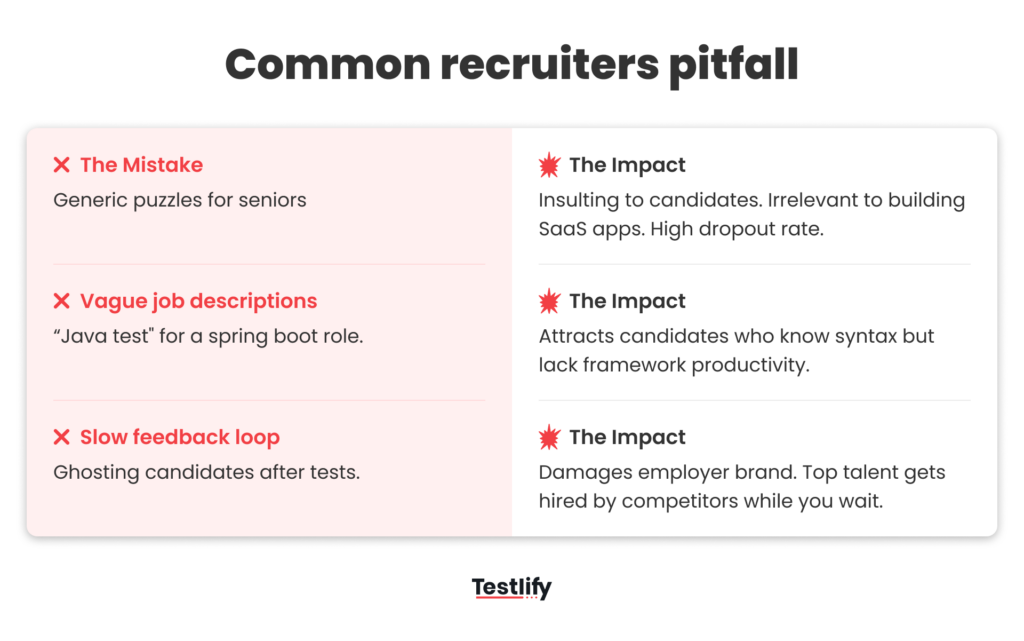
- Relying on puzzles for senior roles: One of the biggest mistakes is asking a developer with 10 years of experience to solve a textbook algorithm puzzle (like “Inverting a Binary Tree”) that has nothing to do with building scalable SaaS applications.
- Lack of role-specific context: Many recruiters use a generic “Java Test” for a backend role when the actual job involves specific frameworks (e.g., Spring Boot) or cloud infrastructure (e.g., AWS). This results in hiring candidates who know the language syntax but lack the practical framework knowledge to be productive on Day 1.
- Poor candidate experience: Candidates often submit a test and never hear back, or they receive a generic rejection email three weeks later. This results in negative reviews on Glassdoor and other review platforms. It’s not only bad for hiring, but it also damages your employer brand.
Final thoughts
Hiring developers becomes much simpler when you stop guessing and start validating skills early. Programming tests help you focus on how candidates actually think, code, and solve problems, long before interviews begin. If you’re serious about improving hiring quality without slowing things down, it’s worth getting this step right.
If you want to see how structured, role-relevant programming tests can fit into your hiring workflow without extra effort, you can book a demo with Testlify and explore it yourself.
Frequently asked questions (FAQs)

Co-Founder and CTO
Jiten Modi is Testlify's CTO and leads a 50-person engineering organization. He writes on technical hiring, evaluating developers with real-world assessments, and building engineering teams.
LinkedInRelated resources
View all
Programming tests
How to administer programming tests effectively

Programming tests
Why should recruiters use programming tests?

Skill assessment
What skills-based hiring data shows beyond the US and UK

HR & recruitment
AI across all stages of the hiring process in 2026

AI in recruitment
Best practices for hiring data analysts using assessments?

Candidate assessment
What tools support voice responses for language proficiency testing?
Get started.
Hire on proof, not resumes.
Run your first skills-based assessment free — no credit card required.