
65 key skills-based hiring statistics for 2026
Discover 65 key skill-based hiring statistics for 2025 and learn how this approach shapes the future of recruitment and talent acquisition.

Skills-based hiring is now the majority practice: 70% of employers report using it, up from 65% a year earlier, according to the National Association of Colleges and Employers' Job Outlook 2026 survey. But employer intent and actual job-posting behavior have started to pull apart, and that gap is the real story in this year's numbers.
Every figure below carries a named source and a year. That matters more than usual on this topic, because several of the most-shared skills-based hiring statistics trace back to vendor marketing rather than research, and a few of the biggest ones fall apart when you follow the link.
TL;DR
- Employer adoption crossed the two-thirds mark: 70% now use skills-based hiring, and 71% of those apply it at least half the time.
- The degree screen is loosening, not gone. Bachelor's-degree requirements on job postings actually ticked up in 2025, so stated policy is running ahead of posting behavior.
- Skills predict performance about five times better than education does, which is why the shift keeps going despite the wobble.
- Hiring is still hard: 72% of employers worldwide report difficulty filling roles, and AI skills are now the hardest to find.
- The assessment market is compounding at roughly 11% a year, so tooling is arriving faster than hiring processes are being redesigned to use it.
- Core skills keep moving, with 39% of them expected to change by 2030. A skills strategy is a standing function, not a project you finish.
 ChatGPT
 Gemini
 Claude
 Grok
Grok Perplexity
What is skills-based hiring?
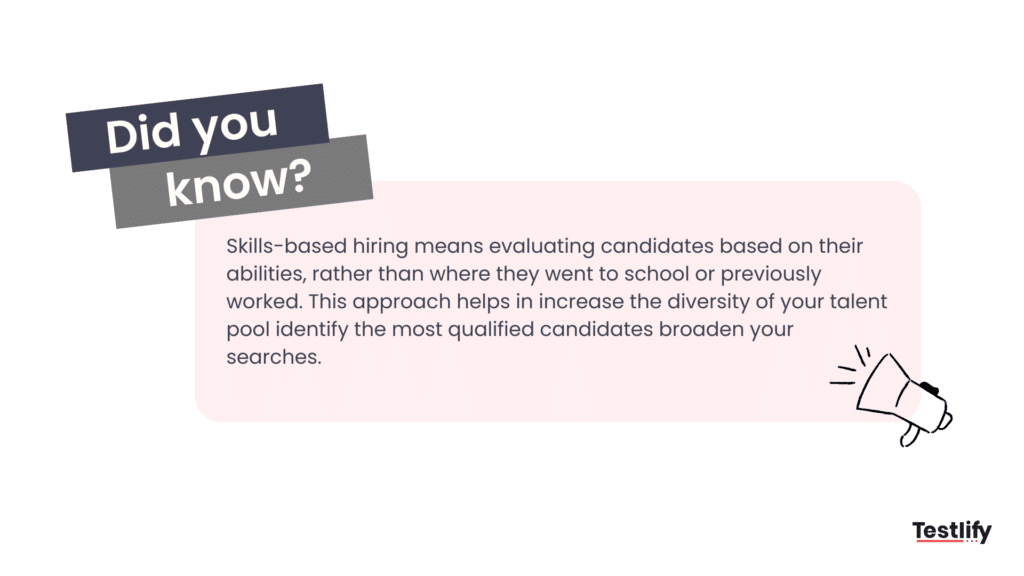
Skills-based hiring is a recruitment approach that evaluates what a candidate can actually do, measured through assessments, work samples, and structured interviews, instead of inferring ability from a degree or a job title. The test is evidence of capability, not proxy credentials.
That definition matters for reading every number on this page. Some surveys measure whether an employer says it hires for skills. Others measure whether job postings still demand a degree. Those are different questions, and in 2026 they give noticeably different answers.
The talent pool this opens up is not small. Opportunity@Work's STARs research counts over 70 million Americans who are Skilled Through Alternative Routes: workers with real, demonstrable capability and no bachelor's degree. A degree filter excludes all of them by default, whatever the job actually requires.
Related reading: why skills-based hiring matters.

Why is skills-based hiring on the rise?
Because it predicts performance better. McKinsey's research on building the future workforce found that hiring for skills is five times more predictive of job performance than hiring for education, and more than twice as predictive as hiring for work experience. That is a large gap, and it is the engine behind everything else here.
The adoption numbers follow the logic. Among employers in the Job Outlook 2026 survey, 70% report using skill-based hiring, up from 65% the year before. Of those using it, 71% apply it at least half the time, which means this has moved past pilot projects into standard operating procedure for most teams.
Where it gets applied is just as telling. Employers use skills-based methods most often during interviewing (87%) and screening (65%). The screen is where credential filters historically lived, so that second number is the one worth watching.
Meanwhile the credential filter itself has weakened. In 2019, nearly three-quarters of employers, 73%, screened candidates by GPA. Today just 42% do. That is a 31-point drop in seven years, and GPA was one of the last cheap proxies standing.
Workers want the change too. Deloitte's research on skills-based organizations found 66% of workers would be more drawn to, and more likely to stay at, an organization that makes decisions based on skills and potential rather than jobs and degrees.
Percentage of employers using skills-based hiring 2025
For the 2025 baseline: 65% of employers reported using skills-based hiring, the figure that 2026's 70% is measured against. Read those two together and the growth rate is about five percentage points a year, steady rather than explosive.
Steady is the honest description. Skills-based hiring gets written about as a clean break with the past, but the survey data shows a grind: a few points a year, concentrated in the interview and screening stages, with the hardest parts of the process changing last.
One warning about the numbers you will see quoted elsewhere. A widely circulated claim that 85% of employers use skills-based hiring comes from an assessment vendor's own marketing survey, not from independent research, and it sits 15 points above the best independent measure available. Check the origin before that figure reaches a board deck.
Metric | Figure | Source |
|---|---|---|
Employers using skills-based hiring (2026) | 70% | NACE Job Outlook 2026 |
Employers using it a year earlier (2025) | 65% | NACE Job Outlook 2026 |
Of users, those applying it at least half the time | 71% | NACE Job Outlook 2026 |
Applied during interviewing | 87% | NACE Job Outlook 2026 |
Applied during screening | 65% | NACE Job Outlook 2026 |
Screened candidates by GPA (2019) | 73% | NACE |
Screen candidates by GPA (today) | 42% | NACE |
Postings requiring a bachelor's degree (Nov 2025) | 19.3% | Indeed Hiring Lab |
Employers reporting difficulty filling roles (2026) | 72% | ManpowerGroup |
Core skills expected to change by 2030 | 39% | WEF Future of Jobs 2025 |
US workers skilled through alternative routes | 70M+ | Opportunity@Work |
What are the skills-based hiring trends for 2026?
The defining trend of 2026 is divergence. Employer intent keeps climbing while job postings quietly hold onto degree language, and anyone planning a hiring strategy off the headline adoption number alone will misread the market.
Indeed Hiring Lab's analysis of where degrees still matter found that as of November 2025, 19.3% of postings required a bachelor's degree or more. That is up from 17.6% in October 2024. Degree requirements did not keep falling. They bounced.
So both things are true at once. More employers say they hire for skills, and slightly more postings ask for a degree. The most likely explanation is a slacker labor market: when applications per role go up, a degree filter is the cheapest way to cut the pile, whatever the stated policy says. Skills-based hiring is winning on the merits and losing on convenience.
The wider picture is friendlier than that one reversal suggests. A little over half of postings, 51%, ask for no formal education requirement at all, and Lightcast and BCG's Competence over Credentials study found US degree requirements fell 3.9% between 2017 and 2022. The long trend is down. The last year is a wobble on top of it.
Pro tip: audit your own postings before you quote adoption statistics to your executive team. The gap between what a company says about skills and what its live job ads actually require is usually wider than anyone expects, and it is measurable in an afternoon.
Skills-based hiring in 2023: the baseline
2023 is the useful comparison point, because that is when degree requirements were falling fastest and optimism peaked. The Burning Glass Institute's Emerging Degree Reset projected that an additional 1.4 million jobs could open to workers without college degrees over five years as employers rewrote their requirements.
Set that against the 2025 reading and the shape of the shift becomes clear. The degree reset was real, and it was not permanent in every sector. Requirements came down, then came partly back where hiring got easier for employers. Anyone who declared the degree dead in 2023 was reading a trend line as a finish line.
Skills-based hiring resume best practices: statistics for 2025 and 2026
Resumes have not disappeared, they have changed job. Employers now read them for evidence rather than pedigree, and NACE's research on high-impact resume skills is specific about what that means: written communication, initiative, strong work ethic, and technical skills each matter to at least 70% of responding employers.
The practical finding is blunter. Listing a skill does not count. Employers want examples, the situation where the skill was used and what came of it. A resume naming ten competencies with nothing behind them performs worse than one that proves three.
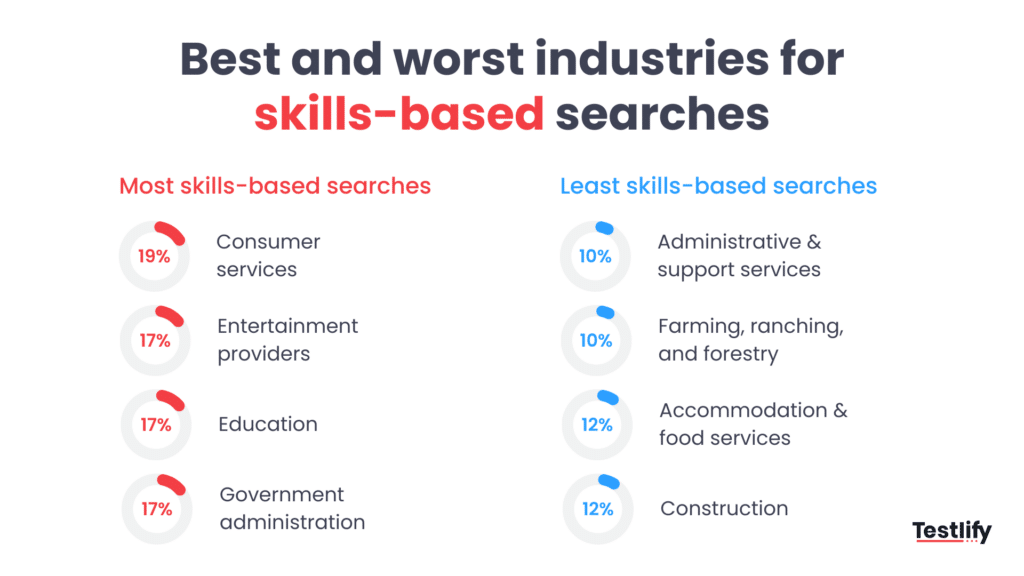
Which skills show up most depends on the role, and the spread is wide. Indeed Hiring Lab's analysis of skill sets in job postings, covering more than 3,000 individual skills across 47 categories, found business operations skills named in more than 70% of postings overall, rising to 97.7% for project management roles and falling to 24.1% for personal care and home health work.
For hiring teams the read-through runs in reverse: if resumes cannot carry proof reliably, the proof has to come from somewhere else in the process. That is the whole argument for testing early.
Does the policy match the practice?
Often not, and this is where most skills-based hiring programs quietly fail. Removing a degree requirement from a job description is a one-line edit. Changing who actually gets shortlisted requires new screening criteria, retrained recruiters, and a different definition of a qualified applicant.
Harvard Business School's Hidden Workers research put hard numbers on the mechanism. Fully 88% of employers agree that qualified, higher-skilled candidates get screened out because they do not match the exact criteria in the job description. More than 90% use a recruiting system to make that first cut, 94% for middle-skills roles and 92% for high-skills roles.
Read those two findings together and the problem is not really philosophical. Employers know the filter is rejecting people who could do the work. The filter runs anyway, because it is automated and nothing has replaced it. A skills strategy that does not change the first automated cut is a statement of values, not a hiring process.
The evidence base here is unusually solid, which is worth knowing when someone waves the trend away as hype. The Lightcast and BCG work analyzed more than 22 million job postings across five countries and as many as 265 distinct occupations, then traced 13 million worker profiles to compare how skills-based hires progressed against everyone else. That is a much heavier factual footing than the vendor surveys most of these statistics come from.
The structural pressure is real too. Deloitte found 81% of executives saying work is increasingly performed across functional boundaries, and 85% saying their organizations need more agile ways of organizing work to keep pace with market change. Rigid job architecture is failing on its own terms, separately from anything anyone believes about degrees.
How big is the candidate skills assessment market?
Polaris Market Research values the candidate skills assessment market at USD 3.18 billion in 2025, up from USD 2.86 billion in 2024, and projects USD 8.35 billion by 2034 at a compound annual growth rate of 11.3%.
Growth near 11% a year says something about where the constraint sits. Tools to measure skills are getting cheaper and more available faster than hiring processes are being redesigned to use them. Most organizations do not have an assessment problem in 2026. They have a workflow problem: the assessment exists, but it runs too late in the funnel to change who gets shortlisted.
Which talent statistics matter most in 2026?
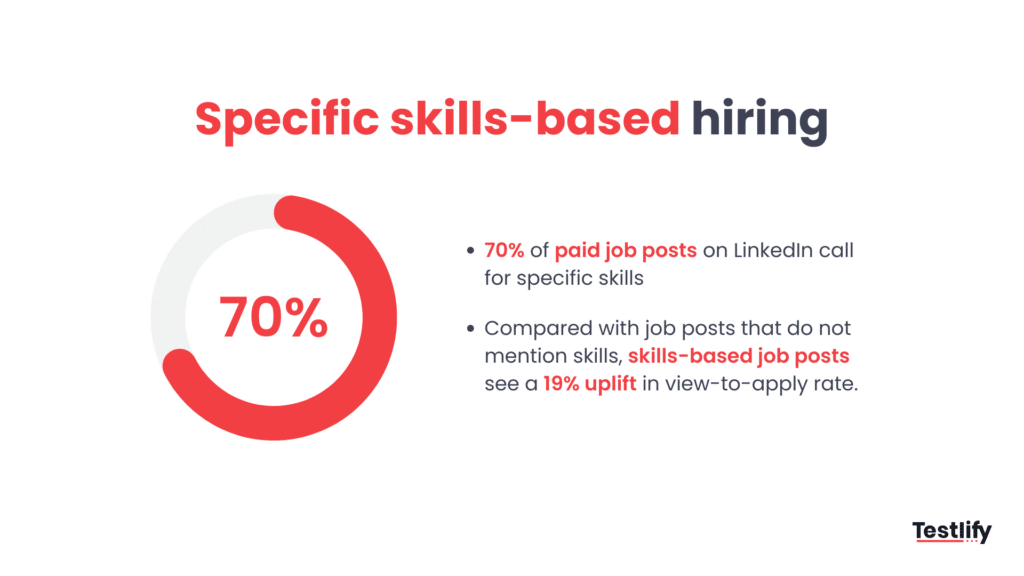
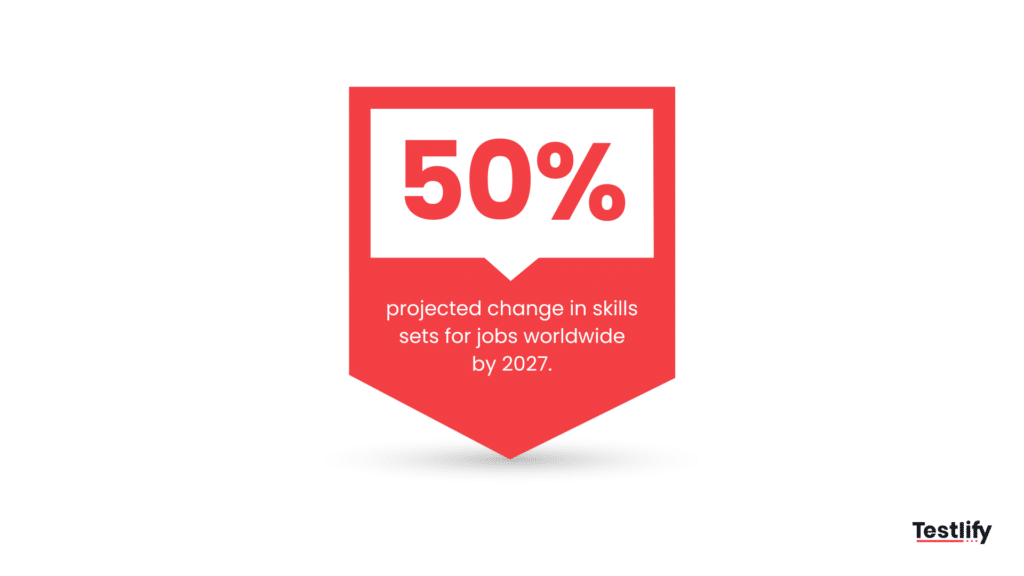
The single most useful talent statistic this year is that the target keeps moving. In the World Economic Forum's Future of Jobs 2025 skills outlook, employers expect 39% of workers' core skills to change by 2030, revised down from a 44% expectation in 2023.
That downward revision is not a sign that skills matter less. It reads more like employers getting better at estimating disruption after a few years of practice. The direction is unchanged: roughly two in five core skills are expected to look different by 2030.
The same report breaks the workforce into a useful shape. Per 100 workers, 41 will not need significant training, 29 need upskilling in their current roles, 19 need reskilling and redeployment, and 11 need training they are not expected to get. That last group is the one that should bother people. Put the middle three together and 59% of workers need some form of training by 2030.
Growth is not the problem either. The WEF projects 78 million net new jobs by 2030. The constraint is whether anyone can staff them.
Employers name the constraint themselves. In the same Future of Jobs research, 63% identify skills gaps in the labor market as the single biggest barrier to transforming their business. Not capital. Not demand. People who can do the work.
The day-to-day labor market backs that up. The US Bureau of Labor Statistics' Job Openings and Labor Turnover Survey put hires at 5.3 million and quits at 3.2 million, a quits rate of 2.0%, with separations at 5.4 million. Openings ran near 7.6 million earlier in 2026, a rate of 4.6%. Plenty of demand, modest movement: exactly the conditions where employers get pickier and credential filters creep back.
Layoffs and discharges stayed low, around 1.7 million in recent months, so this churn is not distress. It is a market where fewer people move voluntarily, which quietly raises the cost of a bad hire and the value of promoting from inside. Both of those reward measuring skills properly.
What do the numbers say about the talent shortage?
They say it is easing slightly and still severe. ManpowerGroup's 2026 Talent Shortage Survey, covering 39,063 employers across 41 countries, found 72% reporting difficulty filling roles. AI skills have overtaken engineering and IT as the hardest to find anywhere in the world.
The year before that, the 2025 survey put the figure at 76%, itself down from a record 80%. Three straight years of small improvements, from a very high base.
National figures vary more than the global average suggests. The same release reports shortages at 83% in Germany, 74% in France, 73% in the UK, and 69% in the US. A global talent strategy built on one worldwide number will be wrong in most of the markets it covers.
The forward projection is heavier. Korn Ferry's talent crunch analysis estimates more than 85 million jobs could go unfilled by 2030 for lack of skilled people, costing around USD 8.5 trillion in unrealized annual revenue. Its underlying study covered 20 economies across finance and business services, technology and media, and manufacturing.
Those forecasts deserve a caveat that rarely travels with them. They model demand against today's credential and training pipelines. Widen who counts as qualified and the shortage shrinks without a single extra graduate, which is the strongest practical argument for skills-based hiring that exists.
How does skills-based hiring affect who gets hired?
It widens the pool, mechanically. Drop a degree filter and 70 million STARs become visible, along with the 54% of college graduates who, per the Lightcast and BCG analysis, do not work in their original field of study anyway. The credential was never describing the work as precisely as it appeared to.
Public opinion has already moved. Pew Research Center's survey on whether college is worth it found just 25% of US adults say a four-year degree is extremely or very important for getting a well-paid job, while 40% say it is not too or not at all important. Nearly half, 49%, say a degree matters less now than it did twenty years ago.
The cost calculation is harsher still. In the same research, 47% said a four-year degree is worth the cost only if the student avoids loans, 22% said it is worth it with debt, and 29% said it is not worth it even without debt. When candidates and employers both discount the credential, keeping it as a hard filter is a choice, not a default.
Representation is the part where honesty is required. Skills-based methods remove one specific barrier, and that is worth doing. They do not fix a pipeline on their own: McKinsey's Women in the Workplace research found women still underrepresented at every level of the corporate pipeline for the eleventh consecutive year, holding 29% of C-suite roles. Screening changes who applies and who clears the first cut. Promotion and retention are separate machinery.
What does it cost to hire, and where does time go?
Enough that a better first cut pays for itself. SHRM's 2025 benchmarking research puts average cost per hire at USD 5,475 for non-executive roles, rising to USD 35,879 for executives. Time to fill runs around 44 days, with screening and interviewing each taking roughly 8 to 9 days of that.
Those two numbers explain why screening is the place where a change pays off most. A mis-hire costs a multiple of the 5,475 figure once you count ramp time and backfill. Meanwhile the screening stage, where a skills measure would do the most good, is only about a fifth of total time to fill. Small change, large downstream effect.
Priorities at the top have shifted to match. Gartner's survey of 426 CHROs across 23 industries, published as its 2026 CHRO priorities, puts AI value and workforce redesign at the top, with job architecture being rebuilt around skills rather than rigid roles. Its wider HR leader trend research points the same way.
Do skills-based hiring results hold up?
Mostly yes, with one caveat worth stating plainly. The predictive-validity finding is the strongest single result here: skills beat education by roughly five to one as a predictor of performance. That is the claim to lean on, and it does not need help.
The caveat is that many circulating benefit statistics, the dramatic retention and cost-per-hire numbers that get passed around without a named study behind them, do not survive a check. Several such figures were removed from this page rather than restated. A number with no traceable source is not evidence, however good it looks on a slide.
The organizational results that do have research behind them are real but more measured. Deloitte found skills-based organizations 79% more likely to provide a positive workforce experience and 63% more likely to achieve results, and its 2025 Global Human Capital Trends research found only 19% of executives think traditional work models are well suited to creating value.
What holds up is the mechanism. Structured evidence collected early, applied consistently to every candidate, produces better decisions than resume screening and unstructured interviews. That is what the Testlify Human+AI Evidence-Based Hiring Framework describes: AI-assisted evaluation combined with human judgment, using structured evidence instead of resumes, intuition, or inconsistent interviews. The decision stays with the hiring team.
Consider a hypothetical 500-person software company hiring 20 support engineers a quarter. Screening by degree filters against a credential that predicts performance about a fifth as well as a skills measure does, while competing for the same credentialed pool that every other degree-gated posting is chasing. Moving a short role-relevant assessment ahead of the first recruiter call changes which candidates reach a human, which is the only point in the funnel where a skills strategy actually bites. At a 44-day average time to fill, it also removes days rather than adding them.
Two related reads: the benefits of a skills-first approach and how assessments correlate with job performance.
Put the numbers to work
The gap between saying you hire for skills and actually doing it shows up in one place: whether a candidate's ability gets measured before someone decides who to talk to. Testlify runs role-relevant skills, cognitive, and behavioral assessments early enough in the funnel to change the shortlist rather than confirm it. Book a demo to see how an assessment fits ahead of your first screening call.
Key takeaways
- Adoption is real but incremental. Employer use rose from 65% to 70% in a year, roughly five points annually. Plan a multi-year transition rather than a switch you flip, and budget for the process work, not just the tooling.
- Stated policy runs ahead of posting behavior. Degree requirements on postings rose from 17.6% to 19.3% between late 2024 and late 2025 even as adoption climbed. Audit your live job ads before trusting your own adoption story.
- The validity case is the strongest argument you have. Skills predict performance five times better than education. When a skills program needs executive backing, that figure carries more weight than any efficiency claim.
- Screening is where the change bites. 87% of employers apply skills methods at interview but only 65% at screening, and more than 90% run an automated first cut. Anything applied after the shortlist is formed cannot change who made it.
- The shortage is a definition problem as much as a supply problem. 72% of employers cannot fill roles, while 70 million US workers are skilled through alternative routes. Widening who counts as qualified shrinks the gap without a single extra graduate.
- Tooling is outpacing process. The assessment market is compounding at 11.3% a year. For most teams the bottleneck is workflow design, not software availability.
- The target keeps moving. With 39% of core skills expected to change by 2030 and 59% of workers needing training, treat skills as a standing function with an owner and a refresh cycle.
- Sourcing discipline matters. Several widely shared skills-based hiring statistics trace to vendor marketing, including an 85% adoption claim that sits well above the best independent measure. Check the primary source before a number reaches a board deck.
FAQs

Related resources
View all
HR & recruitment
Employee poaching: Is it illegal, and how to prevent it

HR & recruitment
7 HR statutory compliance rules you must know

HR & recruitment
Employee Vetting: Steps, Checks, and Best Practices for 2026

HR & recruitment
Transferable Skills: Definition, Meaning & Examples

HR & recruitment
What is a returnship: Benefits and best practices

HR & recruitment
Graduate recruiting: Definition, process, and proven strategies
Get started.
Hire on proof, not resumes.
Run your first skills-based assessment free — no credit card required.