
Resume screening techniques: Manual vs ATS vs AI-assisted
Explore resume screening techniques, from manual review to ATS and AI-assisted screening, and see which method fits different hiring needs.

Resume screening is the step where a hiring team decides which applicants move forward, and in 2026 it runs three ways: a person reads the resume, an applicant tracking system filters it on rules, or an AI model reads it for meaning and scores the fit. Most teams now run some blend of all three.
The choice matters more than it used to. Application volume climbed, AI-written resumes arrived, and two sets of hiring rules (one in New York City, one across the EU) now put legal weight on how an automated screen makes its call. So the honest question is not "which resume screening technique is best", it's which one you can defend for a given role at a given volume.
 ChatGPT
 Gemini
 Claude
 Grok
Grok Perplexity
TL;DR
- Manual screening reads context well and does not scale. Use it on low-volume, high-stakes roles, and on the shortlist rather than the full inbox.
- An ATS filter is a rules engine, not a judge of ability. It is fast and consistent, and it silently drops good people who wrote their experience in different words.
- AI-assisted screening reads for meaning instead of exact keywords. One 2024 study put an automated screening pipeline at 11 times faster than manual review, and the tradeoff is that you now owe an explanation for the scores.
- Resumes are a weak signal about ability no matter who reads them. Skills evidence predicts job performance better than reviewing experience or education.
- If you already run an ATS, the fix is not to swap it out. Add a scoring layer that reads applicants from it and hands back a ranked, evidence-backed shortlist.

What is resume screening?
Resume screening is the process of reviewing job applications against role requirements to decide who advances. It happens before interviews, usually against a mix of must-have qualifications and nice-to-have signals. The output is a shortlist. The risk, at every volume, is that the screen rejects people who could do the job and advances people who wrote a better resume.
That last sentence is the whole problem in one line. A resume is a self-reported document. It shows what a candidate claims and how well they package it, which is a different thing from whether they can do the work. Every technique below is an attempt to get closer to ability without reading 900 documents by hand.
How does automated resume screening work?
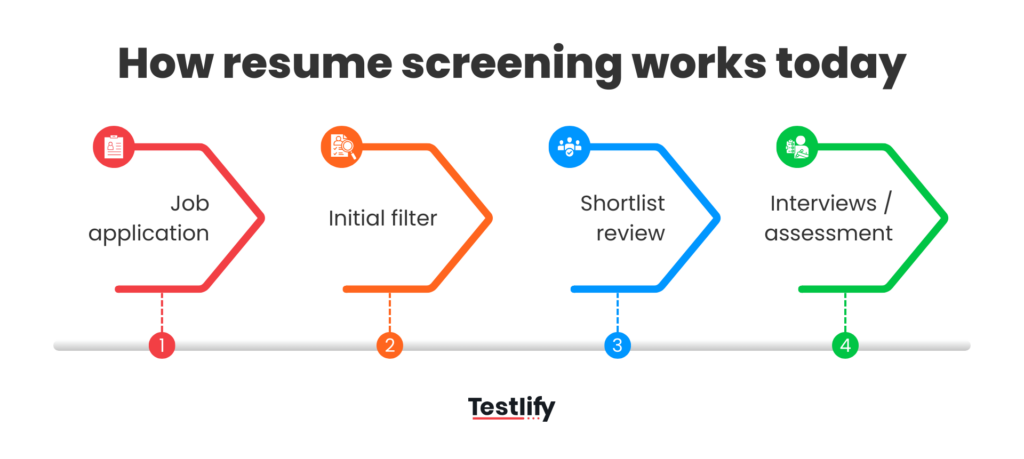
Automated resume screening parses each application into structured fields (skills, titles, dates, education, location), compares those fields against the job's criteria, and either filters or ranks the result. Rules-based systems match keywords and knockout questions. AI-based systems score semantic fit, so "built ETL pipelines" can match a requirement written as "data engineering experience".
The parsing step is where most of the damage happens. A two-column resume, a skills graphic, a date format the parser does not expect, and the record arrives half-empty. The screen then scores a corrupted version of the candidate, not the candidate. Teams that audit their own funnel usually find their worst rejections here, not in the scoring logic everyone argues about.
Pro Tip: before you tune any scoring model, pull 20 rejected applications at random and read them by hand. If more than two or three should have passed, your problem is parsing and criteria, and no amount of AI will fix it.
Where does manual resume screening still win?
Manual screening wins when context carries the decision. A career break with a good reason, a self-taught engineer with a strong portfolio, a candidate whose last title undersells what they actually ran: a human catches all three in seconds, and a keyword filter catches none of them. It also wins when the hire is rare enough that speed does not matter.
Where it falls apart is volume and consistency. Two recruiters reading the same 100 resumes will not produce the same shortlist, and neither will one recruiter on Monday morning and Thursday evening. That inconsistency is invisible, it never shows up in a report, and it is the reason "we screen manually" is not the neutral, safe default it sounds like.
Keep manual review for executive and specialist roles, for the final shortlist on every role, and for auditing whatever your automation did. Not for the first pass on a job that pulls 400 applications.
Resume checker vs ATS vs AI ATS: what is different?
These three get used interchangeably and they are not the same tool. A resume checker is candidate-facing software that scores a resume's formatting and keyword match before it is sent. An ATS is the employer's system of record for applications. An AI ATS adds model-based ranking on top of that record, so applicants arrive scored rather than merely stored.
Tool | Who uses it | What it actually does | What it cannot do |
|---|---|---|---|
Resume checker | The candidate | Scores formatting and keyword overlap against a job post | Nothing on the employer side; it never sees your criteria |
ATS | The employer | Stores applications, runs rules and knockout questions, tracks stages | Judge whether a candidate can do the work |
AI ATS or AI screening layer | The employer | Reads applications for meaning, ranks by job fit, explains the score | Replace the human decision, legally or practically |
The practical takeaway: candidates optimising against a resume checker and employers filtering with an ATS are playing the same keyword game from opposite sides. Neither side is measuring ability. That is why the two approaches keep producing shortlists that look right and interview badly.
AI resume ranking vs manual screening: what wins?
On speed and consistency, AI ranking wins and it is not close. A 2024 study in the Journal of Information Processing built an LLM-agent screening pipeline and reported it running 11 times faster than manual review, with 87.73% F1 on its resume classification step. On judgement, edge cases and accountability, the human still wins.
The interesting part is what AI ranking breaks that manual review did not have to worry about. Researchers analysing roughly 200,000 real resumes collected by a sourcing platform found that about 1% now carry hidden prompt injections, text planted to manipulate an AI reader, and more than 90% of those injections avoid explicit instructions, so a naive keyword scan for "ignore previous instructions" misses them. That is a 2026 USENIX Security finding, not a hypothetical.
So the answer is not one or the other. Rank with a model, decide with a person, and keep a record of both. Testlify's own AI scoring ships with that rule written into the product: "AI scores and insights are for guidance only. Use human judgment for final decisions."
Manual resume screening alternatives at scale
Once a role pulls more applications than a recruiter can read in a day, "screen harder" stops being a plan. The alternatives, in the order most teams should try them: tighten the criteria, add a short knockout or qualifier question set, add a skills assessment before the first call, then add AI ranking on what is left.
An enterprise alternative to manual resume screening inside an existing ATS
Most large teams already run an ATS and are not about to change it. The alternative that works there is a screening layer that reads applicants out of the ATS, scores them, and writes the result back, leaving the ATS as the system of record. Testlify's resume parser does exactly that: it pulls candidates from the connected ATS and can auto-advance them to the next ATS stage when they clear a cut-off score. Rejections stay inside Testlify and are not written back, which is a deliberate choice, because an automated rejection pushed into your system of record is the one action you cannot walk back.
Testlify's AI resume scoring is live with Greenhouse today and free while it is in beta, with other ATS connections available on request. The wider integration set runs past 100 ATS and HR tools, sold as an add-on on the self-serve plans. If you have no ATS at all, Testlify also ships a simple built-in hiring pipeline (job requisitions, an application form, job-board publishing, and applied to reviewed to shortlisted stages) so a small team can post, screen and track in one place.
Both paths run on the Testlify Human+AI Evidence-Based Hiring Framework: AI does the reading and the ranking, validated assessments supply evidence a resume cannot, and a person makes the call with that evidence in front of them. AI supports the process, humans make the decision, evidence improves confidence. On a screening workflow that means the model never auto-rejects, every score is reviewable, and the shortlist is defensible to a candidate who asks why.
Resume screening vs skills testing: which predicts better?
Skills testing predicts better, and the gap is not subtle. The CIPD's selection factsheet states that skills-based assessments are better predictors of on-the-job performance than traditional approaches such as reviewing job experience, education, or unstructured interviews. The same source is blunt about the limit: test results should never be the sole basis for a selection decision.
There is a structural reason resumes lose. A resume is written to pass a screen; an assessment is taken under the same conditions by every applicant. One is a marketing document, the other is a work sample. When the World Economic Forum's Future of Jobs Report 2025 reports that 39% of workers' core skills will change by 2030 and 63% of employers name skills gaps as the main barrier to transformation, a screening method anchored to past job titles gets less useful every year.
The workable order for a high-volume role: parse and rank on the resume to cut the pile, then put a short role-relevant assessment in front of everyone who survives. The resume decides who gets measured. The assessment decides who gets interviewed. That sequence is also how candidate screening methods hold up under an audit, because the deciding signal is the one every applicant produced under identical conditions.
Manual vs ATS vs AI resume screening techniques
Dimension | Manual | ATS rules | AI-assisted |
|---|---|---|---|
Best volume | Under 50 applications | Any volume, simple criteria | High volume, fuzzy criteria |
Speed per 100 resumes | Hours | Seconds | Minutes |
Consistency | Low, varies by reviewer and by hour | High, but only on what the rule says | High, and it drifts if the model or prompt changes |
Catches equivalent wording | Yes | No | Yes |
Explains its decision | Sometimes, if notes were kept | Yes, the rule is the reason | Yes, if the tool surfaces the reasoning |
Main failure | Fatigue, inconsistency, unconscious bias | Rejects qualified people on vocabulary | Parsing errors and manipulated resume text |
Regulatory exposure | Standard employment law | Low, rules are auditable | High, bias audit and disclosure duties may apply |
Read the last row twice. Most teams pick a screening technique on speed and discover the compliance column later.
Which resume screening mistakes cost you good hires?
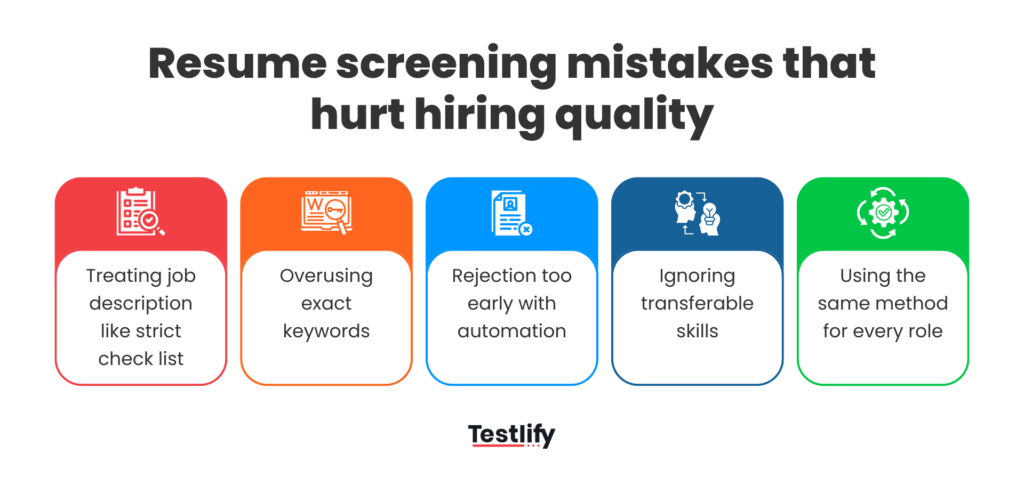
- Screening for the job description instead of the job. Requirements lists get copied forward for years. If nobody in the team can say why a requirement is on the list, it is filtering people out for no reason.
- Treating a keyword match as a skill. "Python" on a resume and Python in production are different claims. Only one of them can be checked before an interview.
- Never reading your own rejections. A screen that no one audits will drift for months without anyone noticing.
- Letting a model auto-reject. Ranking is a suggestion. Rejection is a decision, and it should have a person's name on it.
- Ignoring parsing quality. Half the "bad applicants" in a typical funnel are well-qualified people whose resume format broke the parser.
None of these are exotic. They are the ordinary failure modes of a process that gets judged on time-to-shortlist and never on shortlist quality. If you want a fuller walk through the fixes, screening candidates effectively covers the process end to end, and what every recruiter should know about resume screening goes deeper on the day-to-day mechanics.
What do the 2026 AI hiring rules require?
Two rules now shape automated screening. In New York City, Local Law 144 requires an independent annual bias audit of an automated employment decision tool, a public summary of that audit, and at least 10 business days' notice to candidates before the tool is used on them. Penalties start at $500 for a first violation and run to $1,500 a day for continuing ones.
In the EU, the AI Act classifies recruitment systems that filter applications or evaluate candidates as high risk under Annex III, with obligations for risk management, logging and human oversight applying from 2 August 2026. A system that only stores applications and sends templated email is not caught. The moment it ranks, scores or filters people, it is.
Both rules point the same direction, and it is a direction good hiring practice was already heading: keep records, keep a human in the loop, and be able to explain a rejection. If your screening stack cannot produce the reasoning behind a score, that is now a legal problem as well as a quality one. It is also worth thinking through whether AI actually replaces recruiters, because the regulations answer that question for you: it does not.
Screen on evidence, not keyword luck
Pick the technique that matches your volume, then put real evidence behind the shortlist. Testlify's AI resume screener ranks applicants from your ATS on job fit, and role-based assessments measure what the resume only claims. Book a demo and bring a live role, so the screen can be tested against applications you have already rejected.
Key takeaways
- Match the technique to the volume, not to the trend. Manual review is the right call under about 50 applications because context decides those hires, and it is the wrong call at 400 because no reviewer stays consistent that long. Set the threshold where your team actually breaks, then automate above it.
- An ATS filter measures vocabulary, not ability. It rejects qualified people who described the same work in different words, and it does so silently. Audit a sample of rejections every quarter, because that failure never shows up in a hiring report.
- AI ranking buys speed and hands you an accountability bill. An automated pipeline can run 11 times faster than manual review, and it also inherits bias-audit duties, disclosure duties and a new attack surface. Budget for the review process, not just the tool.
- Resume text is now adversarial. About 1% of real resumes carry hidden prompt injections aimed at AI readers, and most avoid obvious instruction phrasing. Any model-based screen needs sanitised input and a human reading the top of the ranking.
- Skills evidence beats resume evidence. Skills-based assessments predict job performance better than reviewing experience or education, so the resume's job is to decide who gets assessed, not who gets hired.
- Keep the ATS, add the layer. Teams that already run a system of record get more from a scoring layer that reads out of it and writes results back than from any migration, and rejections should stay a human action inside the screening tool.
FAQs

B2B SaaS Content Writer
Rishav Kumar is a B2B SaaS content writer with 4 years of experience. He loves crafting engaging content. Always exploring fresh ideas, he's passionate about helping businesses grow through impactful writing.
LinkedInRelated resources
View all
Resume screening
Resume screening: What every recruiter should know in 2026

Resume screening
Benefits of AI resume screening & it’s drawbacks

HR & recruitment
How Do Employee Benefits Affect Total Employment Compensation?

Workplace culture
Participative Leadership: Meaning, Types, Pros and Cons

Talent assessment
What Is Talent Benchmarking? A 2026 Guide for Hiring Teams

Technical assessments
Coding Interview: How to Run One That Tests Real Skill
Get started.
Hire on proof, not resumes.
Run your first skills-based assessment free — no credit card required.