
Benefits of AI resume screening & it’s drawbacks
Learn the benefits of AI resume screening, its risks, and how it fits beside manual and ATS-based resume screening.

AI resume screening reads inbound applications, pulls out skills and experience, and scores them against the job description so a recruiter can start at the top of the pile instead of the whole pile. It saves real hours. It also rejects people it should not, and the research on that is uncomfortable reading.
Both things are true at once, and most write-ups pick one. This guide covers what the technology actually does, where the time savings are real, where the failure modes are, how it differs from the keyword filters already sitting in your applicant tracking system, and what a candidate should do when asked to consent to it.
 ChatGPT
 Gemini
 Claude
 Grok
Grok Perplexity
TL;DR
- AI resume screening scores and ranks applications against a role so the first pass stops being a manual read of every file.
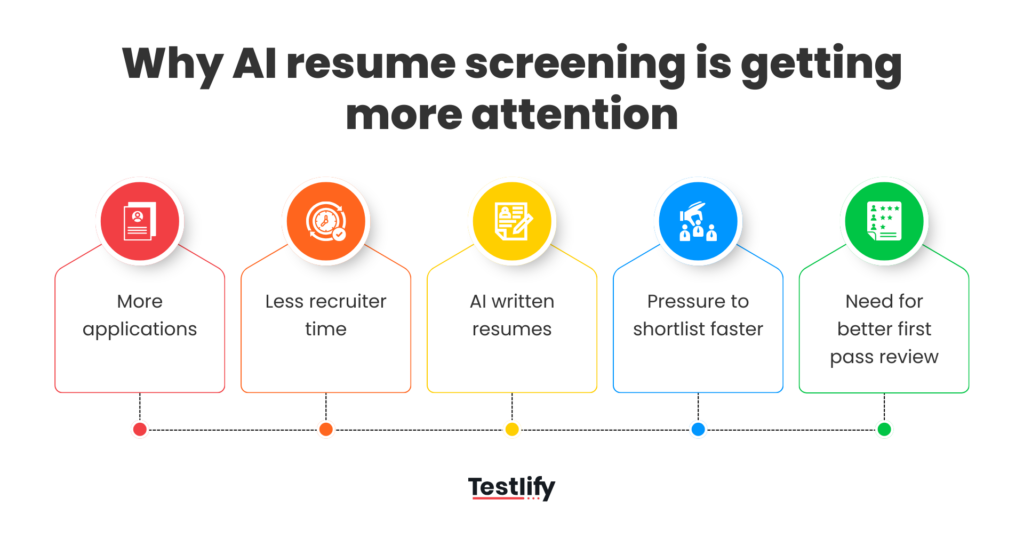
- The speed gain is real and it matters most when volume is the bottleneck. Greenhouse puts application volume per role at nearly 3x its 2021 level.
- The accuracy gain is not automatic. A University of Washington study found leading models favored white-associated names 85% of the time against 9% for Black-associated names.
- A resume is weak evidence either way. Ranking weak evidence faster produces a faster shortlist, not a better one.
- Use it to order the queue and cut obvious mismatches, then decide with something that actually measures the job.

What is AI resume screening?
AI resume screening is software that reads each application, turns it into structured data (skills, titles, tenure, education, tools), compares that data against the requirements of a role, and returns a score or a rank. A recruiter still decides who moves forward. The software decides what order they look in.
That last sentence is the whole distinction, and it gets lost constantly. Screening software does not hire anyone. It changes which twelve applications a recruiter reads properly on a Tuesday afternoon, out of four hundred. That is a lot of influence for something most teams never audit.
How does AI resume screening work?
Most tools run the same five stages. The differences between vendors live in stage three and stage four, not in the pipeline shape.
- Parsing. The file (PDF, DOCX, sometimes a scan) is converted into fields. Name, contact, roles held, dates, education, skills, certifications. Bad parsing here poisons everything downstream, and it is still the most common cause of a qualified person scoring zero.
- Normalizing. Job titles and skills get mapped to a shared vocabulary so "RN", "Registered Nurse" and "Staff Nurse, Ward 4" are recognized as the same thing. Vendors with a thin skills ontology fall over on regional and industry-specific titles.
- Matching. The parsed profile is compared against the role. Older systems count keyword hits. Newer ones use embeddings, which means "built dashboards in Looker" can register as business intelligence experience even though neither phrase appears in the job description.
- Scoring. The match becomes a number, usually weighted by whatever the hiring team marked as required against nice-to-have.
- Ranking and routing. Candidates are ordered, and often auto-advanced or auto-rejected against a cut-off the team sets.
Stage five is where the governance questions live. An auto-advance is low risk. An auto-reject, applied at a threshold nobody revisits, quietly becomes your hiring policy.
Worth walking through what that looks like. Take an illustrative case: a 90-person agency hiring two mid-level account managers gets 380 applications in eleven days. Screening ranks them, the team reads the top 40, and interviews 8. The queue shrank by 90%, which is the win everyone quotes. The part nobody checks is applications 41 to 380, where the two strongest hires from the last round of this same role would have landed if they had described their work the way they actually did, in client outcomes rather than in the job ad's vocabulary. Reading a sample from below the line is the only way to find that out, and it takes about an hour.
That check belongs in the process permanently, not just during a trial. Teams that treat screening as one input inside a structured hiring process catch these misses. Teams that treat the ranked list as the shortlist never see them, because a false negative leaves no trace anywhere in the funnel.
What are the benefits of AI resume screening?
It removes the part of screening nobody defends
First-pass resume review is the least skilled thing a recruiter does and the most time-consuming. Volume has made that worse: Greenhouse's 2025 Workforce and Hiring Report found recruiters now handle nearly three times as many applications per role as they did in 2021, and headcount did not triple to match. Something had to give, and for most teams it was depth of review per application.
Another reason is that candidates are now using AI too. More job seekers use AI to write or submit applications, which makes resume volume higher and first-pass screening harder to manage manually. As AI-written resumes become more common, knowing how resumatic compares with ChatGPT can help explain why some applications look more structured than others. That does not mean every applicant is stronger. It means more resumes look polished on the surface, so teams need better ways to sort relevance, skills, and fit at scale.
It makes the first pass consistent
A human reviewer at 9am and the same reviewer at 6pm are not the same reviewer. Software applies the same rule to application one and application four hundred. That is consistency, and it is worth having. Be precise about what it buys you, though: a consistent rule applied to everyone beats a random rule applied to everyone, and it still loses to a good rule. Consistency amplifies whatever logic you gave it.
It surfaces people a keyword filter buries
This is the genuine upgrade over the filters most teams already run. Semantic matching can connect adjacent experience to a requirement without an exact phrase match, so a candidate who describes the work rather than reciting the job ad has a chance of being seen. Career changers and people from smaller companies, who tend to write about outcomes instead of tool names, benefit most.
It buys back time for the work that predicts performance
Cutting the first pass from days to hours is only worth something if the reclaimed time goes somewhere useful. Teams that get value here spend it on structured interviews and work-sample evaluation. Teams that skip that step just move the same shortlist forward faster, then wonder why quality of hire never improved.
What are the drawbacks of AI resume screening?
Bias does not disappear, it scales
The most rigorous public evidence is not reassuring. University of Washington researchers Kyra Wilson and Aylin Caliskan tested three leading large language models against 550 real resumes and 120 names across nine occupations, more than 3 million comparisons in total. The models favored white-associated names 85% of the time against 9% for Black-associated names, and male-associated names 52% of the time against 11% for female-associated names. Black male-associated names were never preferred over white male-associated names.
A biased human reviewer harms the candidates they personally review. A biased model applies the same distortion to every applicant, every day, at whatever volume you feed it. That is the asymmetry that should decide how much weight you give the score.
A resume is thin evidence to begin with
Here is the objection that rarely gets made out loud. Resume screening is being automated, but nobody has established that resumes predict performance well enough to be worth automating. A resume records what someone was hired to do before, in their own words. Ranking that input more efficiently gets you a faster answer to a question that was already weak. The output is only as good as the signal, and the signal is a self-reported employment history.
Explainability is usually worse than the demo suggests
Ask a vendor why candidate 47 scored below the cut-off. If the answer is a bar chart of matched keywords, the system is simpler than the branding. If the answer is "the model weighted the combination", you have a problem the moment a candidate, a works council or a regulator asks the same question. NIST released its AI Risk Management Framework in January 2023 as a voluntary structure for exactly this, built around four functions: govern, map, measure and manage. The framework is voluntary. The obligation to explain a rejection, in a growing number of places, is not.
Candidates are optimizing against it faster than you are tuning it
Applicants now run their resumes through the same class of model before submitting. The result is a rising share of applications that are well structured, keyword-aligned and hard to tell apart on paper. Screening tools rank surface quality, and surface quality is the easiest thing in hiring to manufacture. The tools that hold up are the ones scoring evidence a candidate cannot generate in thirty seconds.
It can quietly damage candidate experience
Instant rejections, no stated reason, and no route to a human are the three complaints that turn a rejected applicant into someone who tells other people not to apply. Screening makes all three cheaper to do at volume. The fix is not complicated and almost nobody does it: state plainly that automated screening is used, give a realistic timeline, and keep one reachable human in the loop for queries. Candidate experience is the part of this that compounds, because the people you reject this quarter are the pipeline you source from next year.
AI resume screening vs ATS keyword filtering
These get treated as the same product and they are not. Most teams already own the second one, and the practical differences between manual, ATS and AI-assisted screening decide which stage of the funnel you should be fixing.
Dimension | ATS keyword filtering | AI resume screening |
|---|---|---|
How it matches | Exact or near-exact terms from the job ad | Semantic similarity, so related experience can match |
Output | A filtered subset, in or out | A ranked list with a score per candidate |
Handles unusual phrasing | Poorly, the term has to be present | Better, this is its main advantage |
Explainability | High, you can see the matched term | Varies a lot by vendor, ask before buying |
Main failure mode | Misses good people who used different words | Reproduces patterns in its training data at scale |
Audit burden | Low | Real, and in some jurisdictions a legal requirement |
Neither one measures whether the person can do the job. Both are sorting mechanisms for the queue in front of the stage that does.
Should I opt out of AI resume screening?
For most candidates, no. Where an opt-out exists it usually routes the application into a slower manual queue rather than removing it from consideration, and a slower queue is a worse queue when roles close in days. There is no general right to opt out, and declining rarely gets your file read more carefully.
The exception worth knowing is accessibility. If a screening or assessment step disadvantages someone because of a disability, requesting an adjustment is a different request from opting out, and it is the one with legal weight behind it in most jurisdictions.
What a candidate can actually control is the input. Describe the work in plain language, name the tools by their real names, and keep the formatting simple enough to parse. Multi-column layouts, text inside images and decorative tables are still the most reliable way to score zero for reasons that have nothing to do with ability.
For the employer reading this, the same question flips into an obligation. New York City's Local Law 144 requires an automated employment decision tool to have had a bias audit within the past year, requires the results to be published, and requires candidates to be notified at least 10 business days before the tool is used. Enforcement began on July 5, 2023. If your answer to "can a candidate opt out" is "nobody has asked", that is not a policy.
How do you choose an AI resume screening tool?
Buying criteria that survive contact with reality, roughly in the order they will bite you:
- Parsing accuracy on your actual files. Run 50 real applications through a trial, including the badly formatted ones. Vendor demo files are always clean.
- Score explainability. You should be able to show any candidate, or any auditor, why a score landed where it did. If that is not available in the product, it does not exist.
- Bias audit evidence. Ask for the most recent audit and who performed it. In New York City this is already mandatory and published, so there is a template for what a real answer looks like.
- Human override, on by default. Check whether reviewers can see the score, whether the score is included in any aggregate, and whether a human has to sign off before a rejection.
- Where the cut-off lives. Someone owns that number. Make sure it is a person, that it is written down, and that it gets reviewed.
- Integration depth. If it cannot read from and write to the system your recruiters already live in, adoption dies in month two.
- What happens to the people it rejects. Ask whether rejected candidates are notified, on what timeline, and whether anything is retained for the audit trail. This is the question that turns into a complaint later.
The UK Department for Science, Innovation and Technology published responsible AI in recruitment guidance in March 2024 aimed at exactly this procurement moment, written for a non-technical buyer. The questions it raises about assurance and bias belong in the evaluation, not in a review six months after go-live. The wider shift toward AI in recruitment has moved faster than most internal hiring policies, and procurement is the cheapest point at which to catch up.
One more criterion that rarely makes the list: decide in advance what the tool is allowed to decide. Ordering a queue, flagging a hard requirement that is genuinely binary (a license, a visa status, a shift pattern), and grouping similar profiles are all safe uses. Rejecting on a composite score is not, because a composite score is the one output nobody can reconstruct six months later when someone asks why. Write that boundary into the configuration rather than the training deck, because the configuration is what will still be true after the people who bought it have moved on.
Pro tip: before you shortlist a single vendor, take 30 rejected applications from a role you filled well and run them through the trial. If the person you eventually hired does not clear the cut-off, you have learned more in an afternoon than any reference call will tell you.
Screen on evidence, not keywords
The Testlify Human+AI Evidence-Based Hiring Framework is built around a straightforward split: AI supports the process, humans make the decision, and evidence improves confidence in both. Applied to screening, that means using AI to order the queue and cut clear mismatches, then deciding with a role-relevant skills assessment rather than with a better-sorted stack of resumes.
Testlify's AI resume screener scores inbound applications against role criteria in real time and can auto-advance candidates who clear the cut-off to the next stage in your applicant tracking system, which stays the system of record. It runs with the Greenhouse ATS integration today, with further ATS integrations available on request, and it is currently in beta and free to use. The product ships with an explicit disclaimer: AI scores and insights are for guidance only, use human judgment for final decisions. Displaying the AI score to reviewers, including it in the final average, and requiring manual review are all separate toggles, so a team can run scoring as advisory and keep every rejection human.
The assessments are the part that measures the job. Ready to see it on your own roles? Book a demo.
Key takeaways
- Speed is the benefit, not accuracy. Automating a first pass shortens a queue that has roughly tripled since 2021. It does not make the underlying evidence better, so treat the time saved as budget to spend on evaluation rather than as a quality improvement in itself.
- Bias scales with automation. The University of Washington results (85% against 9% by race, 52% against 11% by gender) are a property of models trained on historical text, not a vendor defect. Assume you have it, test for it on your own data, and keep a human in front of every rejection.
- Ranking weak evidence faster is still weak. A resume is a self-reported history. If it is the only input to your shortlist, better sorting will not fix a quality-of-hire problem.
- Explainability is a buying criterion, not a nice-to-have. If you cannot reconstruct why a candidate scored below the cut-off, you cannot defend the decision to that candidate or to a regulator.
- The cut-off is a policy decision. Whoever sets that threshold is setting hiring policy. Name the owner, write the number down, and review it on a schedule.
- Compliance is already live in places. NYC requires an annual published bias audit and 10 business days of candidate notice. Build the audit trail while the tool is being chosen, because retrofitting it after deployment is far more expensive.
Frequently asked questions (FAQs)

B2B SaaS Content Writer
Rishav Kumar is a B2B SaaS content writer with 4 years of experience. He loves crafting engaging content. Always exploring fresh ideas, he's passionate about helping businesses grow through impactful writing.
LinkedInRelated resources
View all
Resume screening
Resume screening techniques: Manual vs ATS vs AI-assisted
Resume screening
Resume screening: What every recruiter should know in 2026

HR Toolkit
Performance Evaluation Template: Free Form, Rating Scale and Examples

HR & recruitment
How Do Employee Benefits Affect Total Employment Compensation?

Workplace culture
Participative Leadership: Meaning, Types, Pros and Cons

Talent assessment
What Is Talent Benchmarking? A 2026 Guide for Hiring Teams
Get started.
Hire on proof, not resumes.
Run your first skills-based assessment free — no credit card required.