
Top qualities every talent leader should have in 2026
Discover the top qualities talent leaders must possess, from adaptability and communication to driving success and growth.

The best talent leaders share a short, learnable list of qualities: empathy, clear communication, adaptability, sound judgment, decisiveness, and a habit of coaching people toward their next role. What separates the strongest from the rest in 2026 is that they back these human skills with evidence, using structured assessments instead of gut feel to decide who to hire, promote, and develop.
That mix is getting rarer at the exact moment companies need it most. In DDI’s 2023 Global Leadership Forecast, only 40% of leaders rated their organization’s leadership quality as high, down from 48% two years earlier, the steepest drop in a decade. The cost of getting it wrong is huge: Gallup puts the annual price of low engagement, most of which traces back to managers, at $8.9 trillion, about 9% of global GDP. A strong talent leader is the cheapest fix for an expensive problem.
 ChatGPT
 Gemini
 Claude
 Grok
Grok Perplexity
TL;DR
- A talent leader finds, grows, and keeps the people a company needs to hit its goals, spanning hiring, development, and retention.
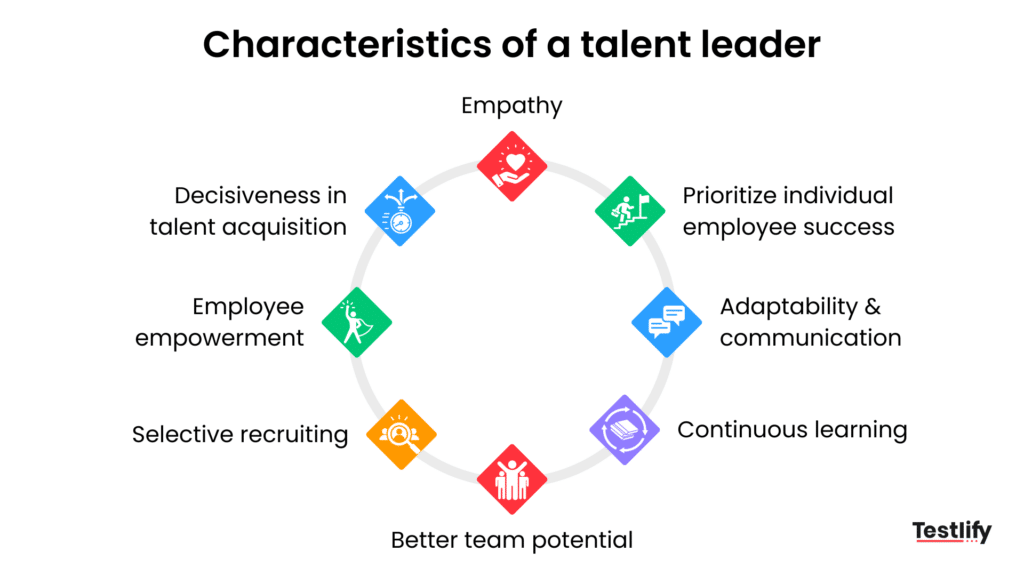
- Eight qualities define the good ones: focus on individual growth, adaptability, continuous learning, collaboration, selective hiring, trust in the team, decisiveness, and empathy.
- These are skills, not fixed traits, so you can build them with coaching and hire for them with structured assessments.
- Evidence beats instinct: talent leaders who assess candidates on real skills make faster, fairer calls and waste fewer hires.
- Developing people, not just recruiting them, is where the return shows up, in retention, promotion rates, and readiness for future roles.

What is a talent leader?
A talent leader is the person who owns how an organization finds, develops, and keeps its people. They make sure the right individuals sit in the right roles, spot high-potential employees early, and connect talent strategy to business goals. The title varies (Head of Talent, People Director, Chief People Officer), but the job is the same: turn hiring and development into a competitive edge.
Assessing leadership skills consistently is part of that job. Testlify’s leadership assessment gives a data-backed read on the skills that predict whether someone can lead, before you hand them a team.
What does a talent leader actually do?
A talent leader works across the full employee lifecycle, not just the hiring stage. Four responsibilities sit at the core of the role.
- Talent strategy: Build plans to attract, grow, and retain people so the company always has a ready pool of qualified candidates for the roles that matter next.
- Leadership development: Spot high-potential employees and give them the coaching and stretch assignments they need to be ready before a senior seat opens, rather than scrambling to fill it.
- A growth environment: Set the tone for coaching and mentoring so people feel backed to learn, take risks, and improve.
- Strategic alignment: Match talent decisions to where the business is going, which means knowing the skills and competencies the workforce will need next, not just today.
For a step-by-step start, see this guide on how to get started with talent management.
What qualities make a great talent leader?
Great talent leaders combine eight qualities: they prioritize individual growth, adapt and communicate clearly, keep learning, build collaboration, hire selectively, trust their teams, decide quickly, and lead with empathy. The table below shows what each looks like in practice and how you can measure it in a candidate or a current leader, so the trait becomes something you can hire and coach for, not just admire.
Quality | What it looks like | How to assess it |
|---|---|---|
Individual growth focus | Removes blockers so each person can do their best work | Coaching scenarios, direct-report feedback |
Adaptability and communication | Adjusts plans fast, keeps teams aligned on the why | Situational judgment tests, communication tasks |
Continuous learning | Grows their own skills and models it for the team | Learning agility measures |
Collaboration | Builds trust and shared goals across functions | Collaboration and teamwork assessments |
Selective hiring | Hires for culture add and future potential, not just skills on paper | Structured interviews, role-based tests |
Trust in the team | Delegates real ownership instead of micromanaging | Delegation and personality assessments |
Decisiveness | Moves quickly on strong candidates before they are gone | Decision-speed and judgment tests |
Empathy | Reads what people need and acts on it | Empathy and emotional-intelligence assessments |
Empathy that comes with action
Empathy tops the list because employees now expect it and notice when it is missing. In EY’s 2023 Empathy in Business Survey, 86% of employees said empathetic leadership lifts morale and 87% said it is key to an inclusive workplace. The catch from the same study: empathy reads as fake when it is not paired with action. Great talent leaders follow a hard conversation with a concrete change, so people trust that being heard leads somewhere.
You can screen for this trait rather than guess at it. Here is how to evaluate candidates with an empathy assessment.
Adaptability and continuous learning
The skills a role needs keep shifting. The World Economic Forum’s Future of Jobs Report 2025 found employers expect 39% of workers’ core skills to change by 2030, and it ranks leadership and social influence among the most in-demand skills of the period. A talent leader who keeps learning, and who builds a team culture where learning is normal, keeps the workforce ready for that shift instead of caught out by it.
Decisiveness backed by evidence
A slow hiring process loses strong candidates to faster competitors. Decisive talent leaders move quickly, but speed without evidence just means fast mistakes. The fix is to score candidates on the skills that matter before the first interview, so a quick yes rests on data, not a hunch. That is the core of the Testlify Human+AI Evidence-Based Hiring Framework, which pairs AI-assisted scoring with human judgment so leaders decide fast and stay right more often.
Testlify’s collaboration assessment is one example, giving a consistent read on how a candidate works with others across every person you consider.
How do talent leaders develop their people?
The strongest talent leaders grow people instead of only buying skills from outside. The payoff is measurable. McKinsey’s research on people development found the organizations that invest most in development deliver about 75 hours of training per employee a year, promote from within at higher rates, and hold on to their people about five percentage points better than peers. Three habits drive that result.
Make growth part of the day job
Learning that only happens at annual review time does not stick. Talent leaders build real paths, tying specific training to the next role a person could hold, so growth feels like progress rather than a checkbox. That is what keeps people who would otherwise leave to grow somewhere else.
Give feedback often, not once a year
Regular, specific feedback beats a single annual score. Talent leaders create short, frequent check-ins where people see what is working and adjust in weeks, not quarters. AI tools can help by flagging patterns and suggesting focus areas, but the coaching conversation stays human.
Develop for skills, not just tenure
Time served is a weak predictor of readiness. Talent leaders map people to opportunities by skill, using assessments to see what someone can actually do. Consider a 500-person software company that wants to fill team-lead roles from within: scoring interested engineers on leadership, collaboration, and communication surfaces two ready candidates the resume would have missed, and shows the rest exactly which skill to build next. That is skills-based hiring applied to internal growth.
The same evidence-first approach improves day-to-day satisfaction. Here is how to improve job satisfaction for your employees once you know what each person is working toward.
Pro Tip: Before you promote your next manager, run the same skills assessment you would use on an external hire. Internal candidates get judged on visibility and tenure, not evidence, which is how the wrong person ends up leading a team. A structured score on leadership, collaboration, and communication turns a political decision into a fair one, and gives the runner-up a clear development plan instead of a vague no.
Hire and promote talent leaders on evidence
Stop guessing whether someone can lead. Testlify’s leadership, collaboration, and communication assessments give you a consistent, comparable score for every candidate and every internal promotion, so your best people decisions rest on data. Start a free trial to build your first assessment in minutes, or book a demo to see how talent leaders use Testlify to hire and grow their teams.
Key Takeaways
- The qualities are learnable, so build them on purpose. Empathy, adaptability, and decisiveness are skills, not fixed personality traits. That matters because it means you can grow your own leaders with coaching and structured development instead of waiting to hire a rare finished product.
- Empathy only counts when it drives action. Employees expect it (86% say it lifts morale) but read it as hollow without follow-through. Pair every hard conversation with a concrete change so trust compounds instead of erodes.
- Decide fast, but decide on evidence. Speed loses candidates less often than a slow process does, yet quick calls made on gut feel produce expensive mis-hires. Scoring skills before the first interview lets you say yes quickly and be right more often.
- Developing people pays back more than poaching them. Organizations that invest in structured development retain staff about five points better and promote from within more often, which cuts the cost and risk of constant external hiring.
- Skills beat tenure for spotting readiness. Time in seat predicts little. Assessing what someone can actually do surfaces ready internal candidates a resume hides, and tells everyone else which skill to build next.
- Assess leaders the way you assess any hire. Use the same structured leadership and collaboration tests for internal promotions as for external candidates, so the decision rests on comparable evidence rather than visibility or politics.
What are the qualities of a good talent leader?
A good talent leader combines empathy, clear communication, adaptability, sound judgment, and decisiveness. They read what a team needs, adjust plans quickly, hire on evidence rather than gut feel, and coach people toward their next role. The strongest ones pair these human skills with data, using structured assessments to back every big people decision.
Is leadership a talent or a skill?
It is both. Some traits, like natural empathy or curiosity, come more easily to certain people, but the core of leadership is learned through practice, feedback, and coaching. Treating leadership as a skill matters, because it means you can build it deliberately with training and measurable development plans rather than waiting to find a born leader.
Who is a talent acquisition leader?
A talent acquisition leader owns the strategy for attracting, assessing, and hiring people. They align hiring with business goals, design the assessment and interview process, and manage the recruiting team. A talent leader is broader: acquisition is one part of a role that also covers development, mobility, and retention across the employee lifecycle.
What is the difference between a talent leader and a talent manager?
A talent leader sets direction: the strategy for how the company finds, grows, and keeps people. A talent manager runs the day to day of that strategy, coaching individuals, tracking performance, and guiding growth within their team. Leaders shape the system; managers make it work for the people in front of them.
What skills should you assess when hiring or promoting a talent leader?
Assess judgment, communication, empathy, and decision-making under pressure, plus the ability to read data and act on it. Structured assessments and work-sample exercises predict these far better than a resume or a single interview. Testlify’s leadership and collaboration tests give a consistent, comparable signal across every candidate you consider.

Related resources
View all
Talent assessment
What Is a Job Simulation? Types, Benefits & How to Create One (2026 Guide)

Talent assessment
How to build a hiring process with talent assessment tools

Talent assessment
Best Talent Assessment Software in 2026: How to Evaluate and Choose

Talent assessment
Top coding assessment software for recruiters

Talent assessment
The latest trends in technical assessments
Talent assessment
How to design and integrate technical assessments into recruiting processes
Get started.
Hire on proof, not resumes.
Run your first skills-based assessment free — no credit card required.