
10 benefits of skills testing for hiring teams in 2027
Ten ways skills tests help hiring teams hire faster and fairer, where they fit in the process, their limits, and how to prove they work.

A resume can say anything, but a skills test only shows what a candidate can actually do. Every recruiter has met the person who interviewed brilliantly and then struggled in week one.
The benefits of skills testing come down to one shift: you judge candidates on what they can do, not on what their resume says. The ten benefits below run from faster shortlists to fairer decisions and fewer mis-hires.
TL;DR:
- Skills testing shows what candidates can actually do, so you get fewer mis-hires, faster shortlists and a consistent yardstick for every applicant.
- In SHRM's Skills-First research, frequent skills-first hirers were more likely to exceed financial goals (35% vs 27%).
- Organisations using project-based assessments were more likely to report low turnover (46% vs 34%), per the same SHRM study.
- A skills-based approach expands talent pools by a median of 6.1 times globally and 15.9 times in the US (LinkedIn Economic Graph).
- Keep tests to 15 to 45 minutes and use two or three test types covering the skills that separate good performers from average.
- Test right after application for volume roles, and after a short recruiter screen for senior or niche roles.
- Map every question to the job, check pass rates by group and offer accommodations so tests stay legally defensible.
 ChatGPT
 Gemini
 Claude
 Grok
 Perplexity
What is skills testing in hiring?
Skills testing in hiring is the use of short, job-related tasks or questions to check whether a candidate can do the work before you interview them. A test might be a coding task, an Excel exercise, a customer email to write, or a set of workplace scenarios, scored the same way for everyone.
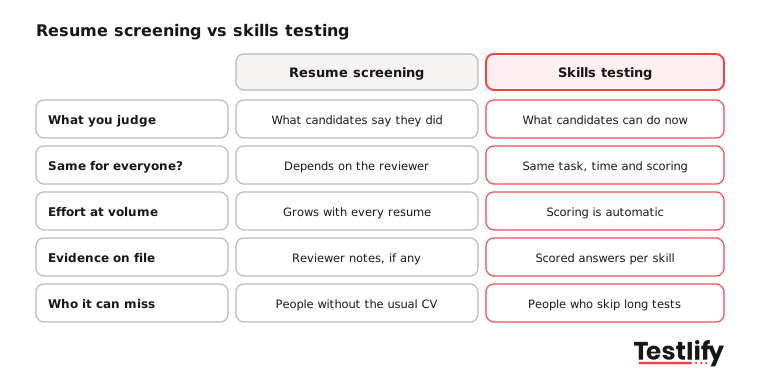
Skills tests are one part of the wider family of talent assessments, which also includes personality and culture measures. If you want the basics of formats, scoring and question types first, read our guide to skill tests.
This article focuses on what testing gives a hiring team in return for the effort.

What are the main benefits of skills testing?
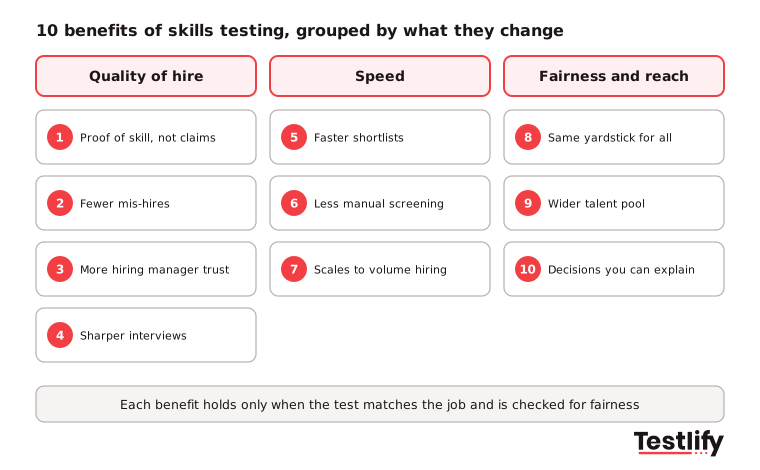
The main benefits of skills testing are proof of real ability, fewer mis-hires, faster shortlists, less manual screening, a consistent yardstick for every candidate, a wider talent pool, and hiring decisions you can explain. The ten benefits below are grouped by what they change: quality of hire, speed, and fairness.
The business case is now backed by broad survey data. In SHRM's Skills-First Movement research (survey fielded in October 2025), organisations that often or almost always use skills-first hiring were more likely to exceed their financial objectives (35% vs 27%).
The same SHRM study found that organisations using project-based assessments in hiring were more likely to report low turnover (46% vs 34%). Only 34% of organisations often or almost always use skills-first practices, and 29% of HR professionals name a lack of tools for assessing skills as a barrier.
1. Proof of skill, not claims
A resume tells you what a candidate says they did. A skills test shows you what they can do today, on a task that looks like the job.
For a support role, that might be replying to an angry customer. For a developer, it is fixing a bug in real code.
2. Fewer mis-hires
When the shortlist is built on demonstrated skill, fewer people reach the offer stage who cannot do the work. Every mis-hire costs a second search, lost output and manager time, so even a small drop in early exits pays for the testing.
3. More trust from hiring managers
Hiring managers often reject recruiter shortlists because they do not trust resume screening. A score report with the actual answers gives them evidence they can check, which cuts the back and forth between recruiter and manager.
4. Sharper interviews
Test results tell interviewers where to dig. Instead of generic questions, a structured interview can probe the exact areas where a candidate scored low, so the interview adds new information rather than repeating the screen.
5. Faster shortlists
Candidates take the test on their own time, and scoring is automatic, so a ranked shortlist is ready in days rather than weeks. That directly shortens time to hire, which matters when strong candidates hold two or three offers.
6. Less manual screening
Recruiters spend fewer hours reading resumes and running phone screens with people who are not a fit. That time moves to the work only people can do: selling the role, closing candidates and advising hiring managers.
7. Scales to volume hiring
Testing 50 applicants and testing 5,000 takes the same effort from the recruiter. For contact centres, retail, BPO and graduate programmes, skills testing is often the only practical way to look at every applicant instead of the first few hundred.
8. The same yardstick for everyone
Every candidate gets the same questions, the same time and the same scoring. That reduces the room for gut feel, school names or a familiar previous employer to decide who moves forward, and makes candidates easier to compare.
9. A wider talent pool
When you hire on skill, people without the usual degree or job title can prove themselves. LinkedIn's Economic Graph team reported in March 2025 that a skills-based approach expands talent pools by a median of 6.1 times globally and 15.9 times in the United States.
For the wider strategy, see the benefits of skills-based hiring.
10. Decisions you can explain
Every score is tied to a job-related task and stored with the candidate record. When a hiring manager, a rejected candidate or an auditor asks why someone was not selected, you can show the evidence instead of reconstructing a memory.
Key takeaway: Most benefits of skills testing compound. Faster shortlists free recruiter time, better evidence earns manager trust, and consistent scoring makes decisions easier to defend.
Who benefits from skills testing, and how?
Skills testing benefits five groups in different ways: recruiters save screening time, hiring managers get better shortlists, candidates get a fair chance to show ability, compliance teams get a consistent record, and leadership gets hiring data it can act on. The table shows what each group gains and what to report back to them.
Who | What they gain | What to show them |
|---|---|---|
Recruiters and TA ops | Fewer resumes to read, fewer phone screens | Hours saved per role, time to shortlist |
Hiring managers | Shortlists they trust, focused interviews | Interview to offer ratio |
Candidates | A fair chance to show ability, quick feedback | Completion rate, candidate survey score |
Compliance and legal | Job-related, consistent, documented decisions | Pass rates by group, test documentation |
HR leadership | Data on skill gaps across roles and locations | Quality of hire, 90-day retention |
Good candidate experience matters here too: a short, relevant test that explains why it is being used feels fairer to candidates than a silent resume rejection.
Which skills tests deliver which benefits?
Skills tests deliver different benefits depending on the type. Role and software tests prove job-ready skill, coding tasks verify technical claims, cognitive tests show how fast someone learns, and situational judgement tests reveal workplace decisions.
Most roles need two or three types, not all of them.
Test type | Best for | Main benefit it delivers |
|---|---|---|
Role-specific skills tests | Any role with clear tasks | Proof of job-ready skill |
Developers, data and QA roles | Verifies technical claims on the resume | |
Graduate and fast-learning roles | Shows reasoning and learning speed | |
Customer-facing and people roles | Shows how candidates handle real scenarios | |
Sales, support, office roles | Closest preview of actual job output | |
Language tests | Global and multilingual teams | Confirms working language level |
Personality and culture tests | Team fit, used alongside skills | Adds work-style context, not a pass or fail |
Pro tip: Start with the three to five skills that separate good performers from average ones in the role, then pick the fewest test types that cover them. Long batteries lose candidates without adding much signal.
Where in the hiring process does skills testing pay off most?
Skills testing pays off most right after the application for high-volume roles, and after a short recruiter screen for senior or niche roles. Early testing replaces resume screening when applicants number in the hundreds; later testing respects the time of scarce candidates you have already started to court.
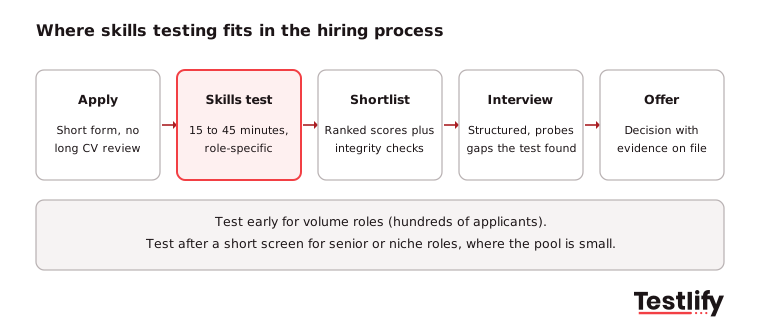
Keep the test between 15 and 45 minutes for most roles. Use a longer work sample only at a late stage, when candidates are invested and the pool is small.
What are the limits of skills testing?
The limits of skills testing are real: a test shows ability on the day, not motivation or long-term fit; a badly built test screens out good people; long tests raise drop-off; and AI tools make unproctored answers harder to trust. Each limit has a fix, and none removes the need for human judgement.
- A test is one data point: Combine scores with a structured interview and references instead of hiring on the score alone.
- Generic tests miss the job: A test that does not match the real work gives you precise scores that mean little. Build from the job description and review it with the hiring manager.
- Length costs candidates: Every extra 15 minutes loses some applicants, especially strong ones with other options.
- AI-assisted answers: Candidates can paste questions into AI tools. Proctoring, question randomisation and AI-assistance detection keep scores honest.
- Automated scoring has its own rules: If you use automated tools to score or rank candidates for jobs in New York City, Local Law 144 requires a bias audit within the year before use, a public summary of results and notice to candidates, as set out by the NYC Department of Consumer and Worker Protection.
How do you keep skills tests fair and legally defensible?
Skills tests stay fair and defensible when every question links to a real job requirement, every candidate gets the same conditions, pass rates are checked across groups, and candidates who need accommodations can ask for them. Document each decision so you can show why the test was used.
The US Equal Employment Opportunity Commission says a test "must be job-related and its results appropriate for the employer's purpose", and that the employer stays responsible even when a vendor built the test, per its guidance on employment tests and selection procedures. In practice that means four habits:
- Map every question to a skill in the job description, and keep that map on file.
- Check pass rates by group for adverse impact, and look for an equally effective alternative if one group passes far less often.
- Offer accommodations, such as extra time, and say how to request them in the invitation.
- Review tests when the job changes, so the test still measures what the role needs.
How do you measure the benefits of skills testing?
The benefits of skills testing are measured by comparing the same hiring metrics before and after you add the test, for the same roles. Track speed, quality, fairness and candidate experience together, so a gain in one area does not hide a loss in another.
Area | Metric | What good looks like |
|---|---|---|
Speed | Days from application to shortlist | Falls after testing starts |
Speed | Recruiter hours per hire | Falls, with fewer phone screens |
Quality | Interview to offer ratio | Rises, as fewer weak candidates reach interviews |
Quality | 90-day retention and manager rating | Holds or rises |
Fairness | Pass rates by group | No group far behind others |
Experience | Test completion rate | High and stable as tests get shorter |
Give it two or three hiring cycles before you judge, and compare like with like: one role family, one region, one season.
How does Testlify support skills testing?
Testlify supports skills testing with a library of 3,500+ tests for technical and non-technical roles, an AI test builder that turns a job description into a role-specific assessment, and automatic scoring with a ranked shortlist. Candidates can take tests in 15+ languages, and results sync to 100+ ATS and HRIS tools.
- Test library: role-specific, software, coding, cognitive, situational judgement, language and personality tests in the Testlify test library.
- Integrity: 20+ proctoring checks, including tab tracking, webcam snapshots and AI assistance detection, covered on the anti-cheating and proctoring page.
- Fit with your stack: two-way sync with ATS integrations such as Workday, Greenhouse, Lever and SmartRecruiters.
- Bias audit: a third-party NYC Local Law 144 bias audit of the Matching Model, completed in June 2023.
Ready to see the benefits of skills testing in your hiring?
Start a 7-day free trial with no credit card and build your first skills test today. Prefer a walkthrough? Book a demo to understand the full benefits of using Testlify to fill your open roles.
Frequently asked questions (FAQs)

Human Resources Lead
Snehi Parmar leads People at Testlify, owning hiring, culture, performance, and retention for a 90-person team. She writes on practical HR strategy and building people processes that scale.
Related resources
View all
Skill assessment
How to choose the right attention to detail test

Skill assessment
How to create an accurate computer literacy test

Skill assessment
Benefits of using computer literacy test for candidate evaluation

Skill assessment
The significance of NLP test in hiring decisions

Skill assessment
How to assess candidate skills with computer literacy test?

Skill assessment
Top language assessment tools for hiring in 2026
Get started.
Hire on proof, not resumes.
Run your first skills-based assessment free — no credit card required.