
How to create talent sourcing strategies in 6 easy steps?
Discover effective talent sourcing strategies for recruiters to proactively find and engage top talent, and build a talent pipeline.

Talent sourcing has become one of the most important components of modern recruitment. In a more competitive environment, recruiters are often left to find a needle in the haystack while searching for skilled candidates. But that might have been different with the right strategies; you streamline the process, improve the hire, and get only the best candidates.
In this blog, we will discuss everything you must to know about talent sourcing strategies and how to innovate so you stay caught up.
 ChatGPT
 Gemini
 Claude
 Grok
Grok Perplexity
What is talent sourcing?
Talent sourcing is finding and identifying potential candidates with the correct talent for a particular role.
In contrast to typical recruitment, which typically employs candidates who are applying for opportunities, talent sourcing reaches out to both, active and passive candidates.
Talent sourcing is building a talent pipeline of great candidates to which you can be connected, where you help them along and hopefully convert some of them into hires when needed.

Why talent sourcing is important for recruiters?
Talent sourcing is no longer a nice-to-have for recruiters but a must in modern recruitment. According to McKinsey & Company, organizations with strong talent pipelines are 2.5 times more likely to report that their recruitment efforts are effective. Here are some key reasons why:
1. Proactively find the best talent
The best candidates are not usually motivated to look for work. They are passive and open to new opportunities but are not actively looking for new employment. Talent sourcing enables recruiters to talk to people and set up contact before they even start considering a move.
2. Reduce time-to-hire
A strong talent pipeline enables you to accelerate your time-to-fill simultaneously because, rather than starting from a new blank slate every time a role opens up, you already have a pool of qualified candidates with whom you can engage.
3. Improve the quality of hires
Focus on building and developing relationships with the best talent, thus making better hiring decisions. Sourcing helps reach out to candidates who probably would not have applied otherwise, thus giving you a more elite pool of talent.
How to build a talent sourcing strategy
To develop a good talent sourcing strategy, you must balance traditional and innovative approaches. We’ll break this down to the core steps.
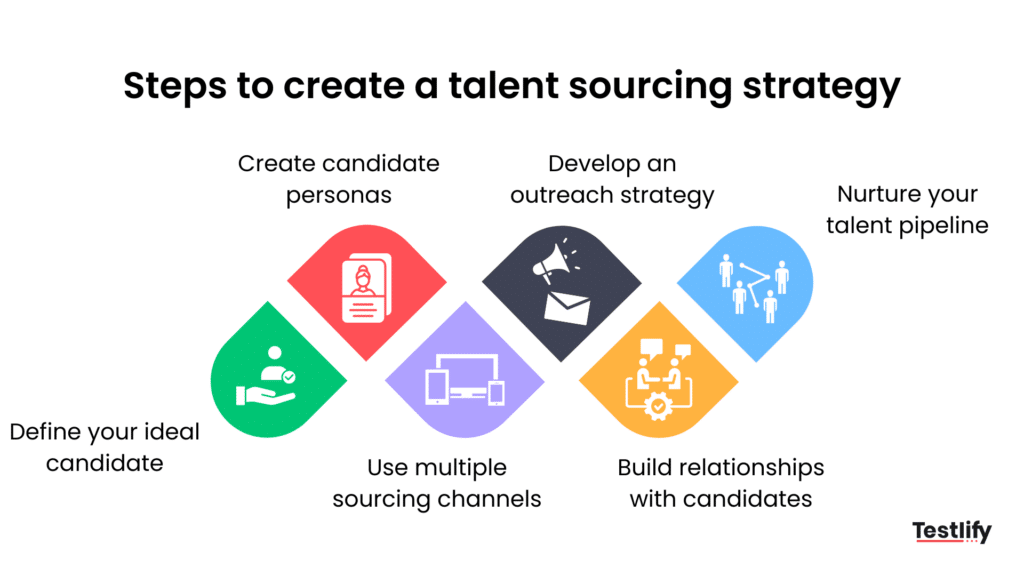
1. Define your ideal candidate
Before you start sourcing, you need to have a clear idea of the type of candidate you’re looking for. This involves understanding:
- The skills and qualifications needed for the role.
- The personality traits that would make someone successful in your company’s culture.
- The background and experience align with the position.
2. Create candidate personas
A candidate persona is a semi-fictional representation of your ideal candidate. It’s like his or her profile, including background, skills, motivations, goals, and potential concerns about switching jobs.
With a candidate persona, you can tailor your sourcing efforts directly toward those with the greatest possibility of being a good fit.
3. Use multiple channels for sourcing
Don’t rely on a single source to find talent. To build a comprehensive talent pipeline, use a variety of sourcing channels:
- Job boards: While they attract active candidates, they can still be a valuable tool for sourcing, especially for niche roles.
- LinkedIn: LinkedIn is a treasure trove of passive candidates. You can search for candidates based on their current role, skills, and location, then engage them through strategic LinkedIn outreach to spark interest in your opportunities.
- Employee referrals: Your current employees can be a great source of candidate referrals. They know the company culture and can recommend candidates who would fit in well.
- Social media: Beyond LinkedIn, platforms like Twitter, Facebook, and Instagram can be used to engage with potential candidates.
- Recruitment databases: If you can access a recruitment database or ATS (Applicant Tracking System), you can search for candidates who have previously applied but weren’t the right fit.
4. Develop an outreach strategy
Once you’ve identified potential candidates, you need to have a clear plan for how you will reach out to them. Crafting personalized messages is key to successful outreach.
Here are some tips:
- Be specific: Mention the candidate’s background or experience that caught your attention. Personalization shows that you’ve done your homework and aren’t just sending generic messages.
- Focus on value: Highlight why the candidate should consider the opportunity. What’s in it for them? Whether it’s career growth, company culture, or exciting projects, ensure you’re offering value.
- Keep it concise: Busy professionals don’t have time to read long emails. Keep your message short, to the point, and engaging.
5. Build relationships, Don’t just recruit
Talent sourcing means finding talent rather than just filling a position when it opens up. Even if the candidate does not want the role at that moment, he will do so tomorrow. And by keeping the relationship positive, you increase the chances that he will ever consider your company.
6. Nurture your talent pipeline
Once you’ve identified the right lead, nurture them until they are ready to move. This may be about sending regular emails about the company, sharing pertinent industry insights, or just keeping the lines of communication open.
Keeping an ongoing relationship with candidates will enable the company to be in front of the candidate’s mind when there is a requirement to change careers.
Talent sourcing tools you should be using
Technology can accelerate the process of seeking talent enormously. Here are some of the best talent sourcing tools:
1. LinkedIn recruiter
LinkedIn Recruiter is one of the most powerful sourcing tools currently available. You can seek candidates in its database by specific criteria, send InMail messages, and check all candidate interactions in one place.
2. Boolean search
Using keywords such as AND, OR, and NOT allows you to optimize your candidate searching through Boolean search. This can be done on any platform: Google, LinkedIn, etc. It will target more relevant information for you.
3. Applicant Tracking Systems (ATS)
An Applicant Tracking System, or ATS, is a tool for viewing your talent pipeline. It is used to keep track of applicant data, interactions, and other information that may help you determine whether the right person should be hired.
Read more: Check out Top Applicant tracking Systems in our blog.
4. Sourcing extensions and plugins
Tools like Lusha and ContactOut will help provide contact information for candidates that isn’t accessible publicly on LinkedIn or any other place.
5. Talent pools
You may also take talent pool management software in Beamery or Avature, which helps you organize and nourish the passive candidates for future roles.
Best practices for talent sourcing
Sourcing is as much an art as it is a science. Here are some best practices to help you succeed in your talent-sourcing efforts:
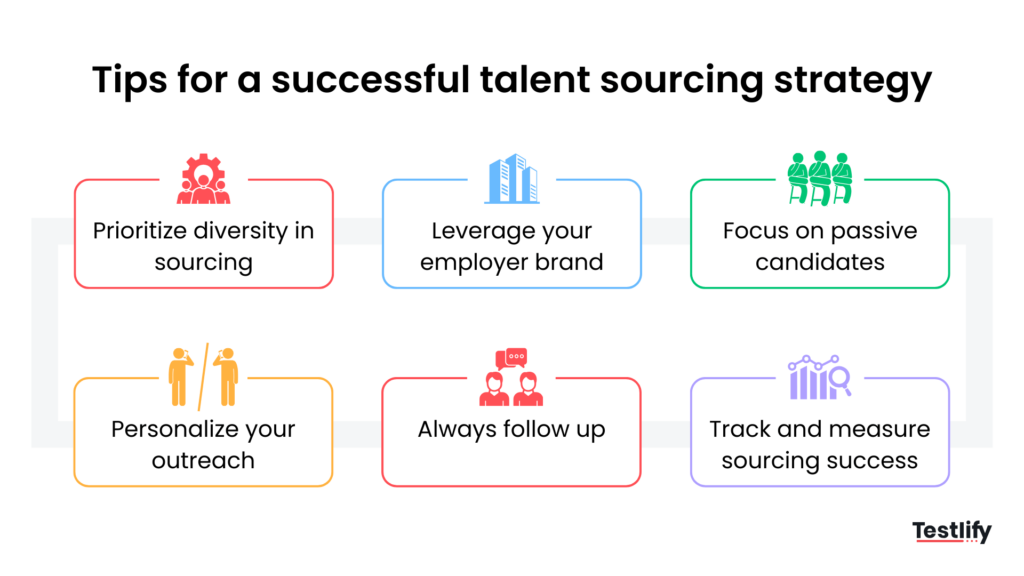
1. Prioritize diversity in your sourcing efforts
Look for candidates who may not otherwise come to you. Look for diverse candidates and job boards or LinkedIn groups geared toward underrepresented groups in your industry just to check off the box and not to narrow the pool in case you inadvertently do so.
2. Leverage your employer brand
A strong employer brand makes your sourcing more efficient. A LinkedIn study states, 80% of talent leaders say employer branding has a significant impact on hiring quality. Candidates already familiar with your company will have a good perception and will engage with your outreach efforts.
3. Focus on passive candidates
Don’t neglect passive candidates. They don’t look for a particular job, but they may still be considering new opportunities. Reach out to them now, and you may manage to capture talent in the future.
4. Always follow up
Candidates are usually busy, and your first contact might get lost in their inbox. Make sure to politely follow up if you don’t receive any response after a few days. Persistence can pay off.
Measuring the success of your talent sourcing efforts
With any other recruitment approach, measuring the impact of your talent sourcing only makes sense. Some of the most relevant metrics you can track include:
1. Time-to-hire
Time-to-hire is that metric measuring how long it takes to go from identifying a candidate to hiring. The less this time-to-hire, the more effective your sourcing strategy will be.
2. Quality of hire
This is a quality-of-hire measure: how well-sourced candidates perform in their jobs after you hire them. The higher the performance rate for candidates sourced, the better your strategy is to target the right talent.
3. Response rate
This is the number of applicants responding to your first contact. A low response rate suggests your messaging needs to be more personal or targeted.
4. Conversion rate
A conversion rate is the number of sourced candidates that convert into hires. The higher the conversion rate is, the better it is because it means you have been sourcing the best-fit candidates who will succeed in your company.
Common challenges in talent sourcing (And how to overcome them)
Like any recruiting strategy, there are also specific challenges in talent sourcing. Here are some of the common challenges and how to help navigate them:
1. Engaging passive candidates
Many candidates are passive and hard to engage since they are not actively seeking a new job. The challenge is that you must give them something valuable: a great company culture, growth opportunities, exciting projects, etc.
2. Balancing personalization and scale
While personalizing your outreach is necessary, doing it on a scale can be cumbersome. Pre-created templates that are easily customized for the candidates are an escape.
3. Managing candidate data
Handling a long list of candidates is likely to be difficult to handle. An applicant tracking system or talent pool management tool can sort this out and ensure the candidate is not overlooked.
Conclusion
Talent sourcing is one of the critical skills that every recruiter needs to make a mark. Taking a proactive approach to finding and engaging the right candidates through proper tools and continually refining your strategy will create a talent pipeline of high-quality hires.
Successful talent sourcing is more than just filling open jobs by plugging into roles – it’s about an association of long-term ties to the best talent and positioning your company as an employer of choice.
Ready to streamline your talent sourcing and make data-driven hiring decisions? Testlify, our skills assessment platform helps you identify top talent with ease. Sign up today and transform your recruitment process!
Happy sourcing!
Frequently asked questions (FAQs)

Content Writer
Yashika Khandelwal is a Content Writer with 3+ years of experience creating research-backed content on hiring, talent assessment, and HR technology. She is a registered Organizational Psychologist and subject matter expert who combines behavioral science with practical recruitment insights to produce accurate, evidence-based content.
LinkedInRelated resources
View all
HR & recruitment
Are boomerang employees the next big hiring trend?

HR & recruitment
What is skills mapping: Frameworks and tools

HR & recruitment
Assessing SEO & digital marketing skills for content strategy

HR & recruitment
Halo and Horn Effect: How to Stop Hiring Bias in 2026

HR & recruitment
What Is Employee Profiling? A Recruiter’s Complete 2026 Guide

HR & recruitment
Reverse Recruiting: How It Works and When to Use It in 2026
Get started.
Hire on proof, not resumes.
Run your first skills-based assessment free — no credit card required.