
Talent pooling
Talent pooling is a recruitment strategy that focuses on identifying, attracting, and retaining a pool of potential candidates for future job openings within an organization.
 ChatGPT
 Gemini
 Claude
 Grok
Grok Perplexity
Talent pooling is a candidate who completed the hiring process for a specific role, reached the final stages, and was not selected but was judged to be highly qualified.
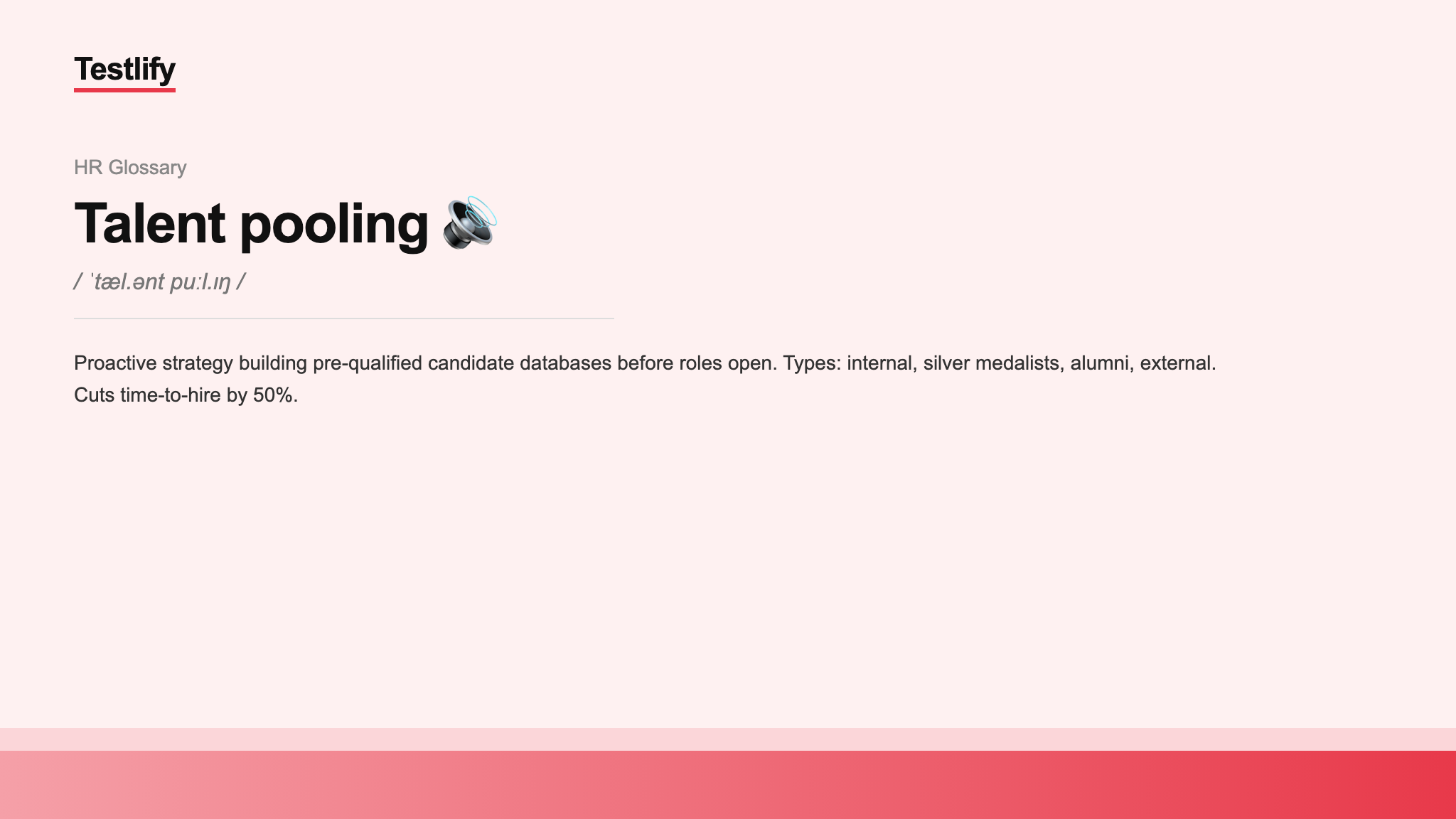
Talent pooling is a proactive sourcing strategy where talent acquisition teams build and maintain segmented databases of pre-qualified candidates before specific roles open. By cultivating internal candidates, silver medalists, alumni, and external prospects through ongoing engagement, enterprise TA teams reduce time-to-hire by up to 50% vs reactive sourcing. Requires CRM/ATS integration and GDPR-compliant consent management.
Talent pool vs. talent pipeline
The two terms are frequently conflated. The distinction is meaningful for how TA teams allocate sourcing effort and CRM resources.
In practice, talent pools feed talent pipelines. A sourcer builds a broad pool of senior data engineers over 12 months. When the VP of Engineering green-lights three new hires, the TA lead pulls the most engaged, highest-matched candidates from that pool into a pipeline and accelerates outreach. Both functions are necessary; they operate at different levels of specificity.
Types of talent pools
Enterprise TA programs typically maintain four to six distinct pool types, each with different sourcing logic and engagement strategies.
Internal talent pools
Employees identified through performance reviews, skills assessments, or succession planning as candidates for lateral moves or promotions. Internal pools reduce external hiring costs and improve retention by showing employees a visible path to growth. Gartner data shows that internal mobility increases employee tenure by more than 40% compared to roles filled externally.
External talent pools
Candidates who have applied to the organization, expressed interest via career pages, or been sourced proactively but are not currently in process. This is the largest pool for most enterprise teams. It includes active job seekers and passive candidates engaged through LinkedIn, industry events, and referrals.
Silver medalist pools
Candidates who made it to the final interview stage but were not selected for a specific role. These are among the highest-value candidates in any pool: they have already been assessed, are familiar with the brand, and were judged as broadly qualified. Re-engaging silver medalists when a comparable role opens cuts sourcing time significantly and improves quality-of-hire because the assessment data already exists.
Alumni pools
Former employees who left in good standing. Boomerang hires, employees who return after working elsewhere, are valuable because they know the culture, systems, and workflows. They typically ramp faster than external hires and carry institutional knowledge from other organizations. Alumni pools work best when HR maintains structured offboarding and an opt-in alumni engagement program.
Skills-based talent pools
Pools organized around competency clusters rather than job titles. A skills-based pool for “Python + ML engineering” may contain candidates from data science, software engineering, and analytics backgrounds. As organizations move toward skills-based hiring, these pools become the primary unit of talent supply planning. They integrate directly with workforce planning models that forecast skills gaps against strategic objectives.
How to build a talent pool
Step 1: define pool criteria
Work with hiring managers and workforce planners to define which roles, skill clusters, and seniority bands will have dedicated pools. Prioritize pools for roles with the highest hire volume, longest time-to-fill, or greatest business impact. Avoid building pools for every role in the org chart; focus on the 20% of roles that create 80% of sourcing pressure.
Step 2: source candidates across channels
Effective pool-building draws from multiple sourcing channels: inbound applicants who were not selected for immediate roles, proactive LinkedIn and GitHub sourcing, referrals from current employees, career fair and campus recruitment contacts, industry events and professional communities, and opt-in career page registrations. For enterprise teams, the ATS and CRM are the primary infrastructure. Only 50% of in-house teams use their ATS as a proactive talent pool system, which means the majority leave significant value on the table.
Step 3: assess and qualify
Not every candidate who expresses interest belongs in an active pool. Use skills assessments at the sourcing stage to qualify candidates before investing engagement effort. Objective assessment data at this stage means that when a role opens, the team is reviewing known quantities rather than re-qualifying cold leads. Skills assessment scores, together with seniority, location preferences, and availability, form the segmentation logic for pool tiering.
Step 4: obtain gdpr-compliant consent
Under GDPR, storing candidate data in a talent pool requires explicit, documented consent. Use a double opt-in process: candidates confirm via email that they agree to be contacted for future opportunities, understand how their data will be used, and know how to withdraw consent. Consent records must be stored in the CRM with timestamps. Data should be refreshed every six months; candidates who do not re-confirm consent must be removed. Failure to manage consent creates legal exposure under GDPR Article 7 and equivalent state-level regulations in the US.
Step 5: segment and tag
Tag each candidate in the CRM with: skill cluster, seniority tier, pool type (internal, external, silver medalist, alumni), location, availability flag, and last engagement date. Clean segmentation is what separates a searchable talent database from a pile of resumes. It enables targeted outreach at scale, which is the core value proposition of talent pooling.
Step 6: run an engagement cadence
Pools decay without nurture. Candidates move on, change roles, and lose interest if the organization goes silent for 12 months. A sustainable engagement cadence for enterprise pools includes: a quarterly newsletter with relevant industry content, role alerts when matching positions open, invitations to webinars or virtual events, and personalized outreach for top-tier or high-urgency candidates. Aim for a 20% response rate to nurture emails as a benchmark for pool health.
Talent pool management
CRM and ATS integration
Talent pool management requires a CRM or talent pipeline module within the ATS. Leading platforms (Greenhouse, Lever, Workday, iCIMS) all offer pool or pipeline functionality. The choice of tool matters less than the discipline of data hygiene: every candidate record needs current contact data, skills tags, consent status, and engagement history. Without clean data, pool search results are unreliable and recruiters default to starting sourcing from scratch.
Pool health and data hygiene
Review candidate data at minimum every six months. Validate contact details, update skill assessments for long-term pool members, re-confirm consent, and archive candidates who have been unresponsive for 12 or more months. Stale data in a pool does not just waste recruiter time; it produces misleading metrics and can create compliance risk under data minimization principles in GDPR.
Talent pool metrics
Enterprise TA teams should track these six metrics to evaluate pool performance:
Skills-based talent pooling
The shift toward skills-based hiring is restructuring how enterprise organizations build and query talent pools. Instead of searching pools by job title or years of experience, TA teams query by competency: “Python, statistical modeling, stakeholder communication, Level 3 proficiency.” This requires that candidates in the pool have verified, structured skills data, which is where objective assessment becomes critical infrastructure rather than a pre-hire formality.
Skills-based pools integrate with workforce planning by mapping pool inventory against forecast demand. If the model projects a need for 40 senior ML engineers in Q3, the workforce planner can query the pool today to see how many pre-vetted candidates are available and how much additional sourcing is needed to close the gap. This is the most mature application of talent pooling: using the pool as a real-time supply signal rather than a passive database.
Talent pooling in enterprise context
For organizations with 1,000 or more employees, talent pooling intersects with several broader workforce management disciplines:
- Succession planning: Internal talent pools for director and VP roles feed succession plans and reduce reliance on executive search firms.
- Diversity, equity, and inclusion: Structured pools built from diverse sourcing channels help reduce the recency and familiarity bias that affects reactive hiring. Tracking pool demographics against hire demographics surfaces where bias enters the process.
- ATS integrations: Workday, Greenhouse, and Lever all surface pool data within the requisition workflow, so that when a role opens, recruiters see matched pool candidates before they post externally.
- Compliance and audit trails: GDPR consent records, data refresh logs, and engagement history create the audit trail that legal and compliance teams require in heavily regulated industries.
Frequently asked questions
A talent pool is a broad database of candidates who could be suitable across a range of roles, maintained on an ongoing basis. A talent pipeline is role-specific and time-bound, focused on candidates being actively cultivated for a known upcoming vacancy. Pools are the raw material; pipelines are the activated subset drawn from that material when a specific hire becomes imminent.
Cite this page
Copy a ready-made citation for this page in your preferred style.
- APA
Testlify. (2023). Talent pooling. https://testlify.com/hr-glossary/talent-pooling/
- MLA
"Talent pooling." Testlify, 27 January 2023, https://testlify.com/hr-glossary/talent-pooling/.
- Chicago
Testlify. "Talent pooling." Testlify. Last modified September 14, 2026. https://testlify.com/hr-glossary/talent-pooling/.
- HTML link
<a href="https://testlify.com/hr-glossary/talent-pooling/">Talent pooling</a>, Testlify (2023)
Related terms
Tangible rewards
Tangible rewards are physical items or experiences offered as recognition or incentive for achieving a specific goal or performance level. These rewards include cash bonuses, gift cards, merchandise, travel, etc.
Targeted Recruiting
Targeted recruiting is a strategy organizations use to seek out and recruit individuals with the specific skills, experience, and qualifications needed to fill a position.
Targeted Selection
Targeted selection is a process used in recruitment that involves identifying specific characteristics, qualifications, and skills for a particular job and then using these criteria to evaluate and select candidates.
Tax
Tax is a financial charge imposed by a government on individuals, businesses, and other entities to fund various public services and programs.
Tax Identification Number (TIN)
A Tax Identification Number (TIN) is a unique number assigned by a country’s tax authorities to individuals and organizations to identify and track tax liability.
Taxable Income
Taxable income is the total amount of money or compensation an individual or organization earns in a given tax year that is subject to income tax.
Get started.
Hire on proof, not resumes.
Run your first skills-based assessment free — no credit card required.