
Employee evaluation forms: How to create one [Free templates]
Learn the importance of employee evaluation forms, how to create them, best practices, and free templates to streamline your performance reviews.
![Employee evaluation forms: How to create one [Free templates]](/api/media/file/Employee-evaluation-forms-2.png?dpl=dpl_6Z8Gzi5dgny5ePrnCfPbRPCRYCA7)
Employee evaluations are an essential component of every organization. They provide managers and HR professionals with a structured way to assess employee performance, encourage growth, and ensure organizational goals are met.
Whether you’re managing a team, overseeing HR processes, or handling employee development, understanding the importance and implementation of employee evaluation forms is crucial for success.
In this blog, we’ll explore everything you need to know about employee evaluation forms, why they’re important, how to create them, different types, and much more.
 ChatGPT
 Gemini
 Claude
 Grok
Grok Perplexity
What is an employee evaluation form?
An employee evaluation form is a structured document used by organizations to assess and review the performance of employees.
This form is used to evaluate key areas of job performance, skills, and behavior, helping to provide feedback to employees and determine areas for improvement. The evaluation process typically occurs at regular intervals, such as quarterly, semi-annually, or annually.
The core purpose of the evaluation form is to make the evaluation process objective and standardized. It allows both the employee and the manager to have a clear understanding of the employee’s strengths and areas that need development.
The form also serves as a record for HR professionals, which can be useful when making decisions about promotions, compensation adjustments, or development plans.
The value of employee evaluations
According to Gallup, only 23% of employees strongly agree that their performance is managed in a way that motivates them to do outstanding work. This suggests a significant gap in how organizations are handling employee evaluations.
In fact, employees who receive regular feedback and feel their performance is being recognized are 14.9% more likely to be engaged at work, which can dramatically impact productivity and overall company culture.

Why is it important to implement employee evaluations?
Employee evaluations play a pivotal role in managing performance and fostering a culture of growth within an organization. Here are some key reasons why implementing employee evaluations is critical:
1. Improves job performance
Employee evaluations provide constructive feedback, which can significantly improve job performance. Regular assessments allow employees to understand their strengths and weaknesses. When employees receive targeted feedback, they can take action to enhance their performance and meet expectations.
For example, employees who receive clear feedback about a skill or task they need to improve can take action in areas that directly impact their role, leading to more efficiency and quality work.
2. Clarifies expectations and goals
Evaluations help employees understand what is expected of them in their roles. By setting clear goals and objectives during the evaluation, employees have a benchmark to work towards. This clarity improves focus and reduces confusion, ultimately leading to greater productivity and engagement.
A Gallup study found that employees who understand what is expected of them at work are 2.5 times more likely to be highly engaged.
3. Encourages professional development
Regular employee evaluations allow managers to identify areas where employees can improve or develop new skills. These evaluations often lead to personalized development plans that can help employees grow in their careers. Providing the right training and resources enables employees to reach their full potential, increasing job satisfaction and reducing turnover.
In fact, according to LinkedIn, companies that offer training programs are 58% more likely to retain their employees.
4. Supports career advancement
Employee evaluations serve as the basis for promotion, salary increases, and professional development opportunities. These evaluations provide the data needed to make informed decisions about career progression within the company. Transparent performance reviews also ensure that employees have a fair chance to move up based on their achievements.
5. Fosters engagement and motivation
A well-conducted evaluation process shows employees that their contributions are valued. This recognition boosts morale, increases engagement, and motivates employees to continue performing at a high level. When employees feel acknowledged and appreciated, they are more likely to stay motivated and aligned with the company’s goals.
6. Improves organizational culture
Consistent evaluations contribute to a transparent work environment, promoting trust between employees and managers. Open feedback encourages a positive work culture where communication is prioritized, and continuous improvement is valued.
7. Aids in decision making
Evaluations help HR and management teams make decisions regarding compensation, promotions, and overall staffing needs. Well-documented evaluations provide the necessary information for these decisions, ensuring fairness and alignment with organizational goals.
How to write an employee evaluation form?
Writing an effective employee evaluation form requires a balance of objectivity, clarity, and fairness. Here’s a step-by-step guide on how to write an employee evaluation that’s thorough and constructive:
1. Prepare in advance
Preparation is key to writing a thoughtful evaluation form. Gather all relevant data about the employee’s performance, including feedback from colleagues, recent work accomplishments, and any performance metrics. Review any previous evaluations and goal-setting discussions to understand the context.
2. Review performance against goals
Look back at the goals set in previous evaluations and assess how well the employee has met or exceeded those goals. This process allows you to measure progress, determine whether the employee is on track, and identify areas that may need more attention.
3. Evaluate key performance areas
Focus on critical areas of job performance, such as:
- Productivity: Assess how efficiently the employee completes tasks and meets deadlines.
- Quality of work: Evaluate the accuracy, attention to detail, and overall quality of the employee’s work.
- Communication: Look at the employee’s ability to communicate effectively with colleagues and clients.
- Teamwork: Consider the employee’s ability to work well with others and contribute to team success.
- Leadership (if applicable): Evaluate the employee’s leadership skills, including decision-making, team management, and mentoring abilities.
4. Provide specific examples
Instead of offering vague feedback, use specific examples to back up your evaluations. For instance, instead of saying, “You did well in meeting deadlines,” provide a specific example like, “You consistently submitted your reports on time every week for the past quarter.”
5. Balance positive and constructive feedback
While it’s important to provide constructive feedback for areas that need improvement, it’s equally important to highlight the employee’s strengths. Positive reinforcement motivates employees and encourages them to continue excelling in their role.
6. Discuss future goals and development plans
The evaluation should be forward-looking. Set new goals and expectations for the employee, as well as a plan for how they can improve and achieve those objectives. Providing opportunities for training or further development can help the employee reach their full potential.
7. Keep it clear and concise
Avoid using overly complex language or being too wordy in your evaluation. The goal is to communicate clearly and concisely, making it easy for both the employee and the manager to understand the feedback and take action accordingly.
How to create an employee evaluation form?
Creating an effective employee evaluation form is a crucial step in ensuring consistency and fairness throughout the evaluation process. Here’s how to create one:
1. Determine key performance areas
Choose specific performance areas that align with the employee’s role and the company’s goals. These areas should cover a broad range of skills, such as productivity, teamwork, problem-solving, and communication. Choose 5-7 criteria for a balanced form.
2. Select an evaluation scale
Use a scale to rate the employee’s performance. You can use a numerical scale (e.g., 1-5), a descriptive scale (e.g., “Excellent,” “Satisfactory,” “Needs Improvement”), or a combination of both. Ensure the scale is consistent and clear for all employees.
3. Include sections for comments
Provide space for both the evaluator and employee to add comments. This is important for elaborating on the ratings and for providing additional context or suggestions for improvement. It also allows employees to voice their perspective.
4. Make it easy to complete
Ensure the form is simple to fill out. Avoid long, complex sentences and unnecessary jargon. You want employees and managers to complete the form efficiently, so clarity is paramount.
5. Test and revise
Before rolling out the form company-wide, test it with a small group of employees and managers. This will allow you to identify any areas of confusion or improvement before it becomes a standardized tool for evaluations.
Types of employee evaluation forms
The type of employee evaluation form you choose depends on the goals of the evaluation and the nature of the employee’s role. Let’s look at the different types of evaluation forms:
1. Rating scale evaluation form
This is the most common type of employee evaluation form. It involves rating the employee on a numerical scale (e.g., 1 to 5) for various performance criteria, such as quality of work, attitude, and leadership skills. The form includes space for comments, and ratings help quantify the employee’s performance.
2. Self-assessment form
A self-assessment form allows employees to evaluate their own performance. This form often complements manager evaluations, helping to provide a more complete picture of the employee’s performance. Self-assessments also foster self-reflection, giving employees a chance to identify areas they’d like to improve.
3. 360-degree feedback form
The 360-degree feedback form collects input from multiple sources: managers, peers, subordinates, and sometimes customers. This form provides a holistic view of the employee’s performance, highlighting strengths and areas for improvement from various perspectives.
4. Competency-based evaluation form
This form evaluates employees based on specific competencies required for their job. For example, a competency evaluation may focus on problem-solving, decision-making, communication, and adaptability. It is especially useful for roles that require specialized skills.
5. Behavioral evaluation form
The behavioral evaluation form focuses on assessing specific behaviors, such as punctuality, teamwork, and communication. This form is valuable for evaluating soft skills and cultural fit within the organization.
What to include in an employee evaluation form?
A well-structured employee evaluation form should include the following key elements:
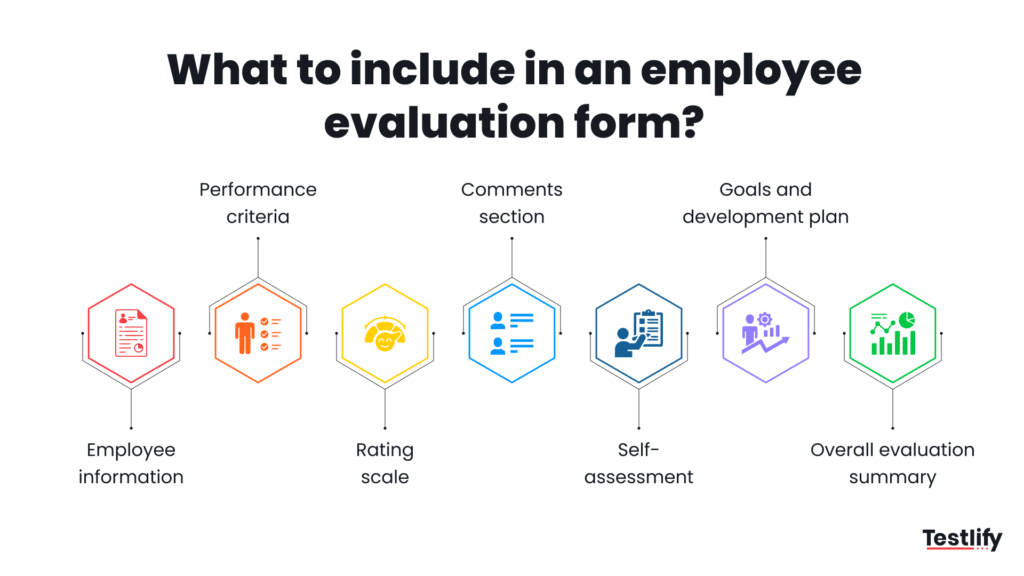
1. Employee information
Include the employee’s name, department, job title, and the date of the evaluation. This section ensures that the form is personalized and serves as a record of the evaluation.
2. Performance criteria
List the performance areas being assessed, such as job knowledge, productivity, communication skills, and teamwork. Each criterion should be clearly defined and measurable.
3. Rating scale
Provide a rating scale for each performance area, whether numerical or descriptive. Make sure the scale is consistent and easy to understand.
4. Comments section
Include space for both the evaluator and the employee to add comments. This section is essential for providing detailed feedback and context for the ratings.
5. Self-assessment
Allow the employee to evaluate their own performance. This section encourages self-reflection and can provide valuable insights into the employee’s perspective.
6. Goals and development plan
Set clear goals for the employee to work towards. Provide a development plan that outlines the skills the employee needs to improve or acquire. This plan helps guide the employee’s future growth.
7. Overall evaluation summary
Provide a final evaluation summary, highlighting the employee’s key strengths, areas for improvement, and a roadmap for development.
Employee evaluation form template
Here’s a simple employee evaluation form template you can use:
Employee name: [Insert name] Job Title: [Insert job title] Department: [Insert department] Date of evaluation: [Insert date]
Performance criteria:
- [Comments]
- [Comments]
- [Comments]
- [Comments]
- [Comments]
- [Comments]
- Job knowledge: [Rating scale]
- Quality of work: [Rating scale]
- Communication skills: [Rating scale]
- Teamwork: [Rating scale]
- Initiative: [Rating scale]
- Leadership (if applicable): [Rating scale]
Employee self-assessment:
- [Employee’s comments on performance]
Goals and development plan:
- [List goals]
Overall evaluation summary:
- [Manager’s comments]
Best practices to evaluate employees
To ensure your employee evaluation process is effective and fair, here are some best practices to follow:
1. Be consistent and objective
Consistency is key. Use the same criteria for every employee and ensure that your evaluations are based on facts and observable performance. Avoid personal biases and ensure fairness in your assessments.
2. Provide regular feedback
Don’t wait until the annual review to provide feedback. Regular check-ins and mid-year reviews help employees stay on track and give them the opportunity to course-correct throughout the year.
3. Encourage open communication
Encourage employees to ask questions and share their thoughts during the evaluation. This two-way communication fosters trust and ensures employees feel heard and valued.
4. Focus on development
The goal of an employee evaluation is to help the employee grow. Provide actionable feedback and suggest specific steps they can take to improve. Encourage them to attend training, take on new projects, or develop new skills.
5. Document everything
Keep detailed records of each evaluation. These documents are not only useful for tracking performance over time, but they also provide a valuable reference in the case of promotions, raises, or disciplinary actions.
What not to do during employee evaluations?
There are several common pitfalls that can make employee evaluations less effective or even harmful. Here’s what to avoid:
1. Avoid vague feedback
Vague comments like “needs improvement” don’t provide actionable insight. Be specific about what the employee did well or where they need to improve.
2. Don’t compare employees to each other
Each employee’s performance should be evaluated individually. Comparing employees can create unnecessary competition and resentment among coworkers.
3. Don’t focus only on negative aspects
It’s important to address areas for improvement, but also take time to highlight the employee’s achievements. Balancing positive and constructive feedback makes the evaluation process more motivating and productive.
4. Avoid using evaluations for punishment
Evaluations are meant to help employees grow, not to punish them for mistakes. Keep the tone constructive and focused on improvement.
HR tips to help managers conduct an effective employee evaluation
Here are a few tips to ensure managers conduct effective evaluations:
1. Be objective and fair
Avoid personal biases and evaluate the employee based on their actual performance and achievements.
2. Create a safe and open environment
Ensure that the employee feels comfortable discussing their strengths and weaknesses.
3. Focus on growth
Use the evaluation as an opportunity to focus on the employee’s future growth and development. Discuss their career goals and how the company can support them in reaching those goals.
4. Follow up regularly
Schedule follow-up meetings to track progress on goals and development plans. This shows that you’re committed to the employee’s success.
Conclusion
Employee evaluations are more than just a tool for assessing performance; they are an opportunity for growth, development, and engagement. By creating structured evaluation forms, following best practices, and maintaining an open and constructive feedback loop, organizations can create a work environment where employees feel valued and motivated to perform at their best.
By implementing a well-thought-out evaluation process, HR professionals and managers can ensure their employees have the support and guidance they need to succeed, which ultimately benefits the entire organization. Whether you’re just getting started with employee evaluations or looking to refine your process, following the tips and strategies outlined in this guide will set you on the path to success.
Frequently asked questions (FAQs)

Content Writer
Yashika Khandelwal is a Content Writer with 3+ years of experience creating research-backed content on hiring, talent assessment, and HR technology. She is a registered Organizational Psychologist and subject matter expert who combines behavioral science with practical recruitment insights to produce accurate, evidence-based content.
LinkedInRelated resources
View all
HR & recruitment
Writing Assessments for Hiring: Identify Top Talent

HR & recruitment
Affiliative leadership: Importance, tips and benefits

HR & recruitment
HR hiring cycle: steps, tools, and best practices

HR & recruitment
Understanding Key Responsibility Areas in recruitment

HR & recruitment
Employee appreciation day 2026: Why it matters (10 ideas)

HR & recruitment
Recruitment Database: Definition, Benefits, Types
Get started.
Hire on proof, not resumes.
Run your first skills-based assessment free — no credit card required.