
How to scale talent acquisition without losing quality?
Learn how to scale talent acquisition without compromising on quality. Discover strategies, tools, and metrics for enterprise-level hiring success.

Every enterprise hiring team hits the same wall eventually. The process that worked for 10 hires a quarter starts breaking somewhere around 50, and recruiters are being asked to fill more roles with leaner teams in 2026, which exposes any process that was only ever held together by good people trying hard.
In a single month, U.S. employers make around 5.2 million hires, and that churn never lets up (U.S. Bureau of Labor Statistics). The teams that scale without a quality collapse do one thing differently: they replace individual judgment with a system, before volume forces the issue.
TL;DR
- Volume does not lower quality on its own. The absence of a system does, and that system needs building before growth forces the issue, not after.
- The single biggest lever is replacing resume judgment with skills evidence, since that is what separates a process that scales from one that just got lucky.
- Automation earns its keep on logistics, not decisions. The moment a filter starts deciding who gets hired instead of who gets screened, quality starts leaking.
- Candidate experience is not a soft metric at volume. It determines whether next year’s pipeline shows up at all.
- Watching time to fill alone guarantees a team that optimizes for speed. Add a quality signal and the whole system reorients around it.
- Two Testlify customers, Netconomy and Virtual Gurus, prove this works outside a slide deck, with real before-and-after results.
 ChatGPT
 Gemini
 Claude
 Grok
Grok Perplexity
The real reason volume breaks quality first
Quality does not drop because a team hires more people. It drops because rapid growth pushes hiring from a strategic function into a reactive one, and speed quietly replaces fit as the real selection criterion.
OpenAI is the clearest recent example. Headcount jumped from about 300 to over 600 people in a single year after ChatGPT took off, and reporting on that stretch described real strain on hiring standards and management (Business Insider). Even a company every candidate wants to join feels the squeeze when volume spikes that fast.
The deeper problem is rarely the recruiters themselves. It is the absence of a system that holds up under load, since every hiring manager evaluating candidates their own way means doubling open roles doubles inconsistency, not output. (For the distinction between the two functions, see our guide on talent acquisition versus recruitment.)

What scaling actually requires from your process
Scaling talent acquisition means growing hiring capacity without a matching drop in hire quality or candidate experience. It is the ability to run the same reliable process at 10 hires or 200, not just doing the same things faster.
The skills side makes this urgent right now. Employers expect 39% of workers’ core skills to change by 2030, and 63% already name the skills gap as the single biggest barrier to transformation (World Economic Forum, Future of Jobs 2025). You are scaling hiring for roles whose requirements are moving under your feet, which is exactly when a resume tells you the least.
SHRM’s 2026 hiring research frames this as precision over scale: the winning teams are not the ones processing the most applicants, they are the ones converting the right ones (SHRM). That distinction is the whole argument for structure over headcount.
Make hiring a lever for the business, not a request queue
When hiring teams work in isolation from leadership, priorities drift and timelines slip. The fix is treating talent acquisition as a strategic partner, which means recruiters sit in the room where headcount and roadmap decisions get made, not two weeks after.
Say a company is about to push its SaaS product into the European market. Aligned hiring targets multilingual candidates with EU compliance experience before the roles even open, not after the first three offers fall through, and the best enterprise hiring engines scale with the business rather than parallel to it. (More tactics in our guide on HR strategies to attract top talent.)
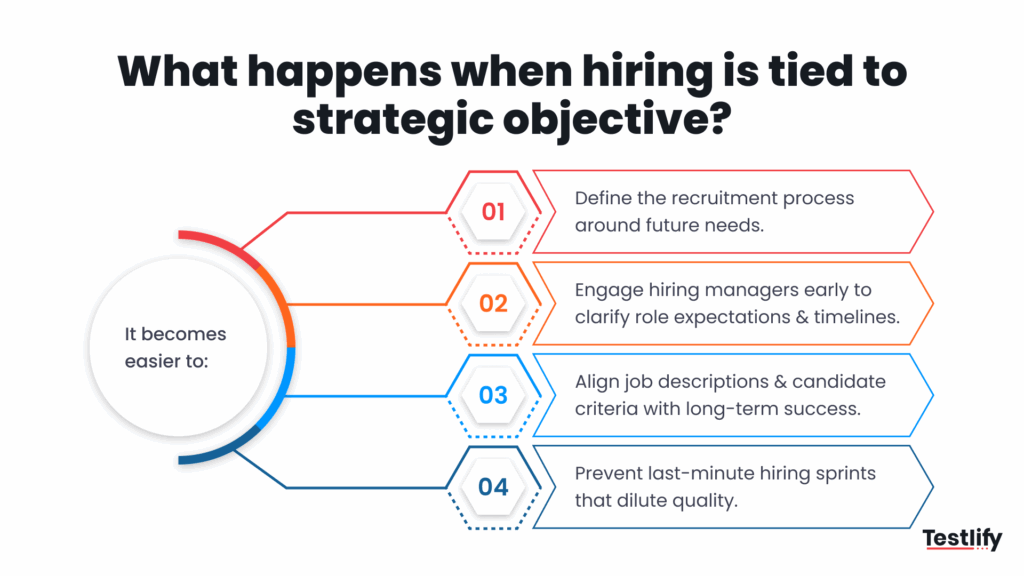
The diagram above is the shortcut version of the difference. Hiring tied to a strategic objective moves in the same direction as the business, while hiring left to run on its own drifts wherever the loudest req happens to point, and that gap compounds fast at enterprise volume.
Build one process that scores everyone the same way
Structured hiring works by applying the same criteria, questions, and scoring to every candidate, so decisions rest on evidence instead of whoever happened to interview that day. Without it, criteria drift between teams and bias creeps in unnoticed.
Lock the competencies before you open the req
Get precise, upfront alignment with hiring managers on the role and its must-have skills before a single candidate applies. Skipping this step is the most common reason a structured process quietly breaks down later.
Ask everyone the same questions
Standardize questions tied to job-relevant competencies and ask them the same way for every candidate. That consistency is what makes two different interviewers’ scores actually comparable.
Score against a scorecard, not a gut feeling
Rate every candidate against consistent benchmarks with a structured interview scorecard. A scorecard turns five different interviewers into one consistent evaluator.
Leave a paper trail
Back every decision with assessment data and documented feedback that anyone can audit later. That record is what protects a hiring manager the day a decision gets questioned.
The payoff compounds over time. Structured hiring fits the foundational HR models that prize consistency and long-term fit, so you are not quietly relaxing standards for the twentieth req the way you might for the second.
Let evidence replace the resume guess
As volume rises, resumes blur together and interviews get rushed, and skills assessments add the objectivity that gut instinct cannot give you at that scale. Use AI-assisted evaluation and validated assessments to gather evidence on what the job actually requires, then let humans make the final call, the same approach our guide to high-performance skill assessments lays out in more depth.
Different roles need different evidence, and a short assessment plan usually blends a few test types.
Assessment type | What it screens for | Best used when |
|---|---|---|
Coding and technical tests | Real, job-relevant skill on the tools the role uses | Screening developers or technical hires at volume |
Cognitive ability tests | Reasoning, problem-solving, learning speed | Analytical roles where the work keeps changing |
Situational judgment tests | Decision-making and fit with how the team works | Customer-facing and people-heavy roles |
Personality and behavioral | Work style, motivation, collaboration signals | Any role where retention hinges on fit |
Testlify supports this with a large test library across technical, cognitive, language, and personality skills built with subject-matter experts, plus AI-assisted video interviews with human review, proctoring to keep results honest at volume, and integrations with major ATS platforms like Workday, Greenhouse, and Lever.
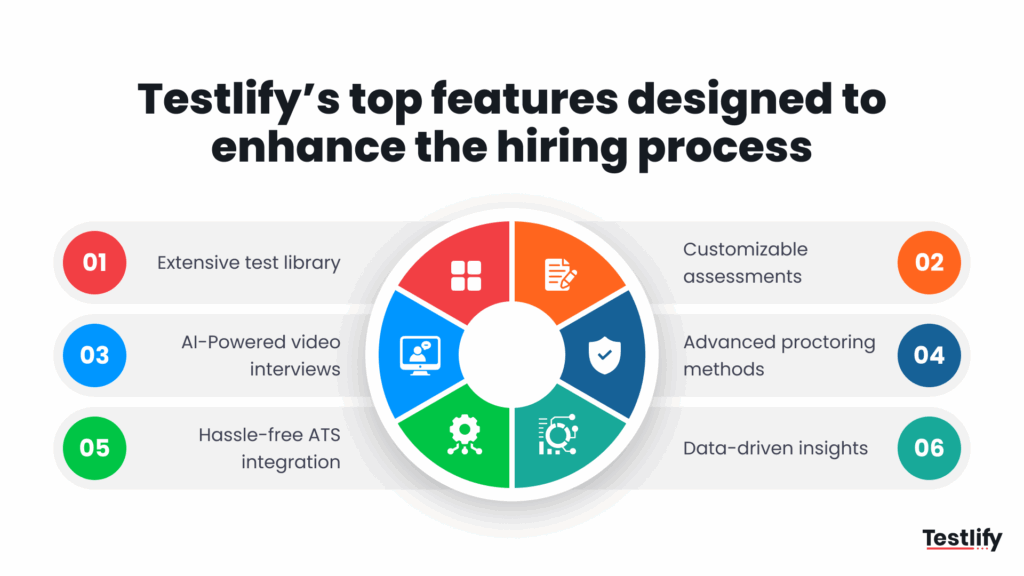
The point of the feature set above is not more tools sitting in a dashboard. It is giving hiring managers the right evidence so they choose the best person for the role instead of the best-scoring resume.
Pro Tip: Put the assessment before the first human screen, not after. Scoring skills upfront lets you replace two or three early interview rounds with one strong signal, which is where high-volume pipelines usually leak the most time.
Where automation earns its keep, and where it costs you
Automation is essential at enterprise volume, but there is a line where it starts costing you quality instead of saving it. A rigid resume filter can reject a strong candidate with an unconventional background, and a cold bot email can lose a good hire before the first real conversation.
The split that holds up well in high-volume hiring puts logistics on one side and judgment on the other.
Automate this | Keep humans on this |
|---|---|
Skills scoring and shortlist ranking | Final hire and reject decisions |
Interview scheduling and reminders | Interviews for shortlisted candidates |
Status updates and next-step nudges | Personal outreach to top candidates |
Reporting and pipeline dashboards | Reading edge cases the filter would miss |
Audit your tools, especially the AI-based ones, on a schedule rather than assuming they still work the way they did on day one. A filter that drifts out of line with the role can quietly screen out the exact people you want, and you will not notice until the pipeline runs dry.
Also Read: Optimizing Talent Acquisition: Integrating AI and PPC Strategies
Also Read: What is Talent Acquisition Partner?
Volume is not an excuse for a bad candidate experience
Protect candidate experience by setting expectations early, communicating on a predictable rhythm, and cutting interview rounds that a strong assessment already covers. At enterprise scale, with hundreds or thousands of people in the funnel, experience is a reputation safeguard, not a nicety.
High-volume hiring tends to break in familiar ways. Candidates apply and never hear back, automated messages read as generic, and two applicants for the same role get wildly different experiences.
Set expectations upfront
Tell candidates the stages, the timeline, and when they will hear back before the process even starts. Ambiguity is what turns a slow process into a bad one.
Automate updates, save the human touch for what matters
A status nudge can be automatic, but an offer conversation cannot. Save the personal touch for the moments a candidate will actually remember.
Collapse the rounds
One strong assessment often replaces three screening calls, which respects everyone’s time. Fewer, sharper rounds beat a long funnel that wears candidates down before the real interview even starts.
Collect feedback and close the loop
Short candidate surveys surface the drop-off points you cannot see from inside the process, the same discipline behind building a positive candidate experience. Acting on that feedback is what turns a one-time fix into a process that keeps improving.
Candidates rarely remember the exact questions. They remember how the process made them feel, and at scale that feeling is what builds or dents your employer brand.
The five numbers that actually prove quality
The metrics that prove quality at scale are quality of hire, time to hire, assessment-to-offer ratio, offer acceptance rate, and candidate satisfaction. Watch them together, since any single one in isolation can mislead a whole team.
If your team is measured only on time to fill, they will optimize for speed and quality is what gives way. Give them a quality signal to hit instead and the behavior changes fast.
Metric | What it tells you | Watch for |
|---|---|---|
Quality of hire | Long-term value: performance, retention, impact | The metric most teams say they cannot measure well |
Time to hire | Speed of the process end to end | A fast hire who leaves in 90 days added nothing |
Assessment-to-offer ratio | How well your tests surface real top performers | A weak ratio means the assessment is off-target |
Offer acceptance rate | Strength of brand, experience, and comp | A low rate points upstream, not to the offer |
Candidate satisfaction | Experience quality across the funnel | Predicts whether next season’s pipeline shows up |
Getting the hire wrong is not free either. SHRM benchmarking puts the average cost per hire near $4,129 and average time to fill around 42 days, so every mis-hire you redo burns roughly six weeks and a few thousand dollars again (SHRM Benchmarking Report). At 50 roles a quarter, a 10% mis-hire rate is real money, and for a fuller metric set, see our breakdown of recruitment KPIs to track.
Proof from two teams that scaled without breaking
The system above is not theoretical. Two examples from Testlify’s own customer stories show it holding up under real hiring volume.
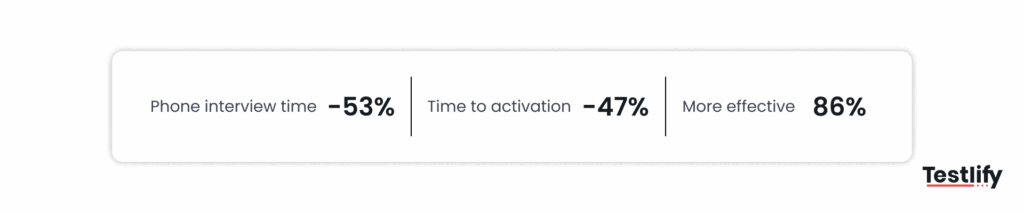
Netconomy used Testlify assessments to run a more consistent screening process and reach better-evidenced hiring decisions, the result shown above.
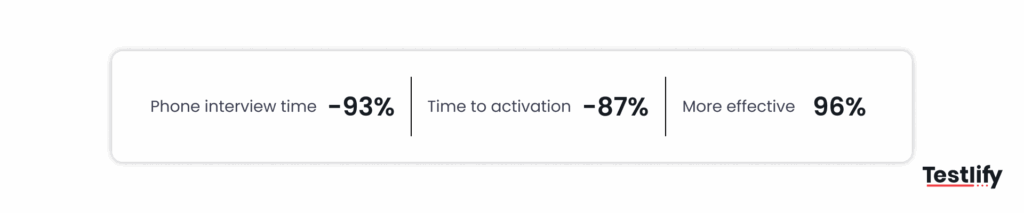
Virtual Gurus used the white-label feature to keep candidate experience on-brand while making evaluations more accurate, with a similar lift in outcomes.
Final thoughts
Scaling talent acquisition without losing quality is not a hiring problem you solve with more headcount. It is a systems problem you solve with structure: one process, one set of evidence, and one small list of metrics everyone actually watches.
Build that system before volume forces it on you, not after. The teams that wait until the wall hits are the ones rebuilding their hiring process and their reputation at the same time.
Key takeaways
- Structure beats headcount. The fix for volume-driven quality loss is a repeatable process, not more recruiters, since a system that behaves the same way at 10 hires and 200 is what actually scales.
- Evidence beats resumes. A validated skills assessment is the cheapest objective signal available once resumes start to blur together, and it filters on real ability instead of how well someone writes a cover letter.
- Automate logistics, not judgment. The line between the two is where quality either holds or leaks, and over-automating is how a strong candidate gets filtered out before anyone reads their file.
- Experience is a metric, not a courtesy. It decides whether your next pipeline shows up at all, which makes it a business risk at enterprise volume, not a nice-to-have.
- Watch quality of hire, not just speed. What leadership measures is what the team optimizes for, so a speed-only scoreboard guarantees a speed-only team.
- Two live customers prove it. Netconomy and Virtual Gurus scaled screening without sacrificing evidence quality, which is the whole argument in practice, not just on paper.
Ready to scale hiring without dropping the bar?
See how structured, skills-based assessments keep quality steady as your hiring volume climbs. Walk through your roles with our team and build an assessment plan that scales with the business.
Frequently asked questions (FAQs)

B2B SaaS Content Writer
Rishav Kumar is a B2B SaaS content writer with 4 years of experience. He loves crafting engaging content. Always exploring fresh ideas, he's passionate about helping businesses grow through impactful writing.
LinkedInRelated resources
View all
Talent Acquisition
Top 10 targeted training strategies to bridge the skills gap

Talent Acquisition
Diversity and inclusion in talent acquisition: Best practices for success

Talent Acquisition
Leveraging technology in talent acquisition: Trends and tools

Talent Acquisition
Building a winning talent acquisition strategy: A step-by-step guide

Talent Acquisition
The evolution of talent acquisition: From traditional to modern approaches

Skill assessment
What skills-based hiring data shows beyond the US and UK
Get started.
Hire on proof, not resumes.
Run your first skills-based assessment free — no credit card required.