
The evolution of talent acquisition: from job ads to AI and skills
How talent acquisition grew from print ads and paper resumes into a planned, skills-first function, and how modern TA teams run it today.

Talent acquisition is the ongoing work of finding, attracting, assessing and hiring the people a business needs, now and in the future. Recruitment fills the open job in front of you. Talent acquisition plans for the next hundred jobs: which skills the business will need, where those people are, how to judge them fairly and how to know if the hire worked.
TL;DR/ Key Takeaways
- Talent acquisition is the ongoing, planned work of finding, attracting, assessing and hiring the people a business needs, now and later.
- Recruitment fills one open role. HR looks after people once they join. Talent acquisition covers everything up to the first day.
- Paper ads and resumes, job boards and the ATS, data and employer brand, then AI and skills-based hiring from 2023 onward.
- Seven stages run from workforce planning to onboarding, and each stage has an owner and a metric.
- Plan with the business, build talent pools early, hire for skills, keep the employer brand honest, respect candidates' time and measure results.
- Time to fill, time to hire, cost per hire, quality of hire, offer acceptance rate and candidate experience.
- AI takes over screening, scheduling and first-round interviews, while people make the final calls. Bias audit rules such as NYC Local Law 144 and the EU AI Act apply.
- A head of TA, recruiters, sourcers, recruiting coordinators, TA operations and an employer brand specialist.
 ChatGPT
 Gemini
 Claude
 Grok
 Perplexity
What is talent acquisition?
Talent acquisition (TA) is the strategic function that plans, finds, attracts, assesses and hires the talent an organization needs to meet its goals. LinkedIn defines it as "the strategies, programs, and processes used to identify and hire qualified job candidates."
The word that matters is strategic. A TA team does not wait for a manager to raise a requisition. A TA team works with the business on workforce plans, builds talent pools before roles open, shapes the employer brand and measures whether hires succeed. Day-to-day recruiting is one part of that work.
Talent acquisition usually covers:
- Workforce planning: which roles and skills the business will need in the next 12 to 24 months.
- Employer brand: why good people would want to work for you.
- Sourcing and pipelines: where the people are and how to reach them before you need them.
- Selection: how candidates are screened, tested and interviewed.
- Hiring and onboarding: offers, start dates and the first 90 days.
- Analytics: time to fill, cost per hire and, above all, quality of hire.
For a short definition, see the talent acquisition glossary.

What is the difference between talent acquisition and recruitment?
Talent acquisition and recruitment overlap, but the scope is different. Recruitment is a short-term, reactive process that fills a specific open role. Talent acquisition is a long-term, planned function that includes recruitment plus workforce planning, employer brand, talent pools and hiring analytics.
Recruitment | Talent acquisition | |
|---|---|---|
Time frame | Now: fill this role | Ongoing: fill future needs too |
Trigger | An open requisition | Business plans and skills gaps |
Scope | Source, screen, interview, offer | Planning, brand, pipelines, selection, analytics |
Main measure | Time to fill | Quality of hire and retention |
Typical owner | Recruiter | Head of TA with recruiters, sourcers and TA ops |
Talent acquisition is also not the same as HR. HR looks after people once they join: pay, benefits, performance, learning and employee relations. Talent acquisition owns everything up to the first day and hands over at onboarding. In smaller companies one HR team does both; in mid-market and enterprise companies TA is usually its own function.
For a deeper comparison, read recruitment vs talent acquisition.
How has talent acquisition evolved?
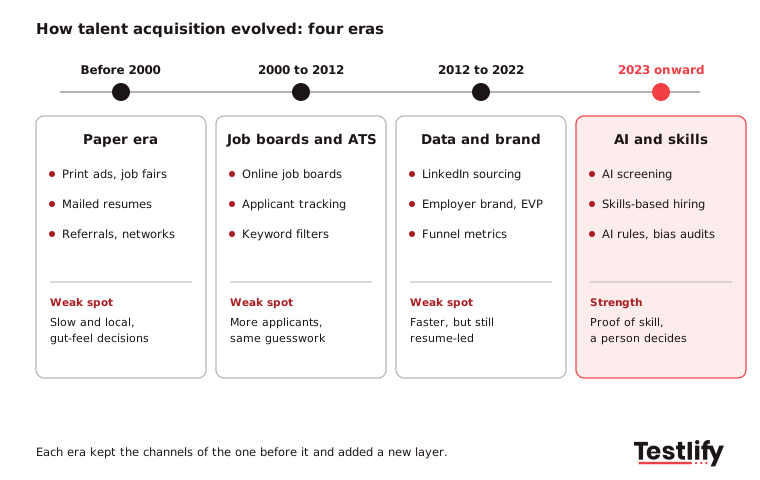
Talent acquisition evolved in four broad eras. Each era added new channels without fully replacing the old ones, and each one fixed a problem the previous era left behind.
1. The paper era (before 2000)
Jobs were advertised in newspapers, trade magazines and at job fairs. Candidates mailed or faxed paper resumes, and managers read them by hand. Referrals and personal networks did much of the work. The weak spot was reach and fairness: hiring was slow, local and driven by who you knew and how a resume looked.
2. Job boards and the ATS (about 2000 to 2012)
Online job boards let one ad reach thousands of people, and applicant tracking systems stored applications and moved them through stages. Volume went up sharply. Screening, though, still meant scanning resumes, now with keyword filters that rewarded people who wrote the right words rather than people who had the right skills.
3. Data and employer brand (about 2012 to 2022)
Professional networks such as LinkedIn made passive candidates reachable. Companies began to treat the employer brand and the candidate experience as part of hiring, and TA teams started tracking funnel metrics like time to fill and source of hire. The pandemic years then made remote interviews and remote hiring normal. Decisions still leaned heavily on resumes and unstructured interviews.
4. AI and skills (2023 onward)
Generative AI arrived in both recruiting tools and candidate applications. Teams now use AI to screen resumes, write job ads, schedule and even run first-round interviews. At the same time, more employers hire on proven skills instead of degrees and job titles.
LinkedIn's 2025 Future of Recruiting report, based on a survey of 1,000+ talent professionals, found that 73% of TA pros agree AI will change the way organizations hire, and 93% say accurately assessing a candidate's skills is crucial for improving quality of hire. Regulators followed: AI hiring tools now face bias audits and new rules (more on that below).
The thread through all four eras is the same question: how do we know this person can do the job? Each era answered it a little better, and the current answer is evidence of skill, gathered fairly, with a person making the final call.
What does the talent acquisition process look like today?
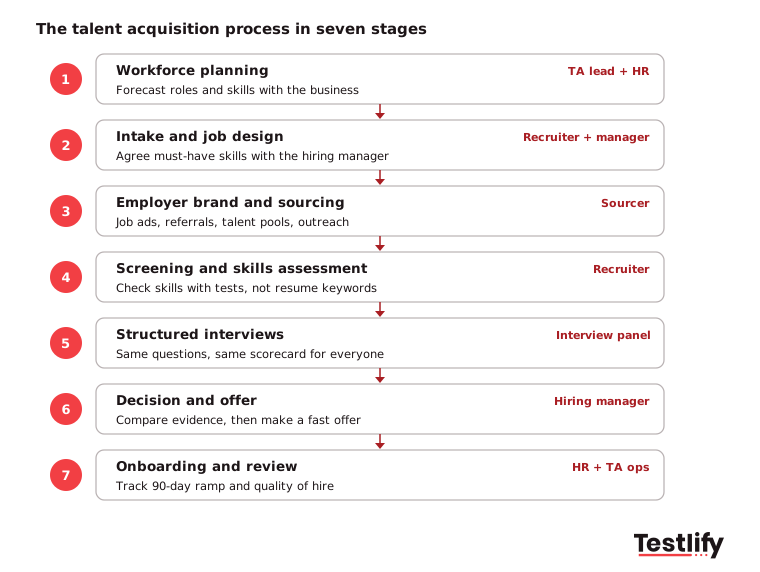
The modern talent acquisition process runs in seven stages, from workforce planning to onboarding, and each stage has a clear owner and a metric that shows whether it works. The stages below are the common shape; volume hiring compresses them, executive hiring stretches them.
Stage | What happens | Owner | Metric that shows it works |
|---|---|---|---|
1. Workforce planning | Forecast roles and skills with finance and business leaders | Head of TA, HR | Planned vs actual hires |
2. Intake and job design | Agree must-have skills, level and pay range with the hiring manager | Recruiter, hiring manager | Requisition changes after kickoff |
3. Employer brand and sourcing | Job ads, referrals, talent pools, outreach to passive candidates | Sourcer, TA marketing | Qualified applicants per role, source of hire |
4. Screening and skills assessment | Check skills with job-relevant tests instead of resume keywords | Recruiter, TA ops | Pass-through rate, candidate drop-off |
5. Structured interviews | Same questions and scorecard for every candidate | Interview panel | Interviewer agreement, interviews per hire |
6. Decision and offer | Compare evidence, make a fast and fair offer | Hiring manager, recruiter | Offer acceptance rate, time to fill |
7. Onboarding and review | First 90 days, then check performance and retention | HR, TA ops | Quality of hire, 90-day retention |
Speed still matters. SHRM's recruiting benchmarking data, drawn from over 4,600 organizations, puts the median time to fill nonexecutive roles at 39 calendar days. Across the teams we work with, the biggest delays sit in stages 2 and 4: a vague intake and a resume pile that someone has to read by hand.
Pro tip: Move skills checks earlier. Testing every applicant on the two or three skills that matter, before anyone reads a resume, shrinks the pile to people who can do the work and gives hiring managers evidence instead of opinions. Pair it with structured interviews so the later stages stay consistent too.
What makes a good talent acquisition strategy?
A good talent acquisition strategy ties hiring to business goals, builds candidate supply before roles open and judges people on evidence of skill. In practice, strong strategies share six habits:
- Plan with the business: Review the hiring plan with finance and leaders every quarter, not only when a manager resigns.
- Build talent pools early: Keep warm pipelines for roles you hire every year: past finalists, referrals, alumni and interns.
- Hire for skills, not pedigree: Define each role by what the person must do and test for it. See what skills-based hiring is and why it matters.
- Make the employer brand honest: Show real teams, real pay ranges and a realistic picture of the job.
- Respect the candidate's time: Short applications, clear stages, quick decisions and feedback. A poor candidate experience costs you finalists and referrals.
- Measure and adjust: Track the metrics below by role and by source, and drop channels that do not produce hires who stay.
The need for this is real: SHRM's 2025 Talent Trends survey of 2,040 US HR professionals found that 69% of organizations still struggle to fill full-time roles. For a step-by-step plan, see how to build a talent acquisition strategy.
Which talent acquisition metrics matter most?
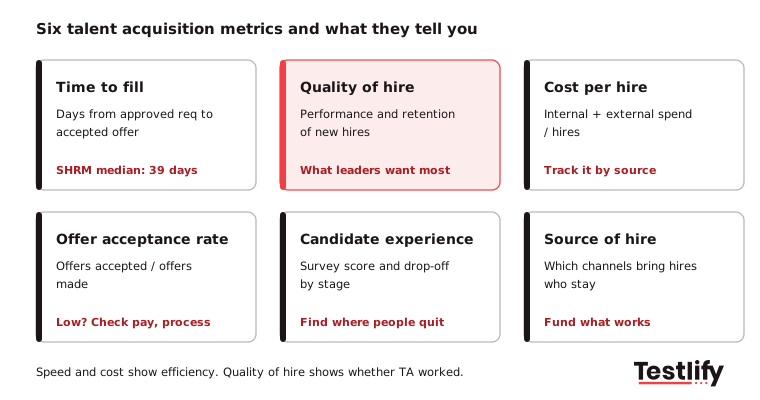
Talent acquisition metrics show whether hiring is fast, affordable and, most important, whether it brings in people who perform and stay. Six metrics cover most of what a TA leader needs to report.
Metric | How to calculate it | What it tells you |
|---|---|---|
Time to fill | Days from approved requisition to accepted offer | Process speed and bottlenecks |
Time to hire | Days from a candidate's first contact to accepted offer | How fast you move good people |
Cost per hire | Internal plus external hiring costs divided by hires | Efficiency by role and source |
Quality of hire | New-hire performance, ramp time and retention | Whether selection worked |
Offer acceptance rate | Offers accepted divided by offers made | Pay, brand and process fit |
Candidate experience | Survey scores and drop-off at each stage | Where people quit the funnel |
Quality of hire is the hardest to measure and the one leaders care about most. LinkedIn's 2025 report found that 61% of TA pros believe AI can improve how they measure quality of hire. A simple start is to compare assessment scores at hiring with 90-day manager ratings and retention. Testlify's free quality of hire calculator and this guide to recruitment metrics to track help you set a baseline.
How is AI changing talent acquisition?
AI is changing talent acquisition by taking over high-volume, repeatable steps (screening, scheduling, first-round interviews and scoring) while people keep the judgment calls. SHRM's 2025 data shows AI use in HR tasks rose to 43% in 2025, up from 26% in 2024.
Gartner's four talent acquisition trends for 2026 point the same way: high-volume recruiting goes AI-first, recruiter work shifts toward more complex tasks, early career programs are redesigned, and AI reshapes how organizations assess talent.
Where AI helps most:
- Screening at volume: Ranking applicants against job requirements with an explainable match score.
- Skills assessment and AI interviews: Consistent questions and scoring for every candidate, at any hour.
- Admin: Scheduling, reminders and status updates that used to eat recruiter time.
- Integrity checks: Spotting copied answers and AI-written responses in tests.
Where a person must stay in charge: setting the criteria, reviewing edge cases, final decisions and any candidate who asks for a human review.
Rules now apply. In New York City, Local Law 144 requires employers using automated employment decision tools to have a bias audit within one year before use, publish a summary and notify candidates; enforcement began on 5 July 2023.
In the EU, the AI Act lists AI systems used for recruitment or selection, including filtering applications and evaluating candidates, as high-risk in Annex III. Before buying any AI hiring tool, ask for its bias audit and how a recruiter can override a score.
Key takeaway: Talent acquisition has moved from finding applicants to proving skills. AI makes that proof possible at volume, but only with clear criteria, audits and a person who owns the decision.
Who works in a talent acquisition team?
A talent acquisition team in a mid-sized or large company usually includes a head of TA, recruiters, sourcers, recruiting coordinators and a TA operations or analytics role. Each role owns a different part of the process.
- Head of talent acquisition or TA director: Owns the strategy, budget, tools and hiring plan with business leaders.
- Recruiters: Run requisitions end to end with hiring managers, from intake to offer.
- Sourcers: Find and engage passive candidates and build talent pools.
- Recruiting coordinators: schedule interviews, manage logistics and keep candidates informed.
- TA operations and analytics: Run the ATS and assessment tools, integrations, reporting and compliance.
- Employer brand specialist: Careers site, content and candidate communication (often shared with marketing).
Most TA professionals come from recruiting, HR or business backgrounds. A degree in HR or business helps, but hands-on recruiting experience and data skills matter more in 2026.
How does Testlify support modern talent acquisition?
Testlify is an AI-native skills assessment and interviewing platform that helps TA teams move from resume screening to evidence of skill. TA teams use it at the screening and assessment stages of the process:
- Skills tests: A test library of 3,500+ tests for technical and non-technical roles, plus an AI test builder that drafts an assessment from a job description.
- AI screening and interviews: An AI resume screener with explainable match scores, plus one-way video and two-way AI interviews in chat, voice and video formats.
- Fair and secure testing: 20+ proctoring checks, 15+ languages and a third-party NYC Local Law 144 bias audit of the Matching Model.
- Fits your stack: 100+ ATS and HRIS integrations, including Workday, Greenhouse and Lever.
You can start with a 7-day free trial, no credit card needed, or book a demo to see it with your own roles.
Frequently asked questions (FAQs)

Content Writer
Yashika Khandelwal is a Content Writer with 3+ years of experience creating research-backed content on hiring, talent assessment, and HR technology. She is a registered Organizational Psychologist and subject matter expert who combines behavioral science with practical recruitment insights to produce accurate, evidence-based content.
LinkedInRelated resources
View all
Talent Acquisition
Contingent workforce management: a guide for hiring teams

Talent Acquisition
Public sector recruitment: a practical guide for hiring teams

Talent Acquisition
Hiring military veterans: a practical guide for employers in 2026

Talent Acquisition
Should job ads still list the years of experience qualified candidates need?

Talent Acquisition
Campus Recruitment: A 2026 Guide to Skills-First Hiring

Talent Acquisition
What is experiential recruiting
Get started.
Hire on proof, not resumes.
Run your first skills-based assessment free — no credit card required.