Demo
Demo
 +1 (844) 755 8378
 Contact


Human Resources (HR) has moved from processing employee data and payroll to being a strategic business partner that helps shape the culture of an organization, nurtures its talent, and ensures overall success. And one of the ways it contributes to these goals is through HR initiatives: strategic programs designed to boost employee engagement, performance, retention, and much more.
Whether you are a seasoned HR professional or new to the field, knowing how to craft and execute successful HR initiatives can unlock your organization’s full potential. Let’s take a look at the world of HR initiatives, explore their importance, and share actionable tips on creating initiatives that could truly be difference-makers.
Summarise this post with:
 Chatgpt
 Perplexity
 Gemini
 Grok
Grok Claude
What are HR initiatives?
An HR initiative is a focused, action-oriented program that can aim to enhance the workforce of an organization, improve company culture, or address particular challenges within HR.
It may cover all possible topics like employee engagement, diversity, leadership development, or performance management.
HR initiatives are important because they do not just focus on “getting the job done” but rather improve the entire work environment and employee experience.
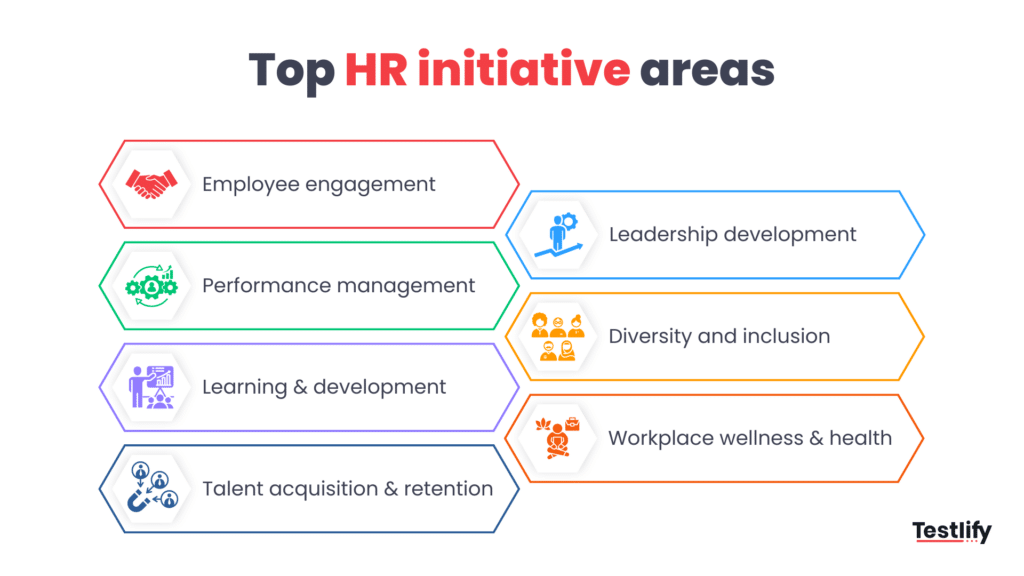
These initiatives can vary greatly depending on the organization’s needs but generally focus on areas like:
- Employee engagement
- Leadership development
- Performance management
- Diversity and inclusion
- Learning and development
- Workplace wellness and health
- Talent acquisition and retention
A Gallup study reported that only 34% of U.S. employees feel engaged at work, while actively disengaged employees cost U.S. businesses up to $550 billion each year in lost productivity.
Thus, HR initiatives that are aimed at boosting engagement and morale are important for improving overall performance.

Top for HR initiatives
HR initiatives can cover a wide range of areas. Let’s take a look at some of the most important ones:
1. Adopt digital transformation
The digital transformation of HR is not a fad; it’s a necessity. More and more companies around the world are embracing digital tools to optimize HR operations and create a better employee experience.
From AI-powered recruitment tools and chatbots to provide support for employees to cloud-based performance management systems, technologies are being implemented to streamline HR processes and optimize talent management using data.
For example, Tata Communications has been able to implement AI-driven recruitment systems, which have resulted in an improvement in the candidate experience and internal mobility, thereby streamlining hiring processes and making them more transparent. This is not just about automation; it is about creating a data-driven culture.
According to the MIT Sloan Management Review, AI can help HR departments predict employee performance, identify gaps in talent, and even provide personalized career development pathways. As we go into 2025, HR has to continue embracing the digital transformation if it wants to stay ahead and meet the emerging needs of employees and employers alike.
2. Prioritize employee health and well-being
Employees’ mental and physical health has never been so important. As the pandemic is still on the world, the shift towards a hybrid or fully remote work culture has increased vulnerability to burnout, stress, and exhaustion in employees.
In fact, a 2023 Gallup study found that 76% of employees reported feeling burned out at work sometimes. HR departments must make employee health and well-being a priority by implementing strategies that promote wellness, work-life balance, and mental health support.
One such successful wellness initiative is Salesforce’s wellness program, which includes flexible working hours, meditation sessions, and mental health days. These efforts not only decrease stress but also enhance the overall job satisfaction of the employees, thereby increasing their productivity.
The World Health Organization claims that for every dollar invested in improving mental health in the workplace, companies earn $4 through increased productivity and decreased absenteeism. Organizations that take care of their employees’ health and well-being will be able to retain top talent and drive long-term success as we step into 2024.
3. Foster diversity and inclusion
Besides being the right thing, creating an inclusive and diverse workplace is good business sense. Studies have revealed that every time a company has diverse leadership teams, there is positive financial performance.
According to McKinsey, companies with more women in the executive team are 25% more likely to perform better than their counterparts. Companies that observe ethnic and racial diversity also have high profitability and productivity.
DEI must be promoted by HR departments through inclusive hiring practices, cultural awareness, and equal opportunities in career advancement. Google has really made tremendous steps in terms of diversity and inclusion by clearly defining diversity goals and providing training for unconscious bias.
However, it is still miles away in most leadership positions. This requires the organization to not only hire a diverse set of candidates but also ensure that everyone has a space where they feel valued, respected, and can thrive.
4. Develop employee development and learning
Businesses in this fast-paced world require employees who are not only skilled but also adaptive to change. With technology continually evolving and new business challenges surfacing, it is essential to invest in employee development.
A prime example of this is IBM, offering employees all-inclusive learning programs that promote the acquisition of new skills and leadership capabilities while being updated on trends in the industry. Continuous performance data analysis and the internal credentialing system by the company help employees grow.
Learning and development should be continuous and accessible. According to LinkedIn’s 2023 Workforce Learning Report, 94% of employees would stay at a company longer if it invested in their learning and development.
Organizations can enhance their employee development programs by offering personalized learning paths, internal mentorship opportunities, and leadership development courses. By fostering a culture of continuous learning, HR departments can ensure that employees are always prepared to meet the evolving demands of the business environment.
5. Agile leadership
Agility is a quality that leaders need to have in today’s VUCA world. A 2022 report from the Center for Creative Leadership indicates that 71% of executives believe agility is the most important leadership quality needed to succeed in today’s business climate. Agile leaders can adapt quickly, make decisions in uncertain environments, and lead teams through change.
Agile leadership development needs to be supported by HR initiatives. For example, it would involve training in leadership on adaptability, resilience, and change management. In the case of Adobe, a leadership training framework has been established that allows managers to take risks, adopt new ideas, and respond rapidly to changes in the market.
The approach helps the leaders face the challenges, enabling their teams to do the same. Agile leadership to navigate both the opportunities and the disruptions of this world will need to be cultivated in HR departments going into 2024.
6. Data-driven decision making
Data is revolutionizing HR practices and empowering HR departments to make better-informed, more strategic decisions. Advanced HR analytics integration has been a game-changer, enabling companies to make smarter decisions on everything from recruitment and talent development to employee engagement and retention.
For example, Netflix utilizes data-driven decision-making in terms of evaluating employee engagement, predicting turnover, and optimizing team structures. Through data analysis of employee performance, satisfaction, and engagement, HR can make decisions that improve overall organizational effectiveness.
As per People Matters, companies adopting a data-driven approach to HR are 3 times more likely to improve their hiring processes and 2.5 times more likely to increase employee retention. As 2024 unfolds, HR departments that make use of data to inform decision-making will be better placed to meet the needs of their workforce and organizational success.
7. Innovative approaches to enhance employee engagement
Employee engagement is one of the most critical factors for improving productivity and reducing turnover.
In fact, Gallup’s 2023 State of the Workplace report revealed that businesses with highly engaged employees experience 23% higher profitability and 21% higher productivity than those with low engagement levels. HR departments must find new and innovative ways to engage employees, beyond the traditional approach of bonuses or recognition programs.
Mastercard is an example of innovation, as it has developed a comprehensive learning environment to enhance engagement through skill development. The company offers a wide range of development programs that help employees grow and prepare for future challenges.
By focusing on creating a culture of continuous learning and development, Mastercard has been able to keep its employees engaged and motivated. Similarly, companies that prioritize work-life balance and offer flexible working arrangements see higher levels of engagement
How to implement HR initiatives successfully
Having a good HR initiative is only half the battle. The success of these programs depends on how well they are executed. Here are a few tips to help you implement successful HR initiatives:

1. Align initiatives with organizational goals
For HR initiatives to really have an impact, they must be aligned with the organization’s overall goals. Whether it is to boost employee retention, improve diversity, or enhance productivity, ensure that each HR initiative supports the broader business strategy.
2. Communicate effectively with employees
Transparency and openness in communication is the way to go. Let employees know what the initiative is all about, how it benefits them, and what role they play in making it successful. According to Gallup research, 53% of employees say that the primary reason they are disengaged at work is because of a lack of communication.
3. Track and measure progress
Using data to track the effectiveness of HR initiatives is a must. Use performance metrics, surveys, and feedback mechanisms to assess the impact of your initiatives and areas for improvement.
4. Celebrate wins
Celebrate the success of HR initiatives through employee recognition, rewards, or company-wide announcements. It keeps the momentum and the employees on their toes.
Conclusion
HR initiatives are one of the important tools that an HR professional must use to improve employee satisfaction, drive organizational success, and develop a healthy working environment. It is in the areas of employee engagement, learning and development, DEI, and wellness where HR can foster a culture of attracting the best talent, retaining employees, and growing business.
With clear objectives and effective communication paired with ongoing measurements and improvement processes, HR activities can help shift your organization upwards, thus propelling you through higher engagement to better performance.