
Soft skills statistics: the 2026 numbers that matter
Check out these eye-opening soft skills statistics you should know to improve hiring, training, workplace culture, and employee performance.

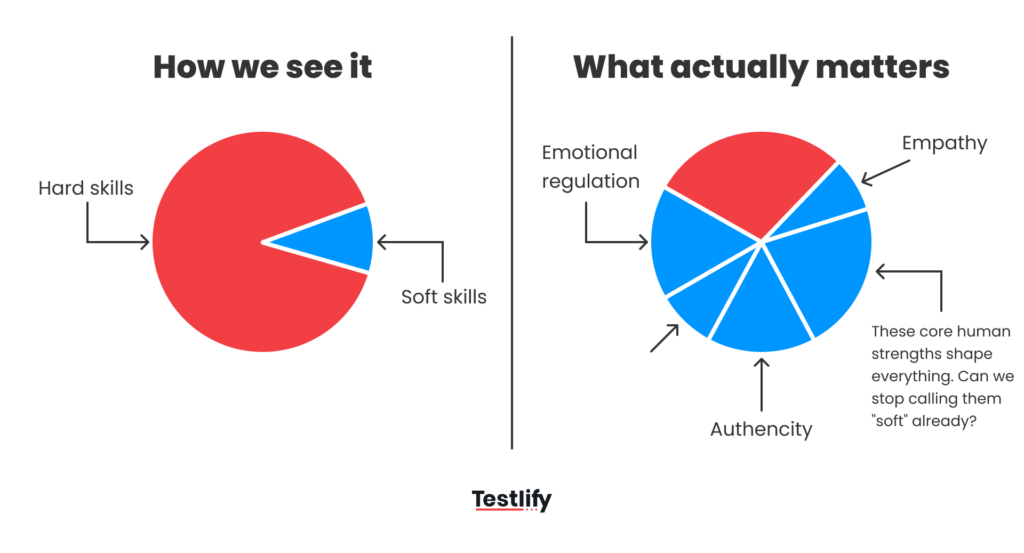
The most quoted soft skills statistic in the world is wrong. You have seen it: “85% of career success comes from soft skills, only 15% from technical skills,” usually pinned on Harvard, Stanford, and the Carnegie Foundation. The Carnegie Foundation has publicly disowned it: the number traces back to a 1918 engineering-education study, not modern research, and no Harvard or Stanford study sits behind it.
That matters because most hiring teams still argue for soft skills using a century-old myth while ignoring the strong, current data sitting right next to it. If your case for measuring communication or judgment rests on a debunked figure, the budget conversation falls apart the moment someone fact-checks you.
So here are the soft skills statistics that actually hold up, each from a named primary source you can open and check, grouped so they tell a story instead of a pile of numbers, plus a practical way to measure these skills in your own hiring. Soft skills statistics from 2024 through 2026 show that employers now rank human skills like analytical thinking, resilience, and communication among their most important hiring criteria, and current research ties them to faster promotions, higher pay, and more durable careers.
 ChatGPT
 Gemini
 Claude
 Grok
Grok Perplexity
TL;DR
- The famous “85% of success is soft skills” stat is a misattributed 1918 figure. The honest, current numbers are more useful and easier to defend.
- Employers are voting with their process: 70% now use skills-based hiring, and analytical thinking, resilience, and leadership top the list of skills they want.
- Soft skills pay off in careers. LinkedIn data links specific skills like communication and problem-solving to 11% faster promotions.
- The bottleneck is measurement, not belief. Close to three in four employers struggle to find the soft skills they need, and most say these skills are the hardest part of hiring to assess.
- You can fix the measurement gap by mapping each soft skill to concrete evidence (a structured interview, a situational judgment test, a work sample) instead of guessing from a resume.

What counts as a soft skill?
Soft skills are the personal and interpersonal abilities that shape how someone works with others: communication, teamwork, adaptability, problem-solving, emotional intelligence, leadership, and time management. They sit opposite hard skills, the teachable technical abilities tied to a specific job, like writing SQL or reading a balance sheet. For a fuller breakdown, see our guide to what soft skills are.
The reason they are hard to hire for is baked into that definition. A coding test gives you a score in an hour. Judgment, empathy, and the ability to defuse a tense conversation do not show up on a resume and rarely surface in an unstructured chat. That gap between how much soft skills matter and how poorly most teams measure them is the thread running through every statistic below.
Soft skills statistics at a glance
Here are the headline numbers, each tied to its primary source and year. Every figure below was checked against the original report, and any stat we could not verify was left out rather than rounded into something that sounds good.
Statistic | Figure | Source (year) |
|---|---|---|
Employers using skills-based hiring | 70%, up from 65% | NACE Job Outlook 2026 |
Companies ranking analytical thinking a core skill | About 7 in 10 | WEF Future of Jobs (2025) |
Growth in demand for social and emotional skills, 2016 to 2030 (US) | 26% | McKinsey Global Institute (2018) |
Faster promotions linked to specific soft skills | 11% | LinkedIn (2024) |
Employers who struggle to find needed soft skills | Nearly 3 in 4 | SHRM (2024) |
Employers naming skills gaps the top barrier to transformation | 63% | WEF Future of Jobs (2025) |
Share of workers’ skills expected to be transformed by 2030 | 39% | WEF Future of Jobs (2025) |
Soft skills share of total employer skill demand (Slovakia, 2017-2021) | 54.7% | Heliyon / Poláková et al. (2023) |
Employers screening candidates on GPA, down from ~75% in 2019 | 42% | NACE Job Outlook 2026 |
How important are soft skills to employers in 2026?
Very, and the proof is in how companies now hire. Seventy percent of employers report using skills-based hiring, up from 65% a year earlier, according to NACE’s Job Outlook 2026. Over the same stretch, the share screening candidates on GPA fell to 42%, down from roughly three-quarters in 2019. Employers are trading proxy signals for direct evidence of what a person can do.
Analytical thinking and resilience lead the demand list
When the World Economic Forum asked employers which skills matter most, the top of the list was not a programming language. Analytical thinking ranks first, treated as a core skill by about seven in ten companies, followed by resilience, flexibility and agility, then leadership and social influence, and creative thinking, per the Future of Jobs Report 2025. Four of those five are squarely soft skills.
A peer-reviewed dataset outside the usual US and Europe surveys backs the same shift. A 2023 Heliyon study led by Poláková et al. analyzed job postings from 19,000 organizations in Slovakia between 2017 and 2021 and found soft skills accounted for 54.7% of total employer skill demand, ahead of digital skills at 29.8%. Interpersonal communication (17.6%), analytical and critical thinking (14.0%), and problem-solving (10.7%) ranked as the top three individually, and the pattern held even inside IT job postings.
The long-term demand curve is bending toward human skills
This is not a one-year blip. McKinsey Global Institute projected that demand for social and emotional skills would grow 26% in the United States and 22% in Europe between 2016 and 2030, as automation absorbs routine tasks and leaves more of the human work for people. That report is from 2018, so treat it as a long-range trendline rather than fresh data, but the direction it called has only sharpened since.
What do soft skills do for careers and the business?
They move careers forward and they show up in performance. LinkedIn’s analysis of member data found that having any soft skill is associated with 8% faster promotions, and four specific skills, organization, teamwork, problem-solving, and communication, were each individually linked to 11% faster promotions. Technical professionals who paired a key soft skill with their hard skills advanced about 13% faster than peers who relied on hard skills alone.
New research backs the long-run payoff
An August 2025 Harvard Business Review study analyzed more than 1,000 occupations and roughly 70 million job transitions. Workers with a broad base of foundational skills, rather than a few hyper-specialized ones, learned new things faster, earned more, moved into more advanced roles, and weathered market shifts better across their careers. The promotion bump LinkedIn measured is the short-run signal; this is the decade-long version of the same story.
Read together, these numbers reframe soft skills from a “nice to have” into a measurable predictor of who advances. The catch is that the prediction only works if you can see the skill before you hire, not after.
Why are soft skills so hard to hire for?
Because almost everyone agrees they matter, and almost no one has a reliable way to measure them. Nearly three in four employers say they have a hard time finding candidates with the soft skills their teams need, SHRM reported in 2024, with the widest gaps in problem-solving, critical thinking, handling ambiguity, and communication. The shortage is not only of people, it is of a dependable way to spot the skill.
Skills gaps are now the top barrier to business change
The cost of getting this wrong is no longer just a slow hire. In the WEF Future of Jobs Report 2025, 63% of employers named skills gaps the single biggest barrier to transforming their business by 2030, ahead of regulation, capital, and technology. When the workforce cannot adapt, strategy stalls, and a lot of that adaptability is soft skill: learning, judgment, and communication under change.
Why the old “85%” stat keeps getting quoted
The myth survives because it is convenient. A single round number that says soft skills are 85% of success is easier to put on a slide than a careful argument. But the figure comes from a 1918 Carnegie Foundation study of engineers, and the foundation itself now points people away from it. You do not need it. The verified numbers above make a stronger case, and they hold up when a skeptical CFO clicks the source.
Which soft skills will matter most by 2030?
The ones tied to change. The WEF Future of Jobs Report 2025 estimates that 39%, about two-fifths, of workers’ existing skill sets will be transformed or outdated over the 2025 to 2030 period. In a world where the technical half-life keeps shrinking, the durable advantage is the capacity to learn and adapt, which is why resilience, flexibility, and curiosity climb the employer wish list alongside analytical thinking.
The seven soft skills employers rank highest
Cross-reference the WEF, LinkedIn, and Heliyon datasets above and the same seven skills show up as the ones employers consistently pay for, promote around, and cite as their biggest hiring gap:
- Analytical and critical thinking
- Resilience, flexibility, and agility
- Communication
- Teamwork and collaboration
- Problem-solving
- Leadership and social influence
- Emotional intelligence and adaptability under change
For hiring, the takeaway is concrete: stop screening only for today’s tool stack. A candidate who can learn the next tool, communicate through the change, and keep their footing when the workflow shifts is the one whose value compounds. Those are soft skills, and they are testable.
How do you actually measure soft skills in hiring?
You make each soft skill produce evidence, instead of inferring it from a resume or a gut read. The cleanest way to do that is the Testlify Competency-to-Evidence Matrix: start with the role, list the competencies that actually predict success in it, then tie each competency to a measurable source of evidence (a structured interview question, a situational judgment test, a work sample, a reference check). The skill stops being a vibe and becomes something two reviewers can score the same way.
A worked example: hiring patient care coordinators
Picture a regional hospital network hiring 15 patient care coordinators a quarter. The role lives or dies on soft skills: calm communication with anxious families, de-escalation, and careful attention to detail across a dozen handoffs. None of that shows up on a nursing-adjacent resume. So the team maps it:
- De-escalation maps to a situational judgment assessment built around real scheduling conflicts and upset-caller scenarios.
- Clear communication maps to a short written and recorded response task scored on a shared rubric.
- Attention to detail maps to a focused skills assessment plus one structured interview question with defined scoring anchors.
Pro tip: do not test for every soft skill at once. Pick the one or two that most predict success in the role, measure those well with a clear rubric, and add more only after the first ones prove they sort strong candidates from weak ones. A focused two-skill assessment beats a sprawling one nobody scores consistently.
Now every shortlist decision rests on comparable evidence rather than who interviewed warmly. That is the practical fix for the SHRM measurement gap: you are not hoping to spot soft skills, you are testing for them. Testlify gives teams the skills assessments, situational judgment questions, and structured scoring to run that matrix, while the hiring decision stays with your people. AI helps organize and surface the evidence; it does not replace the recruiter or make the call. For a deeper how-to, see our guide on assessing soft skills with skills assessments, and pair it with a culture-add assessment where team fit matters.
Put one soft skill to the test this week
Pick the single soft skill that predicts success in your hardest-to-fill role, map it to one assessment using the steps above, and add it to your next shortlist round. Measure how many fewer mis-hires you make over the next quarter. Build that assessment in minutes with Testlify’s skills library, or book a demo to see the Competency-to-Evidence Matrix applied to your roles.
Key takeaways
- Drop the 85% myth and gain credibility. It is a misattributed 1918 figure, and using it hands skeptics an easy win. The verified numbers make a stronger case, so your budget request survives a fact-check.
- Employers already shifted to skills. With 70% using skills-based hiring and GPA screening down to 42%, the market has moved from proxies to evidence, which means your competitors are already screening for these skills.
- Soft skills predict who advances. Specific skills tie to 11% faster promotions and, over a career, to higher pay and resilience, so screening for them improves quality of hire, not just culture.
- The real problem is measurement. Nearly three in four employers cannot reliably find these skills, which means the edge goes to whoever can actually test for them, not just talk about them.
- Hire for adaptability. With 39% of skills set to change by 2030, the candidate who can learn the next tool is worth more than the one who only knows the current one. Screen for learning and judgment, not just today’s stack.
- Map competency to evidence. Tie each soft skill to a concrete assessment so two reviewers score it the same way. That single move turns a fuzzy debate into a defensible shortlist.
Frequently asked questions

Content Writer
Yashika Khandelwal is a Content Writer with 3+ years of experience creating research-backed content on hiring, talent assessment, and HR technology. She is a registered Organizational Psychologist and subject matter expert who combines behavioral science with practical recruitment insights to produce accurate, evidence-based content.
LinkedInRelated resources
View all
HR Toolkit
Performance Evaluation Template: Free Form, Rating Scale and Examples

HR & recruitment
How Do Employee Benefits Affect Total Employment Compensation?

Workplace culture
Participative Leadership: Meaning, Types, Pros and Cons
Talent assessment
What Is Talent Benchmarking? A 2026 Guide for Hiring Teams

Technical assessments
Coding Interview: How to Run One That Tests Real Skill

Employment and labor laws
AI Hiring Laws in 2026: What Employers Need to Know
Get started.
Hire on proof, not resumes.
Run your first skills-based assessment free — no credit card required.