Demo
Demo
 +1 (844) 755 8378
 Contact


Research shows that 87% of companies struggle with skill gaps or anticipate them within a few years (McKinsey). Yet, many businesses fail to identify these gaps until productivity drops or employees leave.
A skill gap analysis or talent gap analysis helps you stay ahead by pinpointing the skills your team needs versus what they currently have so you can bridge the gap before it affects performance.
In this guide, we’ll break down how to conduct a skill gap analysis step by step, and you will also get a free template for talent gap assessment.
Summarise this post with:
 Chatgpt
 Perplexity
 Gemini
 Grok
Grok Claude
What is skill gap analysis?
Skill gap analysis is a process by which employers identify the differences between the skills their employees currently have and the skills they need to meet business needs or perform their jobs effectively.

Put simply, skill gap analysis measures the skills your employees have compared to the skills they need to succeed. Mostly, a skills gap analysis involves five steps:
- Plan
- Identify critical skills
- Measure actual skills
- Analyse data
- Take action

Why does skills gap analysis matter?
Skills gap analysis is important because it helps companies determine what improvements their employees need to make or acquire to perform their roles better now and in the future.
A SCIKEY Market Network study found that around 70% of employees feel a gap between their current skills and the skills they need to perform their jobs best. This indicates that employers and employees understand and advocate for skills gap analysis.

1. It gives details about your team’s competencies
People have both strengths and weaknesses. Even though your marketing group is well-versed in communication, one team member might be a superior editor, and another might be a design expert.
The skill gap analysis will reveal both employees with (important) skill shortages and those highly educated about particular firm sectors.
You’ll be able to concentrate (train) resources on the skills that require the most improvement. The team’s total performance will improve by using its resources best.
2. It promotes growth and learning
Employees often hesitate to ask for training, even when they need to improve specific skills. They may want additional support but feel their employer doesn’t see the need for it or isn’t willing to provide it. 74% of employees feel their companies don’t offer opportunities for learning and development.
Over time, this lack of opportunity can lead to frustration and disengagement, which can cause them to lose motivation. Eventually, they may look for a new job at a company that supports their career growth.
Therefore, it’s crucial to analyze staff skills gaps. This will determine a customized development plan for each employee and give them enough opportunities to upskill.
3. It helps with strategic workforce planning
Your employees’ existing talents can help you build your talent plan. A clear understanding of the individual skills, who can do what, and where to put them will help you retain your competitive edge faster by fostering an enthusiastic and engaged workforce.
Using your skills gap study results, you can develop a talent assessment strategy for what each employee needs to do to enhance performance and boost productivity.
4. It can improve your recruitment efforts
Conducting a skills gap analysis streamlines your hiring process by identifying the exact skills your organization lacks. This clarity helps you attract candidates who fill those gaps, accelerating onboarding, reducing attrition, and cutting hiring and training costs.
5. It creates a competitive advantage
Use a combination of all the discussed tactics to create a competitive advantage and stay one step ahead of your competitors. Knowing your staff’s strengths and weaknesses will help you plan for hiring, training, and growth, increasing your company’s performance.
6. It improves productivity
The main objective of conducting a skill gap assessment is to take the necessary steps to bridge the skills gap, eventually leading to better productivity. Employees with the right knowledge and skills tend to perform better.
Related: Top 10 targeted training strategies to bridge the skills gap
How to conduct a skills gap analysis in 5 steps?
Here’s how to identify skill gaps in the workplace in just five steps.
1. Plan objective
The first stage’s objective is to define the challenge. This refers to determining the requisite skills in a skills gap analysis context.
To ascertain the skills the organization needs both now and in the future, you must first ask specific questions like:
- What is the organization’s goal?
- What are the business goals of the company?
- What fundamental skills are necessary to carry out the purpose and accomplish the company goals?
The following criteria determine if a skill is critical or non-critical. A skill is non-critical if an employee cannot do a task but succeeds. On the other side, if a worker completes a given task but the results are subpar, a critical skill is missing.
Most importantly, choose if you want to perform a skills gap analysis for an individual employee, a team, a department, or even the whole organization.

- Individual: Identifying the missing skills required to excel at a specific job compared to an employee’s existing skill set.
- Team/department/company: Requires a high-level view of the skills needed to run a project efficiently and effectively.
At this stage, determine which stakeholders to engage, from C-suite executives to line managers and general staff.
For individual-level analysis, identify those best suited to assess employees’ skill gaps, typically their team leads or managers.
2. Identify critical skills that are missing
Once you’ve rounded on whom to assess, the next step is to identify the skills and knowledge needed for the company to meet its goals. It’s best to consider skills that might be needed in the future as well.
Consider questions like these:
- What skills does our company value the most?
- What skills will help us stay competitive in the future?
- What do employees need to work effectively and efficiently?
- What skills are becoming more important in our industry?
- Which jobs might be automated?
- Are there new technologies our employees should learn?
- Are there any future job roles we might need?
Look at job descriptions, business goals, company values, industry trends, and regulatory changes for insights. Talk to stakeholders to understand which skills matter most for their roles, teams, and departments.
Don’t waste your time creating JDs anymore. Try Testlify’s free AI job description generator and create a DEI focused JD for any role.
3. Measure actual skills
Once you have identified the skills needed to perform a role, the next step is to measure the actual skills of your employees. This is how you will determine how much of a skills gap your company currently has.
This step acts as a baseline for your employees’ skills and shows you how far along your company needs to prepare or provide to reach the ultimate goal of hitting company objectives.
Employers may use a combination of numerous tools like:
- Skills assessment is one of the most effective skills gap analysis methods. Consider using talent assessment tools like Testlify.
- KPI contributions
- Performance reviews (including 360-degree feedback)
- Interviews
- Use a personal SWOT analysis
4. Review your data
Once you have collected data on your team’s skills, store it in a searchable database. Before spotting gaps, rate each skill by importance so the most critical ones get priority.
Then, compare your team’s current skills with the key skills identified.
- Developing job profiles and identifying critical skills needed for each job role
- Examine current job descriptions to identify future requirements.
- Consider how impending (regulatory) changes and upcoming work trends affect the work.
- Create a list of competencies that best explains what is required to perform the work.
Identifying your employees’ competencies and skill levels
- Create a single, searchable database using the data gathered from competency evaluations.
- HR technology can assist you with numerous aspects by creating a crosswalk with the requisite critical abilities for the present and the future.
5. Fill the gaps
Now that you know what’s missing, you have two options: train your current team or hire new people.
Different skills may need different solutions; no single approach fits all. A McKinsey report shows that 87% of companies globally face skills gaps or expect them soon. Not just this, about 75% of employers are finding it challenging to find skilled workers. This could lead to a $8.5 trillion annual revenue loss by 2030.
Here’s what companies can do to take specific actions to address or reduce the skills gap within their workforce.
Training and development of existing employees
Your skills gap analysis findings may influence the creation of learning and development initiatives that will retrain your staff in the outdated or lacking abilities.
Job redesign
Inquiries into the mission, business goals, and the abilities needed to achieve those goals – both now and in the future may lead to changes in the duties and responsibilities of particular vocations. This is what we mean by “job redesign,” which may also result in people receiving new training in skills that have become important.
Hire new candidates with critical skills
Your skills gap study findings will probably alter the standards by which candidates are hired. Even if you can retrain or upgrade your present employees, you will eventually need to hire new employees (due to employees leaving or retiring).
It will save you time to hire someone with the necessary expertise directly rather than having to train them. Additionally, it will hasten their operational and productive transition.
You can tap into the contingent workforce and engage a freelancer or contractor to help you (temporarily) fill a skills gap if you can’t find people quickly enough.
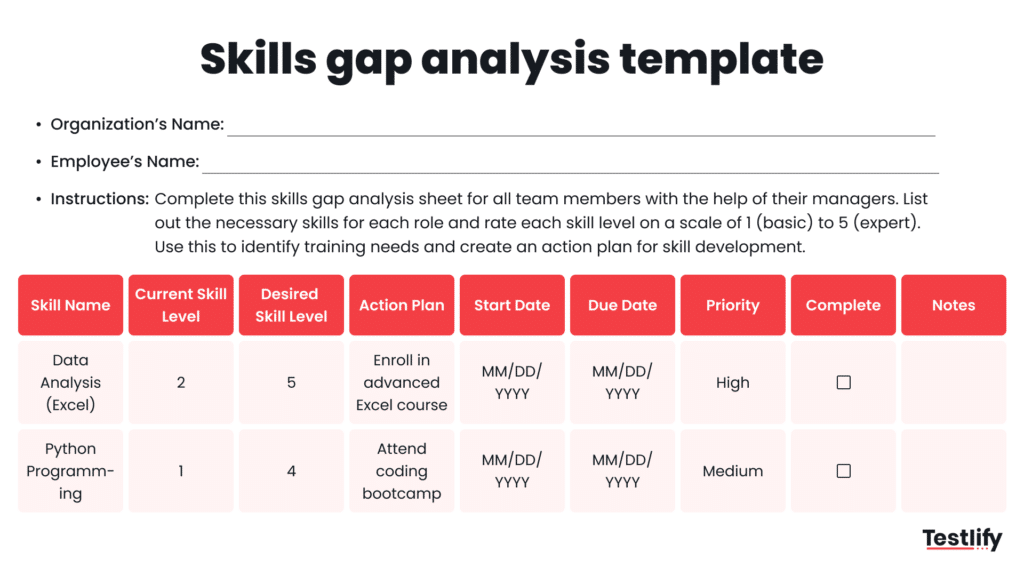
Skills gap analysis template
Instead of following a long process step by step, a skills gap analysis template can help you quickly identify and address gaps between your employee’s current skills and the skills needed for top performance.
This template provides a clear structure, making it easier to assess skill gaps and prioritize development at both the team and individual levels.
The template will cover key areas such as:
- Employee information (name, role, department)
- Current skills (list of existing skills)
- Required skills (based on job role and company needs)
- Skill proficiency levels (beginner, intermediate, advanced)
- Skill importance rating (critical, important, nice to have)
- Gaps identified (difference between required and actual skills)
Here’s a skills gap analysis template for teams as well as for individuals:
Bridge your skills gap with Testlify
Skill gap analysis is a massive hit, not as a fancy addition but as a critical component. There are numerous ways your company can beat the skills gap and plan. Opting for a skills assessment platform like Testlify earlier on will give you leverage over your competitors.
Testlify offers a comprehensive library of 3000+ pre-built assessments, allowing you to evaluate current and future skills needs seamlessly.
Whether it’s technical expertise, cognitive abilities, or soft skills, our platform provides in-depth insights to help you make informed decisions. Testlify’s AI-powered features, including Voice AI, AI avatars, and situational judgment tests, offer an engaging and immersive assessment experience.
Additionally, our on-the-job testing capabilities, such as Microsoft assessments and coding challenges, ensure practical skill evaluation that aligns with real-world requirements.
Start your free assessment today.